Open Software License
What this document covers
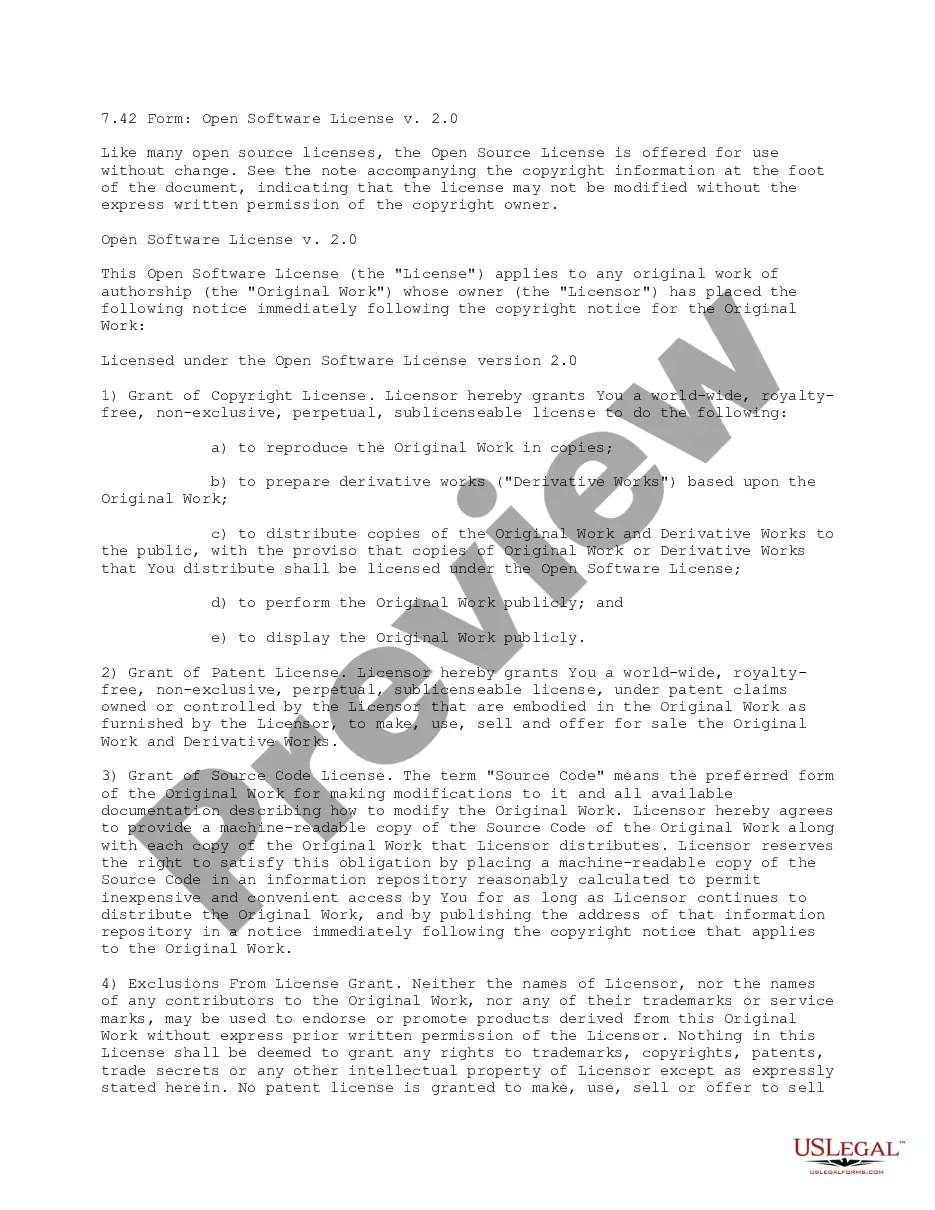
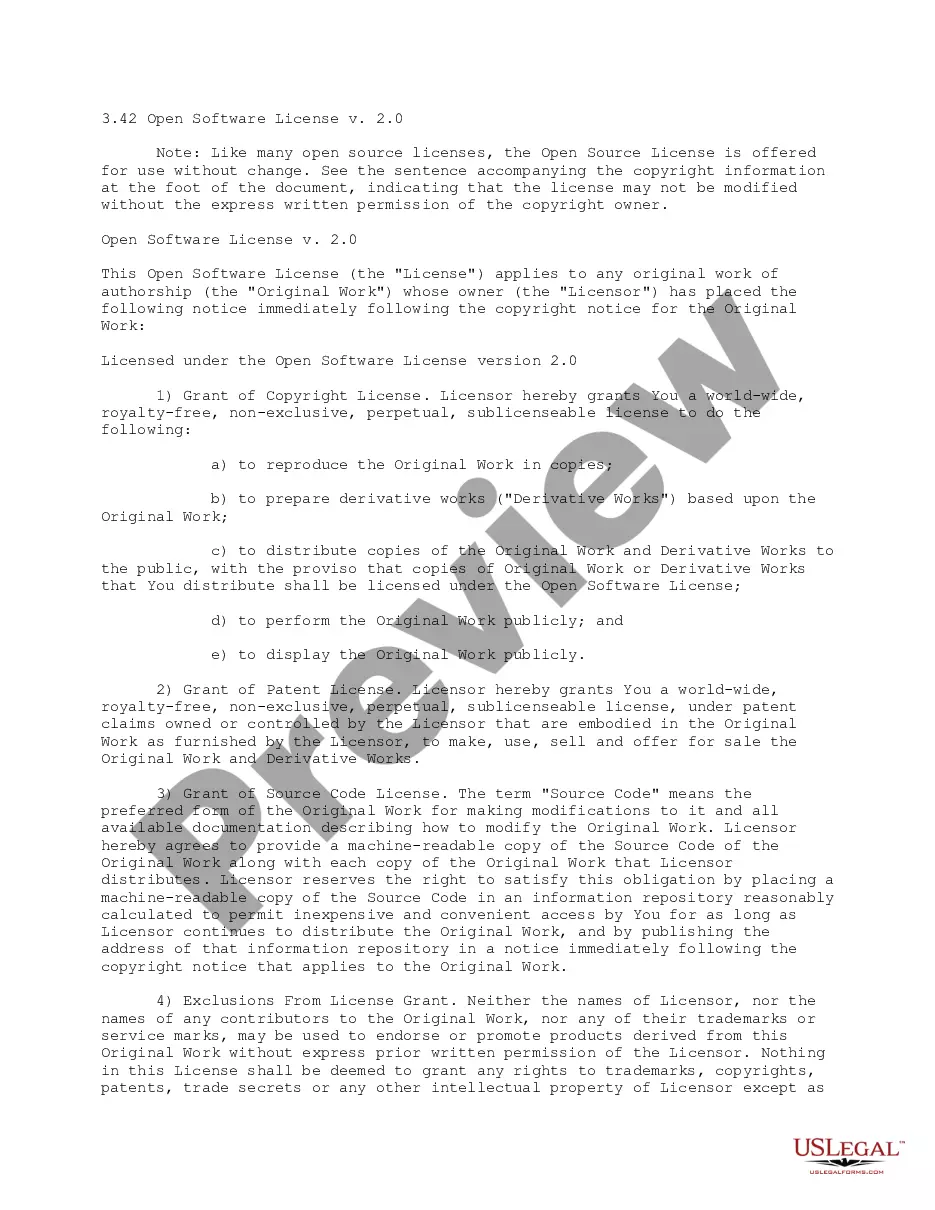
The Open Software License is a legal document that allows users to use, modify, and distribute original works of authorship while ensuring that the same freedoms are preserved in derivative works. This license applies to the works that include the designated notice stating they are licensed under the Open Software License version 2.0. It is particularly important for software developers and organizations interested in open source licensing, as it provides a comprehensive framework for rights and obligations related to software usage and development.
Key components of this form
- Grant of copyright license: Outlines the rights to reproduce, modify, and distribute the original and derivative works.
- Grant of patent license: Grants the right to use patented technologies within the original work.
- Grant of source code license: Requires that the source code is provided for the original work, ensuring transparency and accessibility.
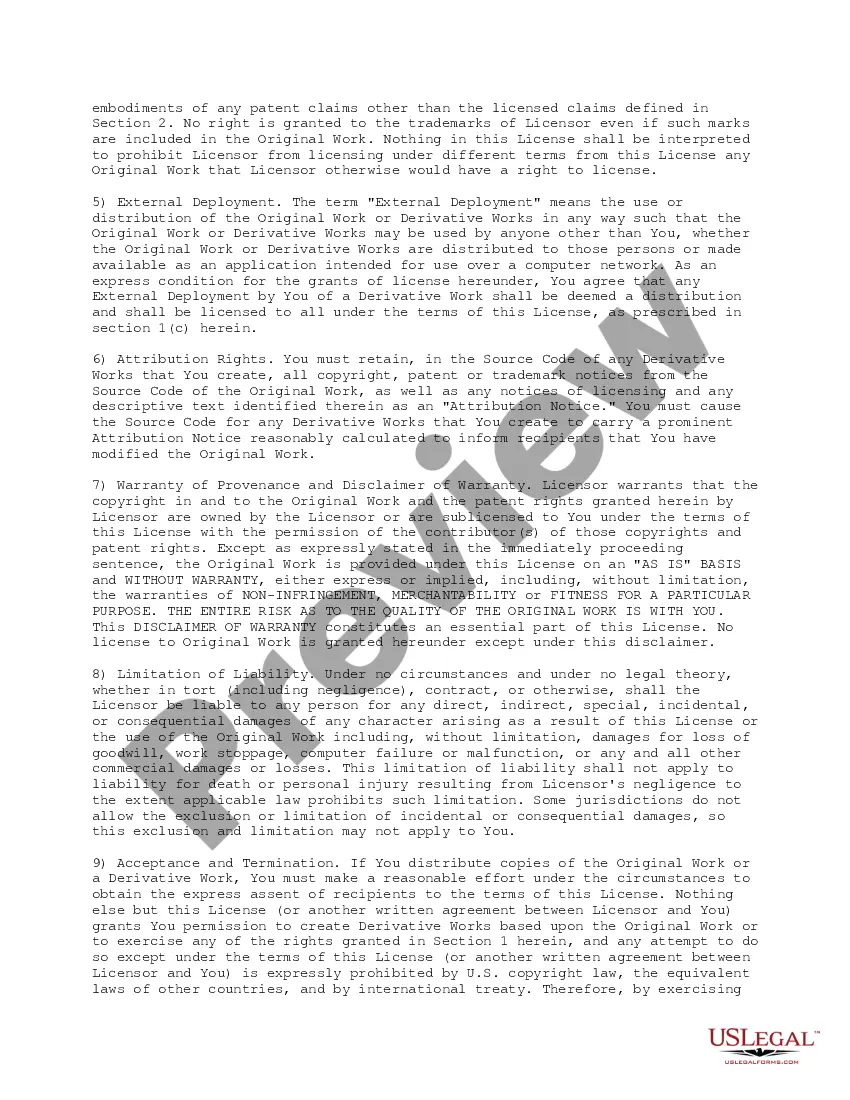
- Attribution rights: Mandates that users must retain copyright and licensing notices in derivative works.
- Warranty of provenance: States that the licensor holds the copyright and patent rights of the original work.
- Termination clauses: Outlines conditions under which the license may be terminated.
When to use this form
This form is typically used when an author or creator wants to allow others to use their software freely but under specific terms that maintain the integrity of the original work. It is ideal for open-source projects where developers wish to foster collaboration and innovation while protecting their rights as copyright holders. If you are distributing software that you want others to use, modify, or incorporate into their projects, this license is essential to clarify the terms of use.
Who needs this form
- Software developers seeking to share their work under an open-source license.
- Organizations that want to adopt open-source technologies while ensuring compliance with specific licensing agreements.
- Creative professionals who wish to provide freedoms regarding the use and modification of their original works.
- Legal entities involved in software distribution looking for a clear licensing framework.
How to complete this form
- Identify the original work and include proper copyright notices.
- Include the statement that the work is licensed under the Open Software License version 2.0.
- Determine whether you wish to grant the rights outlined in the license for derivative works.
- Provide any necessary attribution language in the source code of any derivative works.
- Ensure compliance with the terms of the license by maintaining all appropriate notices in distributions.
Notarization requirements for this form
This form does not typically require notarization unless specified by local law. It is recommended to verify any additional requirements specific to the jurisdiction where the original work is distributed.
Get your form ready online
Our built-in tools help you complete, sign, share, and store your documents in one place.
Make edits, fill in missing information, and update formatting in US Legal Forms—just like you would in MS Word.
Download a copy, print it, send it by email, or mail it via USPS—whatever works best for your next step.
Sign and collect signatures with our SignNow integration. Send to multiple recipients, set reminders, and more. Go Premium to unlock E-Sign.
If this form requires notarization, complete it online through a secure video call—no need to meet a notary in person or wait for an appointment.
We protect your documents and personal data by following strict security and privacy standards.

Make edits, fill in missing information, and update formatting in US Legal Forms—just like you would in MS Word.

Download a copy, print it, send it by email, or mail it via USPS—whatever works best for your next step.

Sign and collect signatures with our SignNow integration. Send to multiple recipients, set reminders, and more. Go Premium to unlock E-Sign.

If this form requires notarization, complete it online through a secure video call—no need to meet a notary in person or wait for an appointment.

We protect your documents and personal data by following strict security and privacy standards.
Common mistakes
- Failing to include the required copyright notices and licensing statements.
- Modifying the license terms without express written permission from the licensor.
- Neglecting to provide the source code for derivative works as required by the license.
Advantages of online completion
- Convenient access to downloadable legal templates that simplify compliance.
- Editable formats that allow customization to suit specific project needs.
- Reliability in the legal framework, as the forms are created by licensed attorneys.
Legal use & context
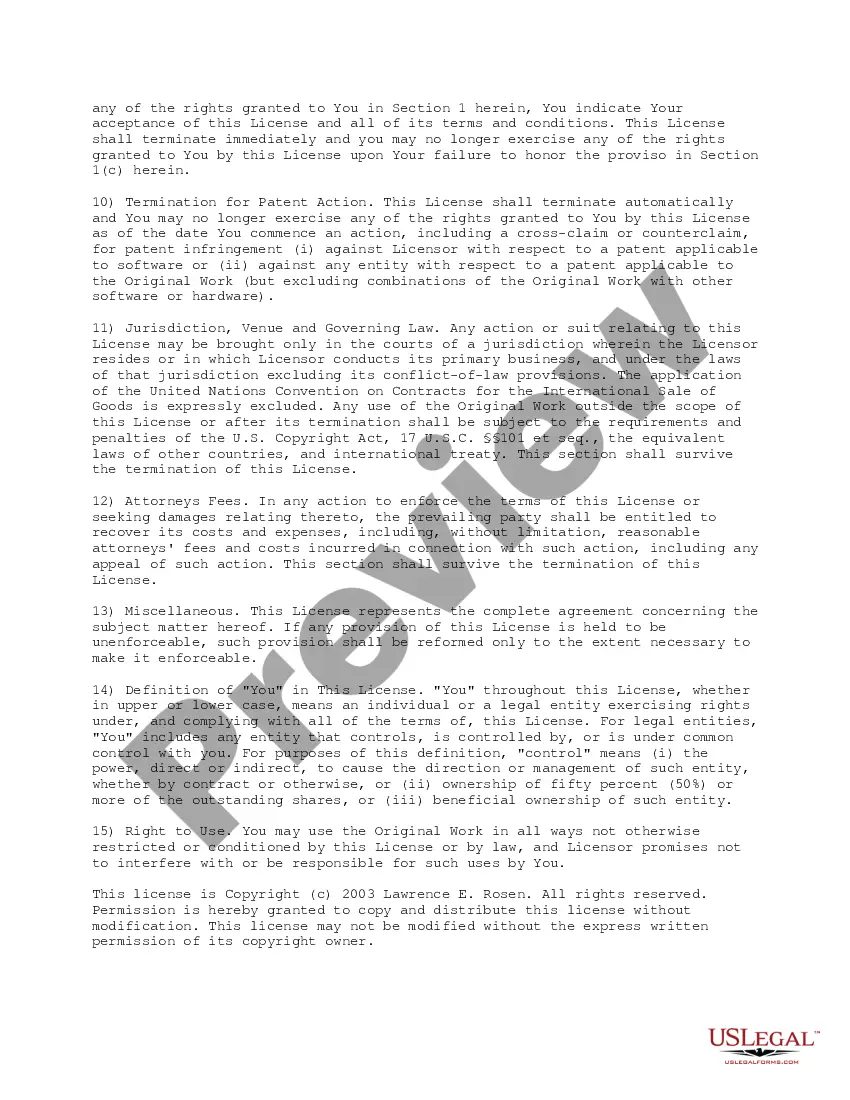
- This license ensures that the original author's rights are upheld while granting specific permissions to users.
- Derivative works must adhere to the same licensing terms, promoting open sharing.
- Users must confirm acceptance of the license terms when distributing copies of the original work.
Looking for another form?



Form popularity
FAQ
MIT (Massachusetts Institute of Technology) License. The true open-source license. Apache License 2.0. GPL (General Public License) Artistic License 2.0. EPL (Eclipse Public License) 1.0. BSD (Berkeley Software Distribution) Licenses. No license. 4 Replies to 7 Ways to License your Software
Commercial software is any software or program that is designed and developed for licensing or sale to end users or that serves a commercial purpose. Commercial software was once considered to be proprietary software, but now a number of free and open-source software applications are licensed or sold to end users.
Wisegeek explains software licensing as a type of contract which exists between the person of company who produces a type of software, and the end user, or person who purchases or downloads the software to use. This means that there are many different types of software licenses.
Public domain. This is the most permissive type of software license. Permissive. LGPL. Copyleft. Proprietary.
Open-source licensed software is mostly available free of charge, though this does not necessarily have to be the case.Licenses which only permit non-commercial redistribution or modification of the source code for personal use only are generally not considered as open-source licenses.
A software license is a document that provides legally binding guidelines for the use and distribution of software.Software licenses typically are either proprietary, free or open source, the distinguishing feature being the terms under which users may redistribute or copy the software for future development or use.
Open your GitHub repository in a browser. In the root directory, click on Create new file . Name the file LICENSE. Click on Choose a license template . Pick one of the licenses (all the ones mentioned in this article are there). Once chosen, click on Review and submit .
An open source mindset Unlike commercial software, users are not charged a licence fee for usage or for the volume of instances of the software they deploy. Instead, distro providers make money by charging for support and maintenance.
Open source licenses are licenses that comply with the Open Source Definition in brief, they allow software to be freely used, modified, and shared. To be approved by the Open Source Initiative (also known as the OSI), a license must go through the Open Source Initiative's license review process.