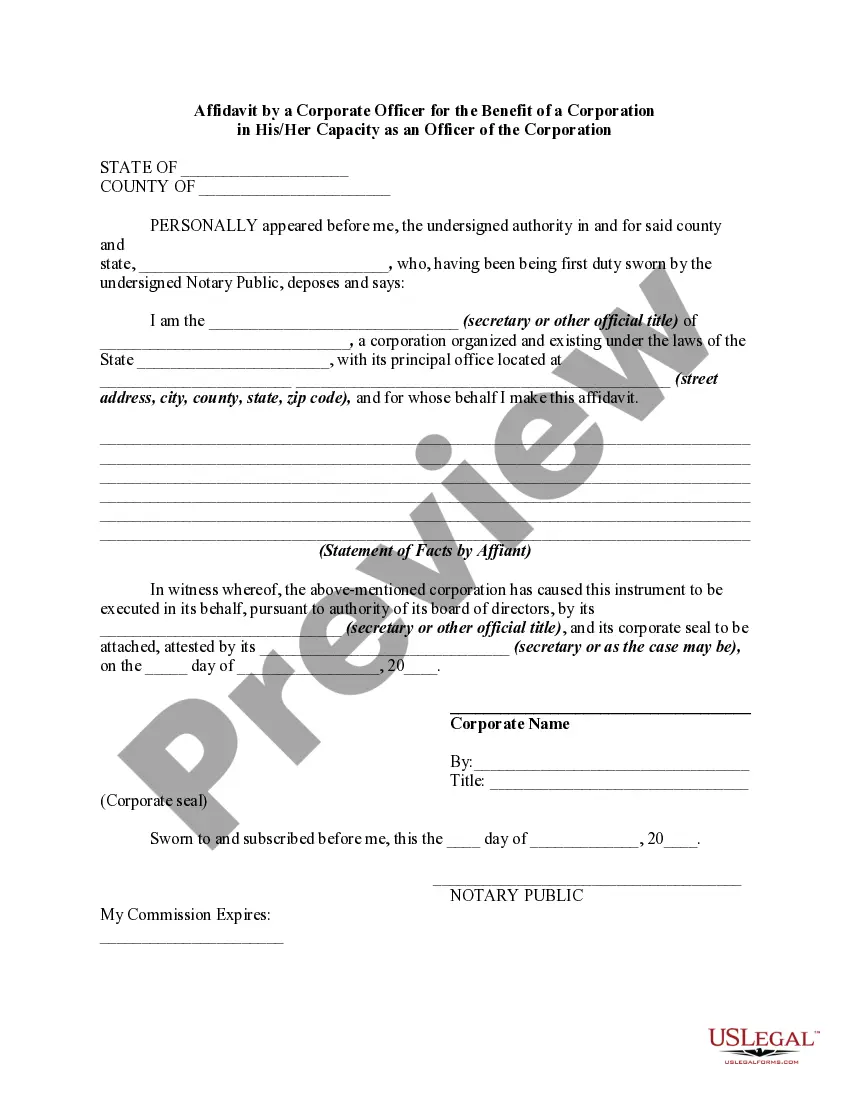
Affidavit by a Corporate Officer for the Benefit of a Corporation in His or Her Capacity as an Officer
What is this form?
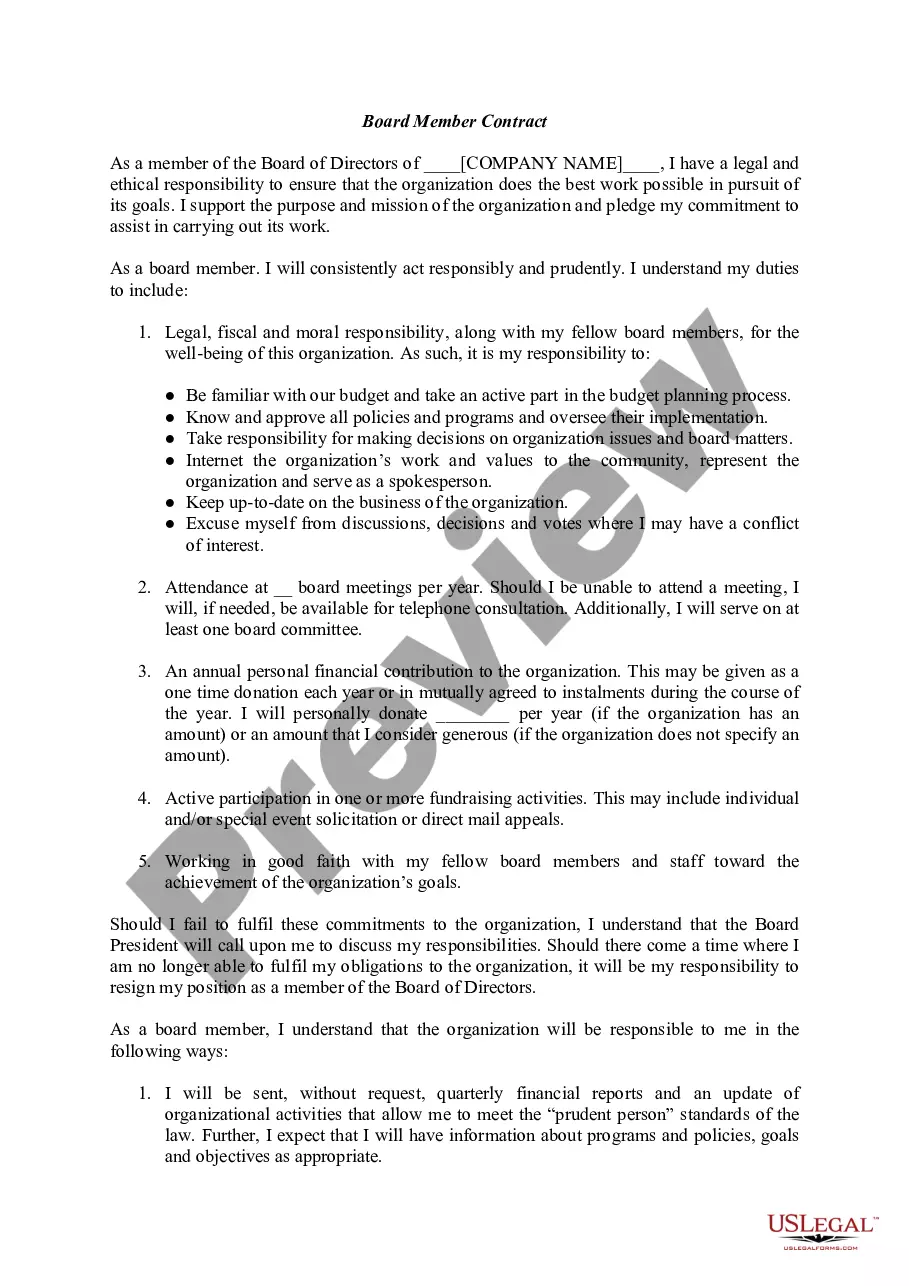
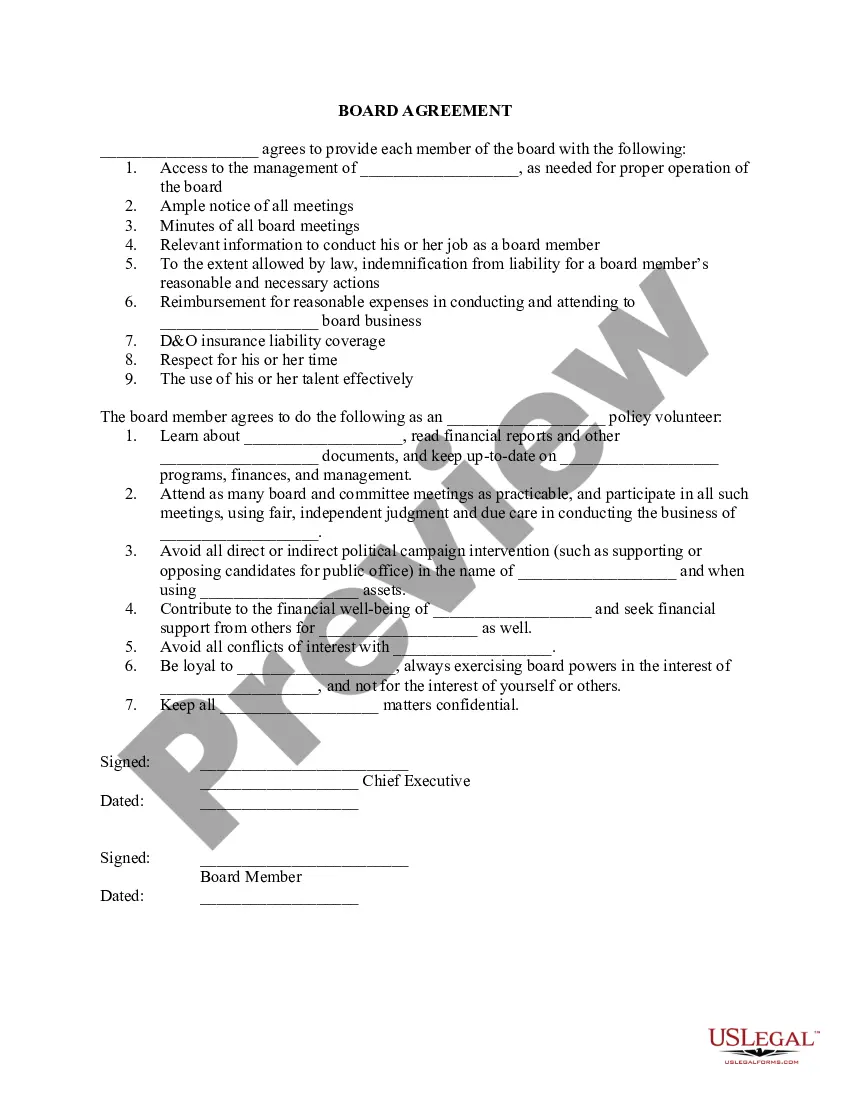
The Affidavit by a Corporate Officer is a legal document used by an individual acting in their capacity as an officer of a corporation. This affidavit serves as a sworn statement of facts by the corporate officer on behalf of the corporation, differentiating it from personal affidavits and those used in individual capacities.
Form components explained
- Personal details of the corporate officer making the affidavit.
- Identification of the corporation, including its official name, state of incorporation, and principal office address.
- A statement of facts provided by the affiant related to the corporation.
- Execution clause with the title of the officer signing on behalf of the corporation.
- A section for notarization to acknowledge the authenticity of the document.

Situations where this form applies
This form is typically used when a corporate officer needs to provide a sworn statement regarding specific facts pertinent to the corporation. Situations may include clarifying company financials, certifying corporate actions, or affirming compliance with legal requirements.
Who needs this form
- Corporate officers such as secretaries, presidents, or treasurers of a corporation.
- Individuals required to provide factual statements on behalf of the corporation for legal purposes.
- Corporations involved in transactions or legal processes that necessitate formal assertions of fact.
How to prepare this document
- Identify the state and county where the affidavit is being executed.
- Provide the name of the corporate officer making the affidavit and their official title.
- Input the complete name of the corporation, including its incorporation state and principal office address.
- Draft the statement of facts clearly and concisely, addressing the matters at hand.
- Complete the execution section, including the date and signatures required.
- Have the affidavit notarized by a licensed notary public to ensure its legal validity.
Is notarization required?
This form must be notarized to be legally valid. US Legal Forms provides secure online notarization powered by Notarize, allowing you to complete the process through a verified video call.
Get your form ready online
Our built-in tools help you complete, sign, share, and store your documents in one place.
Make edits, fill in missing information, and update formatting in US Legal Forms—just like you would in MS Word.
Download a copy, print it, send it by email, or mail it via USPS—whatever works best for your next step.
Sign and collect signatures with our SignNow integration. Send to multiple recipients, set reminders, and more. Go Premium to unlock E-Sign.
If this form requires notarization, complete it online through a secure video call—no need to meet a notary in person or wait for an appointment.
We protect your documents and personal data by following strict security and privacy standards.

Make edits, fill in missing information, and update formatting in US Legal Forms—just like you would in MS Word.

Download a copy, print it, send it by email, or mail it via USPS—whatever works best for your next step.

Sign and collect signatures with our SignNow integration. Send to multiple recipients, set reminders, and more. Go Premium to unlock E-Sign.

If this form requires notarization, complete it online through a secure video call—no need to meet a notary in person or wait for an appointment.

We protect your documents and personal data by following strict security and privacy standards.
Typical mistakes to avoid
- Failing to include the complete corporate name and address.
- Leaving out the corporate officer's title or signature.
- Neglecting to notarize the affidavit, which is crucial for its validity.
- Providing unclear or ambiguous statements in the facts section.
Advantages of online completion
- Immediate access to a professionally drafted legal form.
- Easy customization based on specific corporate needs.
- Convenient download options for printed or digital use.
What to keep in mind
- The Affidavit by a Corporate Officer is important for official corporate declarations.
- It requires clear factual statements and proper signing and notarization.
- Always confirm state-specific requirements to ensure compliance.
Looking for another form?
Form popularity
FAQ
In other words, they carry the responsibility of managing day-to-day business for the corporation. This can include maintaining records, hiring and firing, managing finances, delegating tasks, and more. In many cases, corporate officers are the people who hold high-ranking positions within a corporation.
Officers of a CorporationOfficers include the president or chief executive officer, the chief financial officer or treasurer, and the chief operating officer.Officers of the corporation may also be owners of the corporation.
The bylaws of a corporation are the governing rules by which the corporation operates. Bylaws are created by the board of directors when the corporation is formed.
Article I. Name and purpose of the organization. Article II. Membership. Article III. Officers and decision-making. Article IV. General, special, and annual meetings. Article V. Board of Directors.
Corporations also have officers who are appointed by and receive their powers from the board. Generally, the board of directors is responsible for making major business and policy decisions and the officers are responsible for carrying out the board's policies and for making the day-to-day decisions.
Basic Corporate Information. The bylaws should include your corporation's formal name and the address of its main place of business. Board of Directors. Officers. Shareholders. Committees. Meetings. Conflicts of Interest. Amendment.
The owners of a corporation are shareholders (also known as stockholders) who obtain interest in the business by purchasing shares of stock. Shareholders elect a board of directors, who are responsible for managing the corporation.
Put simply, Corporate Bylaws are the internal rules of your organization. They create the structure of your company and help to make sure that it runs smoothly. These fundamental rules will guide how your business will operate so everyoneshareholders, executives, and employeesare on the same page.
ARTICLE I. NAME OF ORGANIZATION. The name of the corporation is YOUR NONPROFIT NAME HERE. ARTICLE II. CORPORATE PURPOSE. Section 1. ARTICLE III. MEMBERSHIP. ARTICLE IV. MEETINGS OF MEMBERS. ARTICLE V. BOARD OF DIRECTORS. ARTICLE VI. OFFICERS. ARTICLE VII. COMMITTEES. ARTICLE VIII. CORPORATE STAFF.