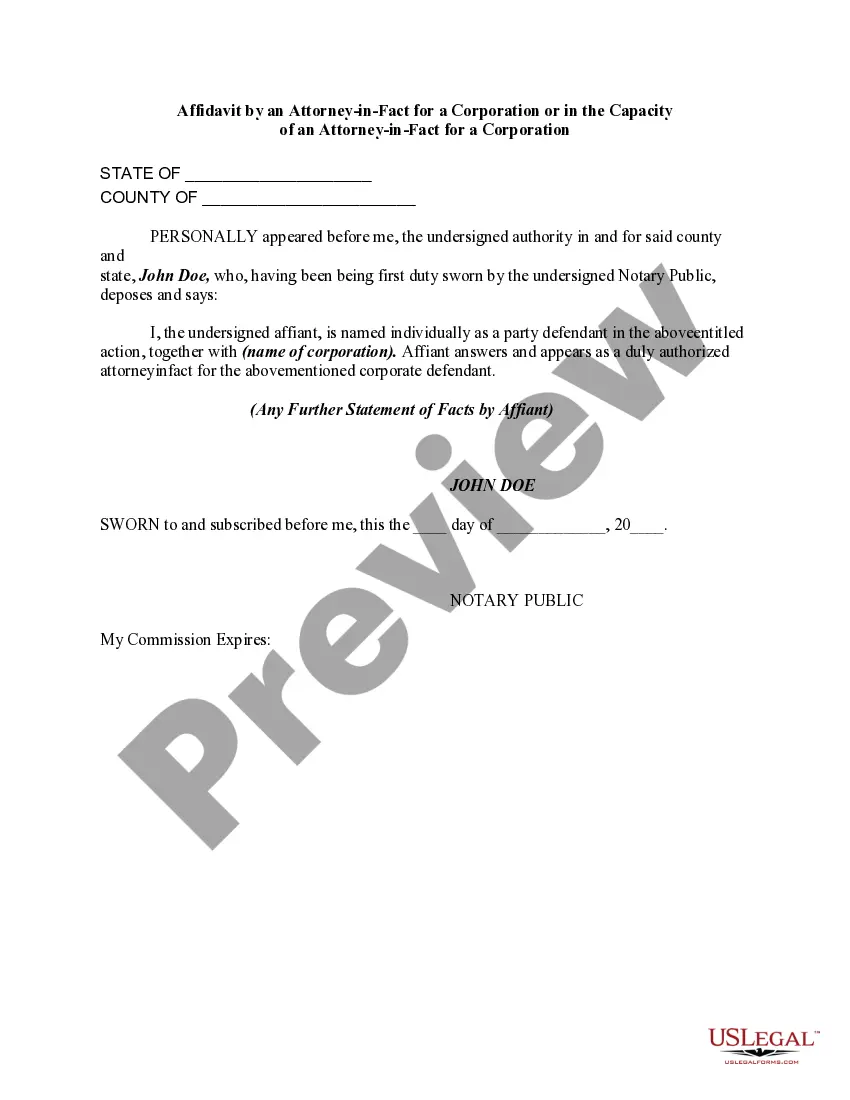
Affidavit by an Attorney-in-Fact for a Corporation or in the Capacity
Overview of this form
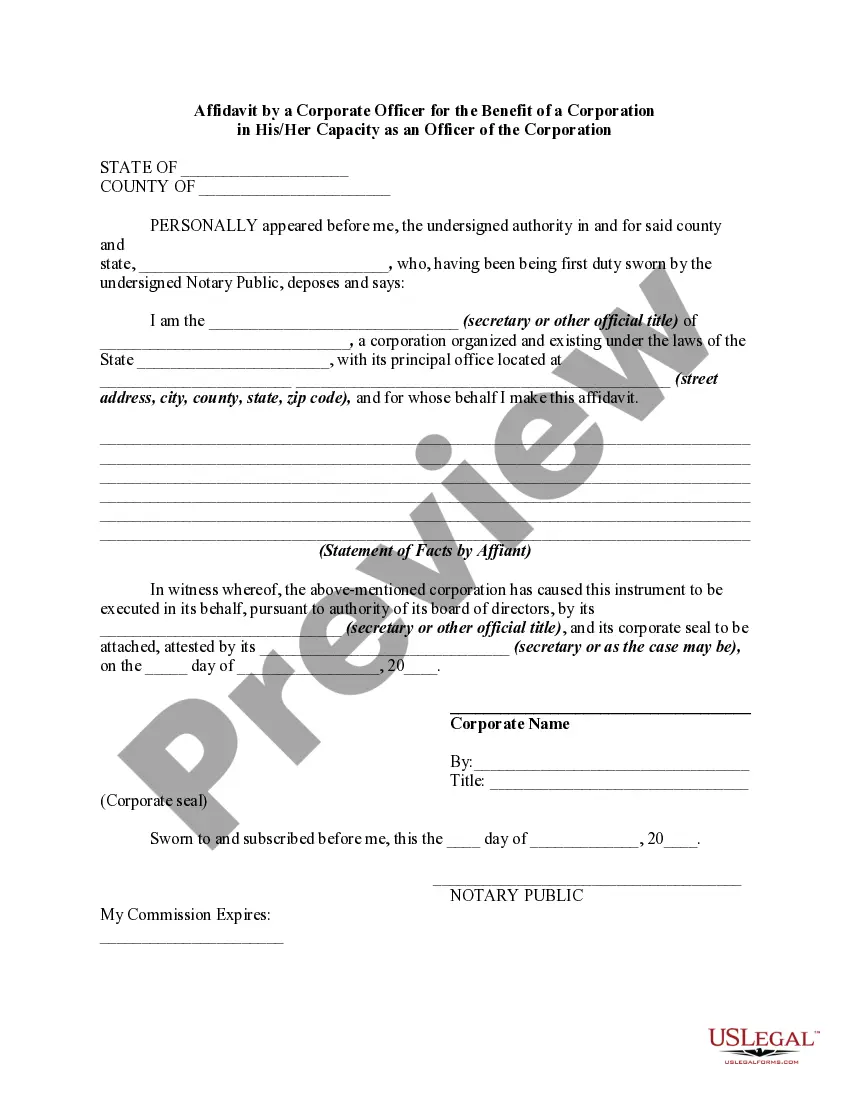
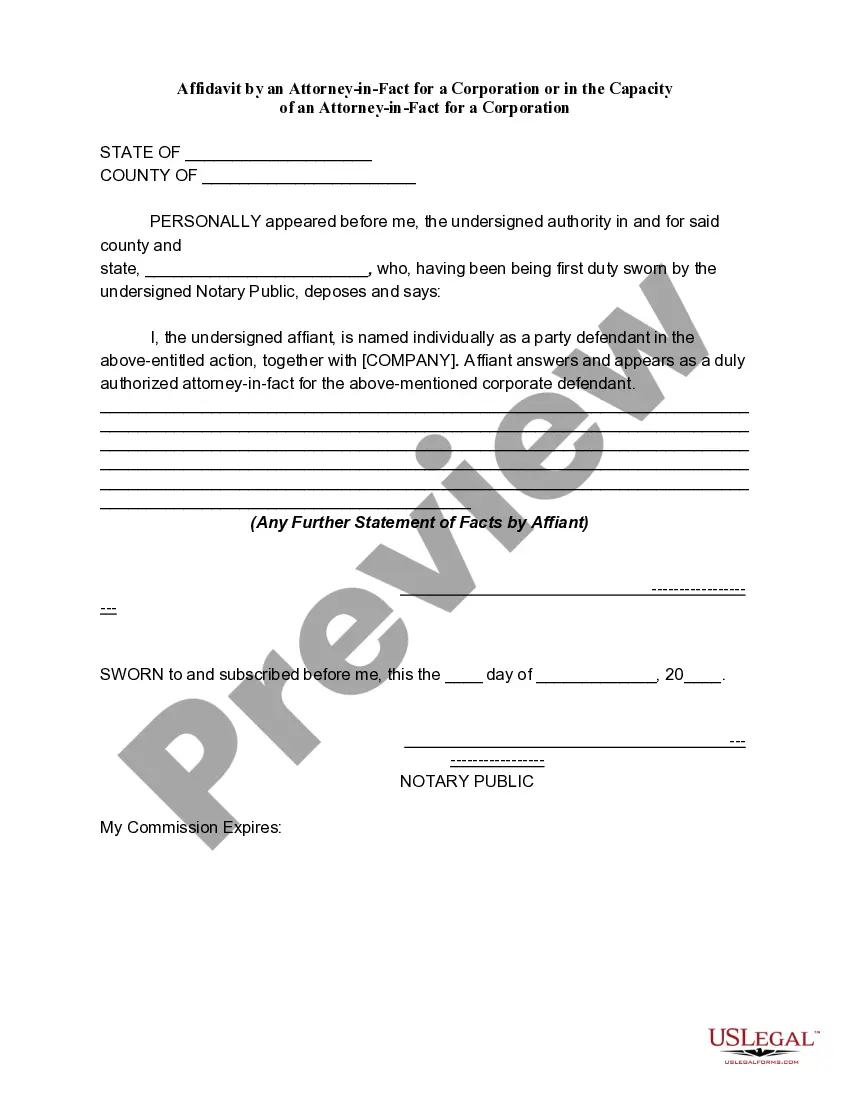
The Affidavit by an Attorney-in-Fact for a Corporation is a legal document that empowers a designated individual, known as the attorney-in-fact, to act on behalf of a corporation in legal matters. This form is essential for corporations that need to assert claims or respond to legal actions where the attorney-in-fact represents the corporation's interests. It is distinguished from other affidavits by its specific use in corporate contexts and the requirement for notarization to validate the affiant's identity.
Key parts of this document
- Affiant's identification: Includes the name, residence, and capacity of the attorney-in-fact.
- Verification statement: The affiant must affirm that they are an authorized representative of the corporation.
- Statement of facts: Any relevant information required to support the affidavitâs purpose.
- Notary section: Where the notary public verifies the affiantâs identity and witnesses the signing of the document.

When this form is needed
This form is used when a corporation needs to designate an attorney-in-fact to handle legal matters on its behalf, particularly in court proceedings or when filing legal documents. It is applicable when a corporation is involved in legal disputes and requires someone authorized to appear for it, ensuring that the process is handled correctly and legally.
Intended users of this form
Eligible users of this form include:
- Corporations needing to authorize an individual as their attorney-in-fact.
- Individuals acting on behalf of a corporation in legal matters.
- Legal representatives who require formal authorization to represent a corporation.
Instructions for completing this form
To complete this affidavit, follow these steps:
- Identify the parties: Write the name of the corporation and the attorney-in-fact.
- Provide identification: Include the attorney-in-factâs name, address, and capacity to act.
- State the facts: Describe any relevant facts or details necessary for the affidavit.
- Sign before a notary: The affiant must sign the form in the presence of a notary public.
- Complete the notary section: The notary will fill in their information and verify the affidavit.
Does this form need to be notarized?
Yes, this form must be notarized to be legally valid. It ensures the affiant's identity is verified and that the affidavit is executed correctly. US Legal Forms offers integrated online notarization, allowing you to complete the process via secure video call, anytime, ensuring convenience and compliance without the need for travel.
Get your form ready online
Our built-in tools help you complete, sign, share, and store your documents in one place.
Make edits, fill in missing information, and update formatting in US Legal Forms—just like you would in MS Word.
Download a copy, print it, send it by email, or mail it via USPS—whatever works best for your next step.
Sign and collect signatures with our SignNow integration. Send to multiple recipients, set reminders, and more. Go Premium to unlock E-Sign.
If this form requires notarization, complete it online through a secure video call—no need to meet a notary in person or wait for an appointment.
We protect your documents and personal data by following strict security and privacy standards.

Make edits, fill in missing information, and update formatting in US Legal Forms—just like you would in MS Word.

Download a copy, print it, send it by email, or mail it via USPS—whatever works best for your next step.

Sign and collect signatures with our SignNow integration. Send to multiple recipients, set reminders, and more. Go Premium to unlock E-Sign.

If this form requires notarization, complete it online through a secure video call—no need to meet a notary in person or wait for an appointment.

We protect your documents and personal data by following strict security and privacy standards.
Common mistakes
- Failing to properly identify the attorney-in-fact or the corporation.
- Omitting the necessary factual statements that support the affidavit.
- Not having the document signed or notarized before submission.
- Providing incorrect or incomplete information in the signature section.
Why complete this form online
- Convenience: The form can be downloaded and filled out at your own pace.
- Editability: Users can customize the form to fit their specific circumstances.
- Reliability: Forms are drafted by licensed attorneys to ensure legal compliance.
Quick recap
- The affidavit is crucial for a corporation to officially convey information or assertions.
- It must be sworn before a notary public to ensure legal validity.
- Proper completion involves identifying all parties and their authority clearly.
Looking for another form?

Form popularity
FAQ
You may select a corporation to act as attorney in fact. For example, a bank or trust company (perhaps one that has also agreed to serve as trustee under a trust created by you) may in some cases be...
After the principal's name, write by and then sign your own name. Under or after the signature line, indicate your status as POA by including any of the following identifiers: as POA, as Agent, as Attorney in Fact or as Power of Attorney.
3 attorney answers Sign his name and then add underneath "by your name, attorney in fact".
After the principal's name, write by and then sign your own name. Under or after the signature line, indicate your status as POA by including any of the following identifiers: as POA, as Agent, as Attorney in Fact or as Power of Attorney.
If you have executed a Durable Power of Attorney, then you have signed a document appointing a person to make financial decisions on your behalf. The document is called a Power of Attorney, and the person named to make decisions on your behalf is called an Attorney-in-Fact (otherwise known as an Agent).
This means you verify the identity of the attorney in fact not the principal and write only the attorney in fact's name in the notarial certificate wording. The attorney in fact signing your journal entry should sign only his or her name.
When the document goes into effect, you become that person's attorney in fact, which means you act as their agent. Generally, to sign documents in this capacity, you will sign the principal's name first, then your name with the designation "attorney in fact" or "power of attorney."
The lawyer has asked you to sign for them, above their name and position title at the end of the letter. You write 'p. p' in the signature space and sign your name after it. This validates the letter, in informing the reader the letter has been signed on behalf of the lawyer with authorisation.