Tennessee Last Will and Testament for Divorced and Remarried Person with Mine, Yours and Ours Children
What is this form?
This Last Will and Testament form is specifically designed for divorced and remarried individuals who have children from previous and current marriages. It allows you to outline how your assets will be distributed upon your death, appoint guardians for minor children, and establish trusts for their benefit. This form is unique as it considers the complexities of blended families, ensuring that all childrenâbiological or stepchildrenâare appropriately catered for in your estate plan.
Form components explained
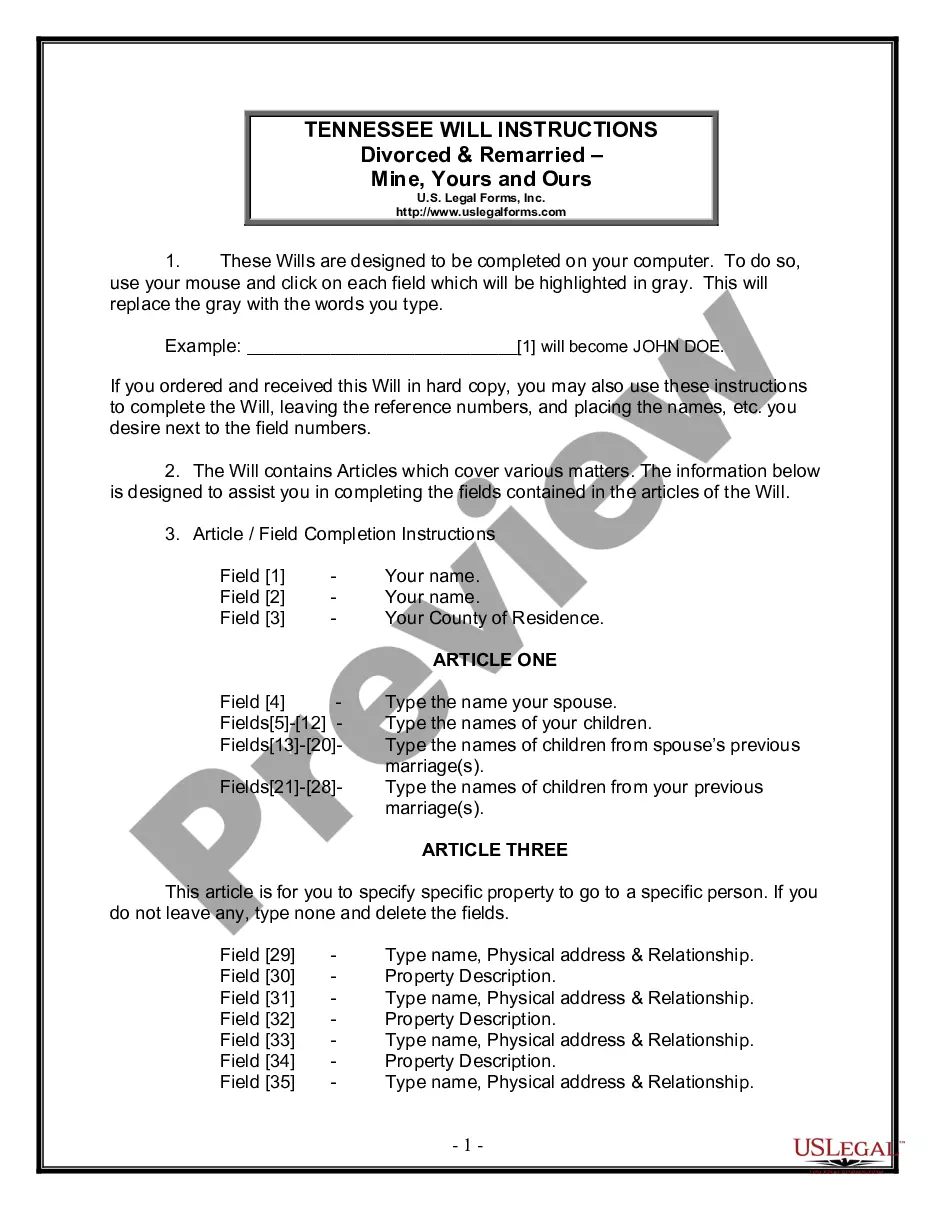
- Introduction section to identify the testator and revoke prior wills.
- Articles outlining marriage, children, property specific bequests, and residuary clauses.
- Appointment of personal representative and alternate representatives.
- Instructions for establishing a trust for minor beneficiaries.
- Designations for guardianship of minor children.
- Signing instructions and self-proving affidavit provisions.






When to use this form
You should use this Last Will and Testament when you are a divorced and remarried person with children from multiple marriages. It is particularly useful to ensure that your wishes are clearly documented regarding asset distribution, child guardianship, and trust establishment for minor children. This will help avoid potential disputes among family members and facilitate a smoother probate process.
Who this form is for
- Individuals who are currently divorced and have remarried.
- Parents with children from both current and previous marriages.
- Anyone looking to clearly define their estate distribution wishes to prevent family conflicts.
- Individuals seeking to establish trusts for the care of minor beneficiaries.
Instructions for completing this form
- Identify and enter your full name and county of residence.
- List the names of your current spouse and children from all marriages.
- Designate specific property and beneficiaries, specifying any special instructions.
- Choose and appoint a personal representative and a guardian for minor children.
- Ensure you sign the will in front of two witnesses and, if applicable, a notary public.
Is notarization required?
Yes, this form must be notarized to be legally valid in many jurisdictions. You will need to sign the will in the presence of a notary public to validate the self-proving affidavit, thereby expediting the probate process after your death.
Get your form ready online
Our built-in tools help you complete, sign, share, and store your documents in one place.
Make edits, fill in missing information, and update formatting in US Legal Forms—just like you would in MS Word.
Download a copy, print it, send it by email, or mail it via USPS—whatever works best for your next step.
Sign and collect signatures with our SignNow integration. Send to multiple recipients, set reminders, and more. Go Premium to unlock E-Sign.
If this form requires notarization, complete it online through a secure video call—no need to meet a notary in person or wait for an appointment.
We protect your documents and personal data by following strict security and privacy standards.

Make edits, fill in missing information, and update formatting in US Legal Forms—just like you would in MS Word.

Download a copy, print it, send it by email, or mail it via USPS—whatever works best for your next step.

Sign and collect signatures with our SignNow integration. Send to multiple recipients, set reminders, and more. Go Premium to unlock E-Sign.

If this form requires notarization, complete it online through a secure video call—no need to meet a notary in person or wait for an appointment.

We protect your documents and personal data by following strict security and privacy standards.
Common mistakes
- Failing to list all children from previous marriages, which may lead to disputes.
- Not updating the will after significant life changes, like divorce or remarriage.
- Completing the document without proper witnessing, invalidating the will.
- Neglecting to specify alternate beneficiaries in case primary beneficiaries predecease you.
Why use this form online
- Convenience: Complete the form from the comfort of your home at your own pace.
- Editability: Easily modify details as needed, ensuring accurate personalization.
- Reliability: Utilize templates drafted by licensed attorneys familiar with current laws.
- Immediate access: Download instantly once completed to begin the execution process.
Summary of main points
- This form helps clarify the distribution of assets in blended families.
- Legal requirements such as witnessing and notarization are crucial for the validity of the will.
- Using this form online offers benefit through ease of customization and compliance with legal standards.
Looking for another form?

Form popularity
FAQ
So, to re-marry the person you divorced requires considerable effort and commitment to resolve the previous irreconcilable differences. Nevertheless, divorced couples can - and do - find ways to not only repair their damaged relationship, but to re-marry.
The first phase of her research, which ended in 1996, consisted of approximately 1,000 survey respondents. In the end, Kalish found that, overall, about 6% of couples who married and divorced ended up remarrying each other, and 72% of reunited partners stayed together.
No. Although we may want to personally exercise grace and say remarriage after divorce is not a sin, the Bible clearly calls remarriage after divorce a sin because marriage only ends in death, not in divorce. We cannot condone what God clearly calls sin (Romans , Isaiah ).
Remarrying an ex-spouse is fairly uncommon but it does happen. This typically happens with couples who married young and have been divorced for a significant period of time.
If you're wondering how long it may take you to get remarried, of course, everyone is different, but the remarriage after divorce statistics when it comes to the average time to remarry after divorce show that about half of all people who experience a divorce will remarry within 5 years of a divorce, a figure that is
If you are committed to remarrying your former spouse, you should plan on being in a loving relationship for a minimum of a year before tying the knot again. During that time, you need to address the reasons why you divorced in the first place. After all, you are marrying the same person.
Remarriage Statistics Nearly 80 percent of divorced people get remarried. Six percent of people even remarry the same spouse.
In the end, Kalish found that, overall, about 6% of couples who married and divorced ended up remarrying each other, and 72% of reunited partners stayed together.
You can't marry the same person twice unless you divorced her from the first marriage. If that's what happened, then yes, when you remarried her, you have to get divorced again.