South Carolina Warning of Default on Commercial Lease
What is this form?
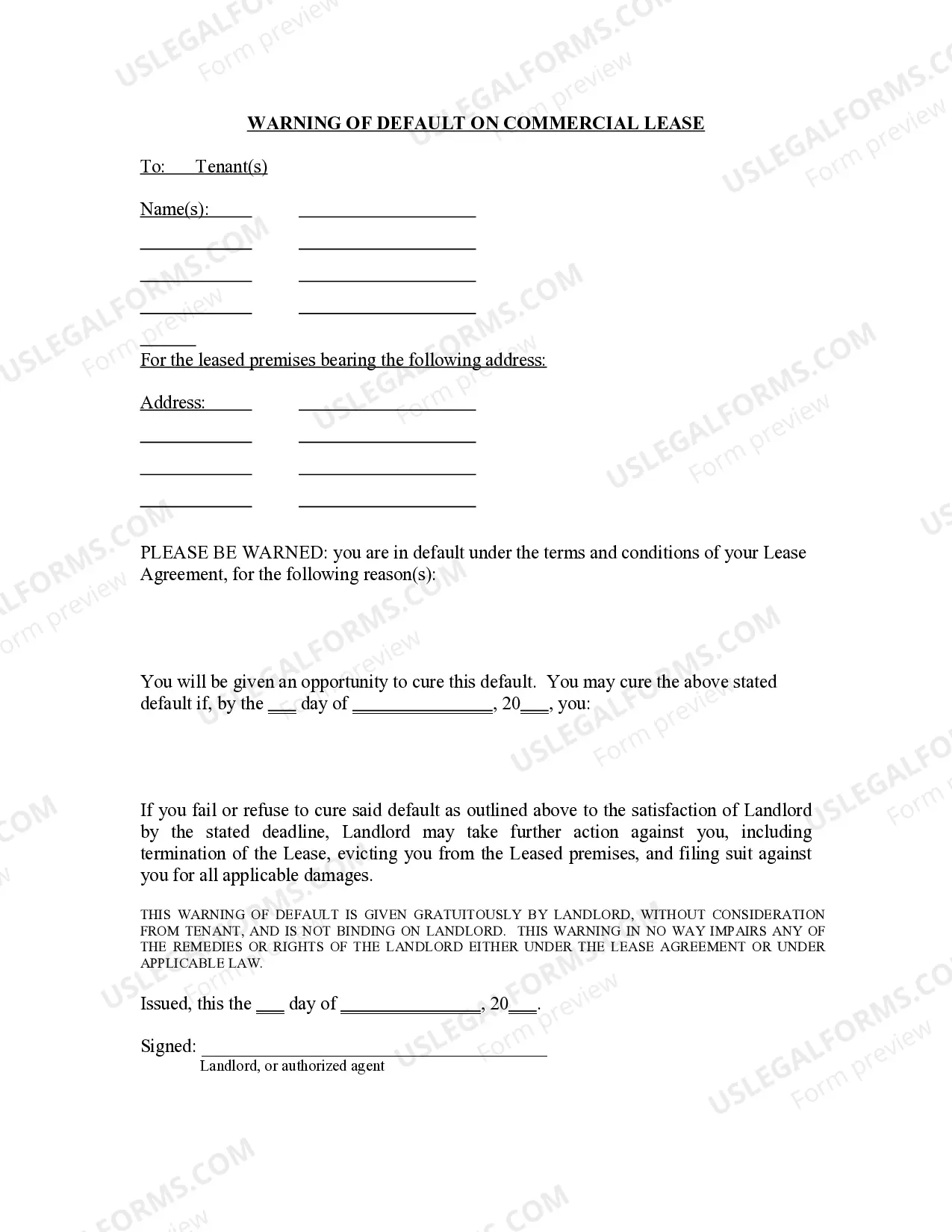
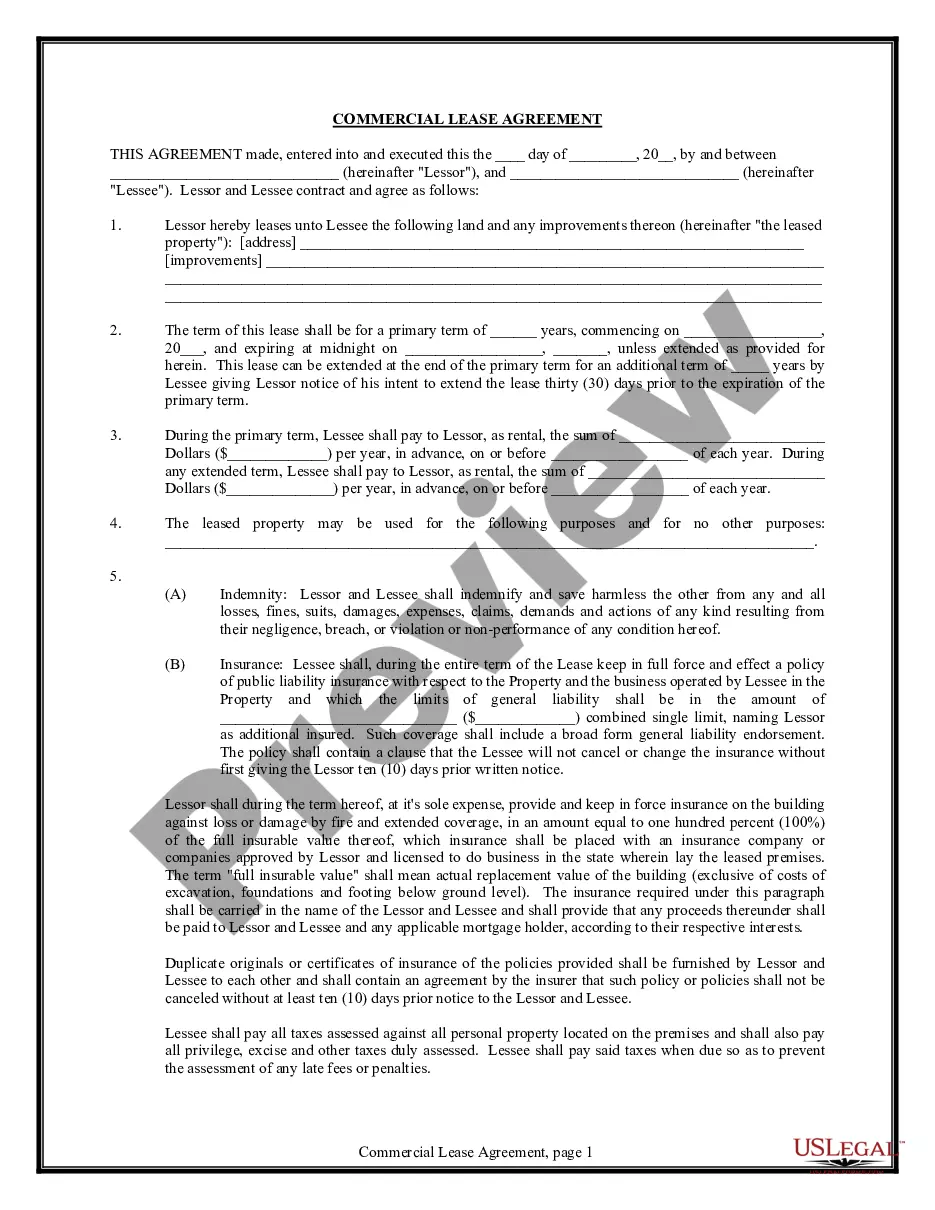
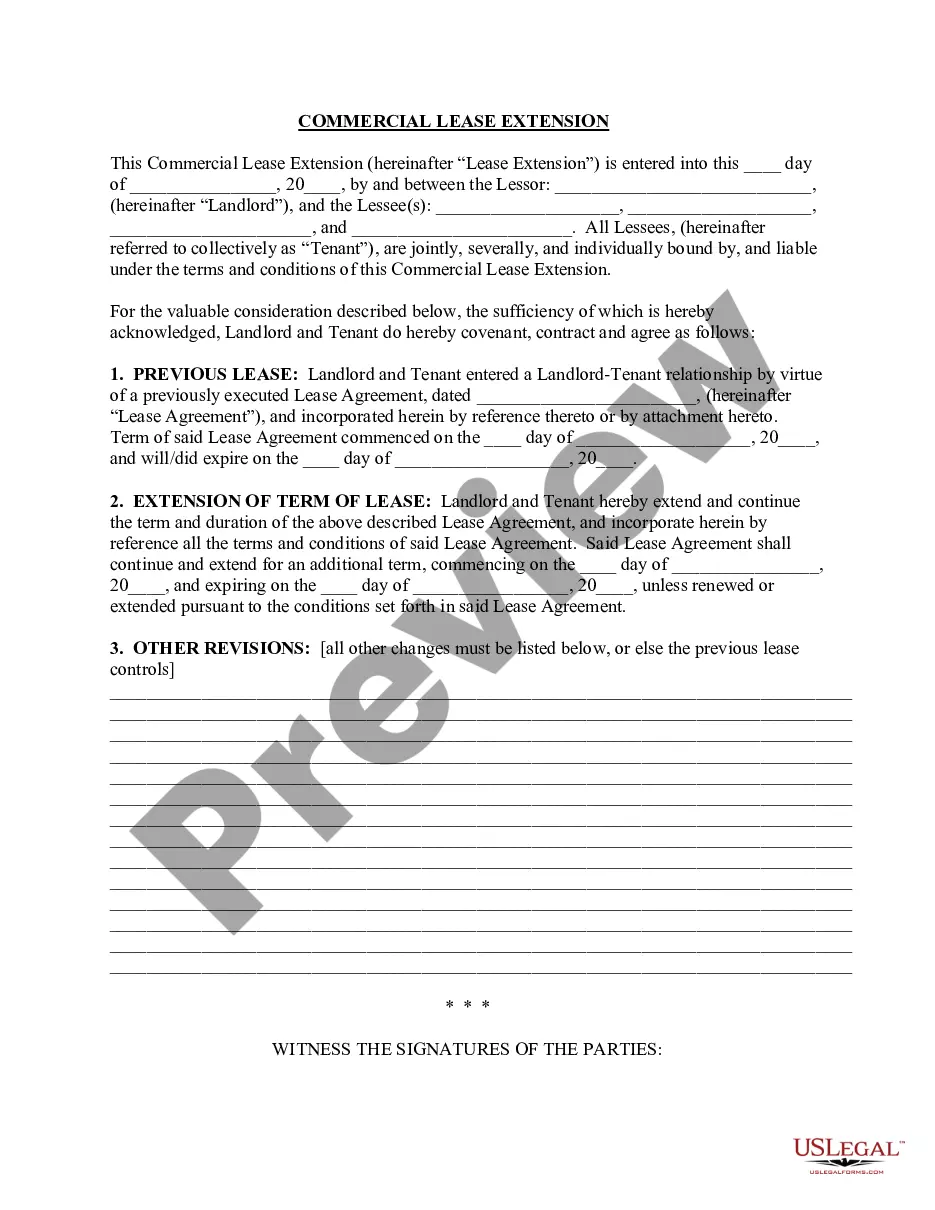
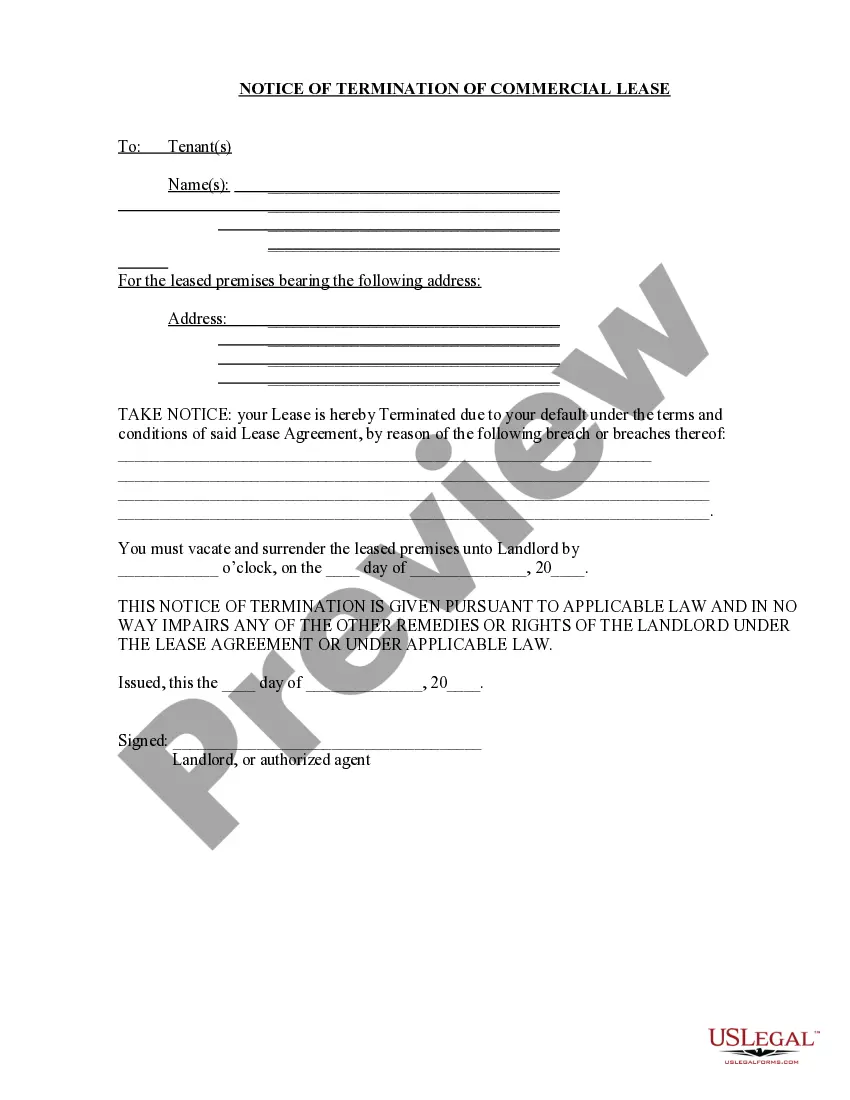
The Warning of Default on Commercial Lease is a formal notice from a landlord to a tenant, indicating potential default under a lease agreement. This notice serves to alert the tenant of concerns, typically regarding late rent payments, and offers a chance to remedy the situation before facing penalties, such as eviction. It is important to note that this form is distinct from other lease-related documents, as it specifically addresses default issues within the leasing context.
Main sections of this form
- Statement that the warning is given without consideration from the tenant.
- Recognition that the warning does not waive any of the landlord's rights under the lease or applicable law.
- Space for the date of issuance.
- Signature section for the landlord or authorized agent.
Common use cases
This form should be used when a landlord needs to notify a tenant of a potential default in compliance with their lease agreement. Scenarios may include late rental payments, failure to maintain property conditions as per the lease, or any other actions that might result in a default status. Providing this warning is a critical step in the eviction process and necessary for legally protecting the landlord's rights.
Who should use this form
This form is intended for:
- Landlords seeking to formally notify tenants of a lease default.
- Property management companies managing commercial leasing properties.
- Legal representatives acting on behalf of landlords in lease agreements.
Instructions for completing this form
- Identify the parties involved (landlord and tenant).
- Specify the date on which the warning is issued.
- Clearly state the reasons for the default, if applicable.
- Provide the landlord's signature or the signature of an authorized agent.
Does this form need to be notarized?
In most cases, this form does not require notarization. However, some jurisdictions or signing circumstances might. US Legal Forms offers online notarization powered by Notarize, accessible 24/7 for a quick, remote process.
Get your form ready online
Our built-in tools help you complete, sign, share, and store your documents in one place.
Make edits, fill in missing information, and update formatting in US Legal Forms—just like you would in MS Word.
Download a copy, print it, send it by email, or mail it via USPS—whatever works best for your next step.
Sign and collect signatures with our SignNow integration. Send to multiple recipients, set reminders, and more. Go Premium to unlock E-Sign.
If this form requires notarization, complete it online through a secure video call—no need to meet a notary in person or wait for an appointment.
We protect your documents and personal data by following strict security and privacy standards.

Make edits, fill in missing information, and update formatting in US Legal Forms—just like you would in MS Word.

Download a copy, print it, send it by email, or mail it via USPS—whatever works best for your next step.

Sign and collect signatures with our SignNow integration. Send to multiple recipients, set reminders, and more. Go Premium to unlock E-Sign.

If this form requires notarization, complete it online through a secure video call—no need to meet a notary in person or wait for an appointment.

We protect your documents and personal data by following strict security and privacy standards.
Typical mistakes to avoid
- Failing to specify the exact default issue in the notice.
- Not providing sufficient time for the tenant to remedy the default before actions are taken.
- Omitting the date of issuance.
- Not signing the document or failing to have it signed by an authorized representative.
Why complete this form online
- Convenient access to a legally vetted document drafted by licensed attorneys.
- Easy to complete and customize according to specific needs.
- Quickly downloadable and usable for immediate legal needs.
Looking for another form?
Form popularity
FAQ
Anyone renting a building, whether for commercial or personal use, has the right to privacy. You are entitled to do anything on the property that you wish, so long as whatever you are doing is legal. The landlord cannot prevent you from operating your business nor from allowing guests or patrons on the property.
For example, the lease may provide that in case of default, the landlord can recover late fees and interest. If the lease is a net lease, it may provide for the landlord to recover such things as property taxes, insurance, utilities, maintenance and repairs.
To Evict a Tenant, You Must Terminate the Tenancy with Legal Cause. To lawfully evict a tenant in South Carolina, you must terminate the tenancy, and you must have legal cause to do so. If a tenant has not paid rent, the matter of unpaid rent is one reason to terminate the tenancy.
If the commercial tenant is a shell corporation and/or does not have any assets of value, the commercial tenant may choose to walk away from its commercial lease obligations.Often the landlord will require guarantees in order to prevent a commercial tenant from walking away from its lease obligations.
In Columbia, South Carolina, an eviction normally takes from 30 to 45 days, and the cost can range from $100 to $1,200, depending on whether you use an attorney to help you through the process.
A break-early fee is a lump sum payment. The amount of the break-early fee will vary greatly depending upon the commercial tenant's specific circumstances. In exchange for the break-early fee, the landlord will agree to release the commercial tenant from all of its obligations under the commercial lease.
The notice simply requires the tenant to leave the premises. With an unconditional quit notice in South Carolina, you can file an eviction lawsuit against the tenant immediately. You can also evict a tenant without them necessarily violating the lease or rental agreement.
CALGARY -- The province says commercial landlords will no longer be allowed to evict business tenants without first applying for rental relief from the government.