Ohio Warranty Deed for Husband and Wife to Three Individuals as Joint Tenants
Overview of this form
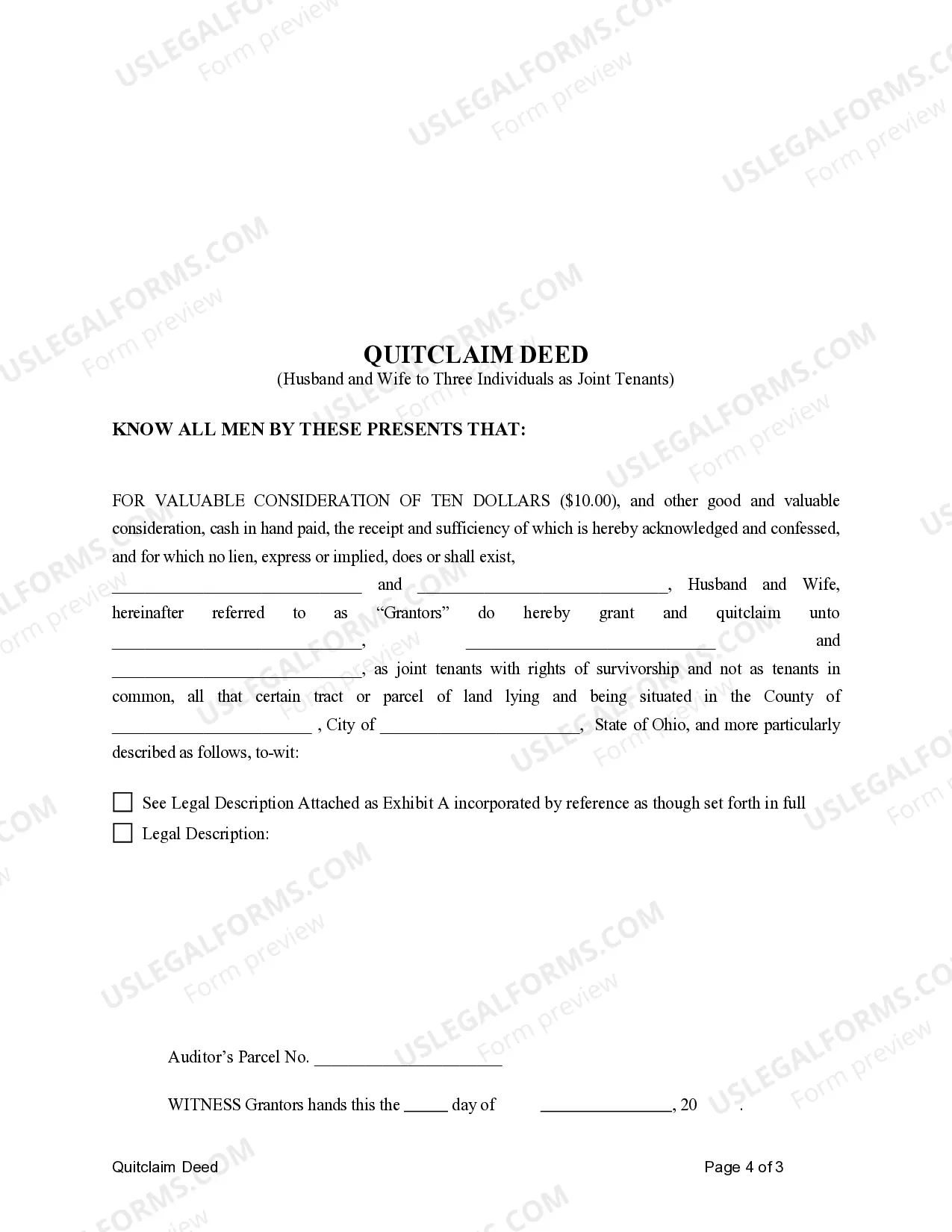
This Warranty Deed for Husband and Wife to Three Individuals as Joint Tenants is a legal document used to transfer ownership of real property. In this form, the grantors are a husband and wife, while the grantees are three individuals who will hold title to the property as joint tenants. This type of deed differs from others, such as a quitclaim deed, as it provides a warranty of title and can specify how grantees will share ownership rights, including survivorship rights.
Form components explained
- Parties involved: Identifies the husband and wife as grantors and the three individuals as grantees.
- Description of property: Clearly describes the real estate being transferred and includes a legal description.
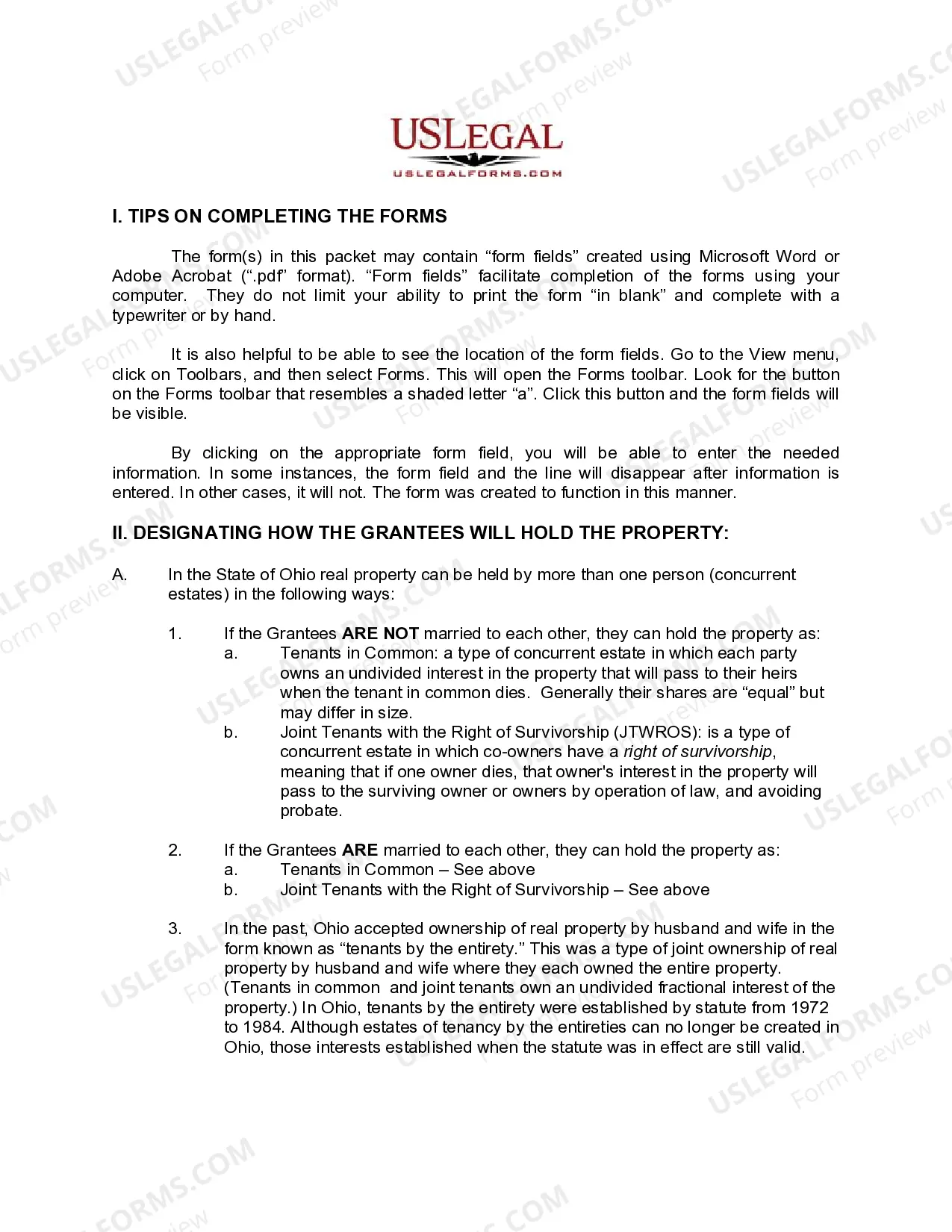
- Holding title designation: Specifies whether grantees will hold the property as tenants in common or joint tenants with right of survivorship.
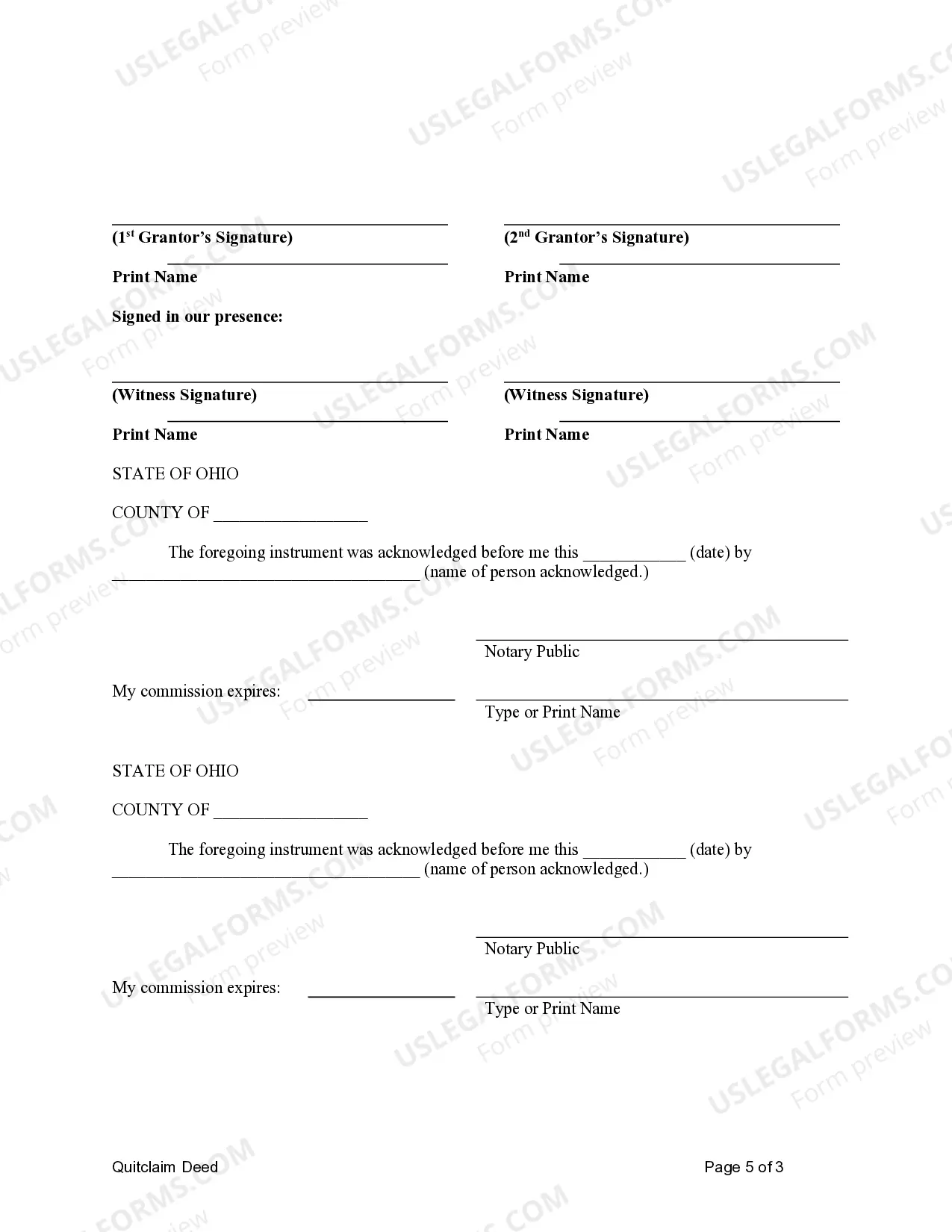
- Notary acknowledgment: Requires acknowledgment of the document by a notary public to validate the transfer.




When to use this document
This form should be used when a husband and wife wish to transfer real property to three individuals who will own the property together as joint tenants. It is applicable in situations where the grantors want to ensure that, upon the death of one joint tenant, the remaining tenants will automatically inherit the deceased's interest in the property, thus avoiding probate.
Intended users of this form
- Married couples transferring property ownership to multiple individuals.
- Property owners in Ohio looking to establish joint tenancy with survivorship rights.
- Individuals seeking to document property transfers clearly and legally.
How to prepare this document
- Identify the grantors: Enter the names of the husband and wife transferring the property.
- List the grantees: Include the names of the three individuals who will hold the property as joint tenants.
- Specify the property: Provide a detailed legal description of the property being transferred.
- Select ownership type: Indicate whether the grantees will hold the property as tenants in common or joint tenants with right of survivorship.
- Gather notarization: Ensure the deed is acknowledged by a notary public.
Notarization requirements for this form
This document requires notarization to meet legal standards. US Legal Forms provides secure online notarization powered by Notarize, allowing you to complete the process through a verified video call, available 24/7.
Get your form ready online
Our built-in tools help you complete, sign, share, and store your documents in one place.
Make edits, fill in missing information, and update formatting in US Legal Forms—just like you would in MS Word.
Download a copy, print it, send it by email, or mail it via USPS—whatever works best for your next step.
Sign and collect signatures with our SignNow integration. Send to multiple recipients, set reminders, and more. Go Premium to unlock E-Sign.
If this form requires notarization, complete it online through a secure video call—no need to meet a notary in person or wait for an appointment.
We protect your documents and personal data by following strict security and privacy standards.

Make edits, fill in missing information, and update formatting in US Legal Forms—just like you would in MS Word.

Download a copy, print it, send it by email, or mail it via USPS—whatever works best for your next step.

Sign and collect signatures with our SignNow integration. Send to multiple recipients, set reminders, and more. Go Premium to unlock E-Sign.

If this form requires notarization, complete it online through a secure video call—no need to meet a notary in person or wait for an appointment.

We protect your documents and personal data by following strict security and privacy standards.
Typical mistakes to avoid
- Failing to accurately describe the property, which can lead to disputes later.
- Not specifying how the grantees will hold the property, which can affect ownership rights.
- Skipping the notarization step, which is necessary for legal validity.
Why use this form online
- Convenience: Downloadable forms allow for easy completion from home.
- Editability: Forms can be filled out digitally, ensuring clear and legible entries.
- Reliability: Access to professionally drafted forms to meet legal standards.
Looking for another form?
Form popularity
FAQ
It's perfectly legal to have a sole proprietorship with a spouse employee. If you and your spouse co-own the business but don't incorporate or create an LLC, your business will usually be a general partnership.
A business jointly owned and operated by a married couple is a partnership (and should file Form 1065, U.S. Return of Partnership Income) unless the spouses qualify and elect to have the business be treated as a qualified joint venture, or they operate their business in one of the nine community property states.
To make the election, income, deductions, asset gain or loss must be divided between each spouse based on the percentage of their ownership in the LLC. Then each spouse must file a separate Schedule C or C-EZ and will also file a Schedule SE to pay any self-employment tax.
Spouses electing qualified joint venture status are treated as sole proprietors for Federal tax purposes.Each spouse must file a separate Schedule C (or Schedule F) to report profits and losses and, if otherwise required, a separate Schedule SE to report self-employment tax for each spouse.
Married couples have the option to file jointly or separately on their federal income tax returns.In the vast majority of cases, it's best for married couples to file jointly, but there may be a few instances when it's better to submit separate returns.
You do not need to name a spouse as a member of an LLC. While there are some beneficial reasons for naming your spouse, there is no law or regulation that states you must. An LLC is a limited liability company recognized by the IRS. It's nothing more than a partnership that has preferential liability protection.
You do not need to name a spouse as a member of an LLC. While there are some beneficial reasons for naming your spouse, there is no law or regulation that states you must. An LLC is a limited liability company recognized by the IRS. It's nothing more than a partnership that has preferential liability protection.
Note: If an LLC is owned by husband and wife in a non-community property state, the LLC should file as a partnership. LLCs owned by a husband and wife are not eligible to be "qualified joint ventures" (which can elect not be treated as partnerships) because they are state law entities.
Generally, a spouse can actually work for a limited liability company (LLC) without receiving pay. While federal and state wage and hour laws usually require that anyone who works for a private company such as an LLC must receive payment for their work, spouses are often exempt from these requirements.
As a sole proprietor, you can hire your spouse to be an employee. But, your spouse must be a legitimate employee.If your spouse is your employee, their wages are not subject to federal unemployment tax (FUTA tax). However, their wages are still subject to federal income and FICA taxes.