Agreement for Home Staging Services
What this document covers
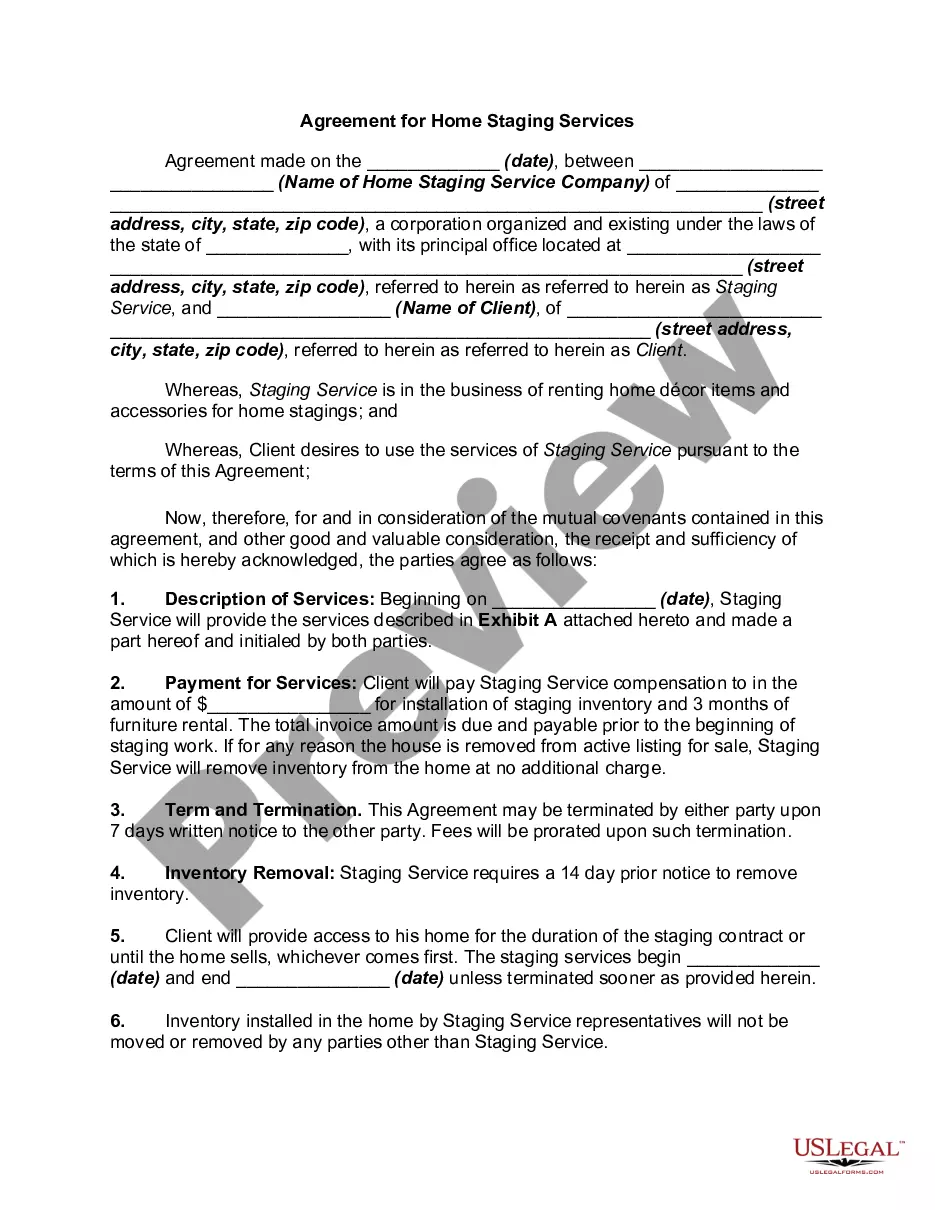
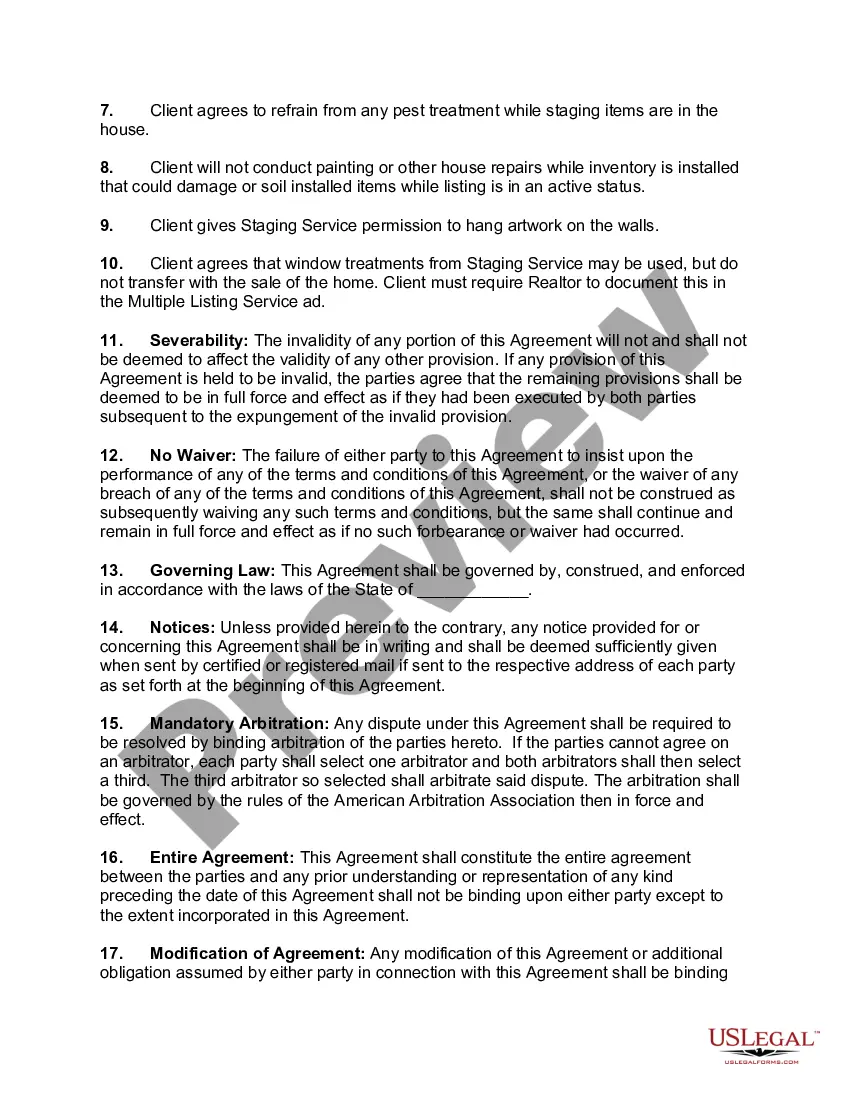
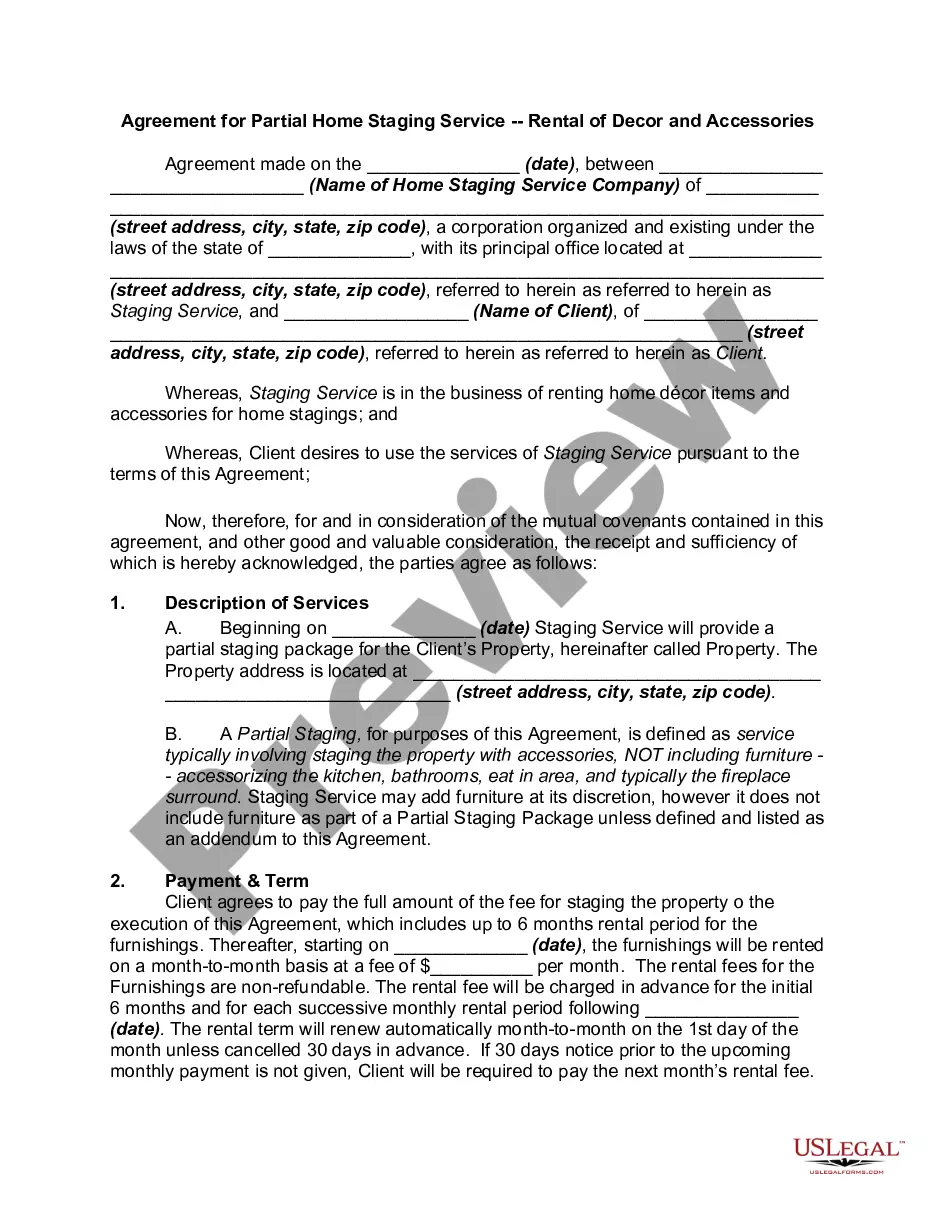
The Agreement for Home Staging Services is a legal document that establishes the terms between a home staging service provider and a client. This agreement outlines the specific services to be provided, payment details, and responsibilities of both parties. It differs from other service agreements by focusing specifically on the staging of residential properties for sale, ensuring that homes are presented in the best possible light to potential buyers.
Form components explained
- Description of Services: Details the specific services provided by the staging service.
- Payment Terms: Specifies the amount due and payment deadlines for staging and rental services.
- Term and Termination: Outlines how the agreement can be terminated and conditions around termination.
- Inventory Removal: States the notice required for the removal of staging inventory.
- Client Responsibilities: Clarifies access to the property and conditions of use for the staging items.
- Governing Law: Indicates the state laws that govern the agreement.
When to use this document
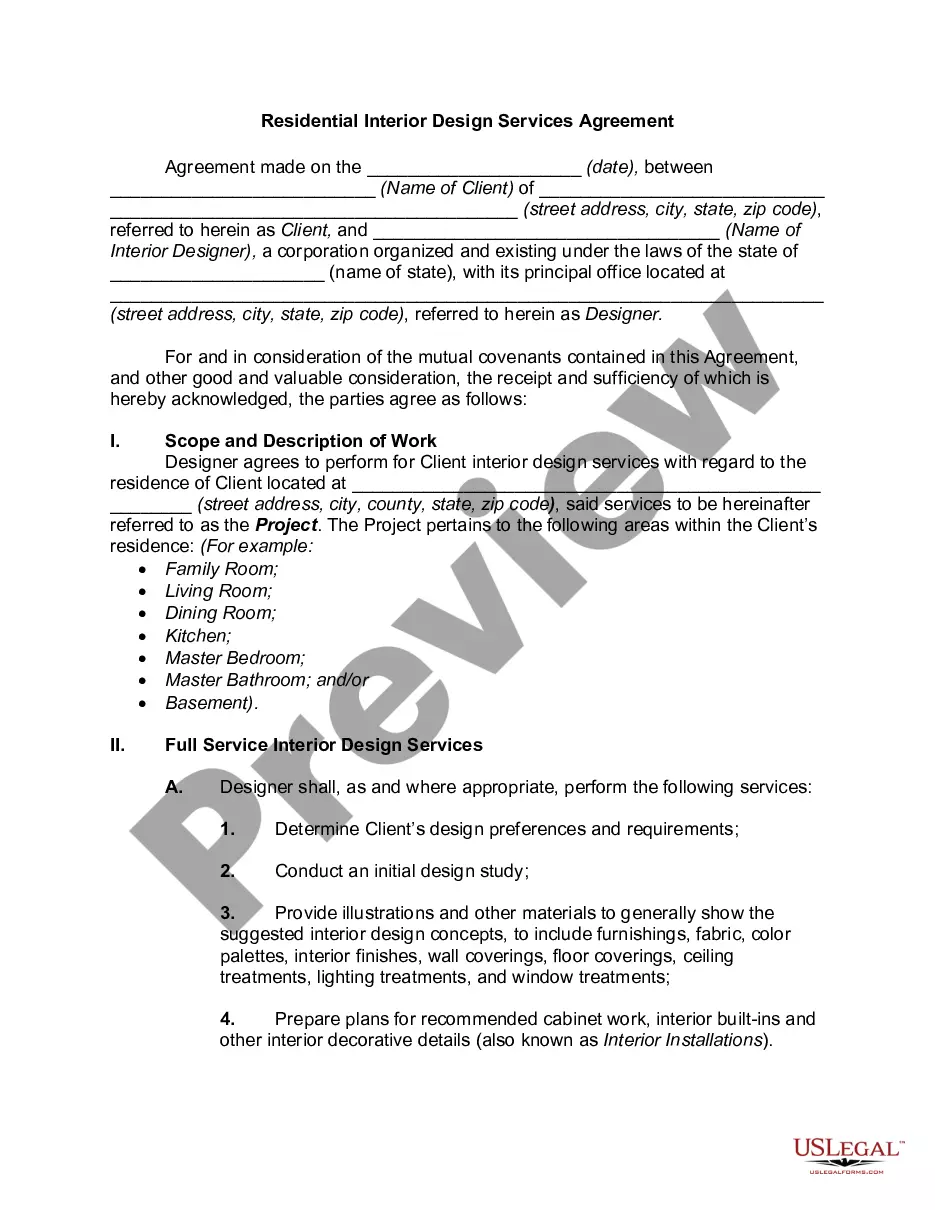
This agreement should be used when a homeowner wants to engage a professional home staging service to prepare their property for sale. It is particularly useful in competitive real estate markets where staging can differentiate a home from others on the market. The agreement formalizes the relationship and expectations between the client and the staging company, thereby reducing the potential for disputes.
Intended users of this form
- Homeowners preparing to sell their property.
- Real estate agents coordinating property staging for their clients.
- Home staging service providers looking to formalize their agreements with clients.
How to prepare this document
- Identify the parties involved by entering the names and addresses of the staging service provider and the client.
- Specify the date when the services will begin and the duration of staging.
- Enter the payment amount agreed upon for the staging services and rental of furniture.
- Detail any requirements for inventory removal and client access during the staging period.
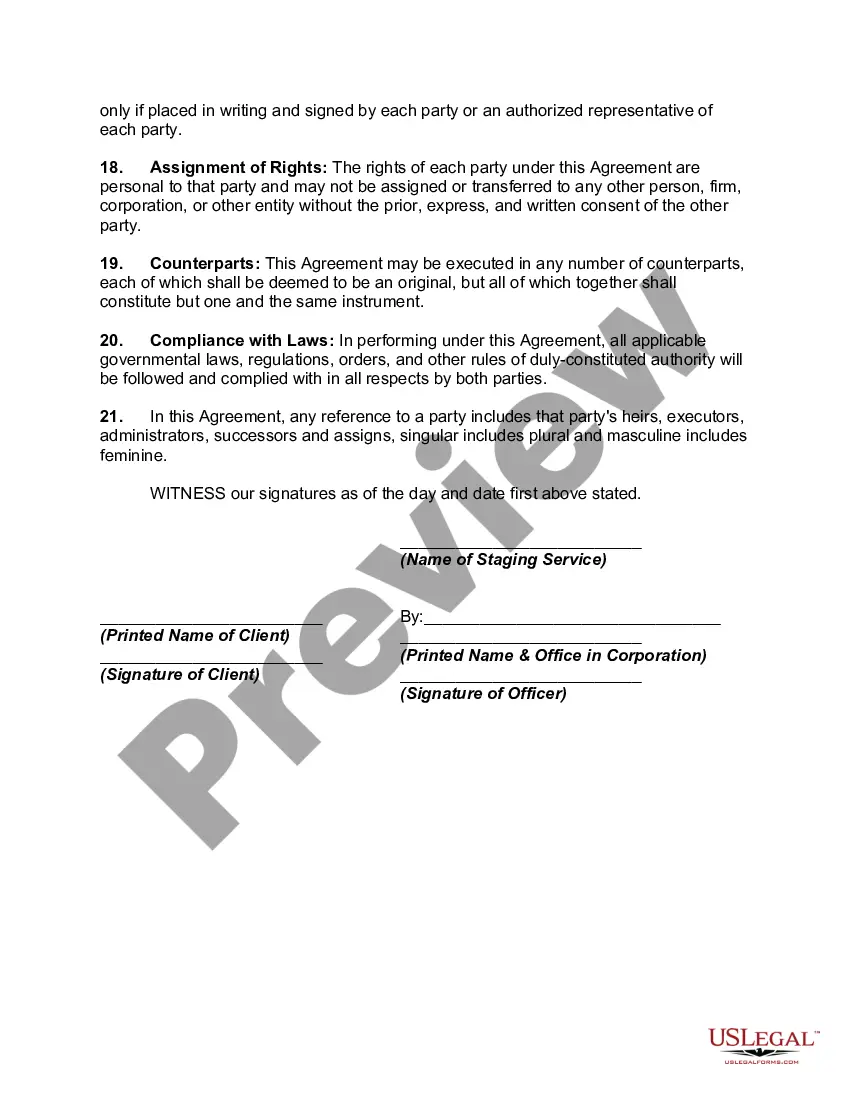
- Ensure both parties sign and date the agreement to finalize it.
Does this document require notarization?
Notarization is generally not required for this form. However, certain states or situations might demand it. You can complete notarization online through US Legal Forms, powered by Notarize, using a verified video call available anytime.
Get your form ready online
Our built-in tools help you complete, sign, share, and store your documents in one place.
Make edits, fill in missing information, and update formatting in US Legal Forms—just like you would in MS Word.
Download a copy, print it, send it by email, or mail it via USPS—whatever works best for your next step.
Sign and collect signatures with our SignNow integration. Send to multiple recipients, set reminders, and more. Go Premium to unlock E-Sign.
If this form requires notarization, complete it online through a secure video call—no need to meet a notary in person or wait for an appointment.
We protect your documents and personal data by following strict security and privacy standards.

Make edits, fill in missing information, and update formatting in US Legal Forms—just like you would in MS Word.

Download a copy, print it, send it by email, or mail it via USPS—whatever works best for your next step.

Sign and collect signatures with our SignNow integration. Send to multiple recipients, set reminders, and more. Go Premium to unlock E-Sign.

If this form requires notarization, complete it online through a secure video call—no need to meet a notary in person or wait for an appointment.

We protect your documents and personal data by following strict security and privacy standards.
Typical mistakes to avoid
- Failing to clearly define the services provided can lead to misunderstandings.
- Not specifying the payment terms or deadlines can result in disputes.
- Overlooking to include clauses for termination or inventory removal notice.
- Not obtaining signatures from both parties, which makes the agreement unenforceable.
Why use this form online
- Convenient access allows for quick downloading and filling out.
- Editable templates that can be customized to your specific needs.
- Secure storage of legal documents for easy retrieval when needed.
Legal use & context
- The agreement is legally binding once signed by both parties.
- It clarifies expectations and protects both the staging service and client from misunderstandings.
- Dispute resolution is facilitated through mandatory arbitration as outlined in the agreement.
Key takeaways
- The Agreement for Home Staging Services is essential for formalizing the stage service relationship.
- Clear terms regarding payment, service duration, and responsibilities help avoid disputes.
- Both parties should ensure they understand their obligations as laid out in the agreement.
Looking for another form?
Form popularity
FAQ
It can also cut the time on the market. Because nearly 90% of home buyers start their search on the Internet, staging is a good way to make sure online photos pop. Home sellers spend an average of $1,800 to stage a home, but costs can range from a couple of hundred dollars to $5,000 or more.
More than half of the real estate agents RESA surveyed said they sometimes offered to pay for staging services (or a portion of the cost) in some cases. Even if the agent won't pay for the staging, nearly 80% of agents surveyed by RESA paid for a consultation with a stager for their clients (at $300 to $500).
Put simply, staging means preparing the home for a potential buyer or "setting the stage," if you will. It involves redecorating, rearranging furniture, cleaning and other aesthetic strategies to present the home in the best possible light.
More than half of the real estate agents RESA surveyed said they sometimes offered to pay for staging services (or a portion of the cost) in some cases. Even if the agent won't pay for the staging, nearly 80% of agents surveyed by RESA paid for a consultation with a stager for their clients (at $300 to $500).
As a general rule of thumb, the average cost for most stagers is $300 to $600 for an initial design consultation, and $500 to $600 per month per staged room.
How Much Do Home Stagers Charge? Most home stagers charge between $150 to $600 for an initial two-hour consultation. Then, there is an additional $500 to $600 per month for each room. Houses require staging materials if it is on the market and being shown to clients, which can last a few days to a few months.
More than half of the real estate agents RESA surveyed said they sometimes offered to pay for staging services (or a portion of the cost) in some cases. Even if the agent won't pay for the staging, nearly 80% of agents surveyed by RESA paid for a consultation with a stager for their clients (at $300 to $500).
The short answer is yes, empty houses do take longer to sell than furnished, occupied or staged homes. A study from the Appraisal Institute found that vacant houses sold for 6% less than occupied houses and stayed on the market longer.
A home stager works to increase the appeal of a home and the chances of a sale at the maximum price.Home stagers can earn anywhere from $500 to $5,000 for a project depending on the square foot of the home, the number of rooms being staged, and the amount of work that goes into staging the home.