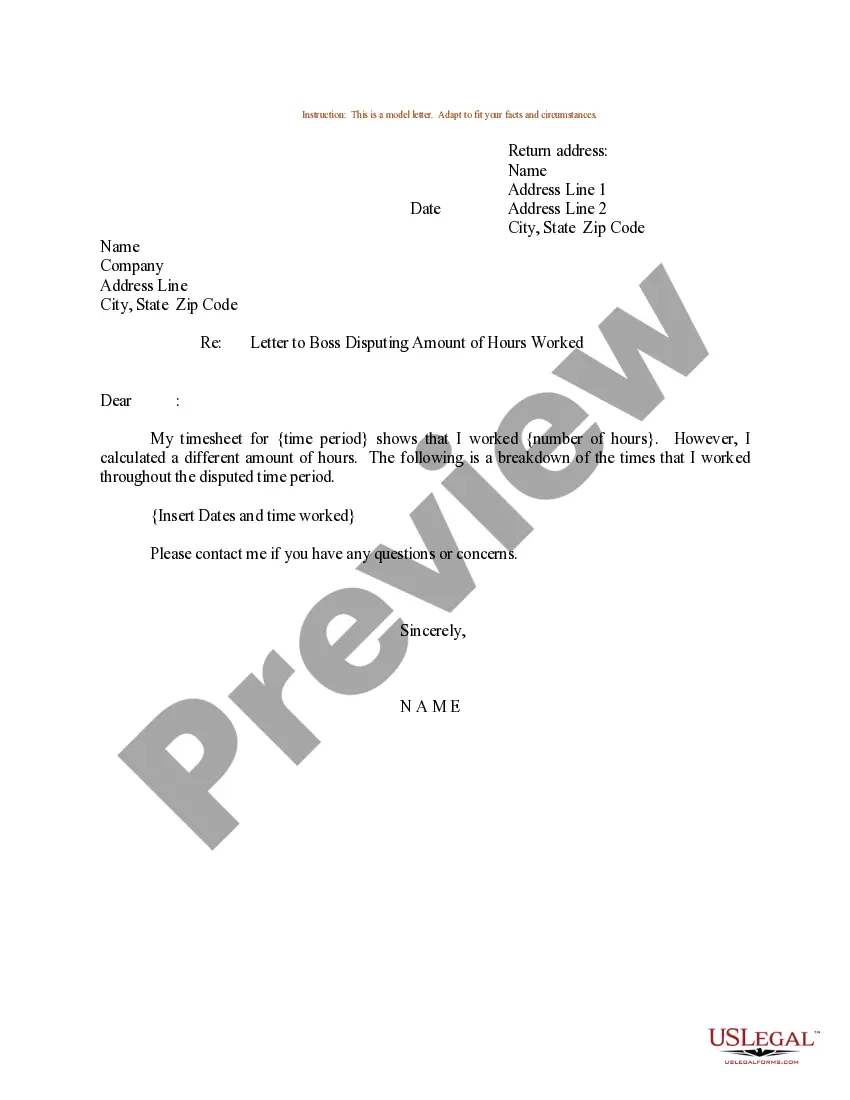
Sample Letter for Letter to Boss Disputing Amount of Hours Worked
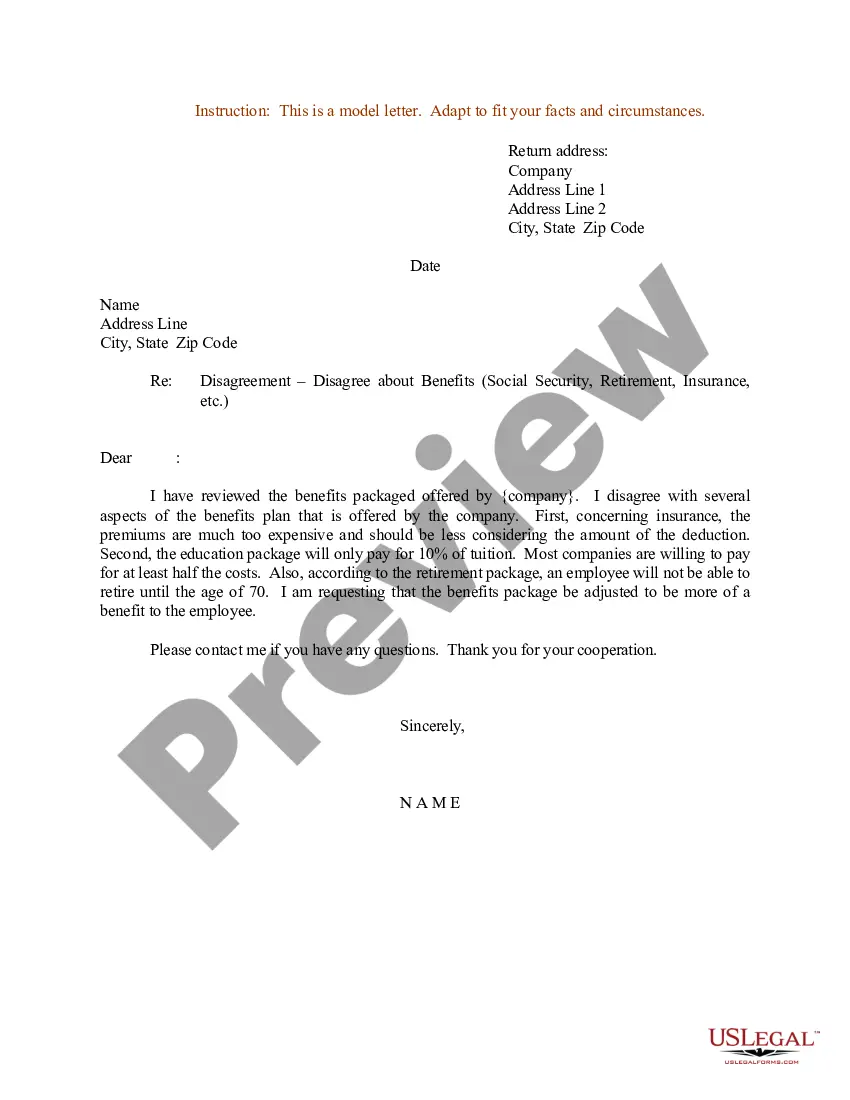
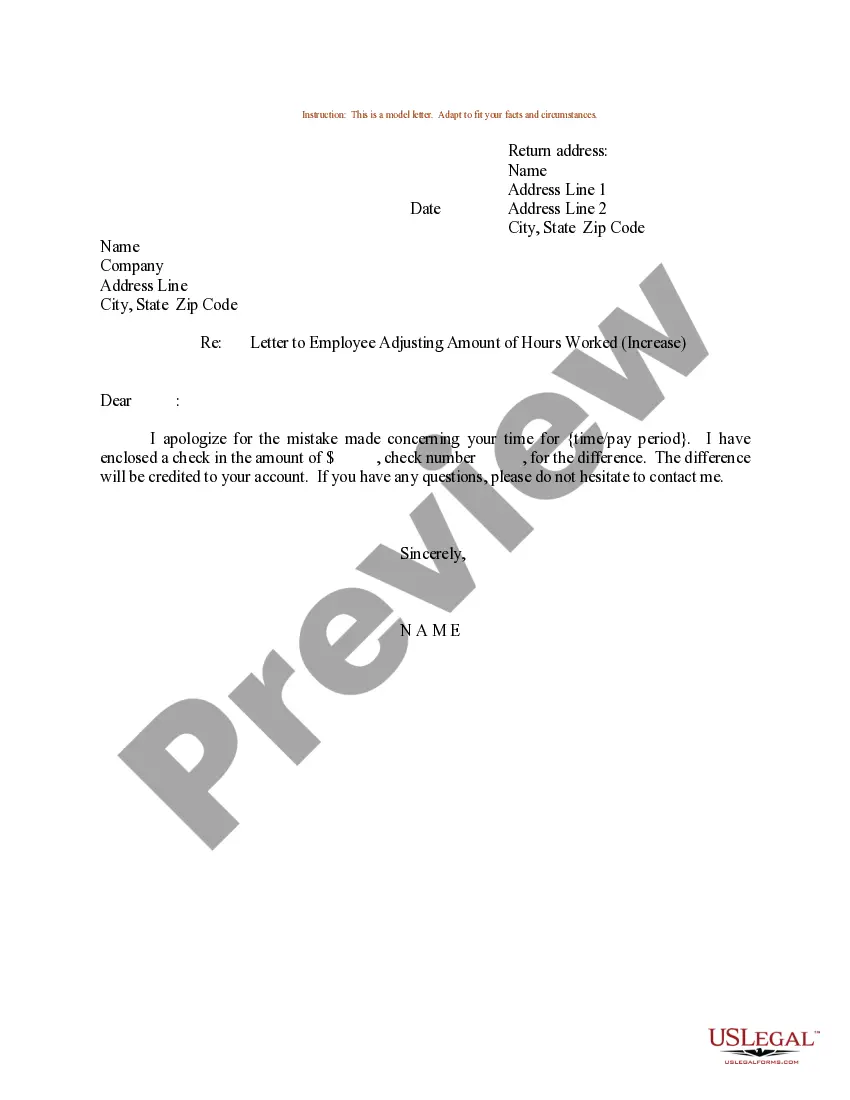
About this form
This Sample Letter for Letter to Boss Disputing Amount of Hours Worked is a template designed to assist employees in formally challenging the recorded hours they have worked. This letter allows you to communicate discrepancies in a clear and professional manner, differentiating it from general complaint letters by specifically addressing timekeeping issues and expectations for resolution.
Main sections of this form
- Return address section: Your address and contact information.
- Date: The date you are sending the letter.
- Recipient address: Your boss's name and address.
- Subject line: Clearly states the purpose of the letter regarding the hours worked.
- Body of the letter: Details about the dispute, including specific hours or dates in question.
- Closing: A courteous sign-off with your name.
When to use this document
This letter should be used when you believe there has been an error in the recording of your work hours, whether due to a misunderstanding, clerical error, or other reasons. It's an important first step in addressing any discrepancies before pursuing further action, such as a formal grievance or appeal within your workplace.
Who should use this form
- Employees who feel their hours worked are inaccurately reported.
- Workers seeking to establish a formal record of their concerns regarding timekeeping.
- Individuals preparing to discuss their work hours with management in a structured way.
- People who wish to maintain professionalism while addressing issues with their employer.
Steps to complete this form
- Enter your return address at the top of the letter.
- Insert the date you are writing the letter.
- Provide your boss's name and company address in the recipient section.
- Write a clear subject line indicating the purpose of the letter.
- Detail your dispute, including specific hours worked and any relevant context.
- Conclude with a polite closing and your full name.
Is notarization required?
This form does not typically require notarization to be legally valid. However, some jurisdictions or document types may still require it. US Legal Forms provides secure online notarization powered by Notarize, available 24/7 for added convenience.
Get your form ready online
Our built-in tools help you complete, sign, share, and store your documents in one place.
Make edits, fill in missing information, and update formatting in US Legal Forms—just like you would in MS Word.
Download a copy, print it, send it by email, or mail it via USPS—whatever works best for your next step.
Sign and collect signatures with our SignNow integration. Send to multiple recipients, set reminders, and more. Go Premium to unlock E-Sign.
If this form requires notarization, complete it online through a secure video call—no need to meet a notary in person or wait for an appointment.
We protect your documents and personal data by following strict security and privacy standards.

Make edits, fill in missing information, and update formatting in US Legal Forms—just like you would in MS Word.

Download a copy, print it, send it by email, or mail it via USPS—whatever works best for your next step.

Sign and collect signatures with our SignNow integration. Send to multiple recipients, set reminders, and more. Go Premium to unlock E-Sign.

If this form requires notarization, complete it online through a secure video call—no need to meet a notary in person or wait for an appointment.

We protect your documents and personal data by following strict security and privacy standards.
Typical mistakes to avoid
- Not including specific dates and hours worked in the dispute.
- Using an informal tone that may undermine the letter's seriousness.
- Failing to proofread for spelling and grammatical errors.
- Not following up on the letter after sending it.
Why use this form online
- Convenient access to a professionally drafted letter template.
- Editable format allowing you to customize the letter easily.
- Immediate download, enabling prompt action on your concerns.
- Reliable format that adheres to common professional standards.
Main things to remember
- The form helps employees formally dispute hours worked with their employer.
- Ensure clear and precise language to avoid misunderstandings.
- Can be customized based on individual circumstances and needs.
Looking for another form?
Form popularity
FAQ
First paragraph: clearly explain the semester(s) and/or class(es) for which you are appealing. Second paragraph/section: write out the reasons for the withdrawal, grade change, or other request. Third paragraph/section: describe any supporting documents you are including with your appeal.
Review the appeal process if possible. Determine the mailing address of the recipient. Explain what occurred. Describe why it's unfair/unjust. Outline your desired outcome. If you haven't heard back in one week, follow-up. Appeal letter format.
3.1 Give Your Boss a Chance. 3.2 Approach them in Private. 3.3 Don't Let Emotion Cloud Your Judgment. 3.4 Keep It in Perspective. 3.5 Don't Discuss It with Others. 3.6 Define Your Aims. 3.7 Be Time Sensitive. 3.8 Don't Downplay Your Experience.
Address the Appropriate Person. Address the letter to your immediate supervisor. State Your Request. State your request for reduced hours. State the Benefits. Explain Your Reasons. Explain How the Work Can Be Divided.
Appeal means to make an urgent request for something that is necessary or desired. To request donations for a charity is an example of appeal. Appeal is defined as to be pleasing or interesting. A perfume that smells good is an example of something that appeals to your sense of smell.
Effective letters of appeal articulate legitimate reasons why a decision should be reconsidered. Persuasive appeal letters identify mistakes that were made by officials handling the matter. Introduce any new evidence that could have potentially changed the initial decision.
Identify exactly the kind of workplace harassment that took place. Write down the details about the harassment. Introduce yourself and your purpose. Present the facts of the harassment. Explain in great detail how you responded. Proffer a solution to the issue. Avoid using offensive language.
Frame the Issue. Before you lodge a complaint, examine its relevance. State Reasons for Writing. Start the letter by briefly stating your reason for writing it. Provide Chronology of Events. State Desired Remedy.
Review the appeal process if possible. Determine the mailing address of the recipient. Explain what occurred. Describe why it's unfair/unjust. Outline your desired outcome. If you haven't heard back in one week, follow-up. Appeal letter format.