Maine Notice of Nonresponsibility - Corporation or LLC
What is this form?
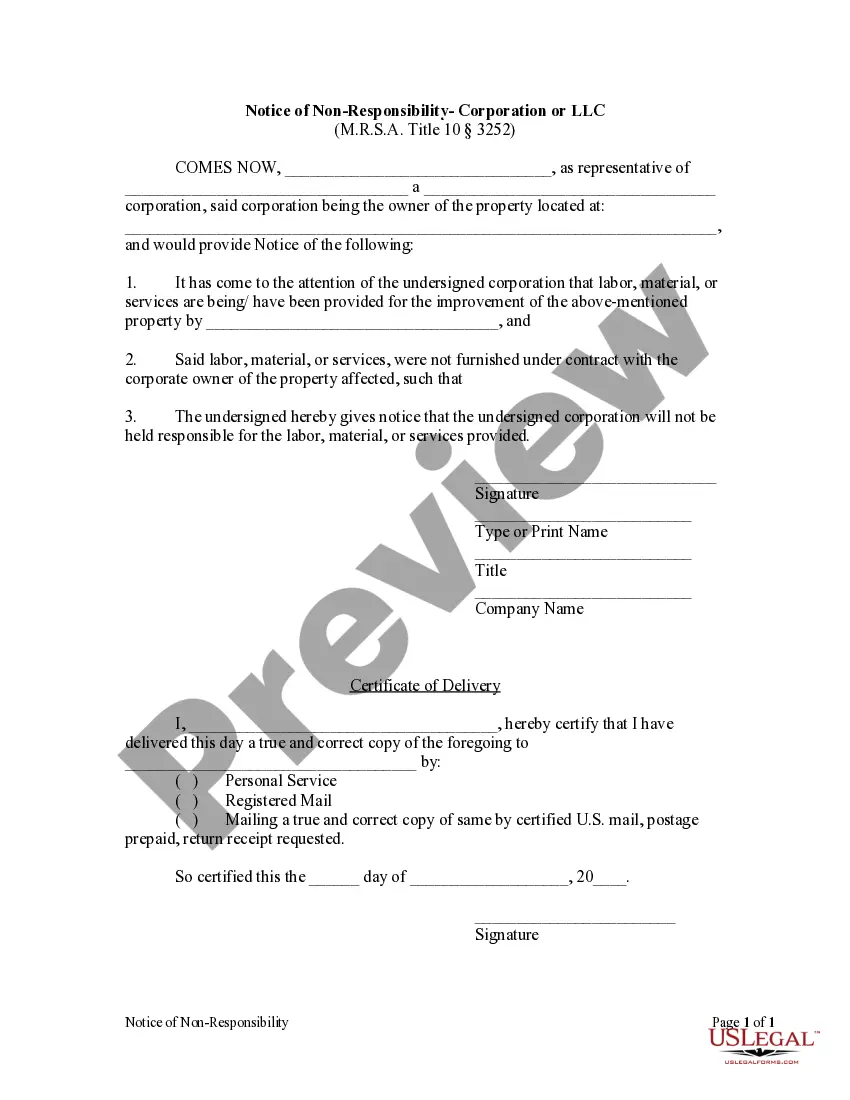
The Notice of Nonresponsibility for Corporations or LLCs is a legal form that allows property owners to declare that they will not be held responsible for improvements made to their property when such improvements are conducted without a contract. This form serves to prevent a lien from attaching to the owner's property, ensuring that those who provide labor, materials, or services cannot seek redress against the property owner. It is particularly relevant in situations where no formal agreement exists between the parties involved.
Key components of this form
- Identification of the corporation or LLC providing the notice.
- Description of the property where improvements are made.
- Notice that labor, materials, or services have been provided without a contract.
- Statement of non-responsibility for the mentioned improvements.
- Signature of the authorized representative along with their title.
- Certificate of delivery to document how and when the notice was served.
When this form is needed
This form should be used when a corporation or LLC finds out that non-contracted labor, materials, or services have been provided on its property. It is crucial for property owners to issue this notice promptly to safeguard their rights and prevent potential liens against their property. Situations that may warrant the use of this form include renovations, repairs, or constructions that are undertaken without the owner's consent or official agreement.
Intended users of this form
- Corporations or LLCs that own property in Maine.
- Property owners who want to limit their liability regarding unauthorized improvements.
- Representatives of corporations or LLCs responsible for managing property affairs.
How to complete this form
- Identify the corporation or LLC as the property owner at the start of the form.
- Provide a detailed description of the property affected by the improvements.
- Specify who performed the labor, provided materials, or rendered services.
- Ensure that the statement of non-responsibility is clearly indicated.
- Have an authorized representative of the corporation or LLC sign and date the form.
- Complete the certificate of delivery to document how the notice was served.
Does this form need to be notarized?
This form does not typically require notarization to be legally valid. However, some jurisdictions or document types may still require it. US Legal Forms provides secure online notarization powered by Notarize, available 24/7 for added convenience.
Get your form ready online
Our built-in tools help you complete, sign, share, and store your documents in one place.
Make edits, fill in missing information, and update formatting in US Legal Forms—just like you would in MS Word.
Download a copy, print it, send it by email, or mail it via USPS—whatever works best for your next step.
Sign and collect signatures with our SignNow integration. Send to multiple recipients, set reminders, and more. Go Premium to unlock E-Sign.
If this form requires notarization, complete it online through a secure video call—no need to meet a notary in person or wait for an appointment.
We protect your documents and personal data by following strict security and privacy standards.

Make edits, fill in missing information, and update formatting in US Legal Forms—just like you would in MS Word.

Download a copy, print it, send it by email, or mail it via USPS—whatever works best for your next step.

Sign and collect signatures with our SignNow integration. Send to multiple recipients, set reminders, and more. Go Premium to unlock E-Sign.

If this form requires notarization, complete it online through a secure video call—no need to meet a notary in person or wait for an appointment.

We protect your documents and personal data by following strict security and privacy standards.
Common mistakes
- Failing to provide a complete description of the property.
- Not delivering the notice to the correct parties.
- Omitting the signature of the authorized representative.
- Delaying in submitting the notice, which may affect its enforceability.
- Not keeping a copy for records after delivery.
Why use this form online
- Convenience of accessing and downloading the form from anywhere.
- Editability allows users to customize the form for their specific situation.
- Availability of templates drafted by licensed attorneys, ensuring legal compliance.
- Quick turnaround time, with no need for in-person meetings.
Looking for another form?
Form popularity
FAQ
A domestic limited liability company (LLC) is an entity:Where none of the members of an LLC are personally liable for its debts. Must be classified for Federal income tax purposes as if it were a sole proprietorship (referred to as an entity disregarded as separate from its owner), a partnership, or a corporation.
An LLC is a limited liability company, which is a type of legal entity that can be used when forming a business. An LLC offers a more formal business structure than a sole proprietorship or partnership. It also offers protection to the owner from personal liability for any of the debts that a business incurs.
In an LLC, individuals with an ownership share are called members. In a corporation, they are called shareholders. One of the advantages an LLC has over a corporation is that in many states, a creditor cannot collect a member's dividends, whereas in a corporation dividends can be collected from shareholders.
LLCs are not corporations and do not use articles of incorporation. Instead, LLCs form by filing articles of organization.
Any person starting a business, or currently running a business as a sole proprietor, should consider forming an LLC. This is especially true if you're concerned with limiting your personal legal liability as much as possible. LLCs can be used to own and run almost any type of business.
Professional LLCs PLLCs offer the same benefits as LLCs. The main difference between a LLC and a PLLC is that only professionals recognized in a state through licensing, such as architects, medical practitioners and lawyers, can form PLLCs.
One of the main reasons to form a corporation or LLC for a small business is to avoid personal liability for the business' debts. As we mentioned earlier, corporations and LLCs have their own legal existence. It's the corporation or LLC that owns the business, its assets, debts, and liabilities.
Both types of entities have the significant legal advantage of helping to protect assets from creditors and providing an extra layer of protection against legal liability. In general, the creation and management of an LLC are much easier and more flexible than that of a corporation.