Massachusetts Warranty Deed from Husband and Wife to Corporation
What this document covers
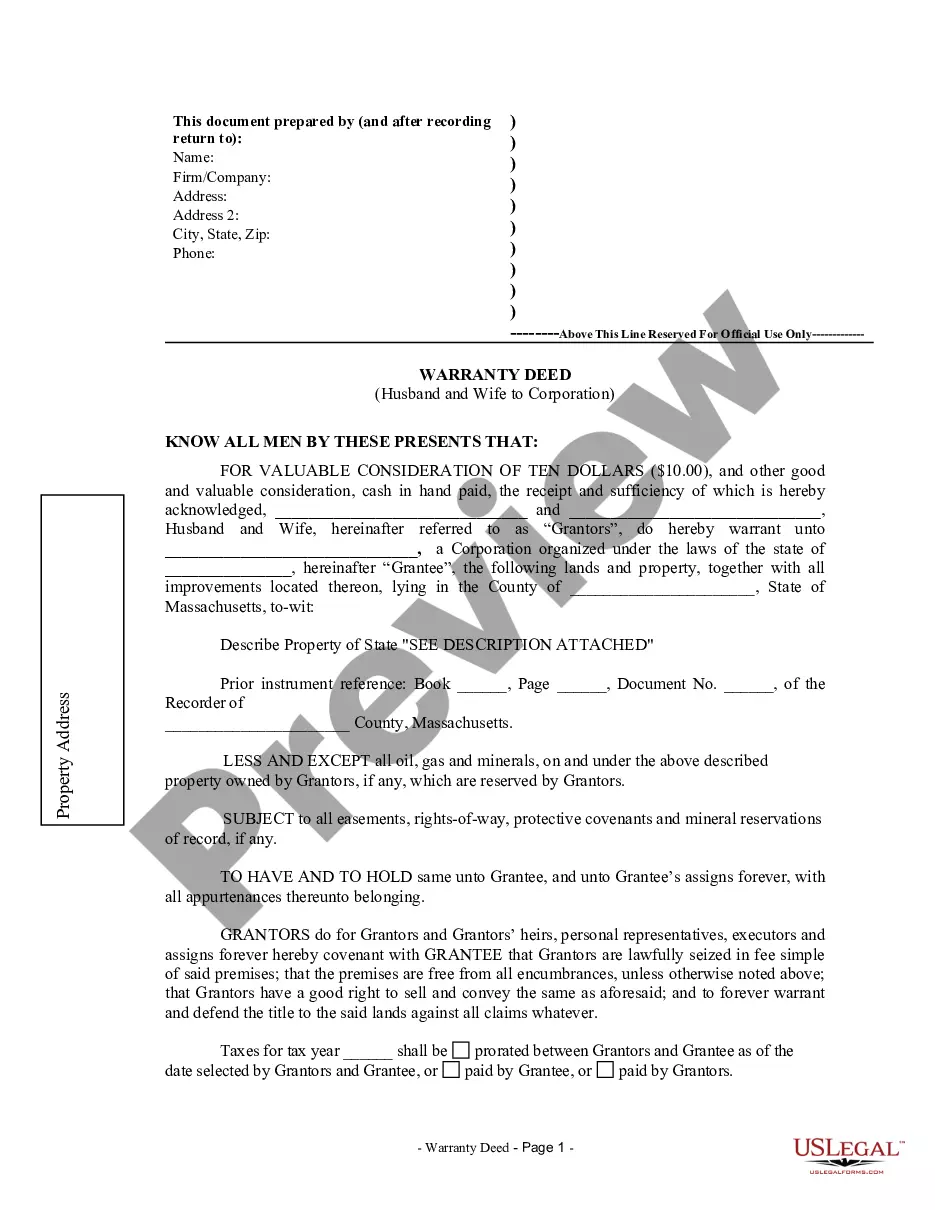
The Warranty Deed from Husband and Wife to Corporation is a legal document used to transfer property ownership from a married couple to a corporation. This form outlines the terms of the transfer, including any reservations, such as oil, gas, and mineral rights. Unlike other types of deeds, this form specifically addresses the situation where both spouses are grantors, providing assurance that the property is free from encumbrances and that the grantors have the legal capacity to convey the property.
Key parts of this document
- Identification of the grantors (husband and wife) and the grantee (corporation).
- Description of the property being conveyed.
- Reservation of oil, gas, and mineral rights, if applicable.
- Covenant assuring the property is free from encumbrances.
- Details regarding the proration of taxes between parties.
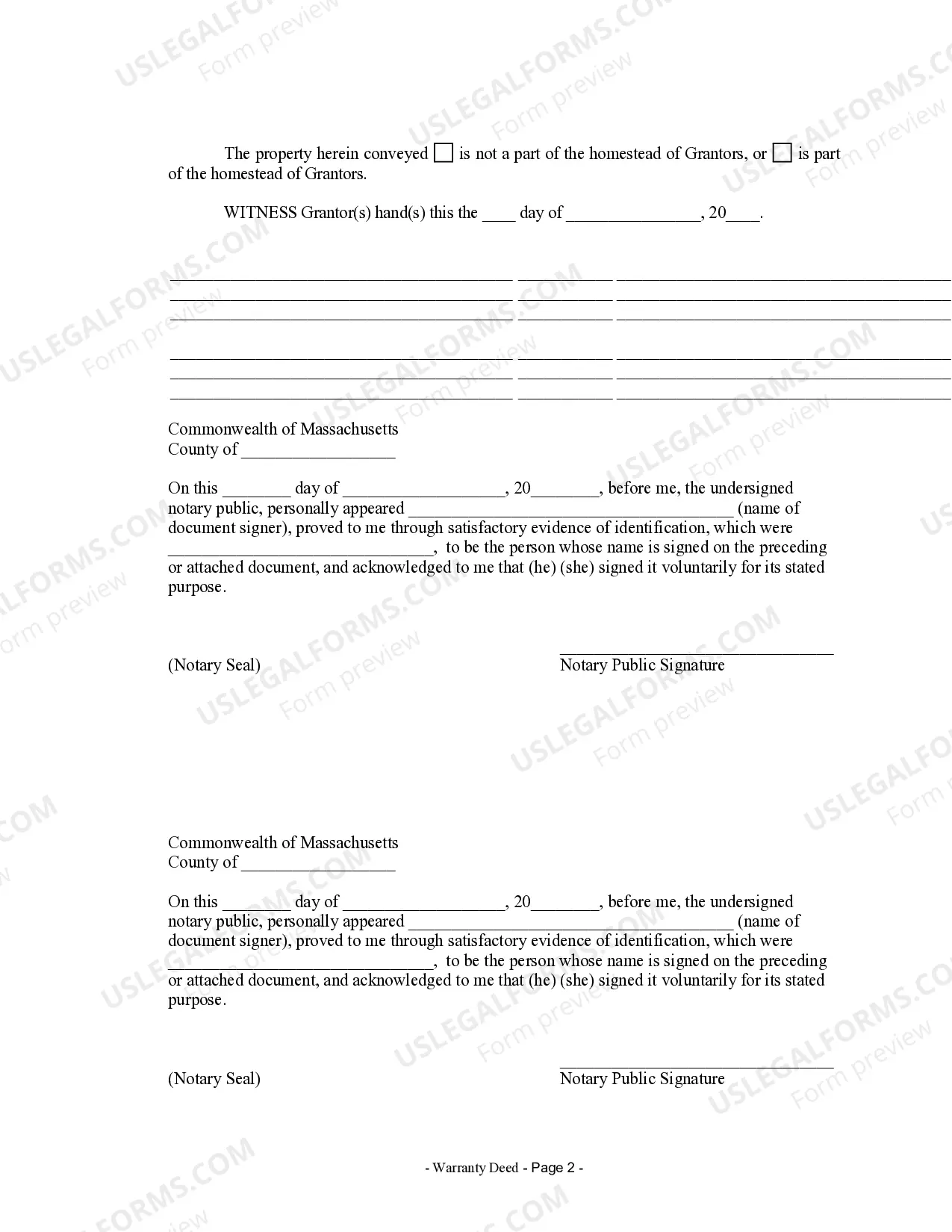
- Signature lines for grantors and a notary section for validation.



Situations where this form applies
This form should be used when a married couple wishes to transfer real estate property to a corporation. Typical scenarios include transferring ownership of property used for business purposes or when a couple decides to dissolve personal ownership in favor of corporate ownership. It ensures that both parties are legally protected during the process and clarifies any reservations about mineral rights.
Who needs this form
This form is intended for:
- Married couples who own property and want to transfer it to a corporation.
- Corporations acquiring property from their owners who are spouses.
- Individuals responsible for property transfers who require legal assurance that the transfer is valid and enforceable.
How to prepare this document
- Identify the parties involved: list the full names of the husband and wife as grantors and the corporation as the grantee.
- Provide a detailed description of the property being transferred, referring to any previously recorded documents.
- Include any reservations of rights, such as oil, gas, or mineral rights.
- Enter the tax year and specify how taxes will be prorated or handled between the parties.
- Both grantors must sign the form, including printing their names beneath their signatures.
- Have the document notarized by a certified notary public to validate the transaction.
Does this form need to be notarized?
Yes, this form must be notarized to be legally valid. Notarization ensures that the identities of the grantors are verified and that the signatures are authentic, which is crucial for property transfers. US Legal Forms offers integrated online notarization services available 24/7 through secure video calls, allowing you to complete the process without travel.
Get your form ready online
Our built-in tools help you complete, sign, share, and store your documents in one place.
Make edits, fill in missing information, and update formatting in US Legal Forms—just like you would in MS Word.
Download a copy, print it, send it by email, or mail it via USPS—whatever works best for your next step.
Sign and collect signatures with our SignNow integration. Send to multiple recipients, set reminders, and more. Go Premium to unlock E-Sign.
If this form requires notarization, complete it online through a secure video call—no need to meet a notary in person or wait for an appointment.
We protect your documents and personal data by following strict security and privacy standards.

Make edits, fill in missing information, and update formatting in US Legal Forms—just like you would in MS Word.

Download a copy, print it, send it by email, or mail it via USPS—whatever works best for your next step.

Sign and collect signatures with our SignNow integration. Send to multiple recipients, set reminders, and more. Go Premium to unlock E-Sign.

If this form requires notarization, complete it online through a secure video call—no need to meet a notary in person or wait for an appointment.

We protect your documents and personal data by following strict security and privacy standards.
Avoid these common issues
- Failing to accurately describe the property, which can lead to legal disputes.
- Not specifying reservations correctly, leading to uncertainty over mineral rights.
- Omitting necessary signatures from both grantors.
- Neglecting to have the document notarized, which may invalidate the deed in certain jurisdictions.
Why use this form online
- Convenience of downloading the form from anywhere at any time.
- Editability allows for customization to fit specific property transfer needs.
- Access to professionally drafted documents increases reliability and legal compliance.
Looking for another form?
Form popularity
FAQ
The drawback, quite simply, is that quitclaim deeds offer the grantee/recipient no protection or guarantees whatsoever about the property or their ownership of it. Maybe the grantor did not own the property at all, or maybe they only had partial ownership.
It is also crucial that a spouse know about the loan, even if he or she is not on the mortgage. In general, the spouse must sign a deed of trust, the Truth in Lending and Right to Cancel documents. By signing these documents, they are simply acknowledging the existence of the mortgage.
A warranty deed contains a guarantee that the grantor has legal title and rights to the real estate. A quitclaim deed offers little to no protection to the grantee.Warranty deeds ensure that the grantor has the right to sell the property, and guarantees that there are no liens or encumbrances against the land.
Special warranties allow the transfer of property title between seller and buyer. The purchase of title insurance can mitigate the risk of prior claims to the special warranty deed.
A warranty deed guarantees that: The grantor is the rightful owner of the property and has the legal right to transfer the title.The title would withstand third-party claims to ownership of the property. The grantor will do anything to ensure the grantee's title to the property.
Quitclaim deeds are most often used to transfer property between family members. Examples include when an owner gets married and wants to add a spouse's name to the title or deed, or when the owners get divorced and one spouse's name is removed from the title or deed.
A warranty deed, also known as a general warranty deed, is a legal real estate document between the seller (grantor) and the buyer (grantee). The deed protects the buyer by pledging that the seller holds clear title to the property and there are no encumbrances, outstanding liens, or mortgages against it.
Quitclaim Deeds are used when the transfer of ownership in the property does not occur as the result of a traditional sale.Under a warranty deed, if it turns out that the property is not what the seller promised or there's an uncleared lien or other block to the title, the buyer can sue the seller and recover damages.
In order to transfer ownership of the marital home pursuant to a divorce, one spouse is going to need to sign a quitclaim deed, interspousal transfer deed, or a grant deed, in order to convey the title to the property.