Indiana Warranty Deed to Separate Property of One Spouse to Both Spouses as Joint Tenants
About this form
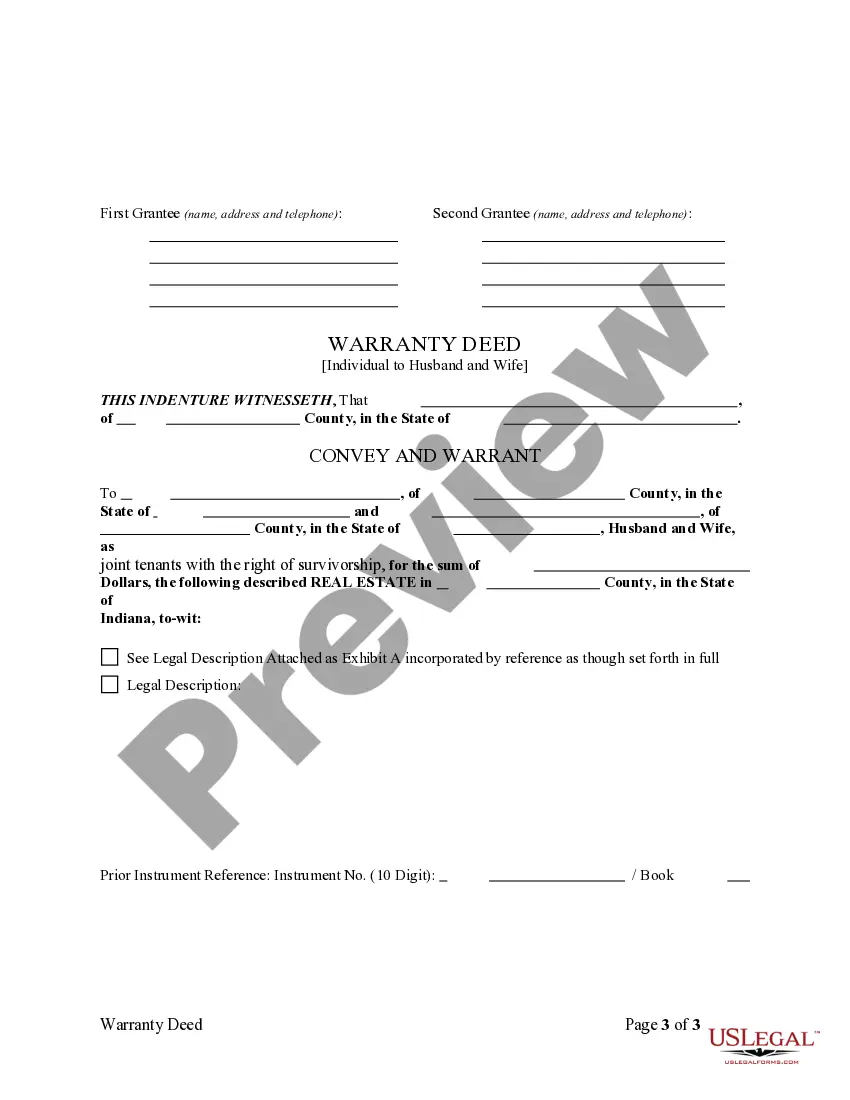
The Warranty Deed to Separate Property of One Spouse to Both Spouses as Joint Tenants is a legal document used when one spouse transfers ownership of a property solely held in their name to both spouses, thereby establishing joint tenancy. This form provides a way for couples to ensure they share equal rights to the property, which can be important in marital arrangements and estate planning. Unlike other forms of deeds, this specific warranty deed offers guarantees regarding the title of the property being transferred.
Form components explained
- Identification of the transferor (the spouse transferring the property) and transferees (both spouses).
- Description of the property being transferred, including legal descriptions as required.
- Statement of the intent to transfer the property to joint tenancy, outlining ownership rights.
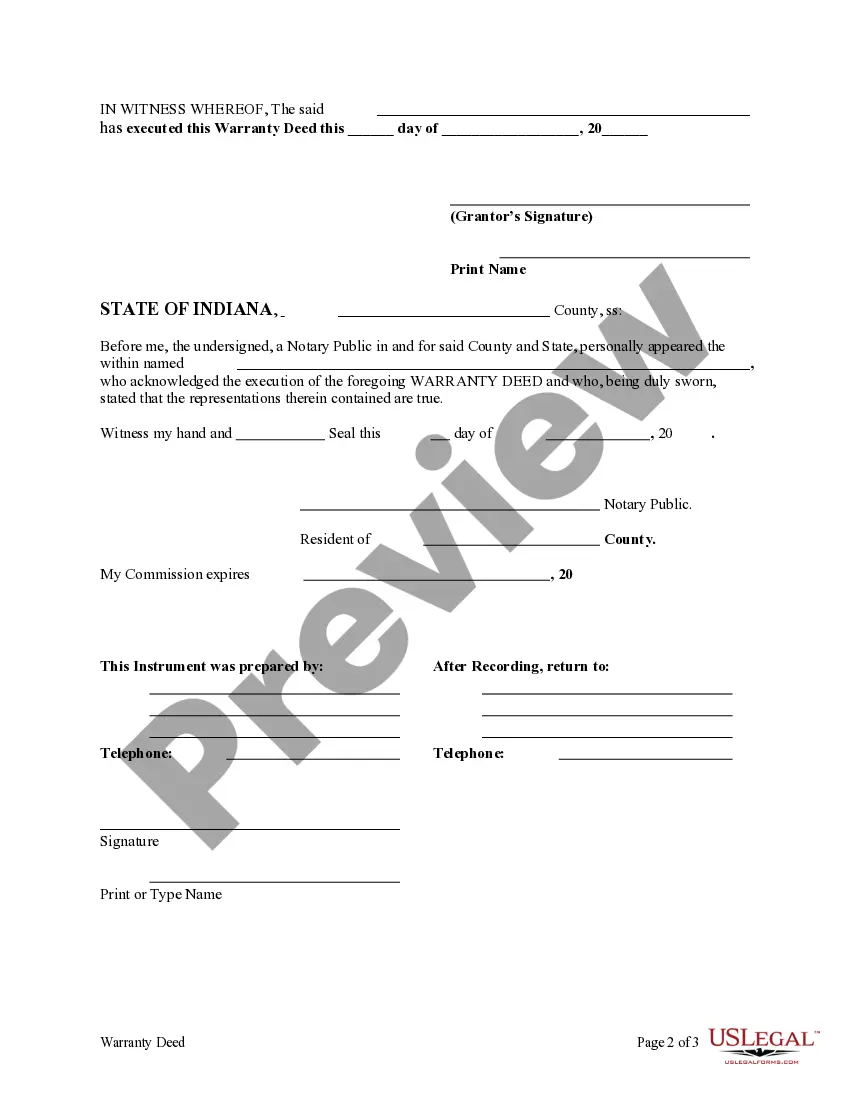
- Signatures of the transferor and transferees to validate the deed.
- Notary acknowledgment section to verify the identities of the parties and the voluntary nature of the signing.




When to use this form
This form is typically used in situations where one spouse owns property individually and wishes to transfer it to both spouses as joint tenants. Examples include when couples are buying a home together, reorganizing property ownership for estate planning, or ensuring that the property passes smoothly without the need for probate in the event of a spouse's death.
Who can use this document
This form is intended for:
- Married couples looking to establish joint ownership of property.
- Spouses who have separate property and want to ensure both parties have equal rights to that property.
- Individuals considering estate planning and wanting to address property distribution upon death.
How to prepare this document
- Identify the parties involved: the transferring spouse and both spouses for joint tenancy.
- Provide a detailed description of the property, including its legal address and any pertinent identifiers.
- Clearly state the intent to transfer the property to both spouses as joint tenants.
- Both spouses should sign the document in the appropriate fields provided.
- Have the signatures notarized to validate the transfer and meet legal requirements.
Does this document require notarization?
This form needs to be notarized to ensure legal validity. US Legal Forms provides secure online notarization powered by Notarize, allowing you to complete the process through a verified video call, available anytime.
Get your form ready online
Our built-in tools help you complete, sign, share, and store your documents in one place.
Make edits, fill in missing information, and update formatting in US Legal Forms—just like you would in MS Word.
Download a copy, print it, send it by email, or mail it via USPS—whatever works best for your next step.
Sign and collect signatures with our SignNow integration. Send to multiple recipients, set reminders, and more. Go Premium to unlock E-Sign.
If this form requires notarization, complete it online through a secure video call—no need to meet a notary in person or wait for an appointment.
We protect your documents and personal data by following strict security and privacy standards.

Make edits, fill in missing information, and update formatting in US Legal Forms—just like you would in MS Word.

Download a copy, print it, send it by email, or mail it via USPS—whatever works best for your next step.

Sign and collect signatures with our SignNow integration. Send to multiple recipients, set reminders, and more. Go Premium to unlock E-Sign.

If this form requires notarization, complete it online through a secure video call—no need to meet a notary in person or wait for an appointment.

We protect your documents and personal data by following strict security and privacy standards.
Common mistakes to avoid
- Failing to include a complete legal description of the property.
- Not obtaining the necessary notarization for the deed.
- Leaving out signature fields for either spouse.
- Not stating the intent for joint tenancy explicitly.
Benefits of completing this form online
- Convenience of accessing and downloading the form anytime, from anywhere.
- Editability allows users to fill out the form on their computer without having to print it initially.
- Reliable legal language drafted by licensed attorneys ensures compliance with legal standards.
Looking for another form?




Form popularity
FAQ
One of the main differences between the two types of shared ownership is what happens to the property when one of the owners dies. When a property is owned by joint tenants with survivorship, the interest of a deceased owner automatically gets transferred to the remaining surviving owners.
If you look at the registered title to your own jointly owned property and the text isn't shown on it, you own it as joint tenants. If it is there, you own it as tenants-in-common.
In estate law, joint tenancy is a special form of ownership by two or more persons of the same property. The individuals, who are called joint tenants, share equal ownership of the property and have the equal, undivided right to keep or dispose of the property. Joint tenancy creates a Right of Survivorship.
With a Survivorship Deed in place, when one of the parties in a joint tenancy dies, the other party (or parties) takes over the deceased party's interest in the property instead of it passing to the deceased's heirs or beneficiaries.
What Is the Difference Between a Warranty Deed & a Survivorship Deed?A warranty deed is the most comprehensive and provides the most guarantees. Survivorship isn't so much a deed as a title. It's a way to co-own property where, upon the death of one owner, ownership automatically passes to the survivor.
In California, most married couples hold real property (such as land and buildings) as joint tenants with right of survivorship.For instance, many married couples share real property as joint tenants. This way, upon the death of a spouse, the surviving spouse will own 100% share of the property.
Which statement applies to both joint tenancy and tenancy by the entirety? The last survivor becomes a severalty owner. A deed signed by one owner will convey a fractional interest. A deed will not convey any interest unless signed by both spouses.
For example, joint tenants must all take title simultaneously from the same deed while tenants in common can come into ownership at different times. Another difference is that joint tenants all own equal shares of the property, proportionate to the number of joint tenants involved.
Split ownership costs fairly until the house sells until the property sells. The amount owed by each party is typically split by the percentage of ownership. If you own 50%, and your two co-owners each own 25%, then you'll need to cover half of all housing expenses while your co-owners split the remainder.