Illinois Quitclaim Deed for Individual to Three Individuals as Joint Tenants with the Right of Survivorship
What this document covers
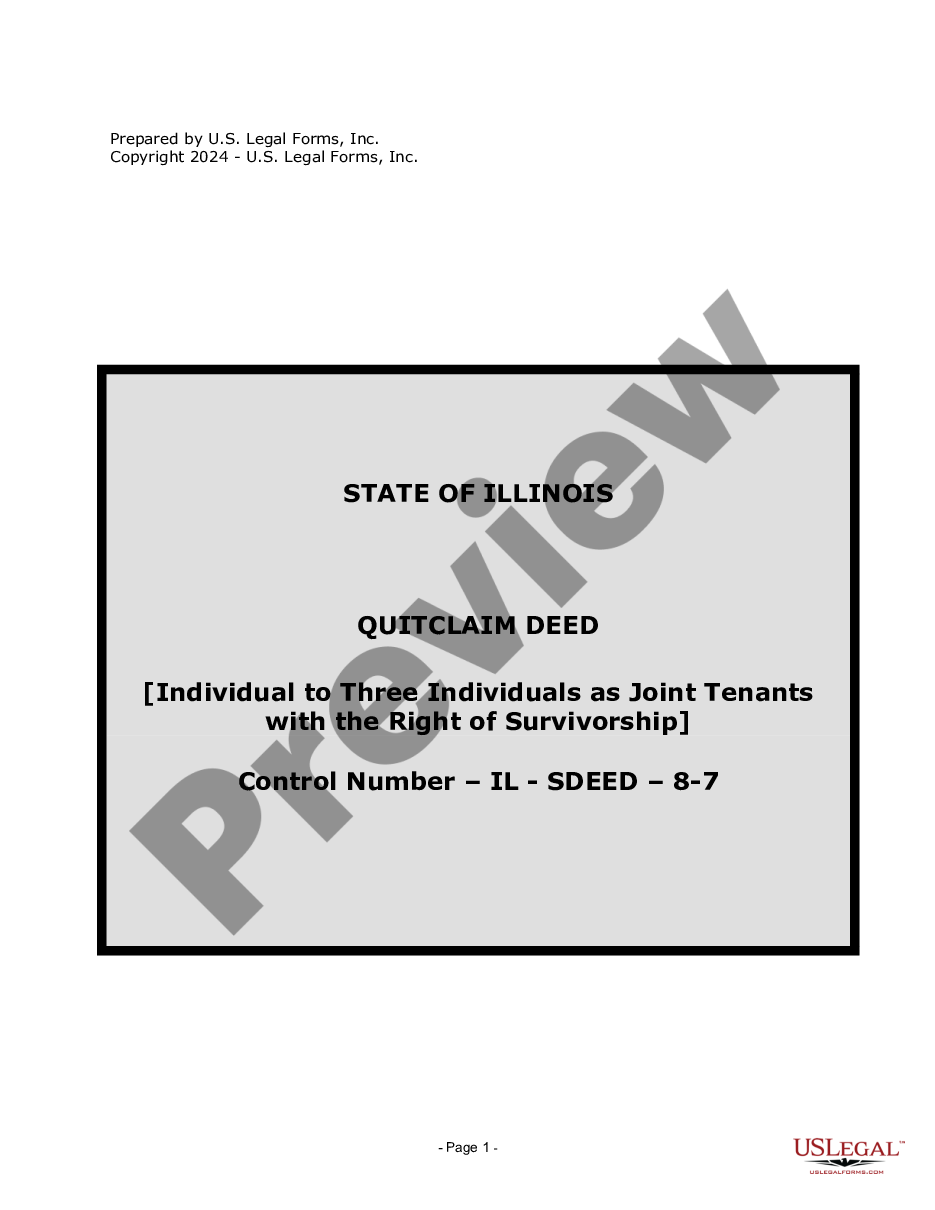
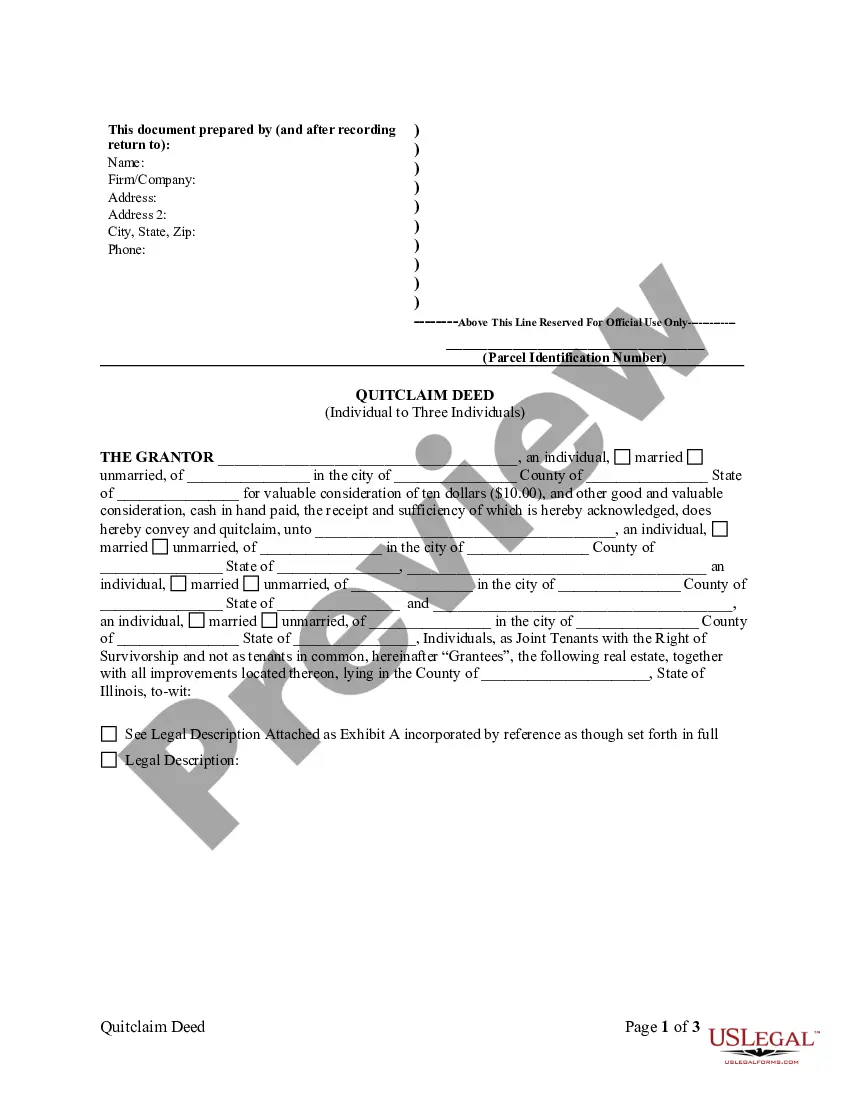
This Quitclaim Deed is a legal document that transfers ownership of property from one individual to three individuals who will hold title as joint tenants with the right of survivorship. Unlike other property transfer forms, a quitclaim deed does not guarantee that the grantor holds good title to the property, making it important to understand the implications of this transfer, especially when multiple individuals are involved in joint tenancy.
Key components of this form
- Identification of the grantor (the individual transferring the property).
- Identification of the grantees (the three individuals receiving property ownership).
- A description of the property being transferred.
- Statement of joint tenancy with the right of survivorship.
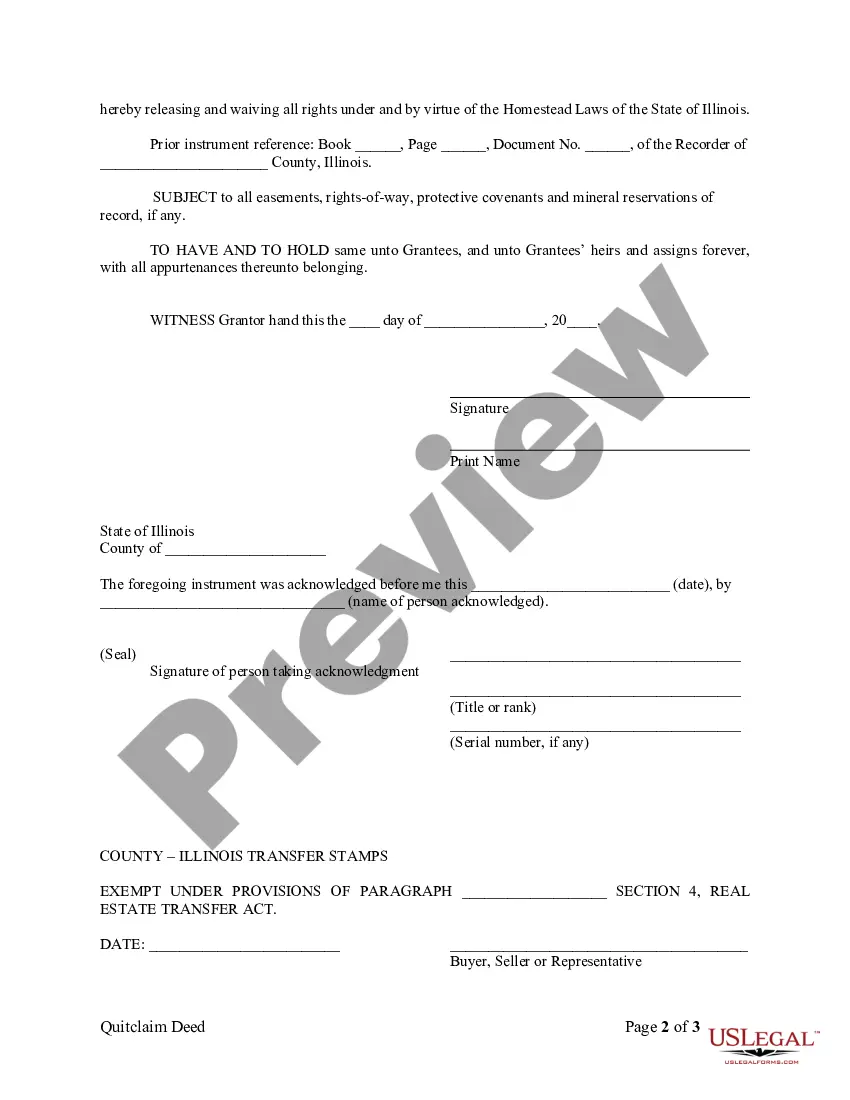
- Signature of the grantor to validate the transfer.
- Notary public acknowledgment to confirm the identity of the parties involved.





When this form is needed
This form is useful when an individual wishes to transfer real estate to multiple recipients who will share ownership as joint tenants. It is commonly used among family members, friends, or partners who want to ensure that, upon the death of one co-owner, ownership automatically passes to the remaining co-owners without going through probate.
Who needs this form
This form is intended for:
- Individuals looking to transfer their property to multiple parties.
- Co-owners wanting to establish joint tenancy with the right of survivorship.
- Property owners who wish to avoid probate upon their death.
Steps to complete this form
- Identify the grantor and enter their name at the beginning of the document.
- List the names of the three grantees who will hold the property as joint tenants.
- Provide a complete and accurate description of the property being transferred.
- Include the current date and signatures of the grantor.
- Have the document notarized to verify the identities of the parties involved.
Notarization requirements for this form
To make this form legally binding, it must be notarized. Our online notarization service, powered by Notarize, lets you verify and sign documents remotely through an encrypted video session.
Get your form ready online
Our built-in tools help you complete, sign, share, and store your documents in one place.
Make edits, fill in missing information, and update formatting in US Legal Forms—just like you would in MS Word.
Download a copy, print it, send it by email, or mail it via USPS—whatever works best for your next step.
Sign and collect signatures with our SignNow integration. Send to multiple recipients, set reminders, and more. Go Premium to unlock E-Sign.
If this form requires notarization, complete it online through a secure video call—no need to meet a notary in person or wait for an appointment.
We protect your documents and personal data by following strict security and privacy standards.

Make edits, fill in missing information, and update formatting in US Legal Forms—just like you would in MS Word.

Download a copy, print it, send it by email, or mail it via USPS—whatever works best for your next step.

Sign and collect signatures with our SignNow integration. Send to multiple recipients, set reminders, and more. Go Premium to unlock E-Sign.

If this form requires notarization, complete it online through a secure video call—no need to meet a notary in person or wait for an appointment.

We protect your documents and personal data by following strict security and privacy standards.
Common mistakes to avoid
- Failing to include the full names of all grantees.
- Not providing a complete property description.
- Missing the signature of the grantor.
- Neglecting to have the document notarized.
- Inadvertently altering the text of the form before completion.
Benefits of completing this form online
- Convenience of completing the form at your own pace from home.
- Editability allows you to correct errors before finalizing the document.
- Access to reliable templates prepared by licensed attorneys.
- Instant downloads for quick processing of your legal needs.
Looking for another form?

Form popularity
FAQ
Filling out a quitclaim deed in Illinois involves several steps. First, clearly write down the names of all parties involved, including the grantor and grantee, and specify the type of ownership, such as 'joint tenants with the right of survivorship.' You can find templates and examples on platforms like US Legal Forms, which simplifies the process and ensures compliance with local laws.
A Quitclaim Deed must be notarized by a notary public or attorney in order to be valid. What does "Grantee's assigns" mean? Grantee's assigns refers to any person that the Grantee transfers the property to, after having received the property from the Grantor.
A quitclaim deed transfers title but makes no promises at all about the owner's title.A person who signs a quitclaim deed to transfer property they do not own results in no title at all being transferred since there is no actual ownership interest. The quitclaim deed only transfers the type of title you own.
It's usually a very straightforward transaction, but it's possible for a quitclaim deed to be challenged. If a quitclaim deed is challenged in court, the issue becomes whether the property was legally transferred and if the grantor had the legal right to transfer the property.
If the quitclaim deed requires the signature of all co-owners, the deed is invalid unless all co-owners have signed it and the deed is then delivered to the grantee.If one individual owns real estate and desires to add a co-owner such as a spouse, a quitclaim deed might be used.
Discuss property ownership interests. Access a copy of your title deed. Complete, review and sign the quitclaim or warranty form. Submit the quitclaim or warranty form. Request a certified copy of your quitclaim or warranty deed.
An unrecorded quit claim deed is still valid.Failure to record a deed could render transfer or mortgaging of the property impossible and create numerous legal difficulties. The purpose of the recording a quit claim deed is to give notice to the world that there has been a change in ownership.
A quitclaim deed affects ownership and the name on the deed, not the mortgage. Because quitclaim deeds expose the grantee to certain risks, they are most often used between family members and where there is no exchange of money.Quitclaim deeds transfer title but do not affect mortgages.
Under California law, a deed that purports to convey title (ownership) or any other interest in real property, such as an easement, is completely void if the conveyancing party's signature on the deed is forged.
A quitclaim deed in Illinois is often used to transfer property between close family members or trusted friends.A quitclaim deed requires trust on the part of the person receiving the deed, because the person transferring it, also known as the grantor, isn't guaranteeing they actually own the property.