Wisconsin Drainage Contractor Package
Overview of this form package
The Wisconsin Drainage Contractor Package is a comprehensive set of legal documents designed specifically for drainage contractors. This package includes essential forms that help contractors, owners, suppliers, and subcontractors assert their legal rights and address key legal issues during construction projects involving cesspools, septic tanks, storm drains, and plumbing repairs. At its core is a drainage contract compliant with state law, setting it apart from other normal construction packages by its focus on drainage-specific needs.
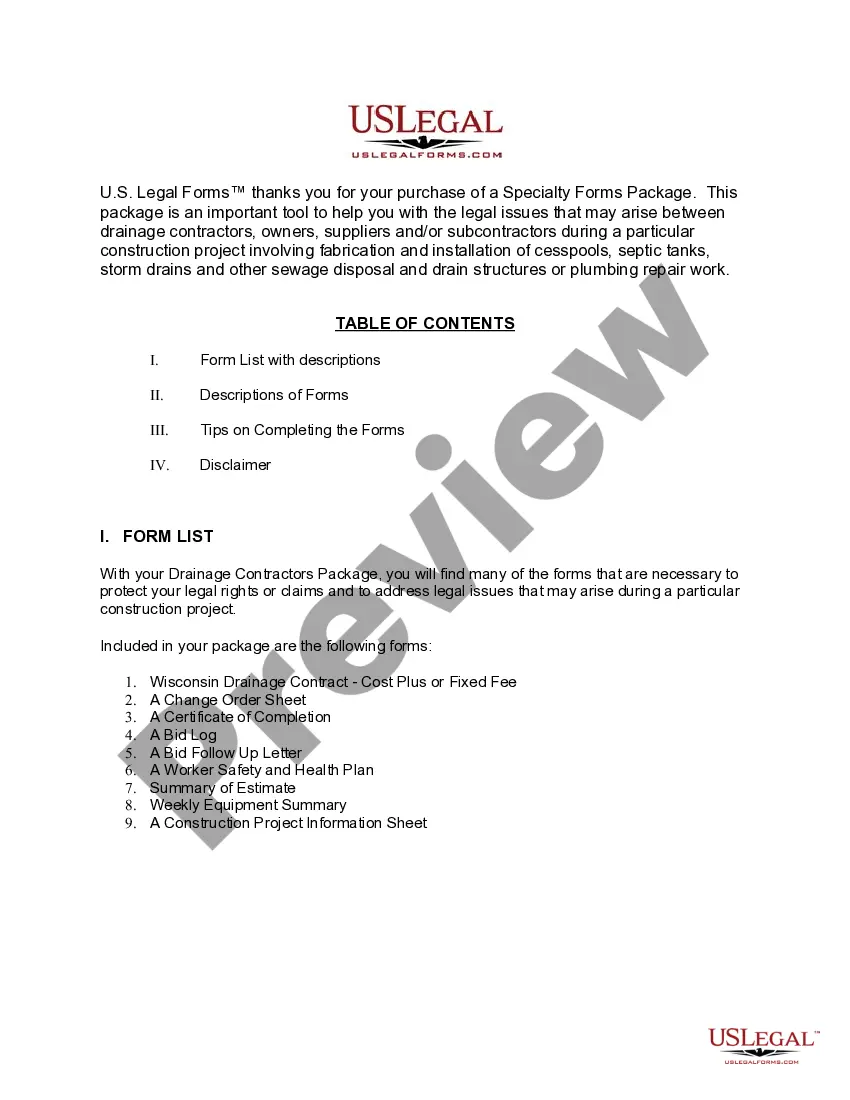
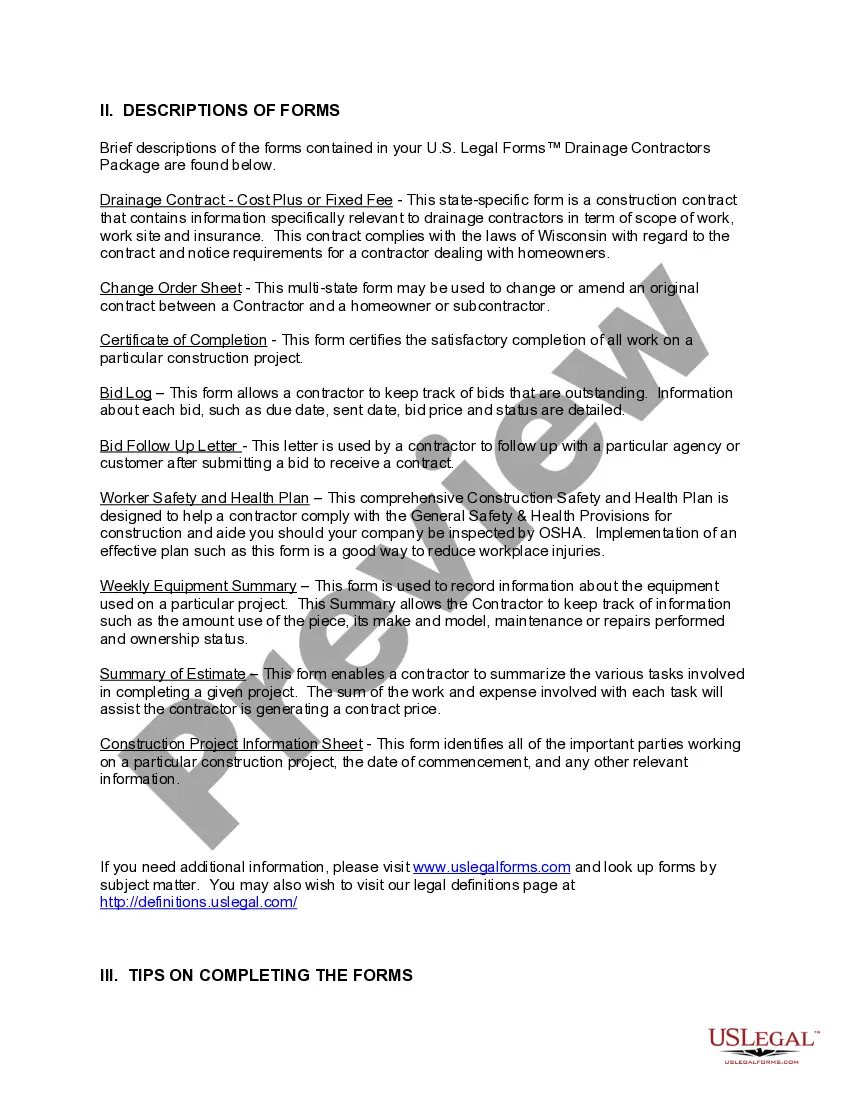
What’s included in this form package
- Drainage Contract for Contractor
- Contractor's Weekly Equipment Summary
- Contractor's Bid Log
- Contractor's Bid Follow Up Letter
- Contractor's Summary of an Estimate
- Construction Safety and Health Plan
- Change Order for Construction or Repairs by Contractor
- Certification of Completion by Contractor
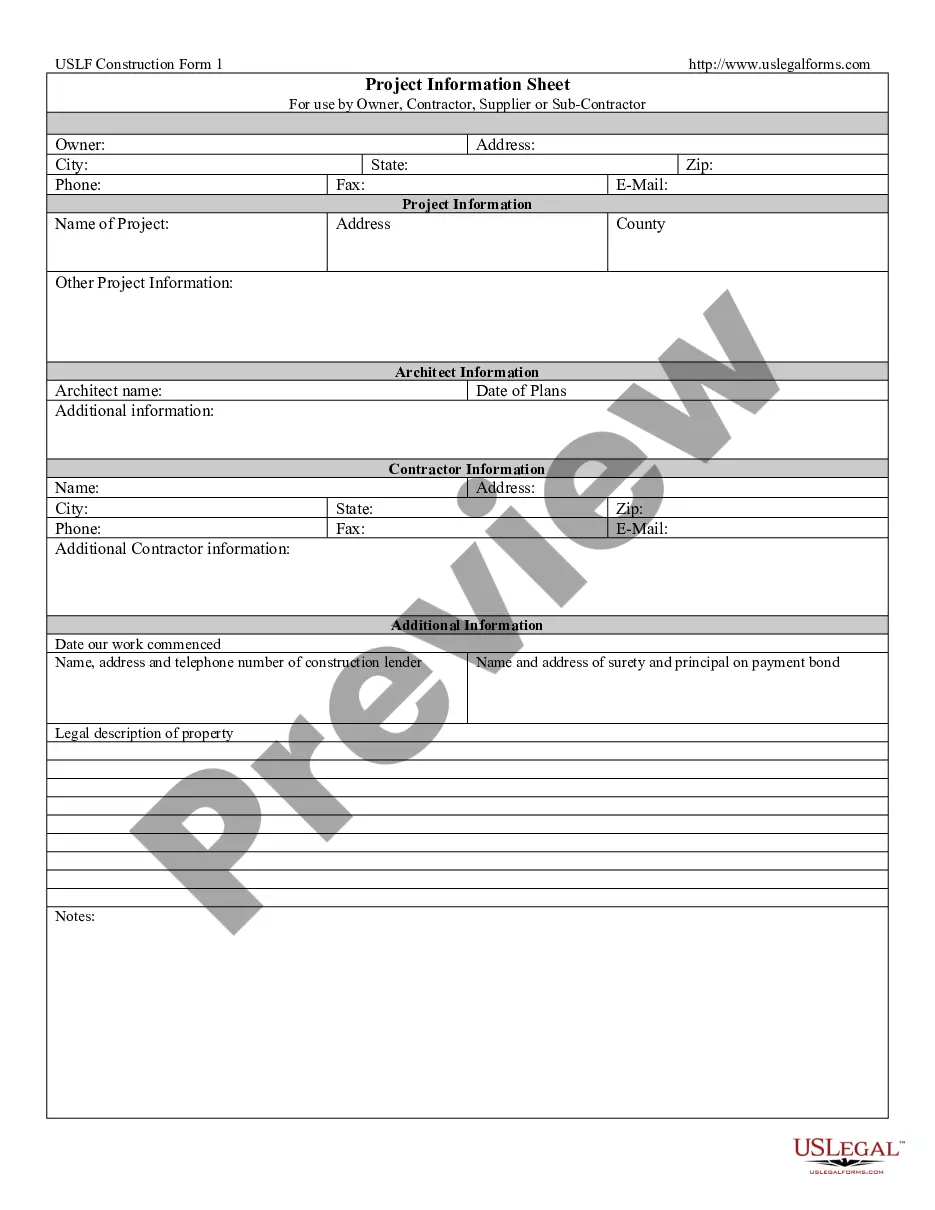
- Construction Project Information Sheet



Common use cases
This package is useful in various scenarios, such as:
- When starting a construction project involving drainage systems.
- When needing to create formal agreements with clients or subcontractors.
- When modifications to existing contracts are necessary.
- When documentation of project completion or safety standards is required.
- When tracking equipment usage and bids during the project lifecycle.
Who can use this document
- Drainage contractors operating in Wisconsin.
- Owners of properties undergoing drainage construction.
- Suppliers and subcontractors working on drainage-related projects.
- Legal professionals advising clients in the drainage construction field.
Steps to complete these forms
- Review the included forms to understand the necessary documentation.
- Identify all parties involved in the drainage construction project.
- Enter relevant dates, signatures, and other required information in the forms.
- Complete the Certificate of Completion to certify project work.
- Utilize the Change Order Sheet for any modifications to contracts.
- Keep track of equipment usage and submitted bids using the Weekly Equipment Summary and Bid Log.
Do forms in this package need to be notarized?
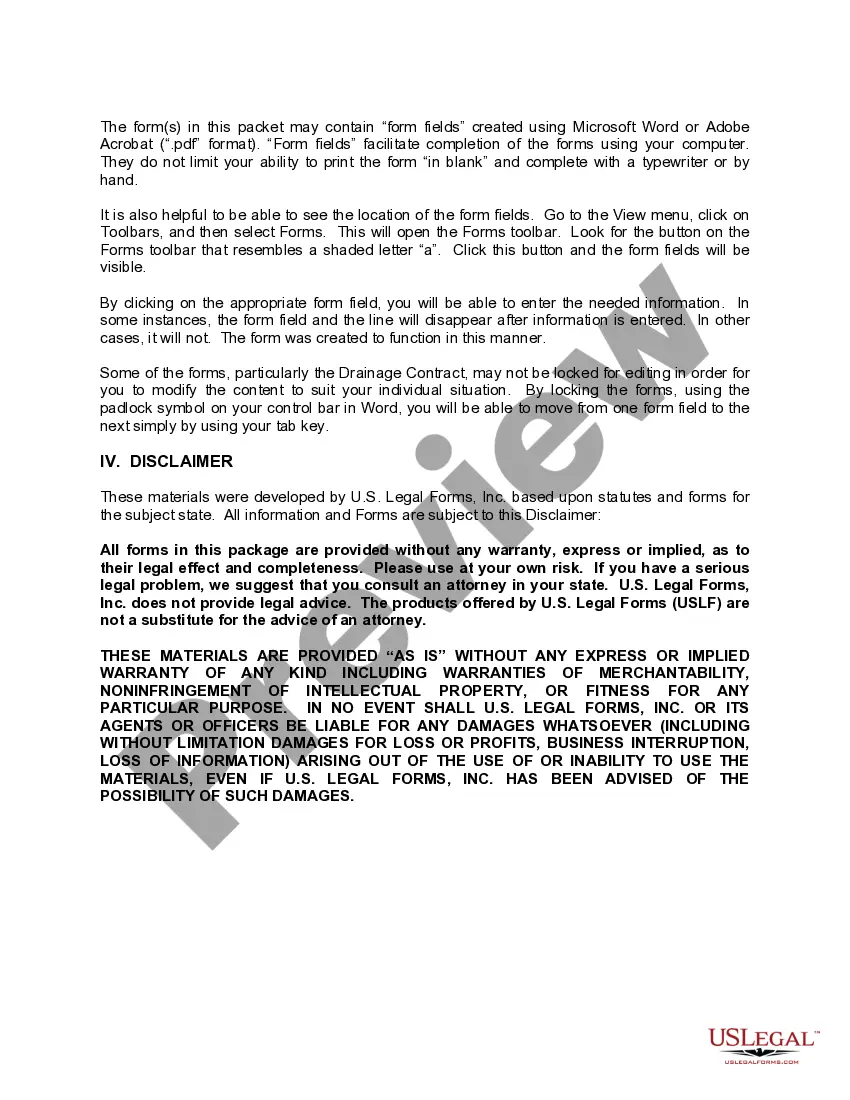
Forms in this package usually don’t need notarization, but certain jurisdictions or signing circumstances may require it. US Legal Forms provides a secure online notarization option powered by Notarize, accessible 24/7 from anywhere.
Get your form ready online
Our built-in tools help you complete, sign, share, and store your documents in one place.
Make edits, fill in missing information, and update formatting in US Legal Forms—just like you would in MS Word.
Download a copy, print it, send it by email, or mail it via USPS—whatever works best for your next step.
Sign and collect signatures with our SignNow integration. Send to multiple recipients, set reminders, and more. Go Premium to unlock E-Sign.
If this form requires notarization, complete it online through a secure video call—no need to meet a notary in person or wait for an appointment.
We protect your documents and personal data by following strict security and privacy standards.

Make edits, fill in missing information, and update formatting in US Legal Forms—just like you would in MS Word.

Download a copy, print it, send it by email, or mail it via USPS—whatever works best for your next step.

Sign and collect signatures with our SignNow integration. Send to multiple recipients, set reminders, and more. Go Premium to unlock E-Sign.

If this form requires notarization, complete it online through a secure video call—no need to meet a notary in person or wait for an appointment.

We protect your documents and personal data by following strict security and privacy standards.
Common mistakes to avoid
- Failing to complete all necessary forms before starting work.
- Not documenting changes using the Change Order Sheet.
- Omitting signatures or dates on contracts and completion certificates.
- Neglecting to track equipment usage and costs accurately.
Benefits of using this package online
- Immediate access to all necessary forms tailored for drainage contractors.
- Editable documents that can be customized according to specific project needs.
- Cost savings of over 50% compared to purchasing individual forms separately.
- Convenience of downloading forms instantly from anywhere.
Looking for another form?

Form popularity
FAQ
The average cost to install a drainage system in yard is $8 to $15 per linear foot or between $1,200 and $8,000, depending on the lawn size. A sub-surface system of yard drainage pipes are connected to drop inlets or catch basins where water runoff is distributed by emitters.
Total Cost: $25 to $55 per ft Subfloor drainage systems are a professionally installed basement waterproofing channel that is very effective, but will cost several thousands of dollar.
Corrugated and PVC slotted subsurface pipes. mole drainage (including mole drains, mole drains over collector pipe systems and gravel mole drains) interceptor drains. ground water pumps.
Reduce Your Watering Schedule. Extend Your Downspout. Dig a Creek Bed or Swale. Construct a Rain Garden. Install a French Drain and/or Dry Well.
Drains are more than a series of pipes that drain wastewater.Drains depend on gravity to push down waste from the house downwards through the pipes to the septic tank. Drains are constituted of various components such as vents, traps and cleanouts which work harmoniously to ensure a smooth flow of waste.
Look for landscapers who specialize in new lawn creation, ground leveling, and drainage management as they are best suited for such a project.
Installing drainage runs most homeowners between $1,896 and $5,537 with an average cost of $3,714. Small, simpler solutions could be as low as $800 and more complicated projects could get as expensive as $8,000.
An installed septic tank could cost you £1,500 to A£2,000 (A£600 for the unit) and a proprietary treatment plant, which needs an electrical supply and has moving parts, will be closer to A£4,500 (A£3,000 for just the unit). Both require emptying usually twice a year at about A£100 a time.
A catch basin has a grate on top and a drainage pipe that slopes away from the basin. This box is set into the ground at a low point on the property. Catch basins help maintain proper drainage and catch debris, which helps prevent pipes downstream from becoming clogged. Water and solids enter the box through the grate.