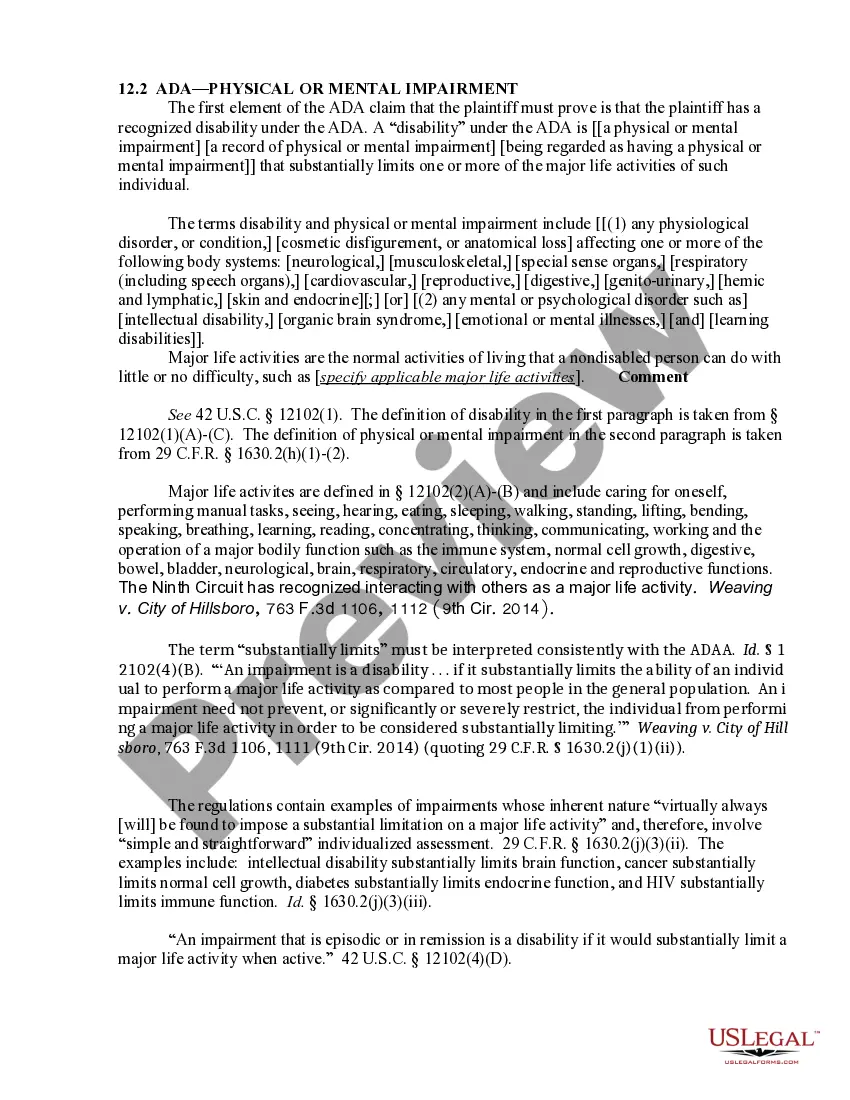
Vermont Construction or Mechanics Lien Package - Corporation or LLC
Overview of this form package
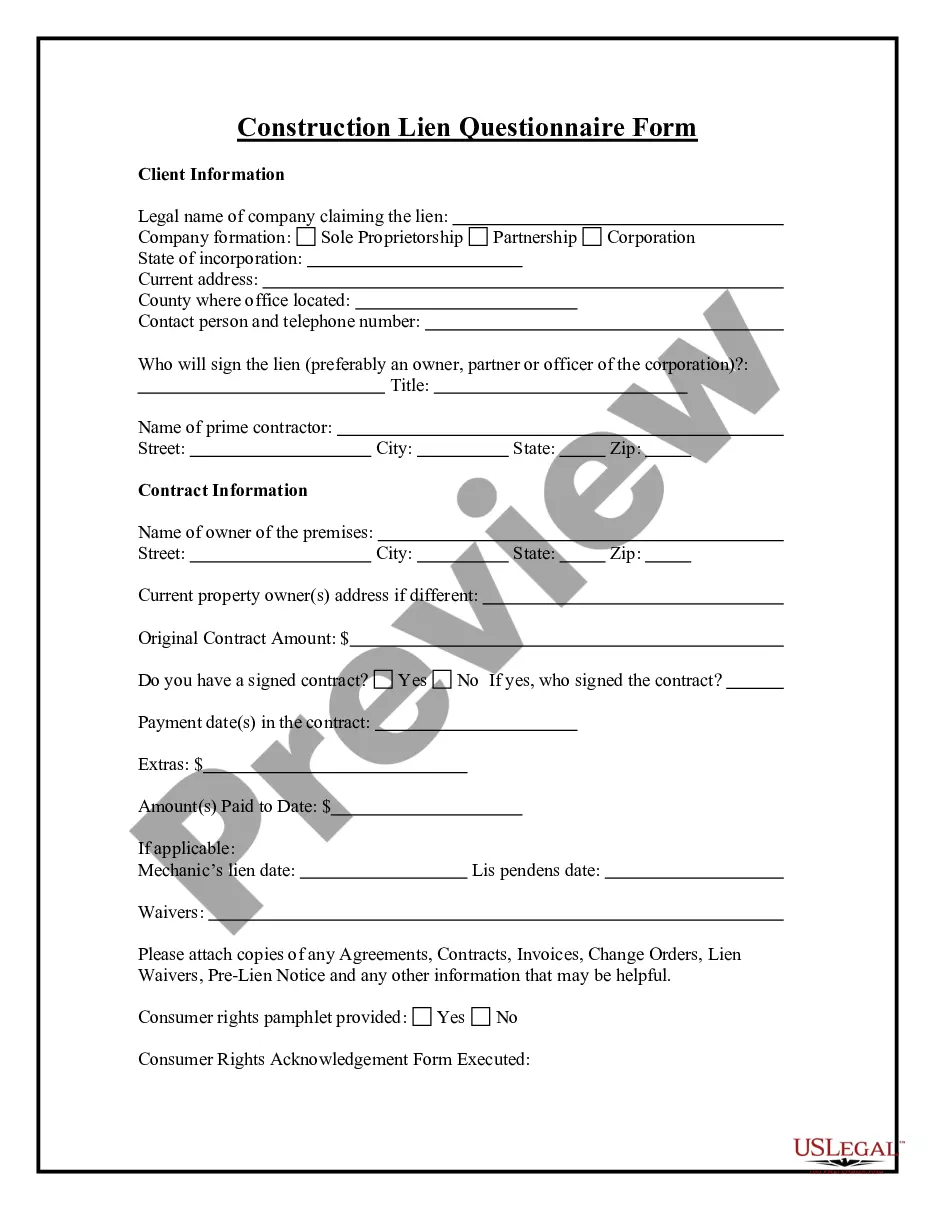
The Vermont Construction or Mechanics Lien Package is specifically crafted for corporations or limited liability companies that provide labor, materials, or services to improve real property. Its primary purpose is to assist these entities in recovering unpaid amounts through a lien placed on the enhanced property. This package differs from similar options by focusing exclusively on the needs of corporate and LLC lienors and includes comprehensive resources to navigate the construction lien process in Vermont.
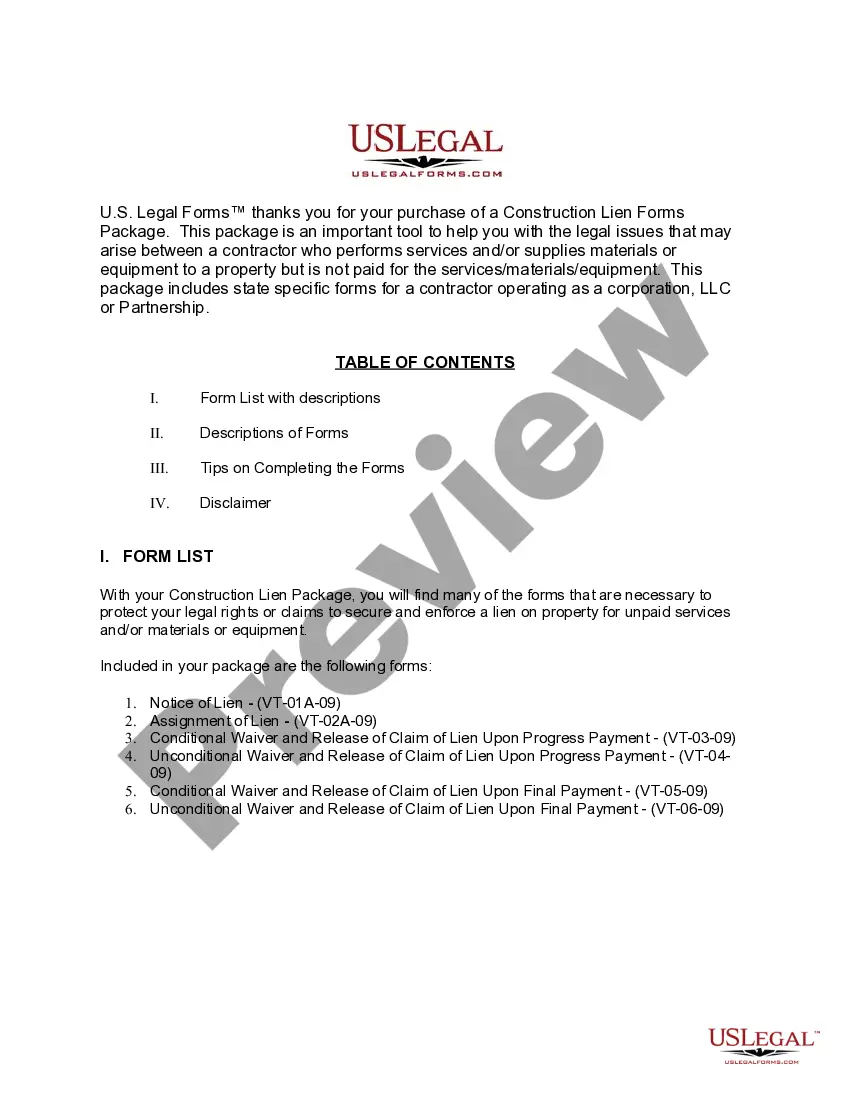
Forms you’ll find in this package
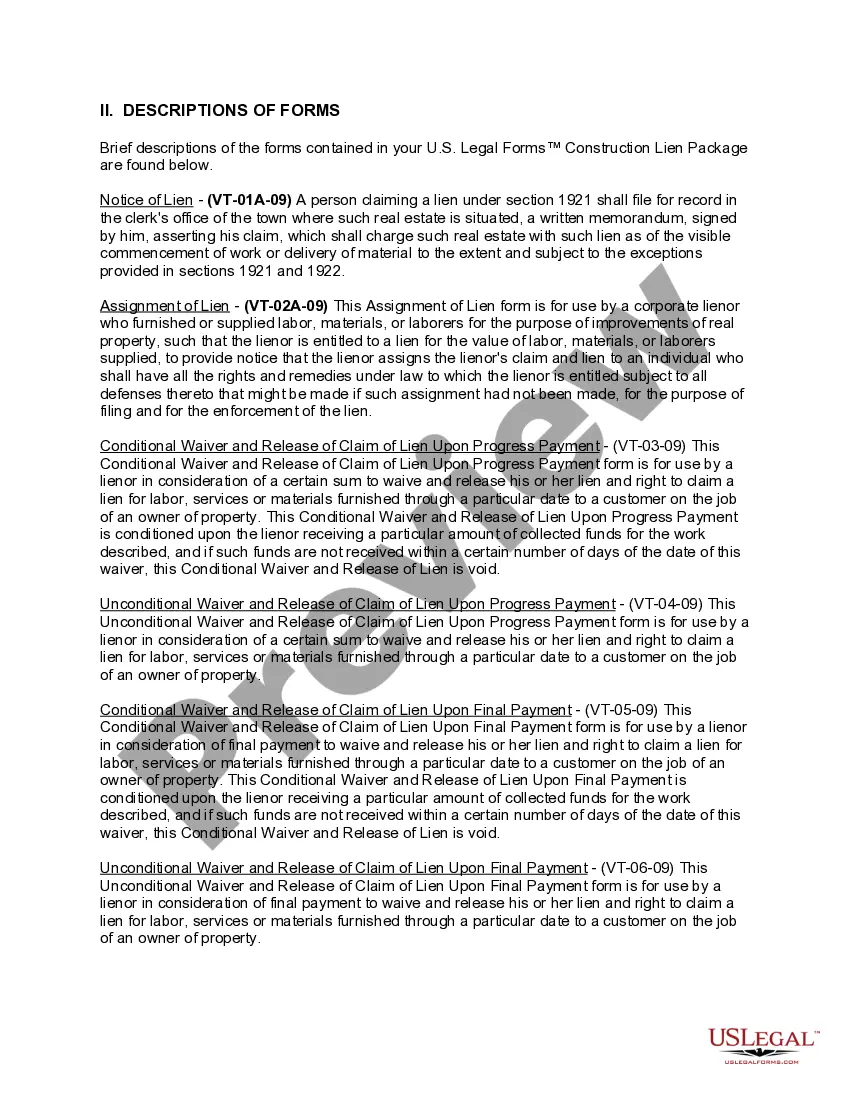
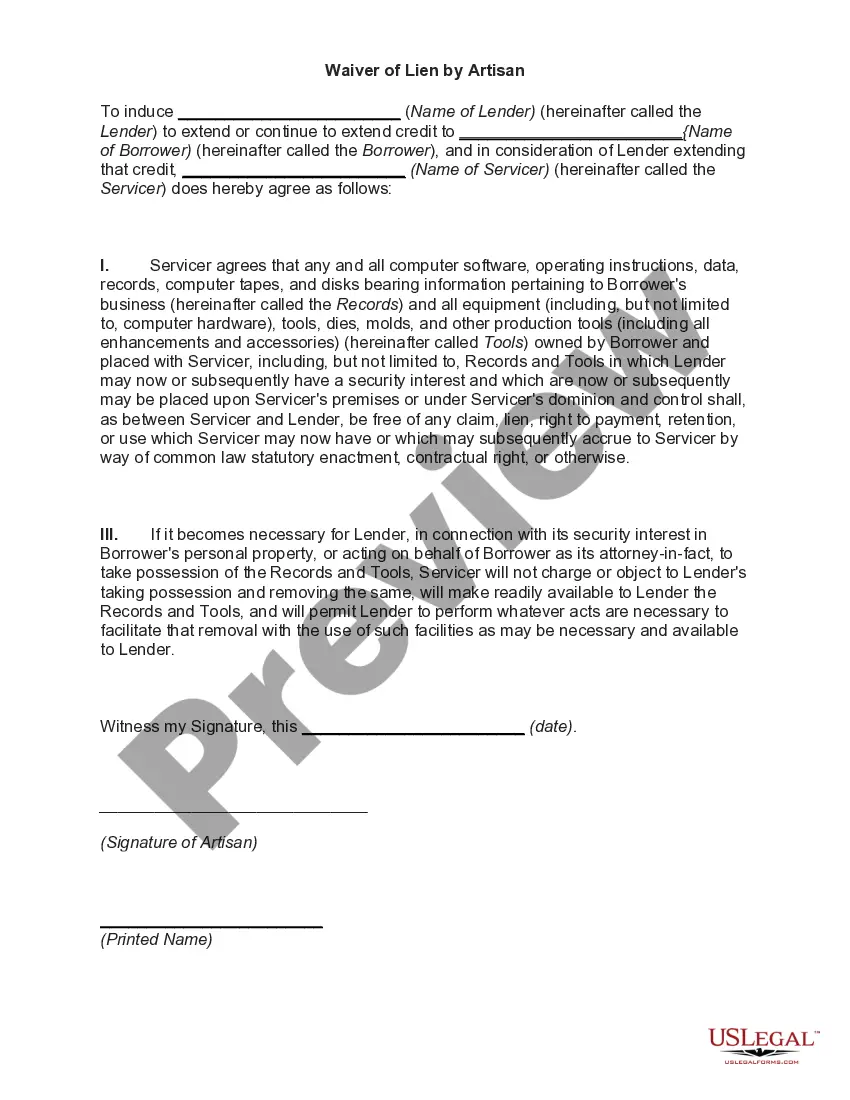
- Notice of Lien by Corporation
- Assignment of Lien - Corporation
- Conditional Waiver and Release of Claim of Lien Upon Progress Payment
- Unconditional Waiver and Release of Claim of Lien Upon Progress Payment
- Conditional Waiver and Release of Claim of Lien Upon Final Payment
- Unconditional Waiver and Release of Claim of Lien Upon Final Payment
When to use this document
This form package is particularly useful in situations where a corporation or LLC has completed work or supplied goods for property improvement but has not received payment. You should consider using this package when:
- You have provided labor or materials for a construction project.
- You need to enforce a lien to secure payment for services rendered.
- Negotiations with the property owner have failed to yield results.
Who can use this document
- Corporations involved in construction or property improvement.
- Limited liability companies (LLCs) supplying services or materials.
- Partnerships in the construction industry seeking legal remedies.
Instructions for completing these forms
- Review the included forms to familiarize yourself with their contents.
- Identify the necessary information such as dates, parties involved, and amounts owed.
- Complete the forms using the editable fields in your preferred digital format or print and fill them out manually.
- Ensure to sign where required and attach any necessary documentation.
- Submit the completed forms to the appropriate authority in Vermont.
Do forms in this package need to be notarized?
Notarization is not commonly needed for forms in this package. However, if your state’s laws require it, our notarization service, powered by Notarize, allows you to finalize documents online 24/7 without in-person visits.
Get your form ready online
Our built-in tools help you complete, sign, share, and store your documents in one place.
Make edits, fill in missing information, and update formatting in US Legal Forms—just like you would in MS Word.
Download a copy, print it, send it by email, or mail it via USPS—whatever works best for your next step.
Sign and collect signatures with our SignNow integration. Send to multiple recipients, set reminders, and more. Go Premium to unlock E-Sign.
If this form requires notarization, complete it online through a secure video call—no need to meet a notary in person or wait for an appointment.
We protect your documents and personal data by following strict security and privacy standards.

Make edits, fill in missing information, and update formatting in US Legal Forms—just like you would in MS Word.

Download a copy, print it, send it by email, or mail it via USPS—whatever works best for your next step.

Sign and collect signatures with our SignNow integration. Send to multiple recipients, set reminders, and more. Go Premium to unlock E-Sign.

If this form requires notarization, complete it online through a secure video call—no need to meet a notary in person or wait for an appointment.

We protect your documents and personal data by following strict security and privacy standards.
Typical mistakes to avoid
- Failing to fill out all required fields on the forms.
- Not providing the correct information about the project or payments.
- Submitting forms after the deadline for liens has passed.
- Neglecting to keep copies of submitted documents for your records.
Benefits of using this package online
- Convenience of downloading and filling out legal forms at your own pace.
- Editability allows for easy adjustments without starting over.
- Reliability as the forms are drafted by licensed attorneys to ensure compliance with legal standards.
Legal use & context
- Mechanics liens are enforceable in Vermont, providing a legal remedy for unpaid contractors.
- The use of these forms helps establish a formal claim against the property for owed amounts.
- Failure to comply with filing procedures could affect enforceability.
Looking for another form?


Form popularity
FAQ
In short, consensual liens do not adversely affect your credit as long as repayment terms are satisfied. Statutory and judgment liens have a negative impact on your credit score and report, and they impact your ability to obtain financing in the future.
Fill out the appropriate mechanics lien form. (Lien form for Original Contractors Lien form for Subcontractors & Suppliers) Deliver your lien form to the county recorder office. Serve your lien on the property owner.
In California, mechanic's liens must be recorded within the earlier of: (1) 90 days from when the entire project is completed or abandoned; or (2) 60 days from when a Notice of Completion or Notice of Abandonment / Cessation is filed. The filing fee to record your lien will be between $95 - $125.
The simplest way to prevent liens and ensure that subcontractors and suppliers are paid is to pay with joint checks. This is when both parties endorse the check. Compare the contractor's materials or labor bill to the schedule of payments in your contract and the Preliminary Notices.
Generally speaking, lien priority is determined according to the date of recordation or the date in which the lien was filed. This means that the ranking of which lienors get to receive payment first is established based on which liens were recorded the earliest. This is also known as first in time, first in right.
Determine If You and Your Services Are Eligible To File A Mechanic's Lien. Deliver 20-Day Preliminary Notice If You Did Not Contract With The Property Owner. Prepare Your Mechanic's Lien Document. Deliver Your Mechanic's Lien to the Property Owner. Timely File Your Lien With the Recorder's Office.
A contractor's lien (often known as a mechanic's lien, or a construction lien) is a claim made by contractors or subcontractors who have performed work on a property, and have not yet been paid.After all, contractors would rather work out a deal than go through the hassle of filing a lien against your property.
A construction lien is a claim made against a property by a contractor or subcontractor who has not been paid for work done on that property.A construction lien makes it difficult or impossible to sell or refinance a property because it makes its title unclear.
In Vermont, a Notice of Mechanics Lien must be filed with the clerk of the town in which the property is located no later than 180 days from the date on which payment became due for the last labor and/or materials furnished to the project.