Vermont Construction or Mechanics Lien Package - Individual
Understanding this form package
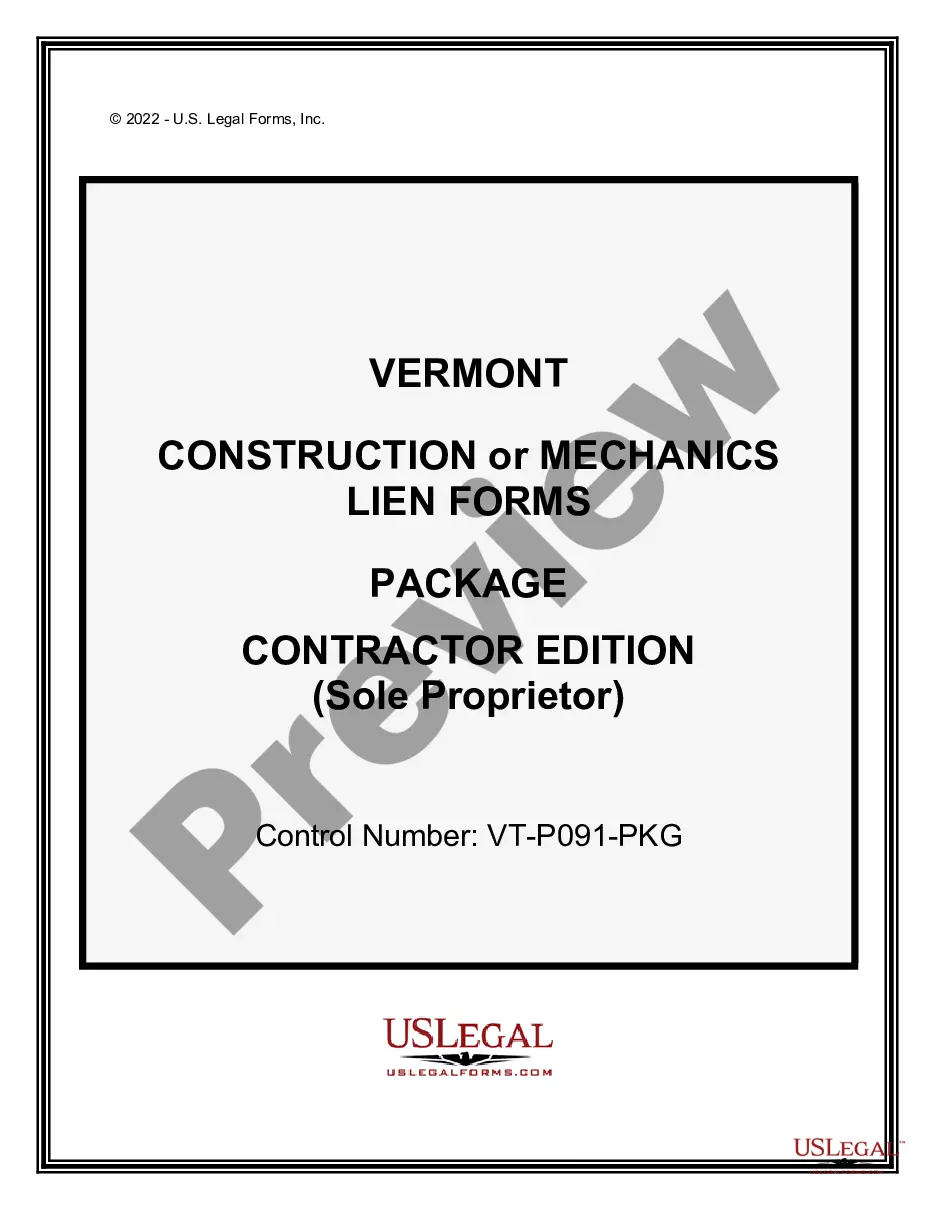
The Vermont Construction or Mechanics Lien Package - Individual is a comprehensive set of legal forms designed specifically for sole proprietors who provide labor, materials, or services to improve real property. This package aids in securing payment through a lien on improved properties, ensuring that contractors can recover money owed for their work. Unlike other packages, this one does not include forms for property owners and focuses exclusively on the needs of individual contractors.
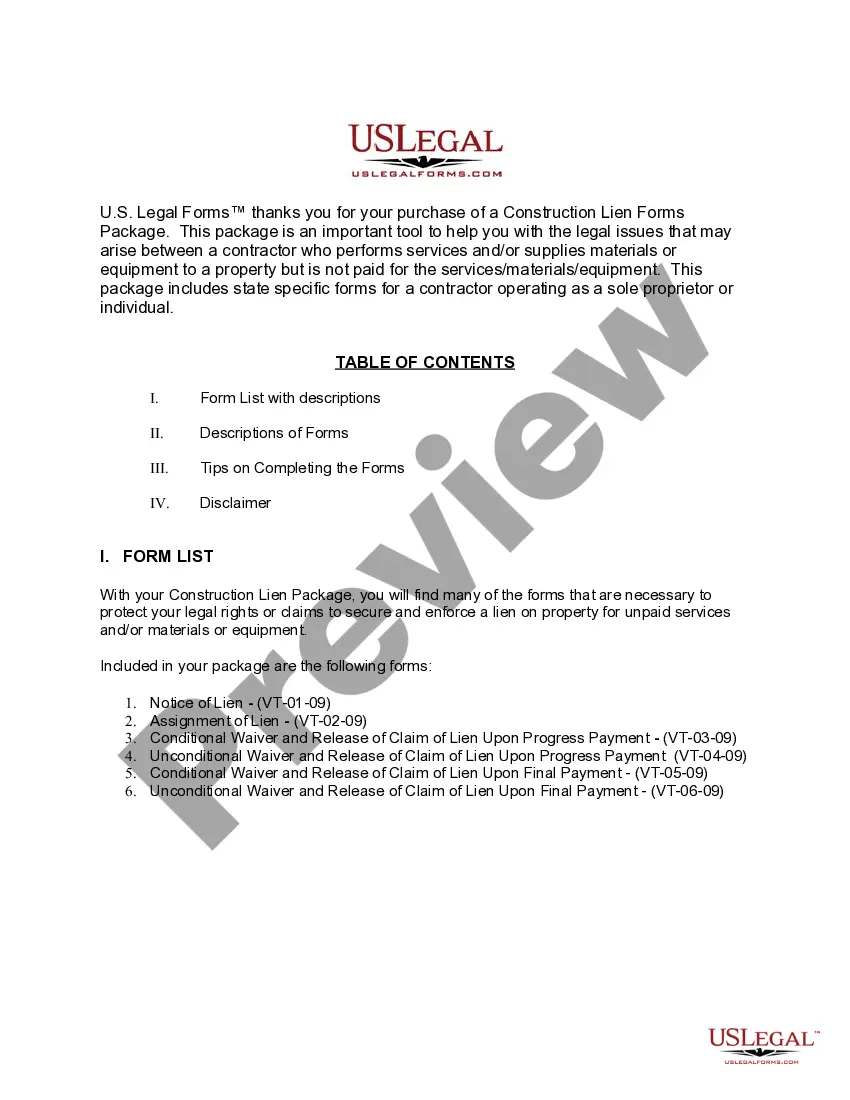
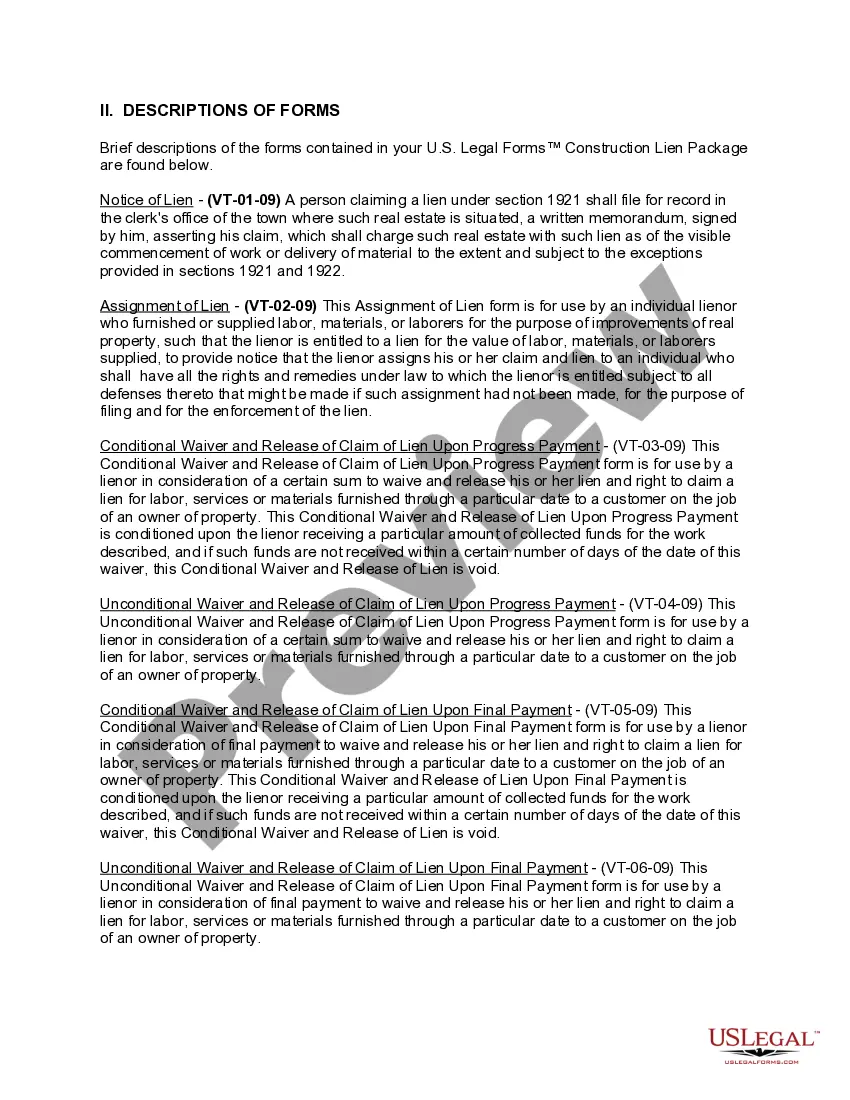
Forms you’ll find in this package
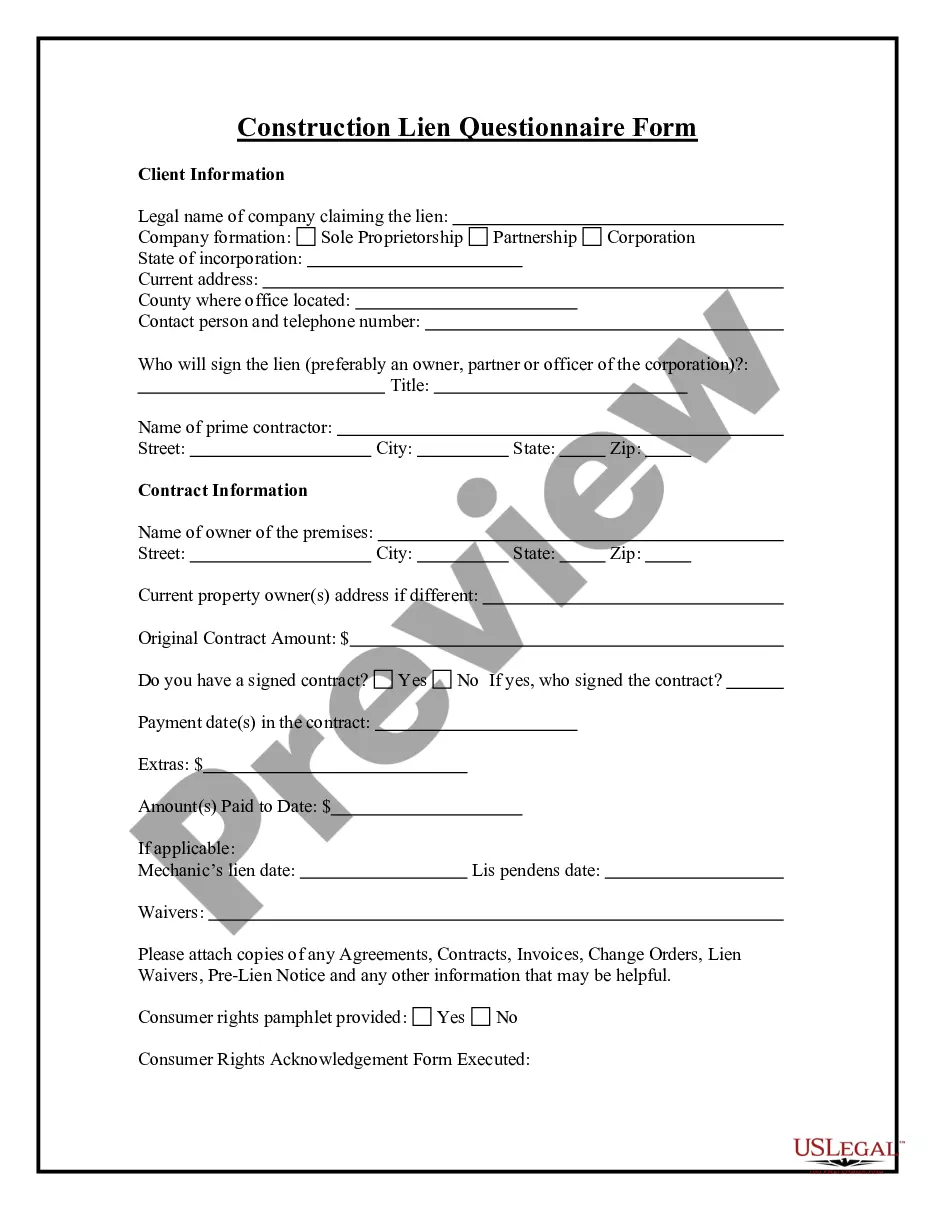
- Notice of Lien by Individual
- Assignment of Lien - Individual
- Conditional Waiver and Release of Claim of Lien Upon Progress Payment
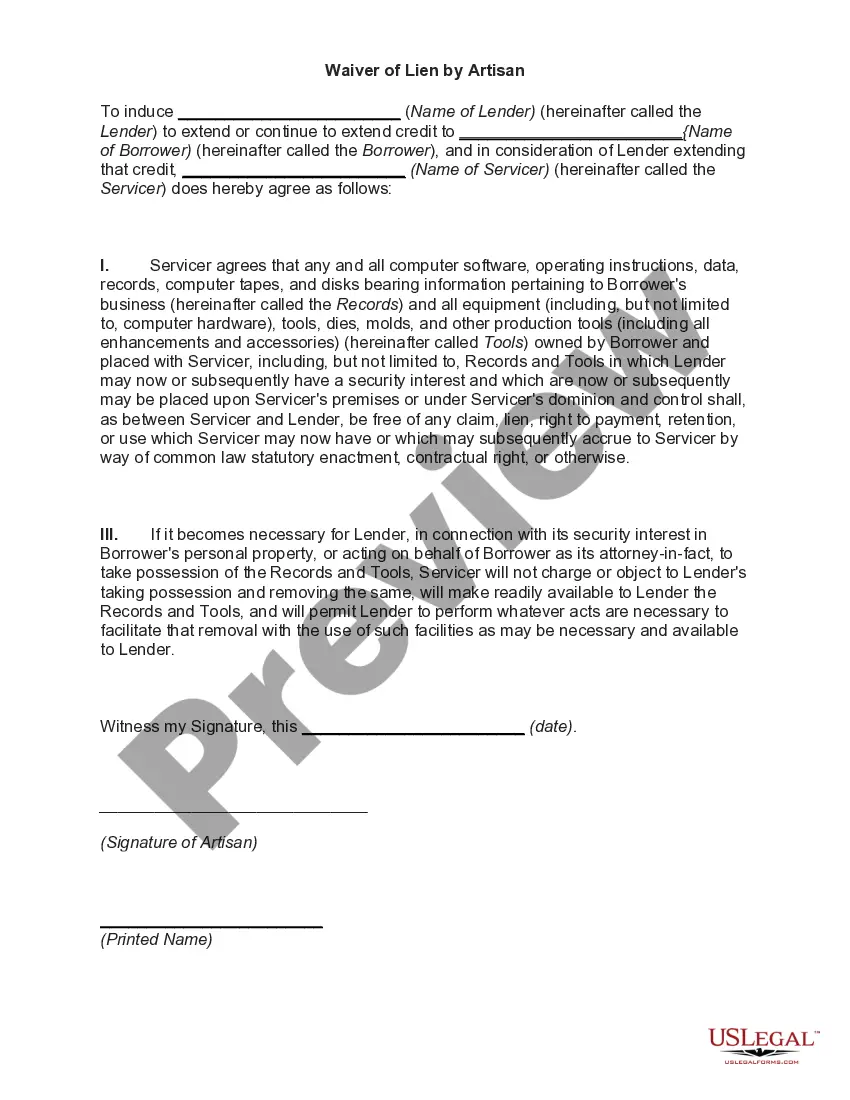
- Unconditional Waiver and Release of Claim of Lien Upon Progress Payment
- Conditional Waiver and Release of Claim of Lien Upon Final Payment
- Unconditional Waiver and Release of Claim of Lien Upon Final Payment
When to use this form package
This form package is essential in various scenarios, including:
- When a contractor has not received payment for work completed on a property.
- If you want to assert a lien on a property to protect your right to claim unpaid wages.
- When entering into new contracts and wanting to ensure payment is secured for future work.
Who should use this form package
- Sole proprietors providing labor or services to improve real property.
- Contractors who supply materials or perform construction work.
- Individuals looking to ensure they receive payment for services rendered.
How to prepare this document
- Review the included forms to understand your options and obligations.
- Identify the parties involved, including yourself and the property owner.
- Enter the necessary details in the form fields, such as dates and amounts owed.
- Follow the tips provided in the package to complete forms efficiently.
- File the completed forms according to Vermont state requirements.
Notarization guidance for this package
Notarization is generally not required for forms in this package. However, specific circumstances or local laws may require it. You can complete notarization remotely through US Legal Forms, powered by Notarize, with 24/7 availability.
Get your form ready online
Our built-in tools help you complete, sign, share, and store your documents in one place.
Make edits, fill in missing information, and update formatting in US Legal Forms—just like you would in MS Word.
Download a copy, print it, send it by email, or mail it via USPS—whatever works best for your next step.
Sign and collect signatures with our SignNow integration. Send to multiple recipients, set reminders, and more. Go Premium to unlock E-Sign.
If this form requires notarization, complete it online through a secure video call—no need to meet a notary in person or wait for an appointment.
We protect your documents and personal data by following strict security and privacy standards.

Make edits, fill in missing information, and update formatting in US Legal Forms—just like you would in MS Word.

Download a copy, print it, send it by email, or mail it via USPS—whatever works best for your next step.

Sign and collect signatures with our SignNow integration. Send to multiple recipients, set reminders, and more. Go Premium to unlock E-Sign.

If this form requires notarization, complete it online through a secure video call—no need to meet a notary in person or wait for an appointment.

We protect your documents and personal data by following strict security and privacy standards.
Mistakes to watch out for
- Failing to provide accurate property descriptions.
- Not signing the forms where required.
- Neglecting to send the notices by the deadlines.
Advantages of online completion
- Accessible and easy to download from any device.
- Edit forms directly on your computer for convenience.
- Reliable, attorney-drafted content tailored to your needs.
Legal use & context
- Construction liens are legally enforceable claims against a property for unpaid work.
- Filing a lien protects your right to payment and may prompt quicker payment from property owners.
- It's essential to meet all deadlines for filing and serving notices to maintain the validity of your lien rights.
Looking for another form?

Form popularity
FAQ
Be sure to include the following pieces of information in your lien: The name, company name and address (including county) of the property owner against whom your lien is filed; the same information about the delinquent client, if different; the beginning and ending dates of the unpaid service; the due date for payment
Who you are. The services or materials you provided. The last date you provided the services or materials. How much payment should be. The date on which you will file a lien if you do not receive payment. How the debtor should pay.
There, a construction lien on a commercial project must be filed with a county clerk within 90 days of the last day services or materials were provided. Filing a construction lien on residential projects requires filing a Notice of Unpaid Balance and Right to File Lien within 90 days of the last day of service.
The short answer to that question is usually no. If somebody owes you money you could sue them, you could obtain a judgment, you can obtain what's called a "judgment lien" and once you get the judgment lien, you can have the court record that against their property including the real estate.
In Vermont, a Notice of Mechanics Lien must be filed with the clerk of the town in which the property is located no later than 180 days from the date on which payment became due for the last labor and/or materials furnished to the project.
The simplest way to prevent liens and ensure that subcontractors and suppliers are paid is to pay with joint checks. This is when both parties endorse the check. Compare the contractor's materials or labor bill to the schedule of payments in your contract and the Preliminary Notices.
Who you are. The services or materials you provided. The last date you provided the services or materials. How much payment should be. The date on which you will file a lien if you do not receive payment. How the debtor should pay.
While it's unlikely that just anyone can put a lien on your home or land, it's not unheard of for a court decision or a settlement to result in a lien being placed against a property.
Filing a construction lien on residential projects requires filing a Notice of Unpaid Balance and Right to File Lien within 90 days of the last day of service. The homeowner must also get a copy of that notice within 10 days of its filing.