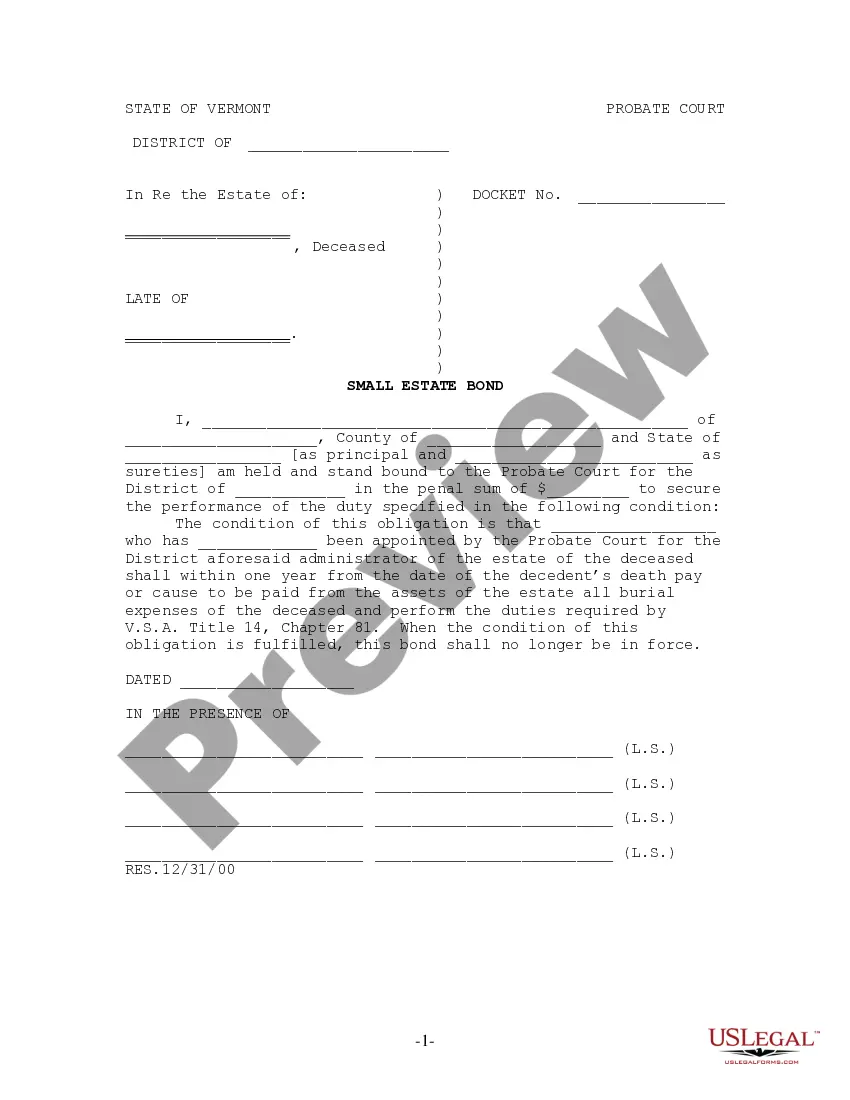
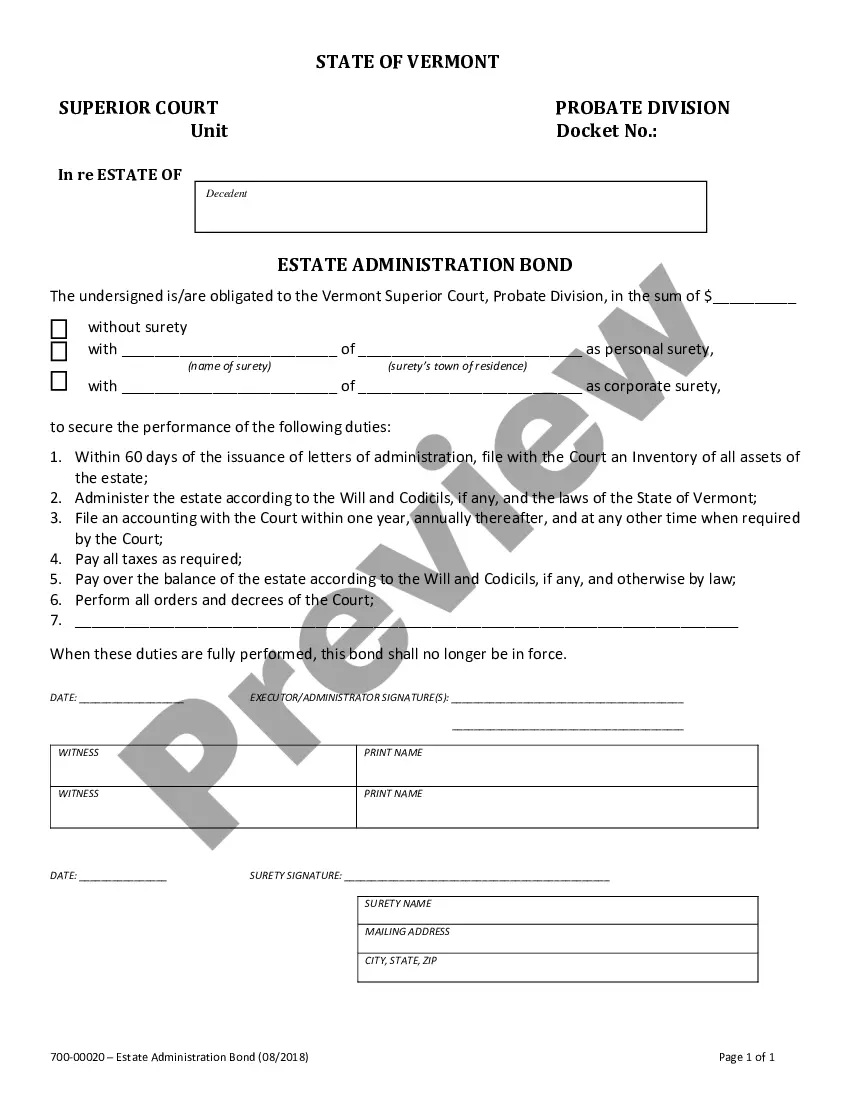
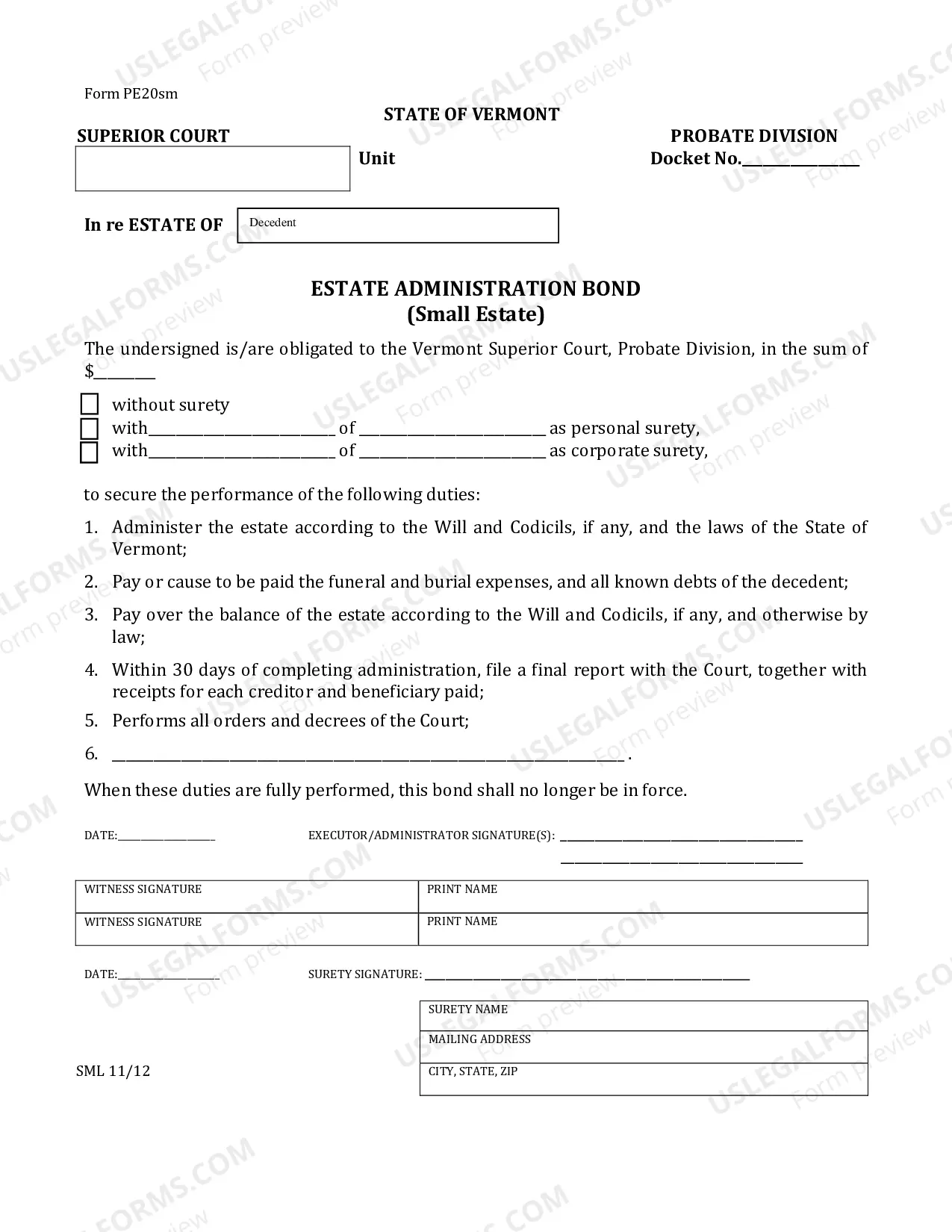
This form is used by the adminstrator or executive of a small estate to post the required bond with the court. This is one of over 150 Official Probate forms for the state of Vermont.
Vermont Small Estate Bond for Administrators and Executors
State:
Vermont
Category:
Control #:
VT-020B-P
Format:
Word;
PDF;
Rich Text
Instant download
This website is not affiliated with any governmental entity
Public form
Description
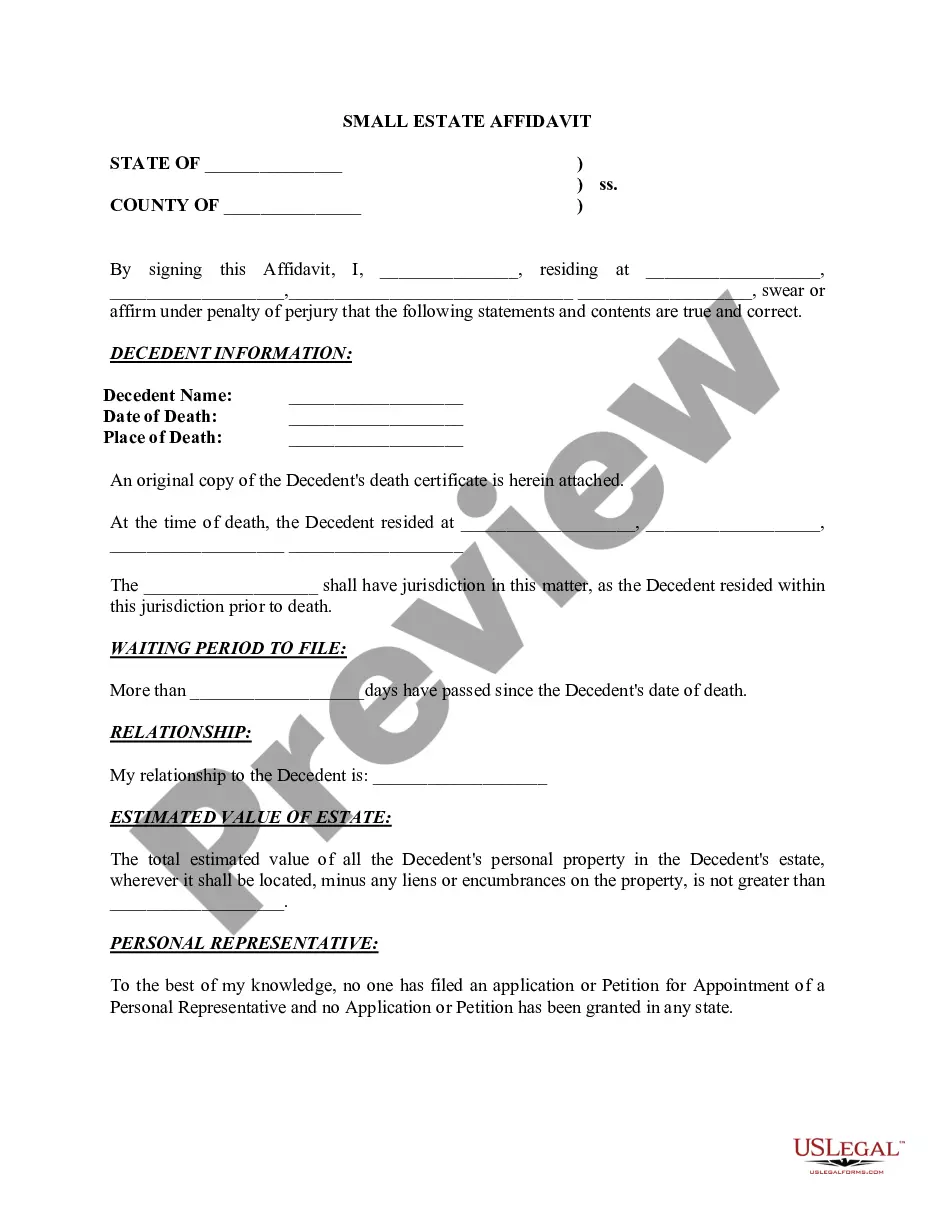
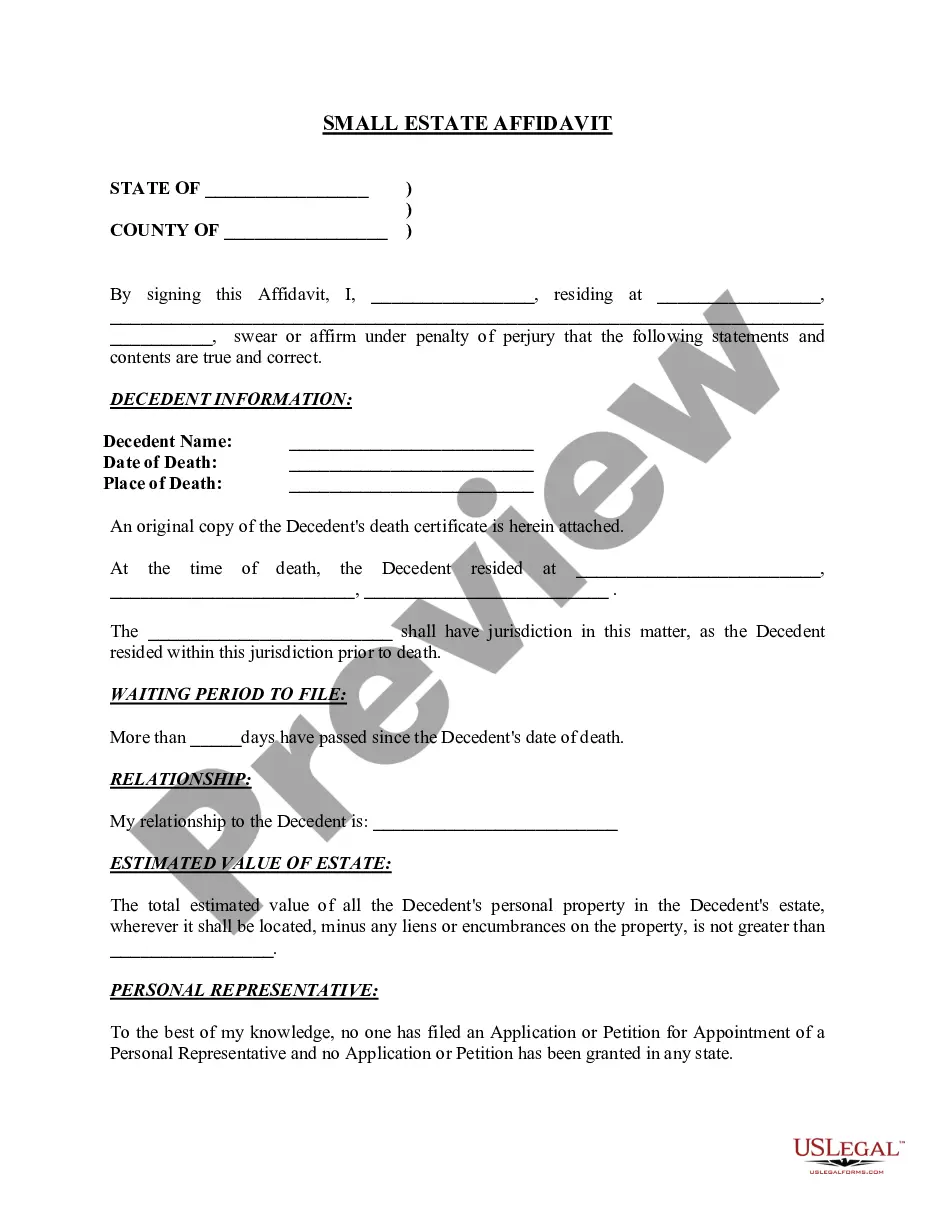
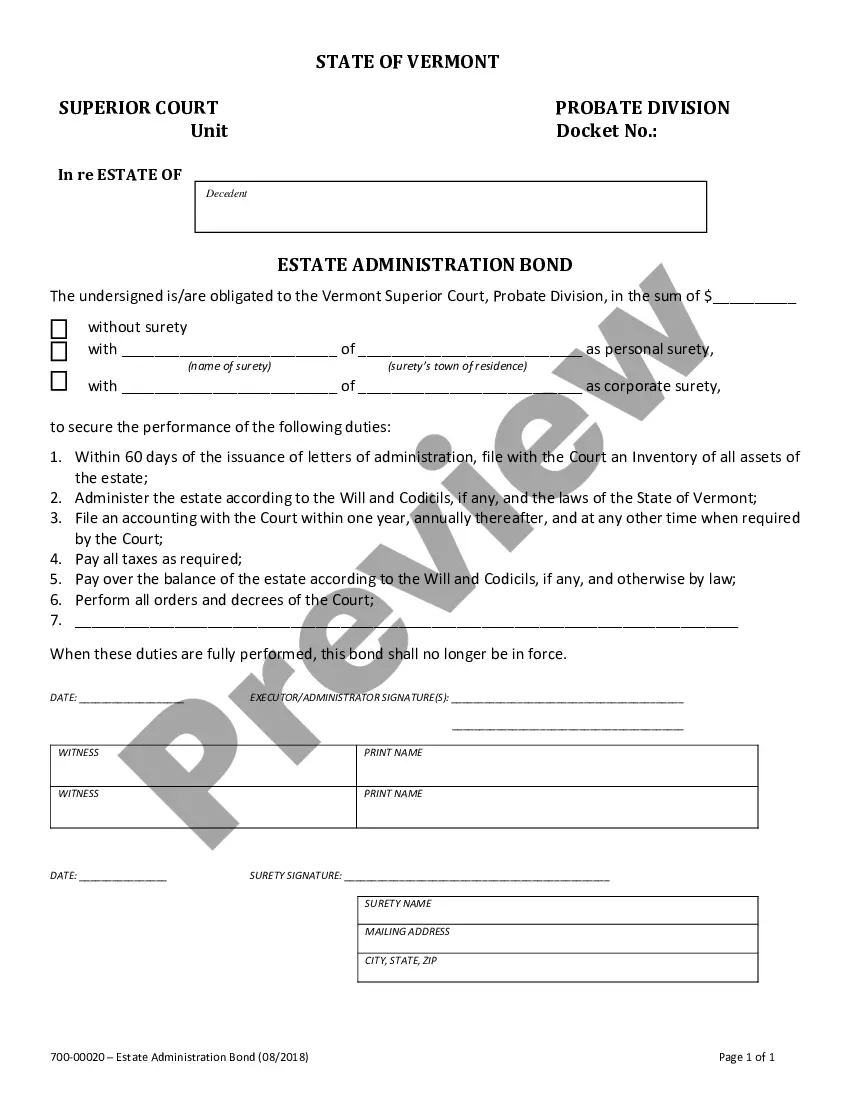
Get your form ready online
Our built-in tools help you complete, sign, share, and store your documents in one place.
Built-in online Word editor
Make edits, fill in missing information, and update formatting in US Legal Forms—just like you would in MS Word.
Export easily
Download a copy, print it, send it by email, or mail it via USPS—whatever works best for your next step.
E-sign your document
Sign and collect signatures with our SignNow integration. Send to multiple recipients, set reminders, and more. Go Premium to unlock E-Sign.
Notarize online 24/7
If this form requires notarization, complete it online through a secure video call—no need to meet a notary in person or wait for an appointment.
Store your document securely
We protect your documents and personal data by following strict security and privacy standards.

Make edits, fill in missing information, and update formatting in US Legal Forms—just like you would in MS Word.

Download a copy, print it, send it by email, or mail it via USPS—whatever works best for your next step.

Sign and collect signatures with our SignNow integration. Send to multiple recipients, set reminders, and more. Go Premium to unlock E-Sign.

If this form requires notarization, complete it online through a secure video call—no need to meet a notary in person or wait for an appointment.

We protect your documents and personal data by following strict security and privacy standards.
Looking for another form?
How to fill out Vermont Small Estate Bond For Administrators And Executors?
Looking for a Vermont Small Estate Bond for Administrators and Executors on the internet might be stressful. All too often, you find documents that you just think are ok to use, but discover later on they’re not. US Legal Forms provides more than 85,000 state-specific legal and tax forms drafted by professional attorneys according to state requirements. Have any document you’re searching for within a few minutes, hassle free.
If you already have the US Legal Forms subscription, merely log in and download the sample. It’ll instantly be included in your My Forms section. If you do not have an account, you should sign-up and choose a subscription plan first.
Follow the step-by-step guidelines listed below to download Vermont Small Estate Bond for Administrators and Executors from our website:
- See the document description and hit Preview (if available) to check if the form suits your expectations or not.
- If the form is not what you need, find others with the help of Search engine or the provided recommendations.
- If it is right, simply click Buy Now.
- Choose a subscription plan and create an account.
- Pay via credit card or PayPal and download the template in a preferable format.
- Right after downloading it, you are able to fill it out, sign and print it.
Obtain access to 85,000 legal templates straight from our US Legal Forms catalogue. Besides professionally drafted templates, users will also be supported with step-by-step guidelines concerning how to find, download, and complete templates.
Form popularity
FAQ
An administration bond is a bond that is posted on behalf of an administrator of an estate to provide assurance that they will conduct their duties according to the provisions of the will and/or the legal requirements of the jurisdiction.
Estate bonds, also known as probate bonds, executor bonds, personal representative bonds, fiduciary bonds, and administrator bonds, are a type of court bond required by courts to protect the interests of an estate and its beneficiaries in accordance with applicable state law.
An Estate Bond moves a small amount of savings from a tax-exposed investment (that is, your non-registered retirement savings plan) to an exempt universal or a permanent whole life insurance policy.
The Executor is responsible for wrapping up the deceased person's affairs and distributing the assets to, or for the benefit of, the persons named in the will (beneficiaries). An Administrator is the person in charge of the estate when my someone dies without a Last Will and Testament.
No Problem. Administrator Bonds Guarantee Estate Distribution. When a decedent dies without a will, an administrator is appointed to administer an estate and the court requires that the administrator obtain an administration bond.
As an aside, Vermont Statute Title 32 § 1143 states that executors may be paid $4 per day spent in court, but this is geared towards the court paying appointed agents, and that amount was set in 1866.
The executor or administrator's job is to manage the deceased estate, pay all debts and distribute the assets according to the Will (or, if there is no Will, according to the law). It is their duty to safeguard the assets and look after the interests of the people who will ultimately receive them (the beneficiaries).
An administrator will take title legally on the estate's assets, and has legal responsibility to file all tax returns and pay all related taxes.In certain cases, the administrator may have personal liability for any unpaid tax amounts due for the estate.
Under California Probate Code, the executor typically receives 4% on the first $100,000, 3% on the next $100,000 and 2% on the next $800,000, says William Sweeney, a California-based probate attorney. For an estate worth $600,000 the fee works out at approximately $15,000.