Virginia Homestead Deed for Single - Home
Understanding this form
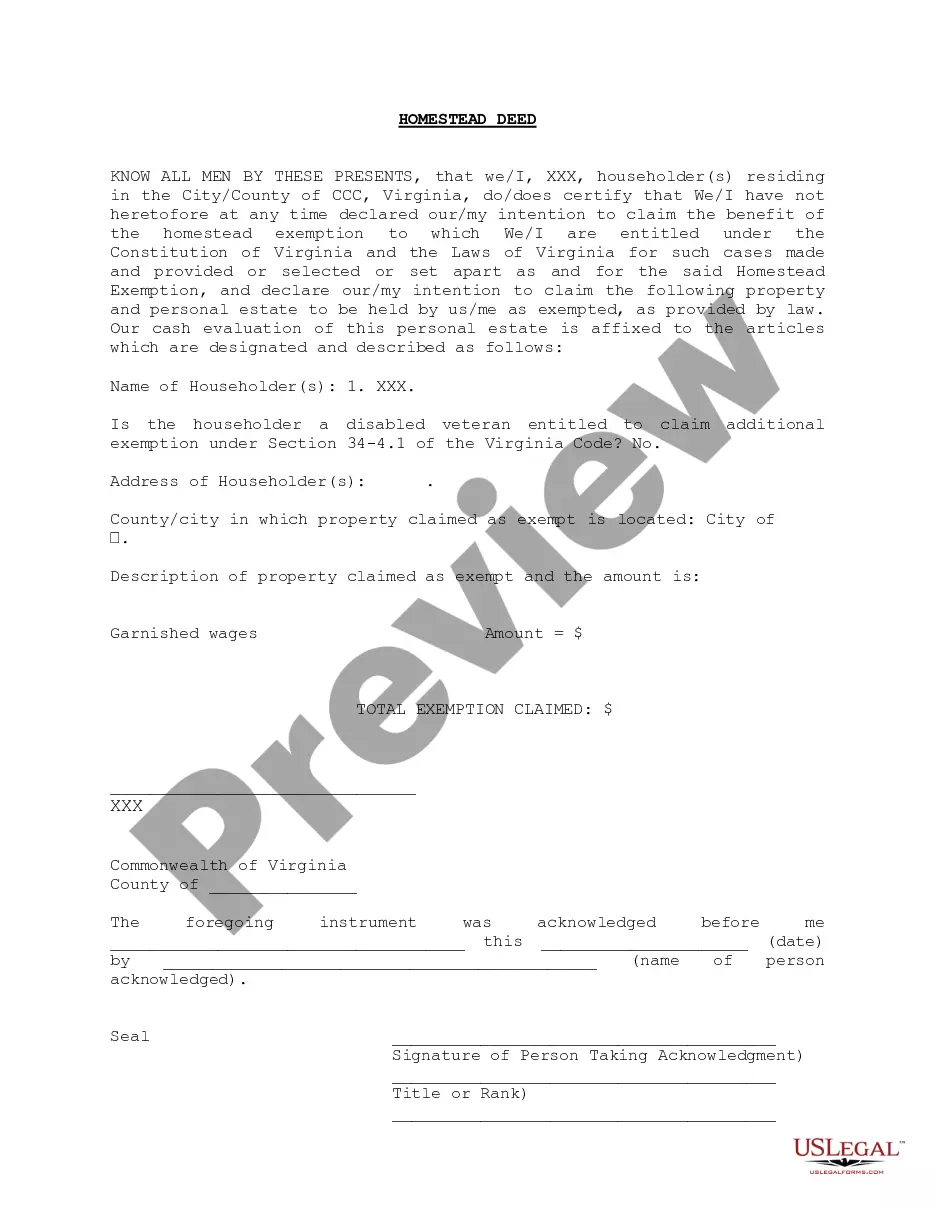
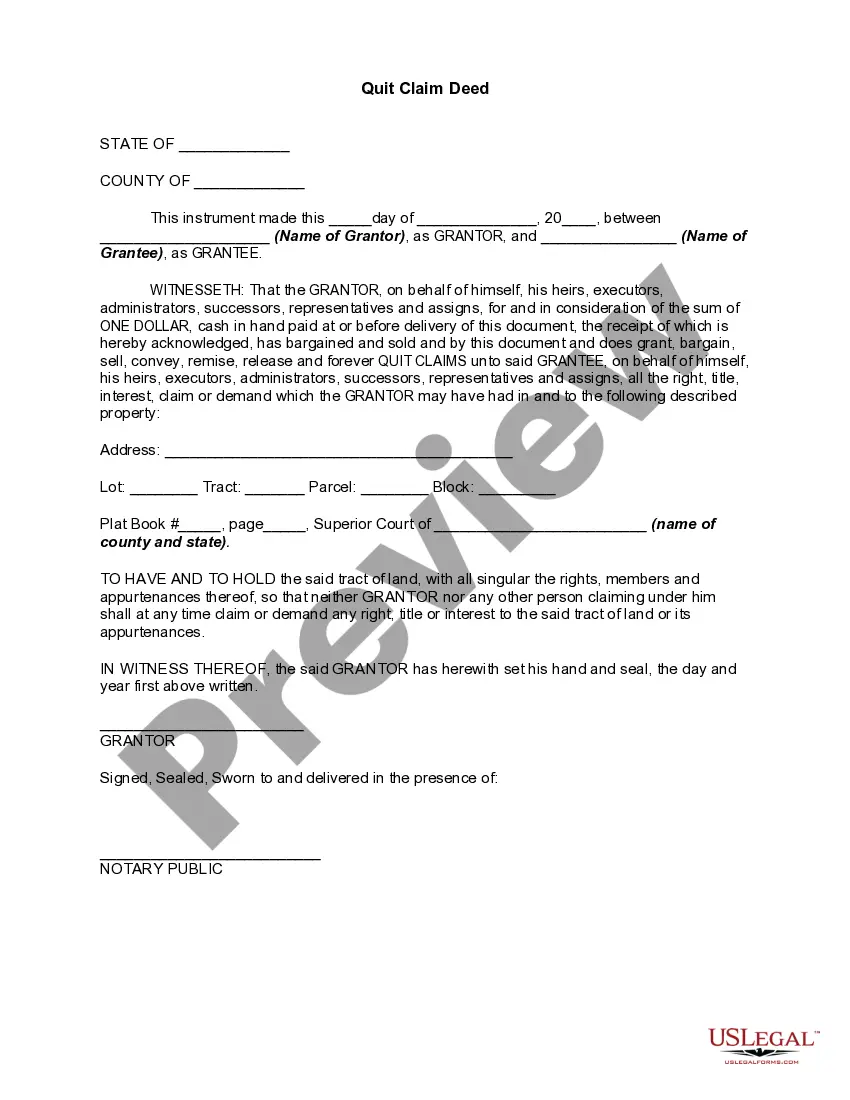
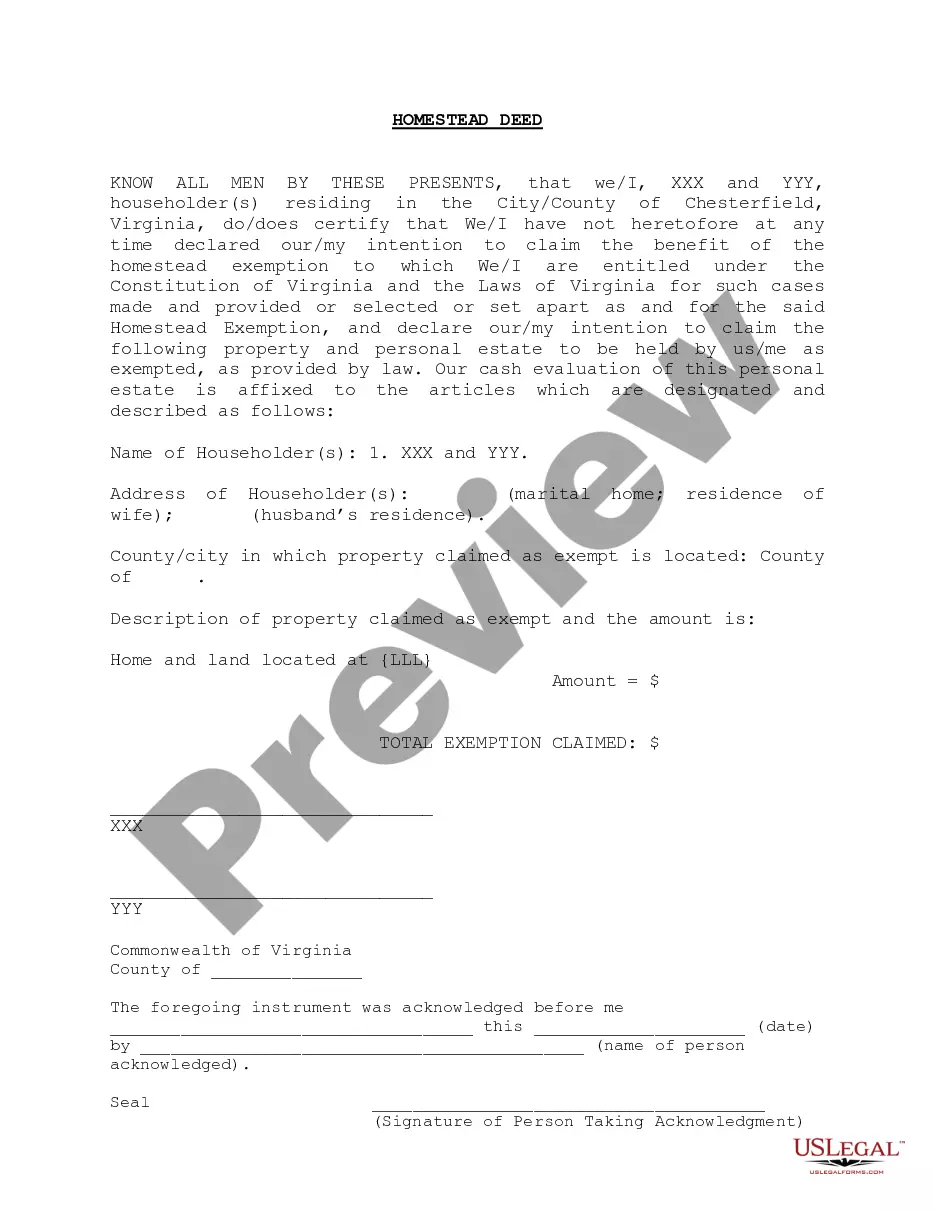
The Homestead Deed for Single - Home is a legal document used to claim a homestead exemption. This exemption allows individuals to protect a portion of their property's value from creditors, thereby reducing their tax liability. Unlike other types of deeds, this form focuses specifically on declaring a singular homestead exemption under Virginia law, making it a vital tool for homeowners seeking financial relief. It includes details about the property and the exempt value claimed.
Key parts of this document
- Declaration of intent to claim the homestead exemption
- Identification of the householder(s) and their residence
- Specification of the property being claimed
- Cash evaluation of the personal estate
- Notary public section for legal verification

When this form is needed
This form is used when an individual wants to officially declare their intention to claim a homestead exemption on their primary residence. It is beneficial for homeowners looking to reduce their taxable property value, especially those who have not previously filed for such an exemption. Situations may include recent home purchases, changes in residency, or applying for additional exemptions available to certain individuals, such as disabled veterans.
Intended users of this form
This form is intended for:
- Homeowners residing in Virginia
- Individuals who have not previously claimed a homestead exemption
- Those eligible for financial protection under the homestead exemption laws
- Disabled veterans seeking additional exemptions
How to complete this form
- Identify the householder(s) and enter their names and address.
- Declare your intent to claim the homestead exemption.
- Specify the property and personal estate you wish to exempt.
- Provide a cash evaluation amount of the personal estate.
- Ensure the form is notarized by a notary public.
Is notarization required?
Yes, this form must be notarized to be legally valid. You can use US Legal Formsâ integrated online notarization service for a secure and convenient experience. You can complete the notarization process via a video call, which is legally equivalent to in-person notarization, allowing you to finalize your documents without travel.
Get your form ready online
Our built-in tools help you complete, sign, share, and store your documents in one place.
Make edits, fill in missing information, and update formatting in US Legal Forms—just like you would in MS Word.
Download a copy, print it, send it by email, or mail it via USPS—whatever works best for your next step.
Sign and collect signatures with our SignNow integration. Send to multiple recipients, set reminders, and more. Go Premium to unlock E-Sign.
If this form requires notarization, complete it online through a secure video call—no need to meet a notary in person or wait for an appointment.
We protect your documents and personal data by following strict security and privacy standards.

Make edits, fill in missing information, and update formatting in US Legal Forms—just like you would in MS Word.

Download a copy, print it, send it by email, or mail it via USPS—whatever works best for your next step.

Sign and collect signatures with our SignNow integration. Send to multiple recipients, set reminders, and more. Go Premium to unlock E-Sign.

If this form requires notarization, complete it online through a secure video call—no need to meet a notary in person or wait for an appointment.

We protect your documents and personal data by following strict security and privacy standards.
Common mistakes to avoid
- Failing to provide accurate property information.
- Neglecting to complete all required fields.
- Not having the form notarized when necessary.
- Submitting the form after the filing deadline.
Benefits of using this form online
- Immediate access to legally drafted templates tailored to your needs.
- Easy to fill out and customize with your information.
- Secure storage and downloading options available.
- Convenient for filing without the need for in-person visits.
Key takeaways
- The Homestead Deed for Single - Home is essential for claiming homestead exemptions in Virginia.
- Proper completion and notarization of the form are required for legal effectiveness.
- Using this form can lead to significant savings on property taxes and protection from creditors.
Looking for another form?


Form popularity
FAQ
In Virginia, you must file a homestead declaration (a form filed with the county recorder's office to put on record your right to a homestead exemption) before you file for bankruptcy to claim the homestead exemption. Contact your county or city recorder for information about filing a homestead declaration.
A valid Florida driver's license. Either a valid voter's registration or a Declaration of Domicile, reflecting the homeowner's Florida address. At least one of your automobiles must be registered in Florida.
Filing for the Homestead Exemption can be done online. Homeowners may claim up to a $50,000 exemption on their primary residence. The first $25,000 of this exemption applies to all taxing authorities.
Step 1: Complete the Required Forms. Evaluate if you qualify for a Homestead Exemption. Step 2: Notarize. The Homestead Declaration must be notarized and then filed in the Recorder's Office of the county in which the property is located. Step 3: Record the Homestead Declaration at the Recorders Office.
Homestead exemptions have rules and regulations that differ by state. In all states, however, an individual or married couple can have only one homestead exemption, as homesteads are designed to protect some or all of the owners' equity in their primary residence. Homeowners can only have one legal primary residence.
A Homestead Deed is a list of property that a debtor otherwise would lose to a creditor that the debtor wants to protect from creditors. The Homestead Deed must be in proper legal form and should be prepared by a Virginia licensed attorney.There is a $21 filing fee to file each Homestead Deed.
Virginia homestead laws allow residents to designate up to $5,000 worth of real estate (including mobile homes) as a homestead, plus $500 for each dependent.Note that you must file a homestead declaration before filing for bankruptcy, in order to take advantage of Virginia's homestead exemption.
Declaring a homestead on your owner occupied, primary residence in California will protect some of your equity, ownership amount, from creditors in or out of bankruptcy. California also offers an automatic homestead exemption, that does not require filing a declaration.