Joint Defense Agreement
Overview of this form
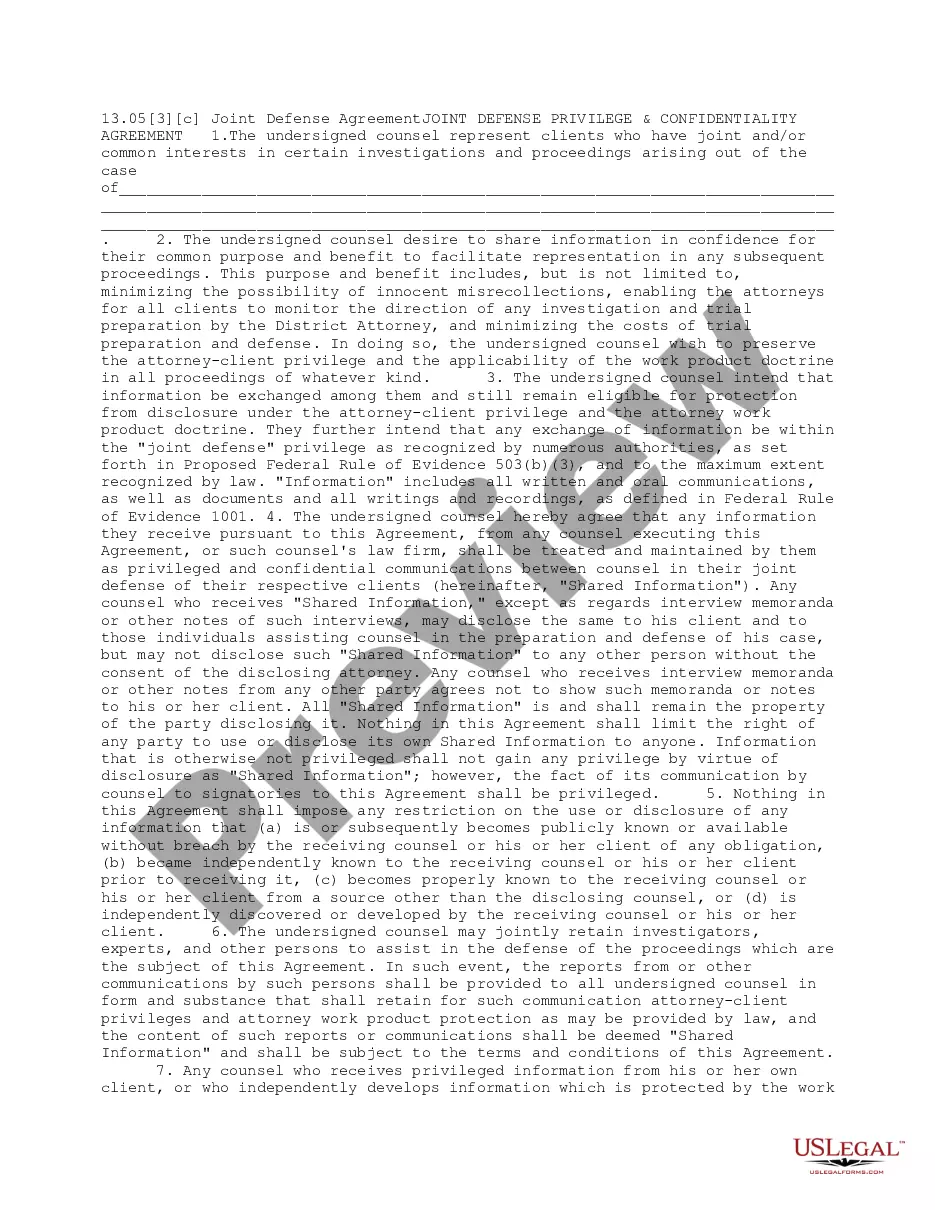
The Joint Defense Agreement is a legal document that allows multiple parties involved in the same legal matter to share information while maintaining confidentiality. This form is specifically useful in cases that involve commercial trade secrets, enabling parties to protect sensitive information while collaborating on their defense strategies. Unlike standard confidentiality agreements, this form specifically aims to preserve attorney-client privilege and the work product doctrine among the parties involved.
Key components of this form
- Identification of the parties involved in the agreement.
- Purpose of information sharing for mutual legal interests.
- Confidentiality provisions protecting shared information.
- Terms regarding the retention and destruction of documents after proceedings.
- Stipulations for the use of shared information in future adversarial situations.


Common use cases
This form is ideal in situations where multiple parties are facing similar legal challenges, particularly in investigations involving complex commercial trade secrets. It helps when parties need to collaborate effectively while safeguarding their confidential information, such as in litigation or during pre-trial investigations.
Who this form is for
- Attorneys representing clients with common legal interests.
- Parties engaged in legal proceedings related to commercial or trade secrets.
- Individuals or organizations involved in multi-party litigation or investigations.
Completing this form step by step
- Identify all parties involved in the agreement and their legal representatives.
- Clearly outline the common interests and purpose of the information sharing.
- Specify terms for the confidentiality and handling of shared information.
- Detail the procedures for retaining or destroying materials after the conclusion of the case.
- Ensure all parties sign the form to solidify their agreement to the terms.
Notarization guidance
This form does not typically require notarization unless specified by local law. It is important to check local regulations to confirm any additional requirements that may apply.
Get your form ready online
Our built-in tools help you complete, sign, share, and store your documents in one place.
Make edits, fill in missing information, and update formatting in US Legal Forms—just like you would in MS Word.
Download a copy, print it, send it by email, or mail it via USPS—whatever works best for your next step.
Sign and collect signatures with our SignNow integration. Send to multiple recipients, set reminders, and more. Go Premium to unlock E-Sign.
If this form requires notarization, complete it online through a secure video call—no need to meet a notary in person or wait for an appointment.
We protect your documents and personal data by following strict security and privacy standards.

Make edits, fill in missing information, and update formatting in US Legal Forms—just like you would in MS Word.

Download a copy, print it, send it by email, or mail it via USPS—whatever works best for your next step.

Sign and collect signatures with our SignNow integration. Send to multiple recipients, set reminders, and more. Go Premium to unlock E-Sign.

If this form requires notarization, complete it online through a secure video call—no need to meet a notary in person or wait for an appointment.

We protect your documents and personal data by following strict security and privacy standards.
Common mistakes
- Failing to identify all relevant parties or representatives.
- Not clearly defining the scope of confidentiality.
- Omitting signature from one or more parties.
- Neglecting to specify the procedure for handling documents post-case.
Advantages of online completion
- Convenient access to legal templates from anywhere.
- Editable forms that allow tailoring to specific needs.
- Reliability of templates drafted by licensed attorneys.
Legal use & context
- This agreement helps ensure that shared information remains confidential and protects attorney-client relationships.
- It is recognized in many jurisdictions and is vital in maintaining legal privileges during collaborative defenses.
Looking for another form?


Form popularity
FAQ
On the other hand, common interest privilege arises when two or more persons have a common interest in a particular matter which is the subject of legal advice so that if one of the parties obtains legal advice which is privilege and provides it to the other party, the other party can also claim legal professional
In California, there is no formal joint-defense privilege. Rather, it is a judicial doctrine derived primarily from the attorney-client privilege.Although joint-defense agreements can be formed orally, a joint-defense agreement should always be in writing and reviewed with and signed by the client.
Unlike the Ninth Circuit, California does not recognize a joint-defense privilege per se; however, California does recognize a common interest doctrine which can allow privileged information to be disclosed without waiver of the privilege.
Joint Defence Agreements (JDAs) memorialize the agreement of defendants to exchange confidential and/or privileged information without waiving privilege over that information while tolling agreements toll limitation periods and preserve the rights of defendants to claim against each other in subsequent proceedings.
A defense pact (or defence pact in Commonwealth spelling) is a type of treaty or military alliance in which the signatories promise to support each other militarily and to defend each other. In general, the signatories point out the threats in the treaty and concretely prepare to respond to it together.
Attorney-client privilege refers to a legal privilege that works to keep confidential communications between an attorney and his or her client secret. The privilege is asserted in the face of a legal demand for the communications, such as a discovery request or a demand that the lawyer testify under oath.
The common interest privilege is an extension of the attorney client privilege. It serves to protect the confidentiality of communications passing from one party to the attorney for another party where a joint defense effort or strategy has been decided upon and undertaken by the parties and their respective counsel