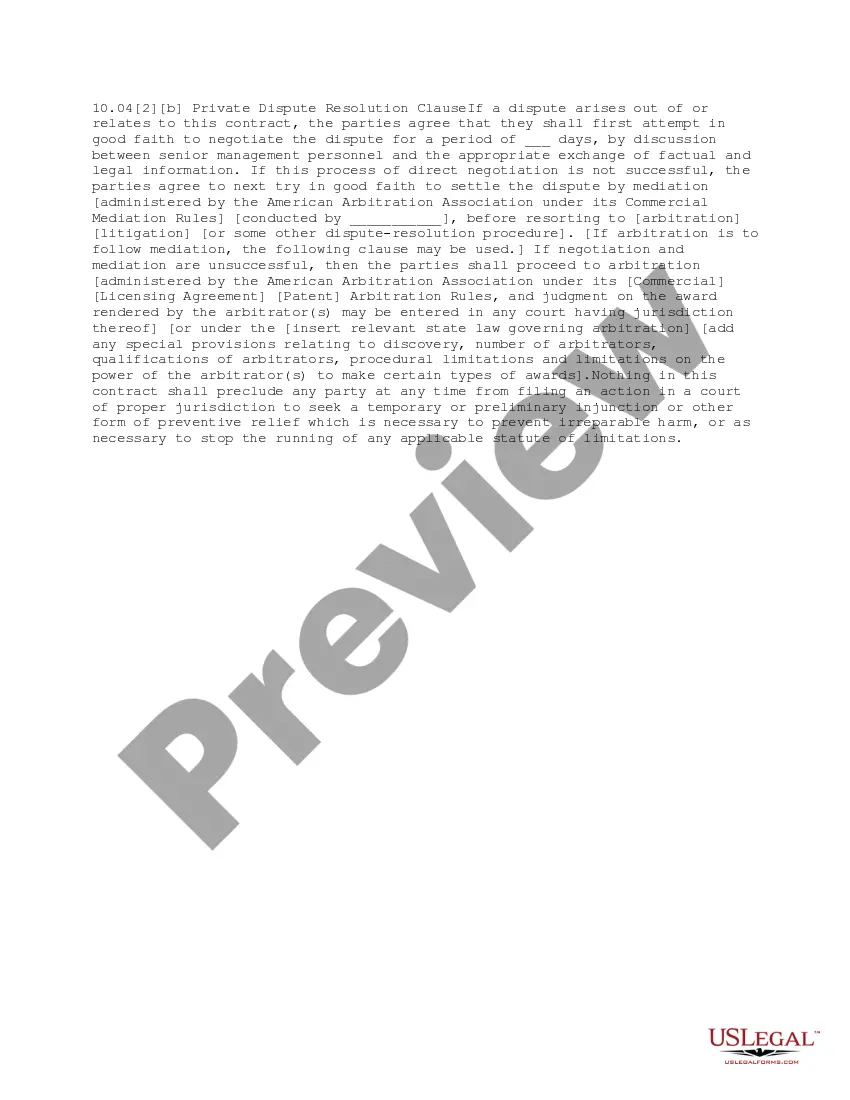
Private Dispute Resolution Clause
Understanding this form
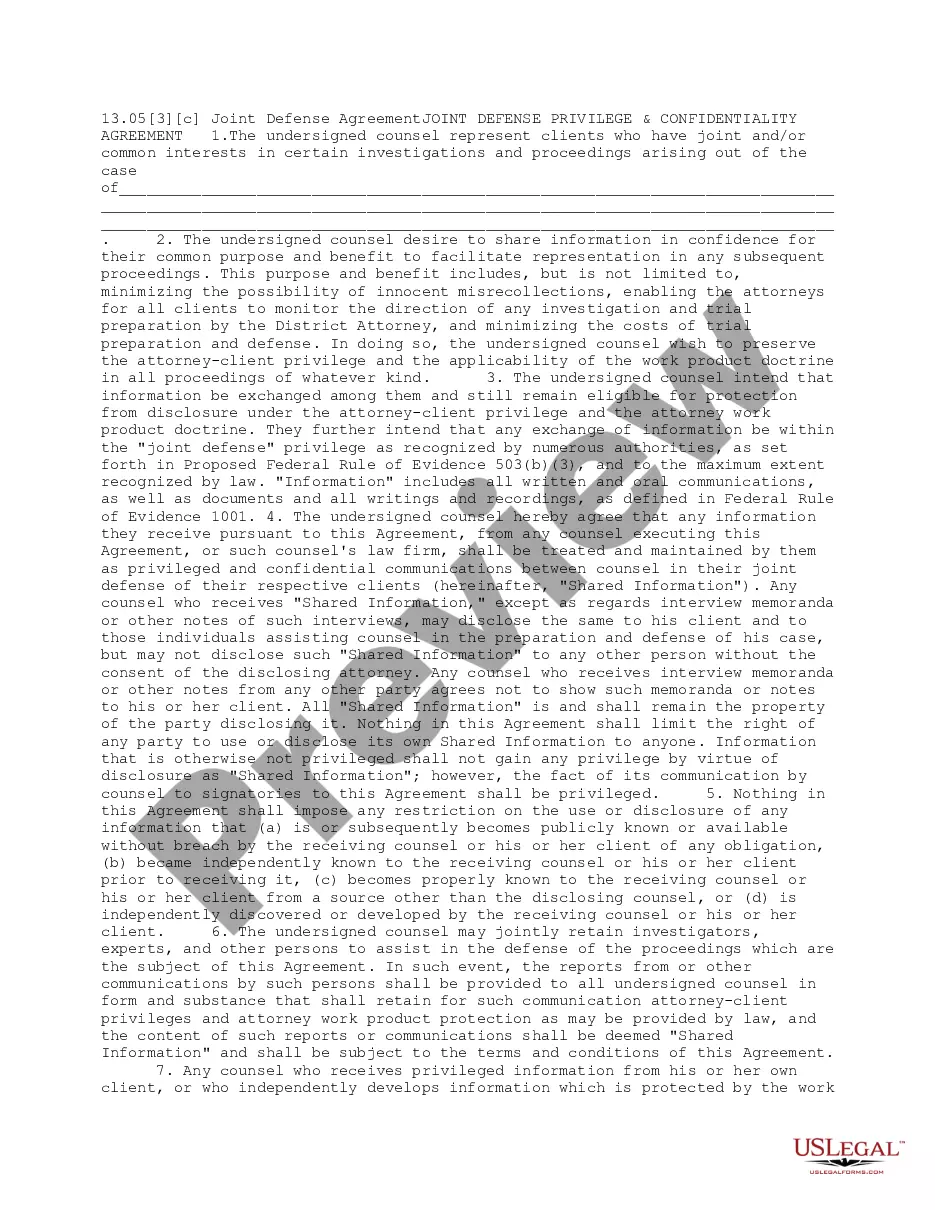
The Private Dispute Resolution Clause is a legal document designed to outline the process for resolving disputes that arise from a contract. This form emphasizes the importance of negotiation and mediation before proceeding to arbitration or litigation, specifically in contracts involving licensing, patents, or commercial trade secrets. It helps parties agree on a structured approach to address conflicts, promoting amicable resolutions without resorting immediately to legal action.
Key components of this form
- Negotiation clause with a specified period for good faith discussions.
- Mediation provision administered by the American Arbitration Association.
- Arbitration guidelines if mediation fails, including the relevant rules.
- Temporary injunctive relief provisions to prevent irreparable harm.
- Customization options for state-specific arbitration laws and procedures.

Common use cases
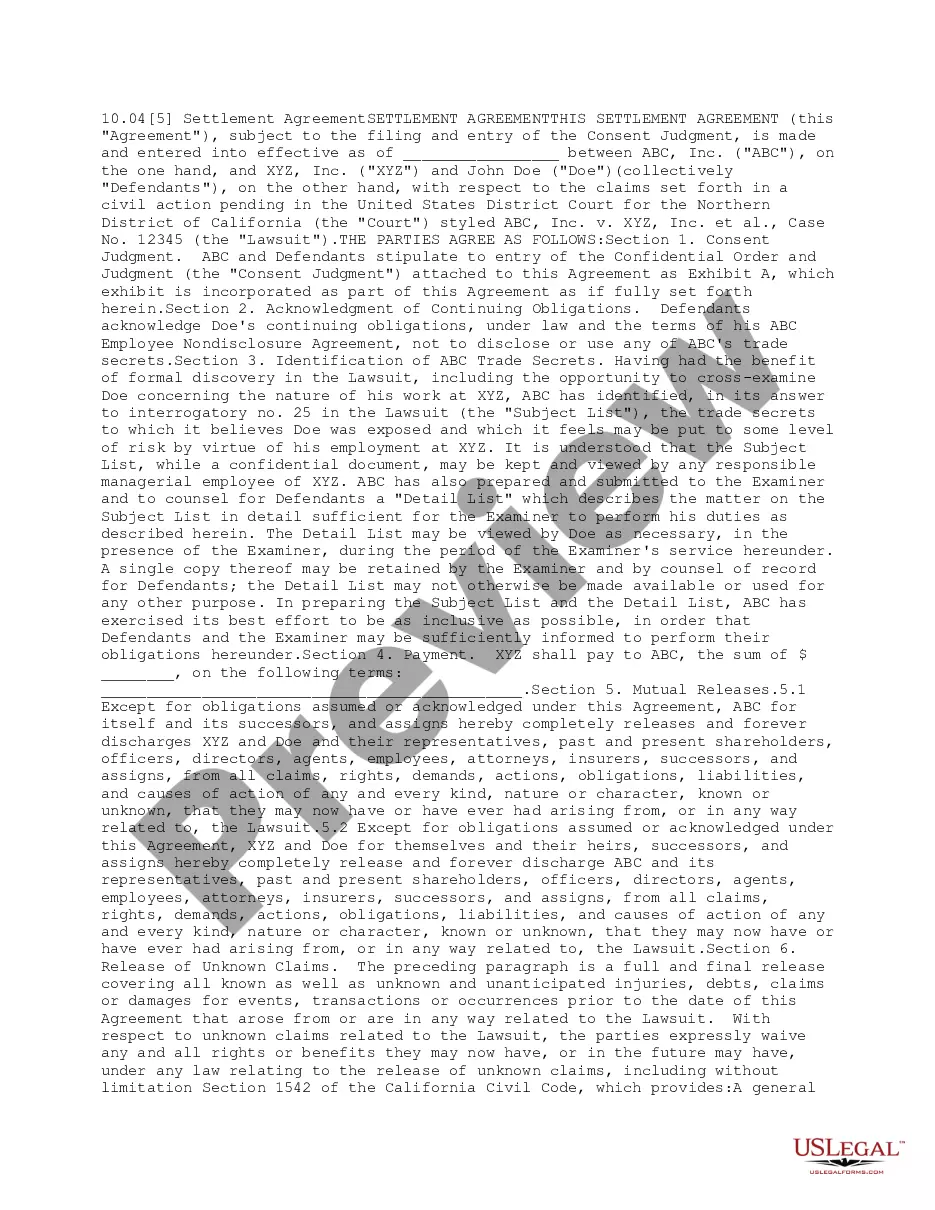
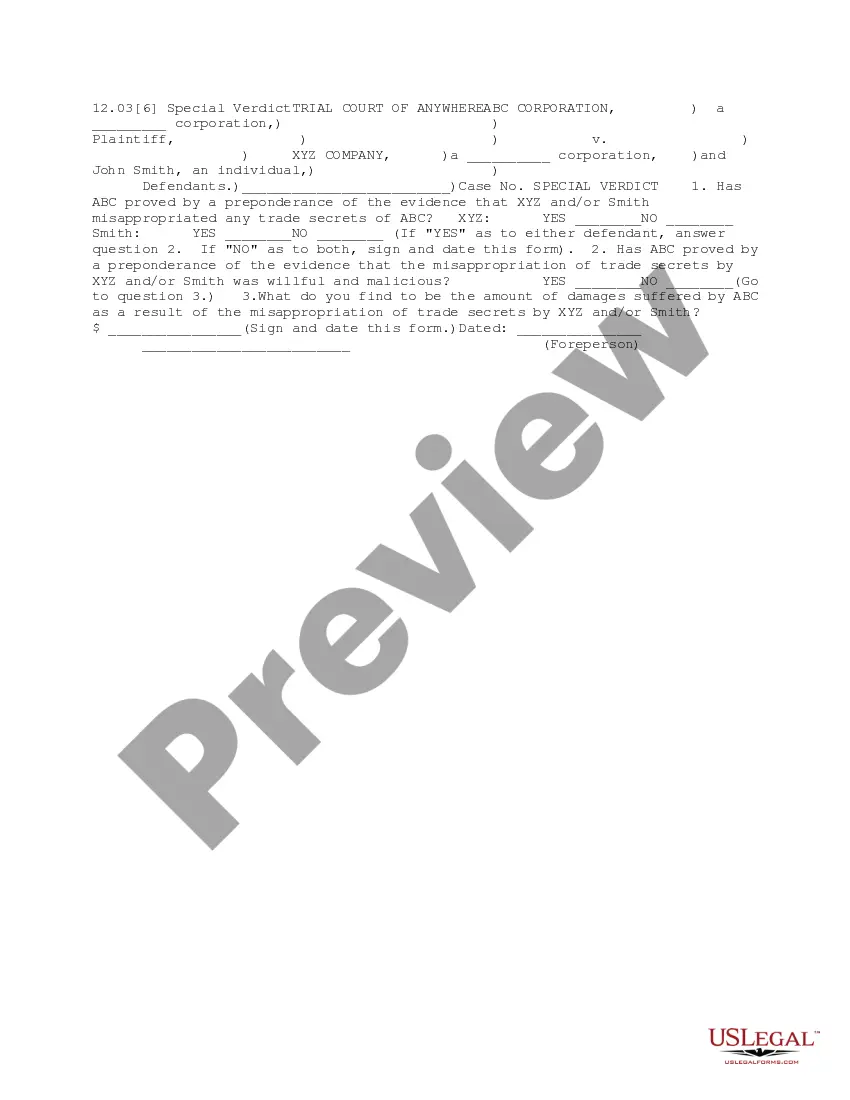
This form is essential when entering into contracts where disputes may arise related to licensing, patents, or trade secrets. It is particularly useful for businesses looking to establish clear procedures for resolving conflicts before they escalate to litigation or arbitration, helping to save time and costs associated with legal battles.
Who needs this form
- Businesses and organizations involved in contract negotiations.
- Parties entering agreements that may involve licensing, patents, or trade secrets.
- Legal professionals advising clients on dispute resolution strategies.
- Anyone looking to ensure a structured approach to resolving potential disputes amicably.
How to prepare this document
- Identify the parties involved in the contract.
- Fill in the number of days for the negotiation period.
- Specify the mediator or mediation service to be used.
- Include any relevant state laws governing arbitration.
- Sign and date the document to signify agreement.
Notarization guidance
This form does not typically require notarization to be legally valid. However, some jurisdictions or document types may still require it. US Legal Forms provides secure online notarization powered by Notarize, available 24/7 for added convenience.
Get your form ready online
Our built-in tools help you complete, sign, share, and store your documents in one place.
Make edits, fill in missing information, and update formatting in US Legal Forms—just like you would in MS Word.
Download a copy, print it, send it by email, or mail it via USPS—whatever works best for your next step.
Sign and collect signatures with our SignNow integration. Send to multiple recipients, set reminders, and more. Go Premium to unlock E-Sign.
If this form requires notarization, complete it online through a secure video call—no need to meet a notary in person or wait for an appointment.
We protect your documents and personal data by following strict security and privacy standards.

Make edits, fill in missing information, and update formatting in US Legal Forms—just like you would in MS Word.

Download a copy, print it, send it by email, or mail it via USPS—whatever works best for your next step.

Sign and collect signatures with our SignNow integration. Send to multiple recipients, set reminders, and more. Go Premium to unlock E-Sign.

If this form requires notarization, complete it online through a secure video call—no need to meet a notary in person or wait for an appointment.

We protect your documents and personal data by following strict security and privacy standards.
Mistakes to watch out for
- Failing to specify a reasonable negotiation period.
- Not selecting an appropriate mediation service or mediator.
- Omitting relevant state laws that could affect the dispute resolution process.
- Using vague language that may lead to misunderstandings during negotiations.
Benefits of completing this form online
- Easy access to customizable templates drafted by licensed attorneys.
- Convenient downloading and editing options to fit specific needs.
- Secure and structured data collection for a streamlined process.
- Quick preparation of forms without the need for extensive legal consultation.
Legal use & context
- This form outlines enforceable procedures to resolve disputes between parties, reducing the risk of escalation to litigation.
- Clear guidelines for mediation and arbitration are provided, aligning with standard legal practices.
- The clause prioritizes amicable resolution, reflecting best practices in contract law.
What to keep in mind
- The Private Dispute Resolution Clause facilitates negotiation and mediation prior to arbitration.
- Use this form to resolve disputes amicably in contracts involving sensitive information.
- Ensure compliance with state laws applicable to the form.
- Review the form carefully to avoid common mistakes in completion.
Looking for another form?

Form popularity
FAQ
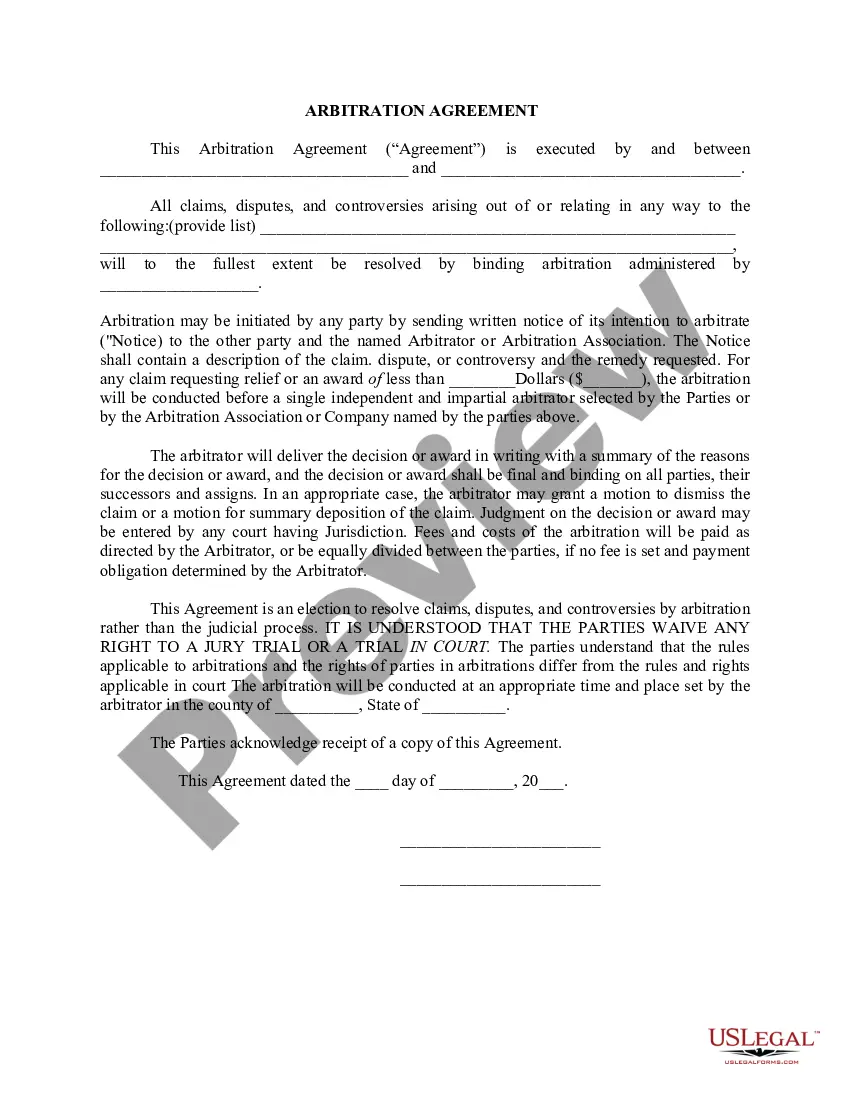
But first things first: An arbitration agreement is a contract in which you give up your right to bring certain claims to court. Instead, you agree that you may raise those claims only in an arbitration proceeding.Cases go to arbitration more quickly, and often cost less, than they would in court.
What Should Be Contained in an Arbitration Clause? Contract arbitration clauses usually contain language such as "The parties to this contract hereby agree to resolve legal disputes through arbitration methods rather than civil lawsuits". The clause may be tailored exactly to how the parties need it to be.
What Should Be Contained in an Arbitration Clause? Contract arbitration clauses usually contain language such as "The parties to this contract hereby agree to resolve legal disputes through arbitration methods rather than civil lawsuits". The clause may be tailored exactly to how the parties need it to be.
As such, in the absence of words in the contract evidencing a contrary intention, clauses specifically referring a dispute to arbitration generally survive termination of the underlying contract.
Introduction. Ingredients of an Arbitration clause. Appointment of an Arbitrator. Language. Governing law and Jurisdiction. Award to be final and binding. Whether unilateral arbitration clauses are enforceable in a court of law. Circumstances where the document entailing an arbitration clause is not stamped. Conclusion.
An example of an arbitration would be when two people who are divorcing cannot agree on terms and allow a third party to come in to help them negotiate.
The most common forms of ADR are arbitration, mediation, the rent-a-judge program, summary jury trial, and minitrial, although techniques can be combined to form hybrids suited to a particular dispute or legal jurisdiction.
Therefore, it is important to keep the arbitration clause simple, only incorporating essential aspects. An example of a basic arbitration clause is: Dispute Resolution: Any claim, dispute or difference relating to or arising out of this Agreement shall be referred to the arbitration, of a sole arbitrator.