Special Verdict
What this document covers
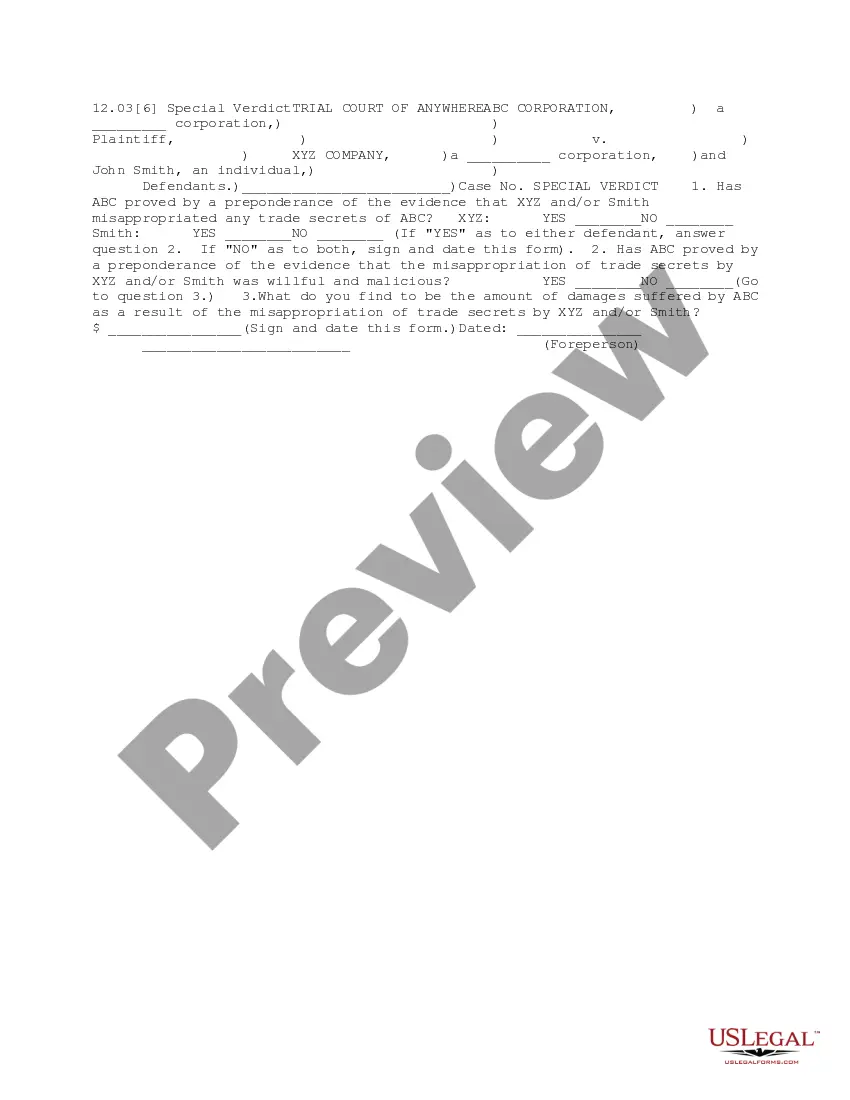
The Special Verdict form is a legal document used in cases involving the misappropriation of commercial trade secrets. It is specifically designed for jurors to determine the facts of a case without rendering a complete decision. This form differs from a standard jury verdict by providing clear questions that focus on key issues of misappropriation and damages related to trade secrets.
Main sections of this form
- Identification of the parties involved in the case.
- Questions addressing whether misappropriation of trade secrets occurred.
- Determination of whether the misappropriation was willful and malicious.
- Assessment of the damages suffered by the plaintiff.
- Signature line for the foreperson of the jury.
Situations where this form applies
This form is used during a trial when there is a dispute over the alleged misappropriation of trade secrets. It is relevant in cases where a company or individual believes their confidential business information has been unlawfully acquired or disclosed by another party. The form helps the jury clarify their findings based on the evidence presented.
Who can use this document
- Jurors assigned to a trial involving a trade secret misappropriation case.
- Litigators and attorneys seeking to provide jurors with a clear framework for their verdict.
- Parties involved in legal disputes over the unauthorized use of proprietary information.
Completing this form step by step
- Enter the full names of the plaintiff and defendants at the top of the form.
- Answer the question regarding misappropriation for each defendant.
- If misappropriation is found, indicate whether it was willful and malicious.
- Specify the amount of damages suffered by the plaintiff.
- Sign and date the form at the bottom as the foreperson of the jury.
Is notarization required?
This form does not typically require notarization unless specified by local law. Always check the relevant jurisdiction's requirements to ensure compliance.
Get your form ready online
Our built-in tools help you complete, sign, share, and store your documents in one place.
Make edits, fill in missing information, and update formatting in US Legal Forms—just like you would in MS Word.
Download a copy, print it, send it by email, or mail it via USPS—whatever works best for your next step.
Sign and collect signatures with our SignNow integration. Send to multiple recipients, set reminders, and more. Go Premium to unlock E-Sign.
If this form requires notarization, complete it online through a secure video call—no need to meet a notary in person or wait for an appointment.
We protect your documents and personal data by following strict security and privacy standards.

Make edits, fill in missing information, and update formatting in US Legal Forms—just like you would in MS Word.

Download a copy, print it, send it by email, or mail it via USPS—whatever works best for your next step.

Sign and collect signatures with our SignNow integration. Send to multiple recipients, set reminders, and more. Go Premium to unlock E-Sign.

If this form requires notarization, complete it online through a secure video call—no need to meet a notary in person or wait for an appointment.

We protect your documents and personal data by following strict security and privacy standards.
Common mistakes
- Failing to answer all questions on the form.
- Missing the signature line, which invalidates the form.
- Overlooking the need to specify damages, which is critical for the plaintiffâs claim.
Benefits of using this form online
- Convenience of accessing the form anytime and anywhere.
- Editable templates allow for easy customization to meet case specifics.
- Access to legal guidance ensures the form meets necessary legal standards.
Looking for another form?
Form popularity
FAQ
Rule 49 identifies three kinds of jury verdicts: general, special, and general with interrogatories. The general verdict asks the jury one (or two) questions going to the ultimate issues ("do you find for the plaintiff or the defendant? or "do you find the defendant guilty or not guilty?").
A verdict in which the jury gives its findings on factual issues in the case, without necessarily stating which party should win.A special verdict can provide many benefits in a complex case, especially if one party appeals the judgment.
A general verdict form requires the jury to apply the law to the facts and to find for either the plaintiff or the defendant.At the opposite end of the spectrum is the special verdict form. Special verdict forms require the jury to make written findings on issues of fact and nothing more.
Definition. A jury's findings or conclusions on the factual issues presented by a case. Sometimes, the term also refers to the judge's resolution of issues in a bench trial.
Possible verdicts in criminal cases are guilty or not guilty. In a civil suit, the jury will find for the plaintiff or the defendant. If the jury finds for the plaintiff, it will also usually set out the amount the defendant should pay the plaintiff for damages, often after a separate hearing concerning damages.
A verdict in which the jury decides which party should win the case, without listing its specific findings on any disputed issues.
In a civil case, the judge will tell you how many jurors must agree in order to reach a verdict. In a criminal case, the unanimous agreement of all 12 jurors is required.This situation is a mistrial, sometimes referred to as a "hung jury," and may mean the case goes to trial again with a new jury.
Verdicts are of several kinds, namely, privy and public, general, partial, and special. 3.
Decides the verdict by deciding the facts. Decides on issues of law during a trial. Decides whether or not there is enough evidence to bring criminal charges.