Arbitration Reference Clause
About this form
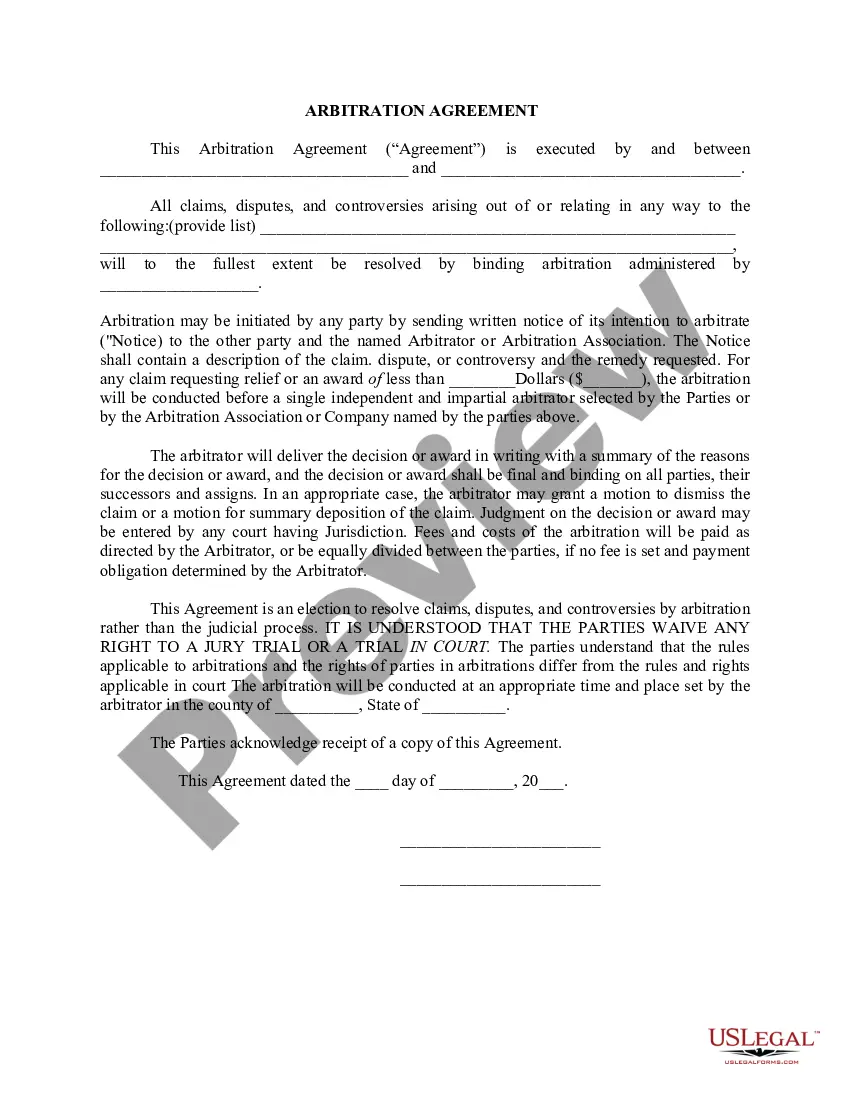
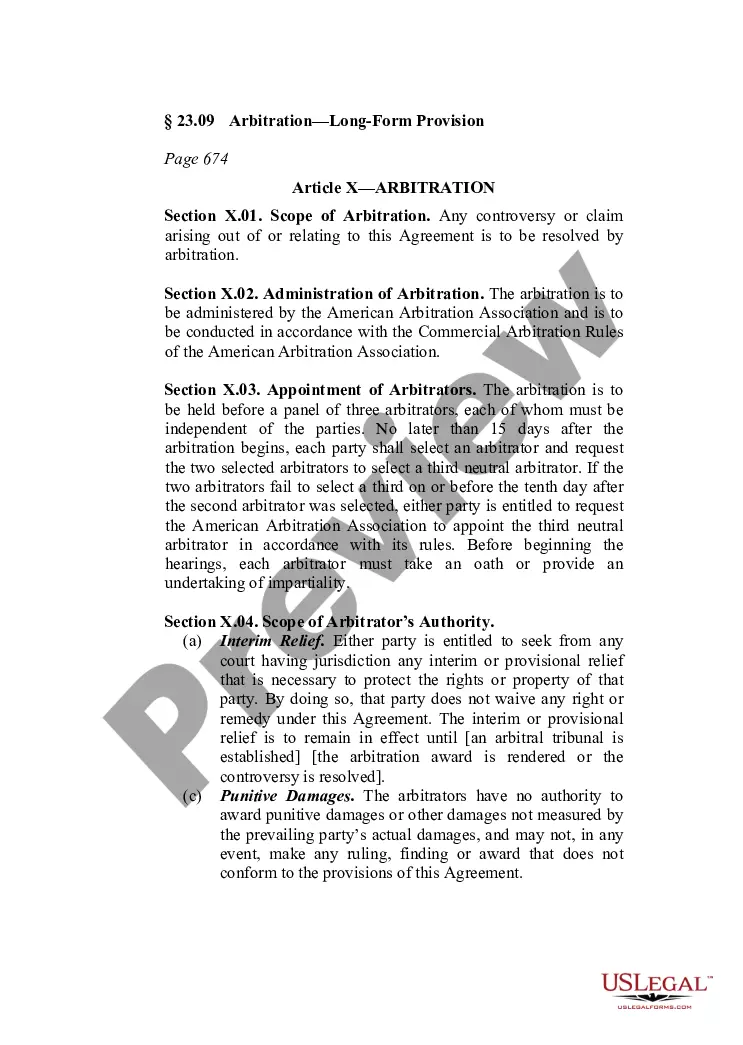
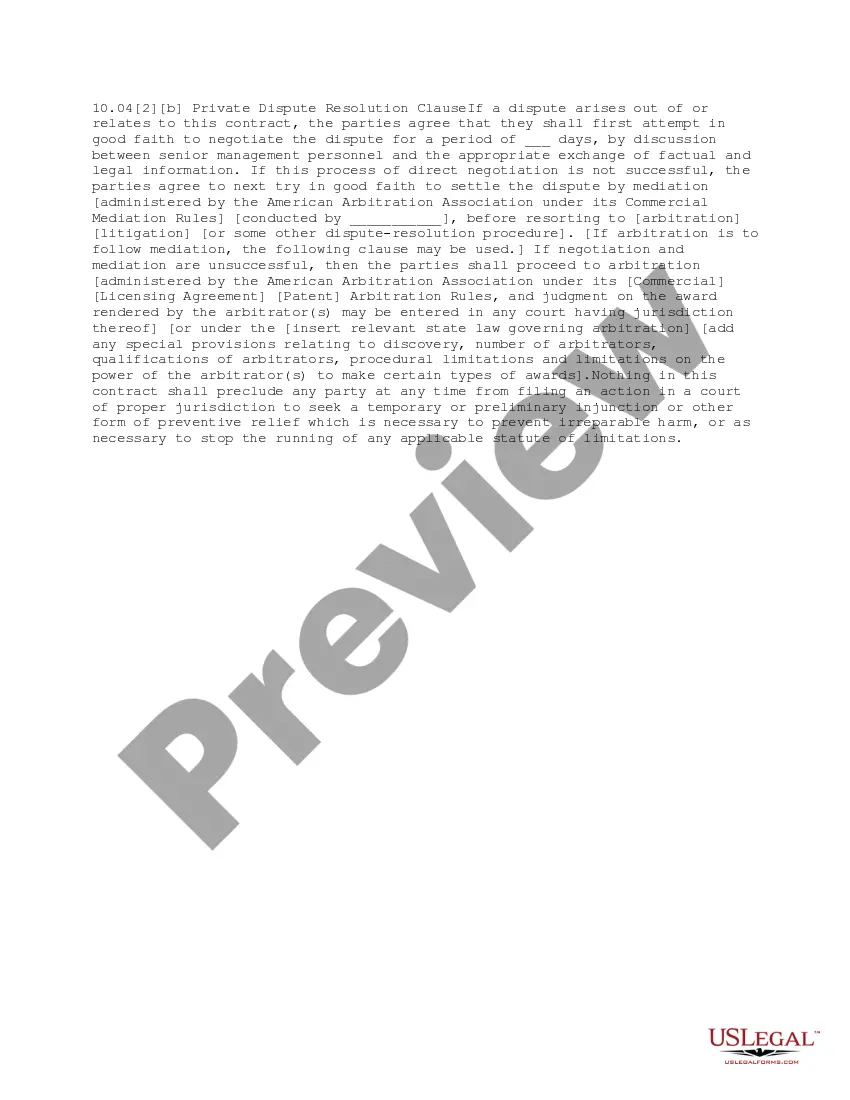
The Arbitration Reference Clause is a legal document designed to facilitate the resolution of disputes through arbitration rather than traditional litigation. This form is specific for contracts related to licensing, patents, or commercial trade secrets, making it distinct from other forms of arbitration agreements. By including this clause, parties agree to settle conflicts through arbitration administered by the American Arbitration Association under its specific rules, rather than going to court.
Key components of this form
- Statement of arbitration: Establishes that any dispute will be settled through arbitration.
- Reference to American Arbitration Association: Specifies the administering body for the arbitration process.
- Inclusion of rules: Details the Commercial Licensing Agreement Patent Arbitration Rules that will govern the arbitration.
- Judgment enforcement clause: Allows for the arbitrator's decision to be recognized in any court with jurisdiction.
When to use this form
This form should be used when entering into contracts that may involve licensing agreements, patents, or commercial trade secrets. It is especially useful in scenarios where parties wish to avoid the costs and time associated with litigation by agreeing in advance to resolve disputes through arbitration instead.
Who this form is for
- Business owners engaged in licensing agreements.
- Individuals or companies involved in patents and trade secrets.
- Contract negotiators looking to include arbitration clauses in agreements.
- Legal professionals drafting contracts for clients.
How to complete this form
- Identify the parties involved in the agreement.
- Ensure the arbitration clause is incorporated into the contract text.
- Specify that arbitration will be conducted by the American Arbitration Association.
- Reference the appropriate arbitration rules governing the process.
- Include a clause for enforcing the arbitration judgment in court.
Is notarization required?
Notarization is not commonly needed for this form. However, certain documents or local rules may make it necessary. Our notarization service, powered by Notarize, allows you to finalize it securely online anytime, day or night.
Get your form ready online
Our built-in tools help you complete, sign, share, and store your documents in one place.
Make edits, fill in missing information, and update formatting in US Legal Forms—just like you would in MS Word.
Download a copy, print it, send it by email, or mail it via USPS—whatever works best for your next step.
Sign and collect signatures with our SignNow integration. Send to multiple recipients, set reminders, and more. Go Premium to unlock E-Sign.
If this form requires notarization, complete it online through a secure video call—no need to meet a notary in person or wait for an appointment.
We protect your documents and personal data by following strict security and privacy standards.

Make edits, fill in missing information, and update formatting in US Legal Forms—just like you would in MS Word.

Download a copy, print it, send it by email, or mail it via USPS—whatever works best for your next step.

Sign and collect signatures with our SignNow integration. Send to multiple recipients, set reminders, and more. Go Premium to unlock E-Sign.

If this form requires notarization, complete it online through a secure video call—no need to meet a notary in person or wait for an appointment.

We protect your documents and personal data by following strict security and privacy standards.
Avoid these common issues
- Failing to clearly identify all parties in the agreement.
- Not specifying the correct arbitration rules or administering body.
- Omitting the enforcement clause for the arbitration award.
- Using vague language that may lead to misinterpretation of the arbitration process.
Why use this form online
- Convenience of instant access and download.
- Editability to customize the clause for specific needs.
- Reliability of attorney-drafted templates ensuring legal accuracy.
- Time-saving as it eliminates the need for prolonged legal consultations.
Legal use & context
- The Arbitration Reference Clause is enforceable in most jurisdictions under the Federal Arbitration Act.
- It provides an alternative dispute resolution method widely recognized by courts.
Looking for another form?



Form popularity
FAQ
Filing and Initiation: An arbitration case begins when one party submits a Demand for Arbitration to the AAA. Arbitrator Selection: The AAA works with the parties to identify and select an arbitration based on the criteria determined by the parties.
Reference to arbitration can be in respect of all disputes between the parties or all disputes regarding a contract or in respect of specific enumerated disputes.After a dispute arises between the parties, they enter into an arbitration agreement to refer that specific dispute to arbitration.
Therefore, it is important to keep the arbitration clause simple, only incorporating essential aspects. An example of a basic arbitration clause is: Dispute Resolution: Any claim, dispute or difference relating to or arising out of this Agreement shall be referred to the arbitration, of a sole arbitrator.
What Should Be Contained in an Arbitration Clause? Contract arbitration clauses usually contain language such as "The parties to this contract hereby agree to resolve legal disputes through arbitration methods rather than civil lawsuits". The clause may be tailored exactly to how the parties need it to be.
What Should Be Contained in an Arbitration Clause? Contract arbitration clauses usually contain language such as "The parties to this contract hereby agree to resolve legal disputes through arbitration methods rather than civil lawsuits". The clause may be tailored exactly to how the parties need it to be.
But first things first: An arbitration agreement is a contract in which you give up your right to bring certain claims to court. Instead, you agree that you may raise those claims only in an arbitration proceeding.Cases go to arbitration more quickly, and often cost less, than they would in court.
An example of an arbitration would be when two people who are divorcing cannot agree on terms and allow a third party to come in to help them negotiate.
Introduction. Ingredients of an Arbitration clause. Appointment of an Arbitrator. Language. Governing law and Jurisdiction. Award to be final and binding. Whether unilateral arbitration clauses are enforceable in a court of law. Circumstances where the document entailing an arbitration clause is not stamped. Conclusion.