Proof of Death and Heirship
What this document covers
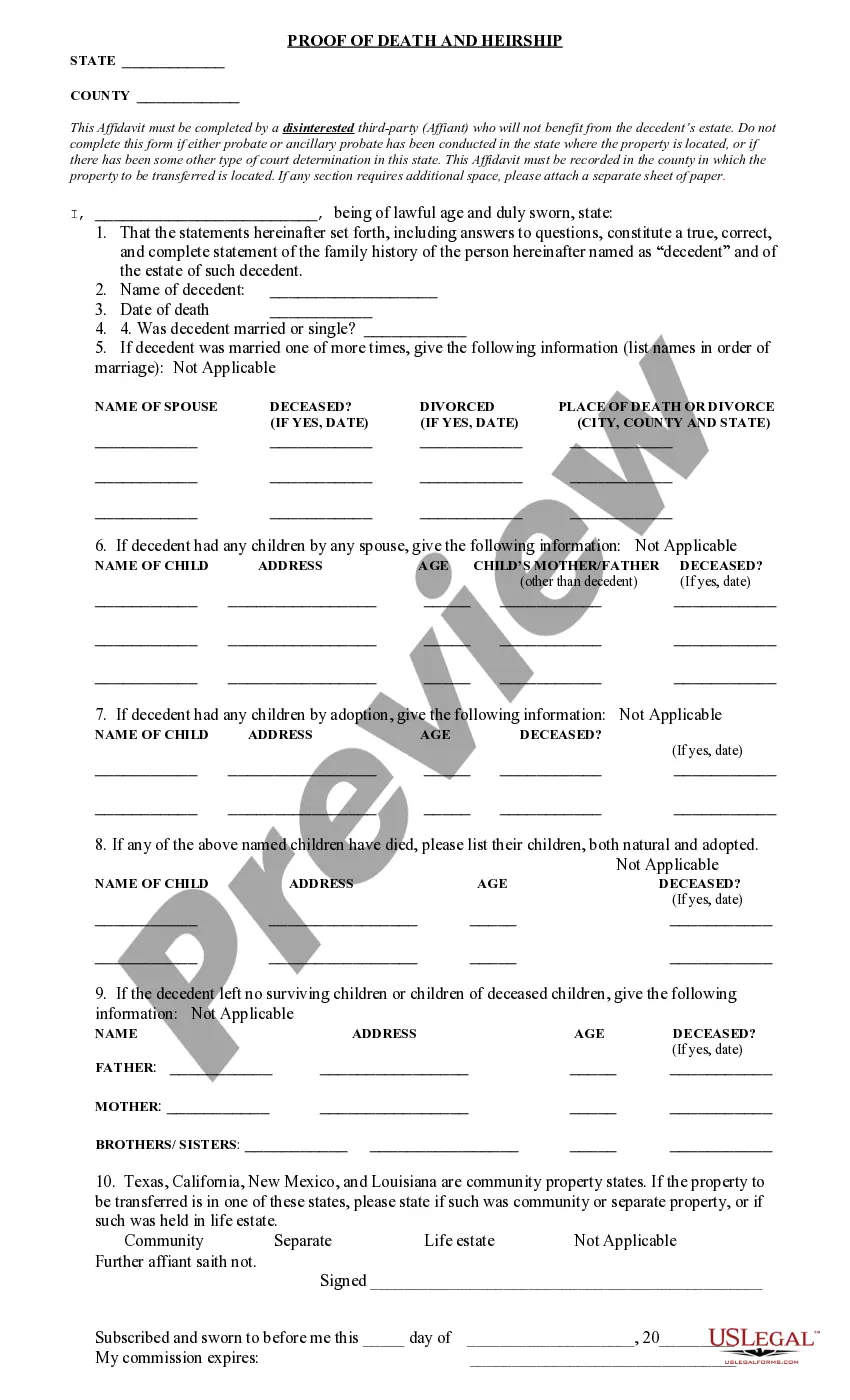
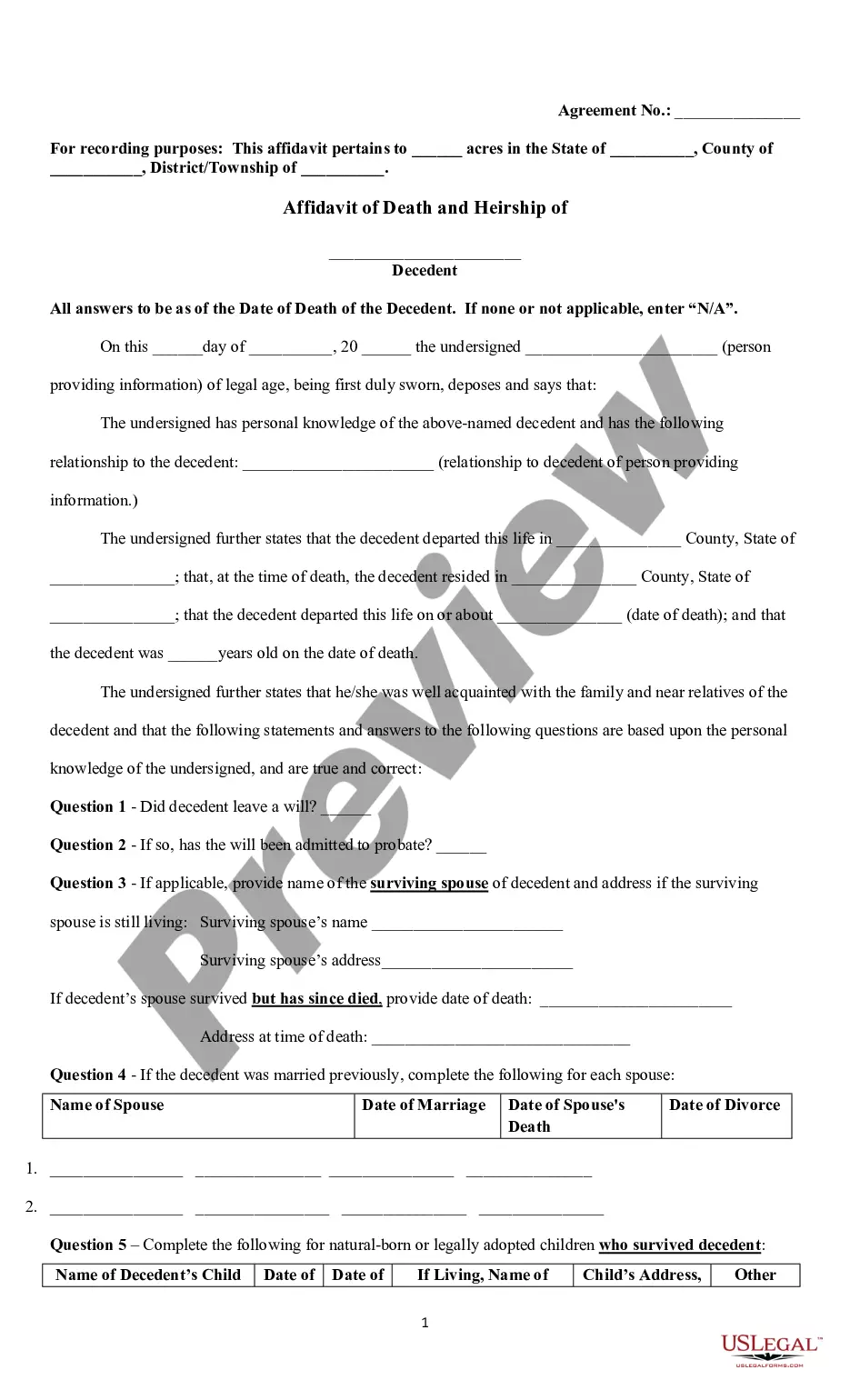
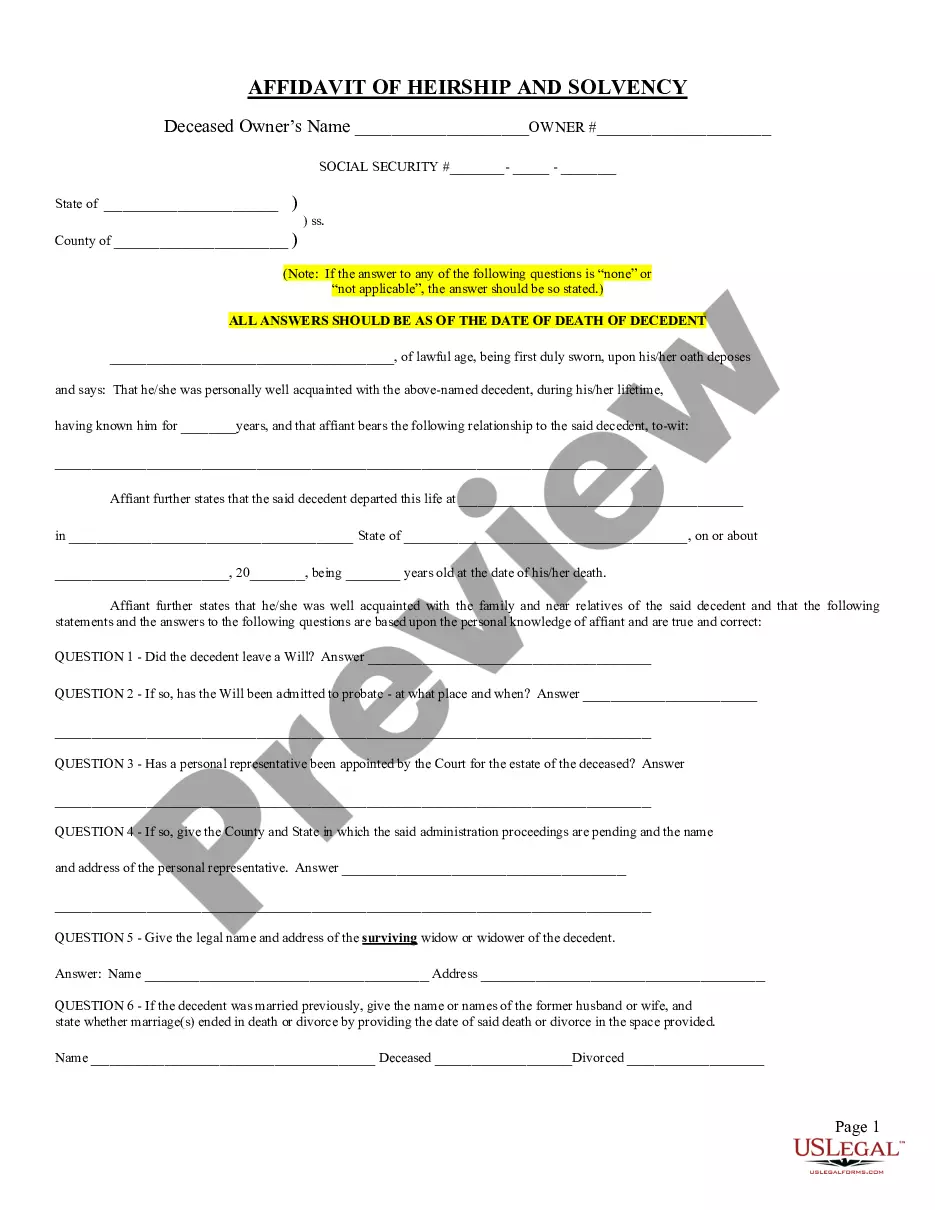
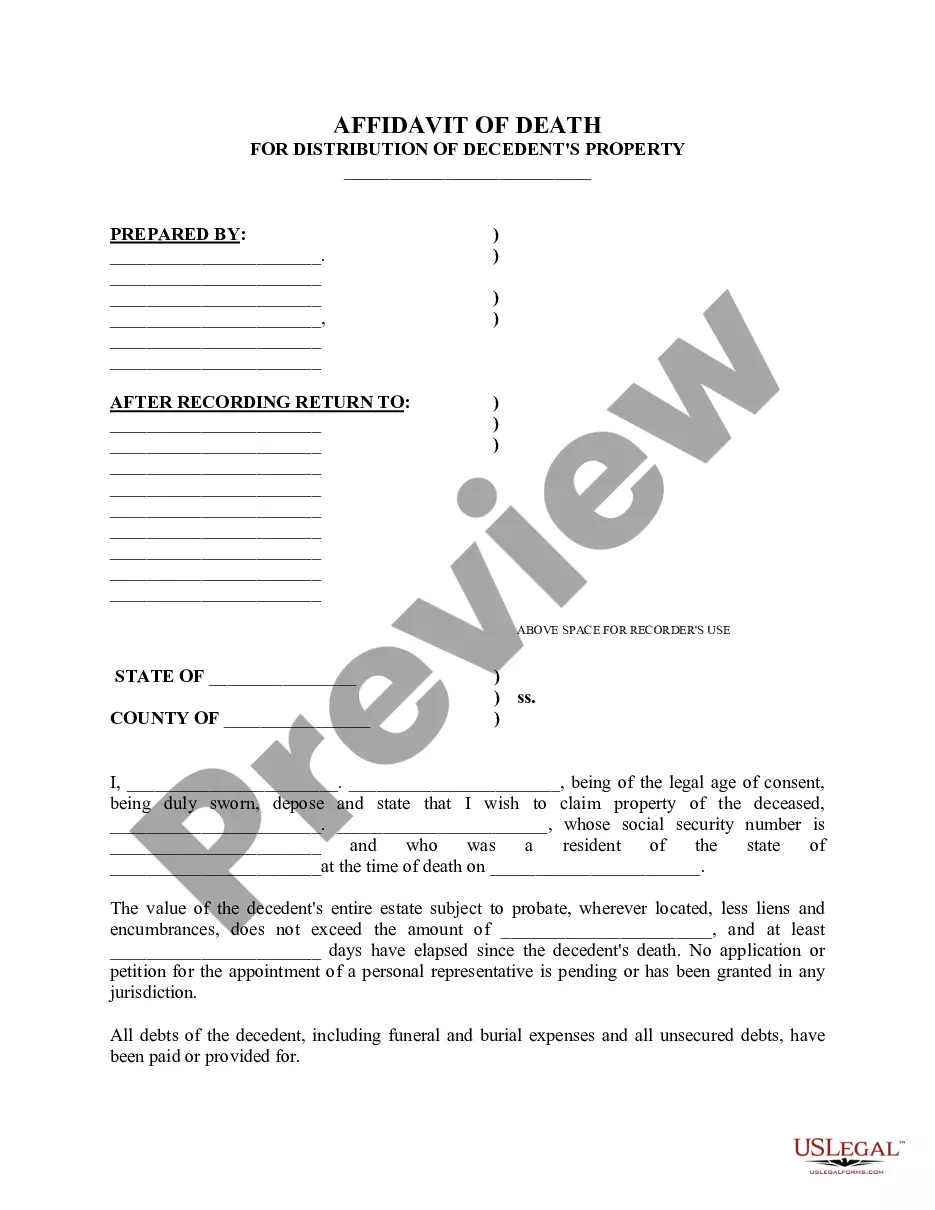
The Proof of Death and Heirship is a legal document used to verify the identity of a deceased person and establish their heirs. This affidavit is particularly important when transferring property to heirs without going through probate. It can serve to clarify the distribution of assets according to the decedent's wishes when no will exists, thus differing from a last will and testament.
Main sections of this form
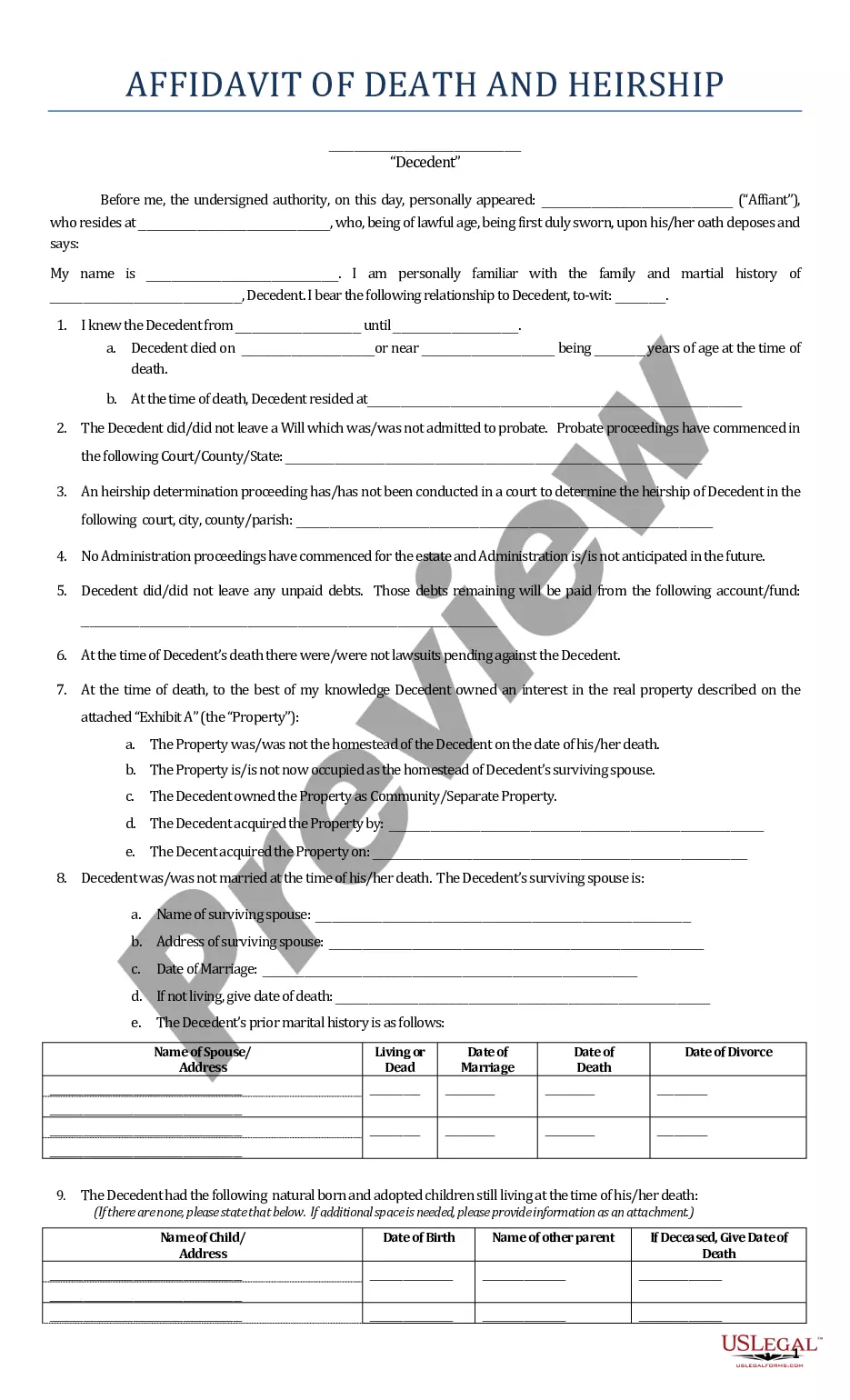
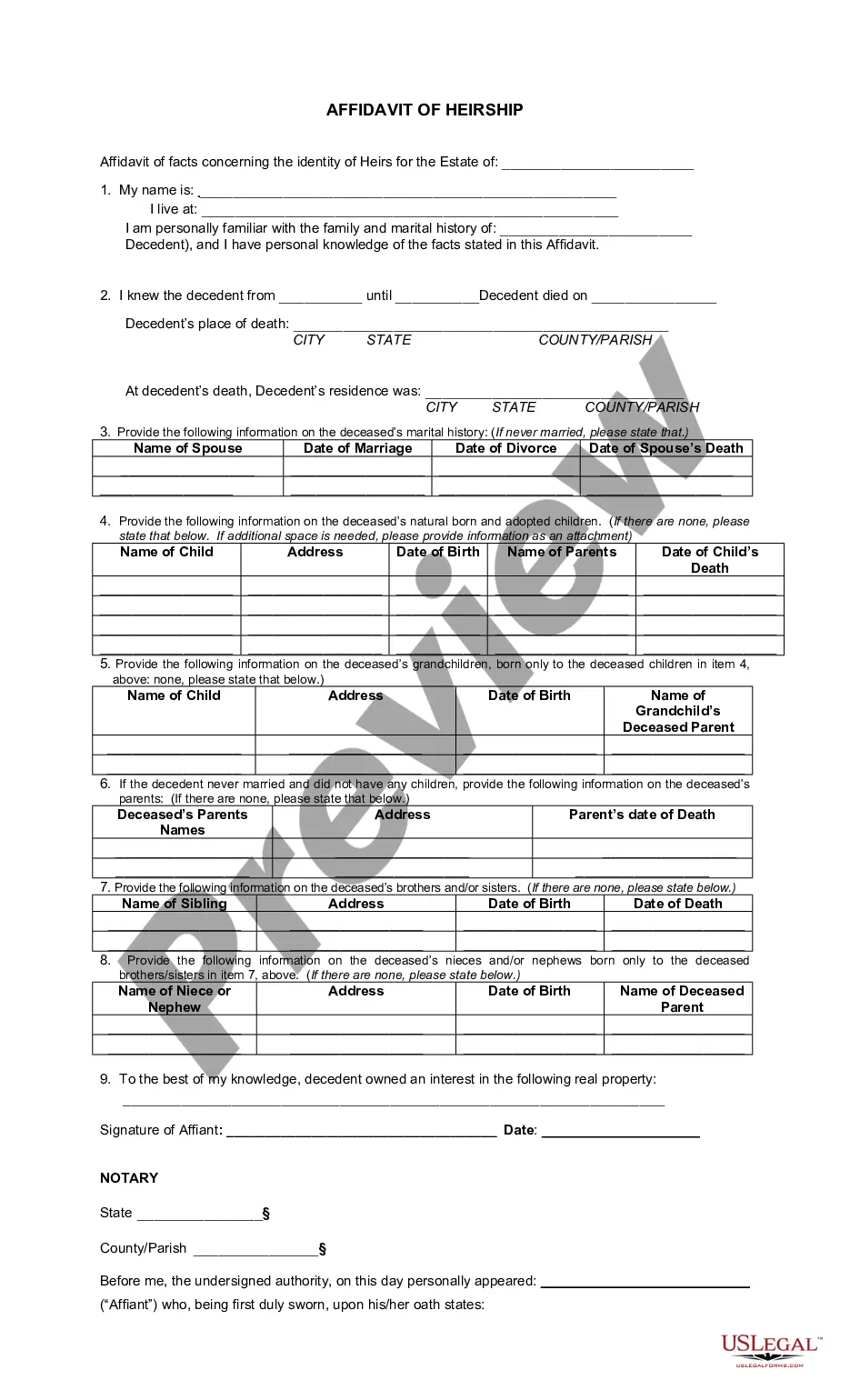
- Identification of the decedent, including their name and date of death.
- Information about the marital status of the decedent.
- Details regarding the decedent's children, including natural and adopted children.
- Information on surviving family members such as parents and siblings.
- Declaration of property ownership type if in community property states.

When this form is needed
This form is essential in situations where a property owner has died, and the heirs need to establish ownership rights. It is particularly useful when there is no existing will or if the will is being contested. Use this affidavit instead of probate when you want to expedite the transfer of property and avoid court proceedings, provided no probate has been conducted or court determinations are pending.
Who this form is for
This form should be completed by a disinterested third party, also known as the affiant. The affiant must not stand to benefit from the deceased's estate. The target audience includes family members of the decedent, estate representatives, and individuals who need to clarify heirs for the purpose of property transfer.
Completing this form step by step
- Begin by providing your name as the affiant, along with the state and county where the affidavit is being executed.
- Fill in the decedent's name and date of death.
- Specify the marital status of the decedent and provide details about their spouses and children as applicable.
- Indicate if the decedent had any adopted children and their details if applicable.
- Declare any relevant property ownership classification if the property is located in a community property state.
- Sign the affidavit in the presence of a notary public to validate the document.
Notarization requirements for this form
Yes, this form must be notarized to be legally valid. Notarization ensures that the affidavit is recognized by courts and relevant authorities. US Legal Forms provides an integrated online notarization service available 24/7 through a secure video call, eliminating the need for in-person meetings and ensuring legal equivalence.
Get your form ready online
Our built-in tools help you complete, sign, share, and store your documents in one place.
Make edits, fill in missing information, and update formatting in US Legal Forms—just like you would in MS Word.
Download a copy, print it, send it by email, or mail it via USPS—whatever works best for your next step.
Sign and collect signatures with our SignNow integration. Send to multiple recipients, set reminders, and more. Go Premium to unlock E-Sign.
If this form requires notarization, complete it online through a secure video call—no need to meet a notary in person or wait for an appointment.
We protect your documents and personal data by following strict security and privacy standards.

Make edits, fill in missing information, and update formatting in US Legal Forms—just like you would in MS Word.

Download a copy, print it, send it by email, or mail it via USPS—whatever works best for your next step.

Sign and collect signatures with our SignNow integration. Send to multiple recipients, set reminders, and more. Go Premium to unlock E-Sign.

If this form requires notarization, complete it online through a secure video call—no need to meet a notary in person or wait for an appointment.

We protect your documents and personal data by following strict security and privacy standards.
Common mistakes
- Failing to complete all required fields, especially regarding marital and children information.
- Using this form when a probate has already been conducted.
- Not having the document properly notarized for recording.
- Providing incorrect information about the decedentâs property type.
Benefits of using this form online
- Immediate access to the affidavit, allowing for quick completion and filing.
- Editability lets users customize the document for their specific situation.
- An organized structure simplifies gathering necessary information.
- Reliability ensures that the affidavit complies with essential legal standards.
Looking for another form?

Form popularity
FAQ
A Louisiana small estate affidavit?also known as the ?affidavit of small succession??is a legal document that can be used by the surviving spouse and the adult heirs of a deceased person to transfer assets and properties that are valued at less than $125,000.
A ballpark fee for preparation of the affidavit is between $750 for a very simple estate with few heirs to several thousand dollars for a more complicated estate with many heirs. The filing fees to record the affidavit in each county where the real property is located usually run about $50 to $75 in Texas.
Once the affidavit has been recorded, the heirs are identified in the property records as the new owners of the property. Thereafter, the heir or heirs may transfer or sell the property if they choose to do so. At that point, the deed most commonly used to transfer the property is a General Warranty Deed.
The affiant must be a person with personal knowledge of the family and marital history of the decedent. The affidavit must include the name and address of the affiant. The affidavit must state the name of the decedent, the date and place of death, and the decedent's residence at the time of death.
An affidavit of heirship must be signed and sworn to before a notary public by a person who knew the decedent and the decedent's family history. This person can be a friend of the decedent, an old friend of the family, or a neighbor, for example.
What is an Affidavit of Heirship in Illinois? An affidavit of heirship is a written statement establishing the right of inheritance. To be valid, it must be signed under oath and witnessed by a third party.
When using an affidavit of heirship in Texas, the witnesses must swear to the following conditions: They knew the decedent. The decedent did not owe any debts. The true identity of the family members and heirs. The person died on a certain date in a certain place. The witness will not gain financially from the estate.
An affidavit of heirs is a legal document used to establish who are the rightful heirs or beneficiaries of a deceased person's estate. It typically identifies each heir by name and relationship and lists any assets that may be inherited.