Amendment to Easement and Right-of-Way to Allow It to Be Used For Telecommunications Purposes
About this form
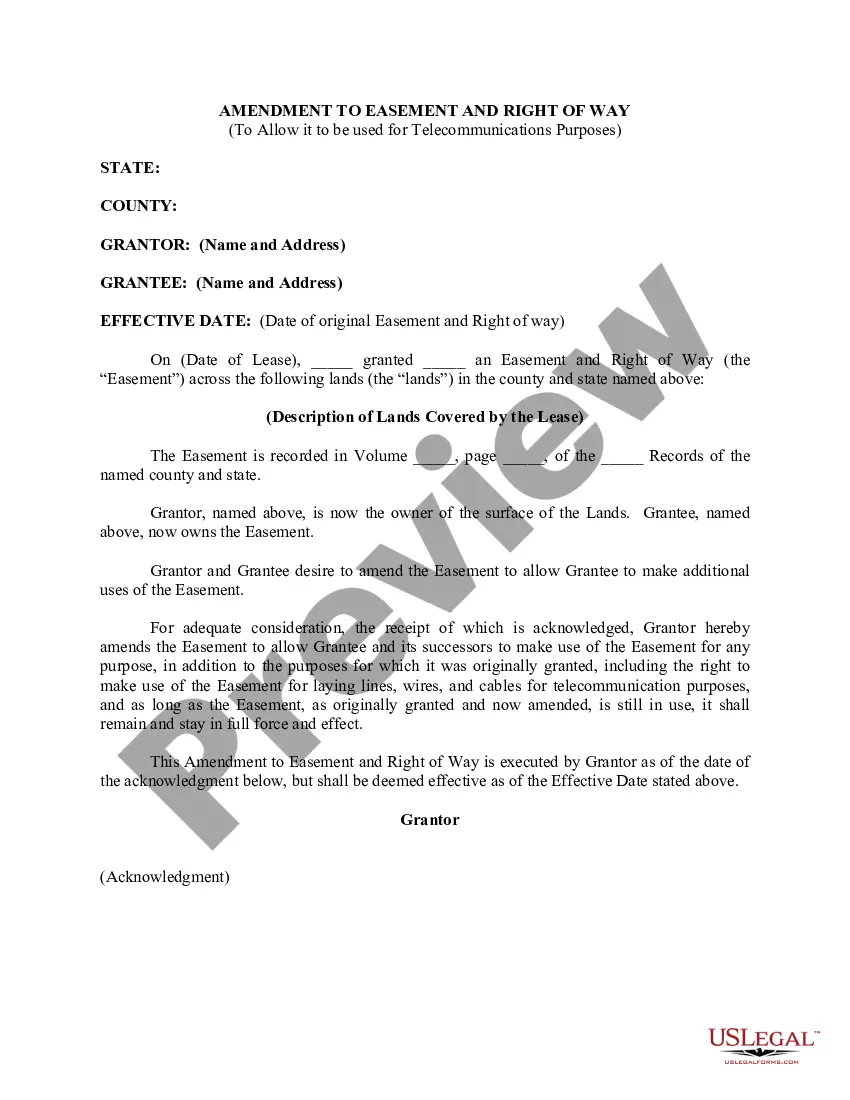
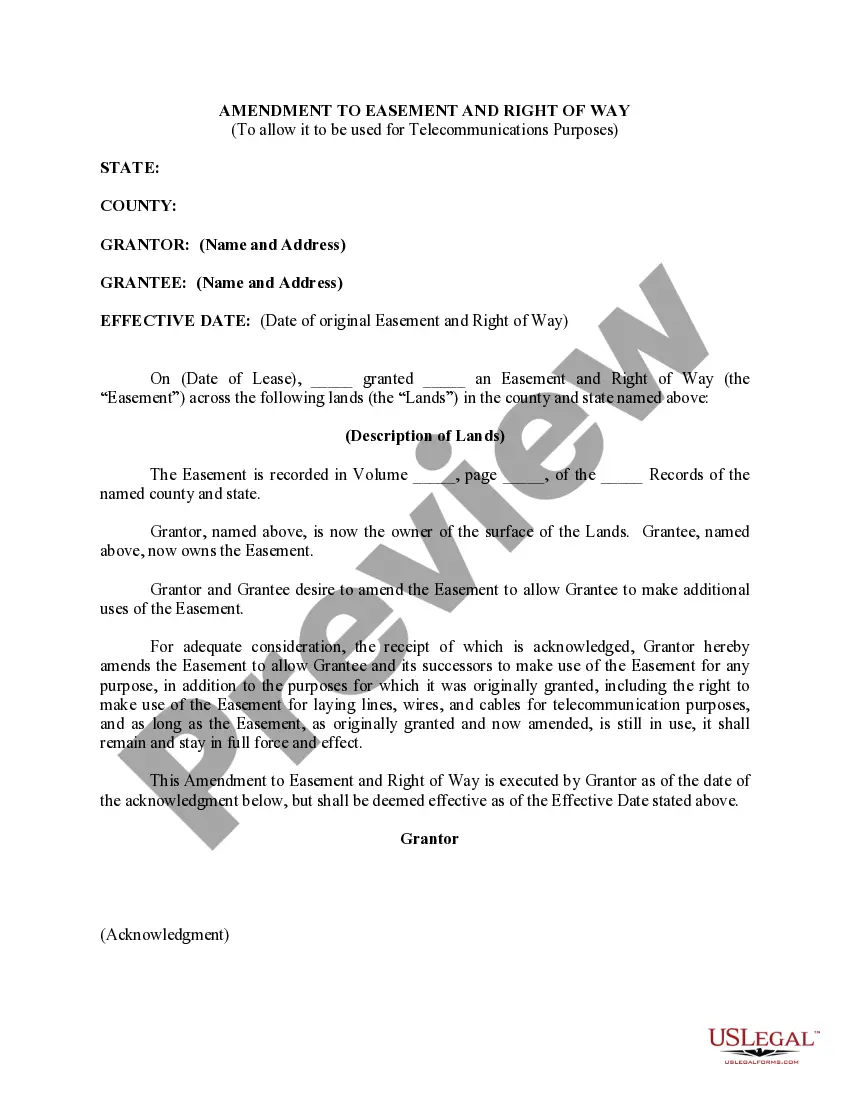
The Amendment to Easement and Right-of-Way to Allow It to Be Used for Telecommunications Purposes is a legal document that modifies an existing easement. This form enables the Grantee and their successors to use the easement not only for its original purposes but also for telecommunications, such as laying lines and cables. This amendment is crucial for property owners who wish to expand the scope of use for an easement while ensuring its legal validity.
Form components explained
- Identification of the Grantor and Grantee with their addresses.
- Effective date of the original easement.
- Description of the lands covered by the easement.
- Reference to the recording of the easement in public records.
- Statement defining the new permitted uses of the easement.
- Signatures of the Grantor with acknowledgment of the amendment's execution.
When this form is needed
This form should be used when the property owner (Grantor) wants to permit additional uses of an existing easement for telecommunications. Typical situations include telecommunications companies wanting to install new infrastructure or when a property owner wishes to enhance the usability of existing easements to accommodate modern communication needs.
Who should use this form
- Property owners (Grantors) who have granted easements on their land.
- Telecommunications companies (Grantees) who need to utilize easements for laying lines and cables.
- Successors of the original easement holders who require expanded rights to the easement.
Instructions for completing this form
- Identify the parties involved: Enter the names and addresses of the Grantor and Grantee.
- Specify the effective date: Include the date of the original easement.
- Describe the property: Provide a detailed description of the lands covered by the easement.
- Reference the recording: Note the volume and page number where the original easement is recorded.
- Acknowledge: Ensure the Grantor signs the form to validate the amendment.
Does this form need to be notarized?
This form must be notarized to be legally valid. US Legal Forms provides secure online notarization powered by Notarize, allowing you to complete the process through a verified video call.
Get your form ready online
Our built-in tools help you complete, sign, share, and store your documents in one place.
Make edits, fill in missing information, and update formatting in US Legal Forms—just like you would in MS Word.
Download a copy, print it, send it by email, or mail it via USPS—whatever works best for your next step.
Sign and collect signatures with our SignNow integration. Send to multiple recipients, set reminders, and more. Go Premium to unlock E-Sign.
If this form requires notarization, complete it online through a secure video call—no need to meet a notary in person or wait for an appointment.
We protect your documents and personal data by following strict security and privacy standards.

Make edits, fill in missing information, and update formatting in US Legal Forms—just like you would in MS Word.

Download a copy, print it, send it by email, or mail it via USPS—whatever works best for your next step.

Sign and collect signatures with our SignNow integration. Send to multiple recipients, set reminders, and more. Go Premium to unlock E-Sign.

If this form requires notarization, complete it online through a secure video call—no need to meet a notary in person or wait for an appointment.

We protect your documents and personal data by following strict security and privacy standards.
Mistakes to watch out for
- Failing to include all necessary party names and addresses.
- Not specifying the original effective date of the easement.
- Leaving out the required property description.
- Neglecting to sign the document in the presence of a notary if required.
Benefits of completing this form online
- Convenience: Download and complete the form at your own pace.
- Editability: Make necessary adjustments to fit your specific needs.
- Reliability: Access professionally drafted forms created by licensed attorneys.
Looking for another form?
Form popularity
FAQ
An easement is a limited right to use another person's land for a stated purpose. Examples of easements include the use of private roads and paths, or the use of a landowner's property to lay railroad tracks or electrical wires.
A Right of Way Easement is a form of Easement annexed to land which grants a right to travel over a part of the landowner's property. This right of way is usually granted to neighbouring landowners. The legal rights of the attached landowners to use and maintain the right of way may not always be clear.
An easement deed allows a party that is not the owner to use a portion of the land. It is a written agreement between two parties that spells out what part of the property is available for access and how it may be used. Since you are granting an easement to your land, you can set any terms and conditions you like.
Give the document a simple title: Grant of Easement is sufficient. Identify the parties. You need to explain who the parties are to the agreement. The person granting the easement to his property is the Grantor and the person gaining access to the property is the Grantee.
Public rights of way can come into existence through creation (either by legal order or by an agreement made with the landowner) or dedication by the landowner (either expressly or by presumption or by deemed dedication following 20 years' public use).
Generally speaking, an easement is a more serious property right; it is the legal right to use someone else's land for a particular purpose. Easements are often recorded at the county clerk's office and encumber your property's title.Here, however, you probably do not need to take the step of granting an easement.
What are Easements and Rights-of-Way? Easements are nonpossessory interests in real property. More simply, an easement is the right to use another's property for a specific purpose. Rights-of-way are easements that specifically grant the holder the right to travel over another's property.
An easement is a nonpossessory right to use and/or enter onto the real property of another without possessing it. It is "best typified in the right of way which one landowner, A, may enjoy over the land of another, B".
An easement, right of way or profit can be expressly released by deed. Once this has been done then it is extinguished and cannot be revived. An easement, right of way or profit can be sometimes impliedly released by the owner's actions or in rare cases by the owner's inaction.