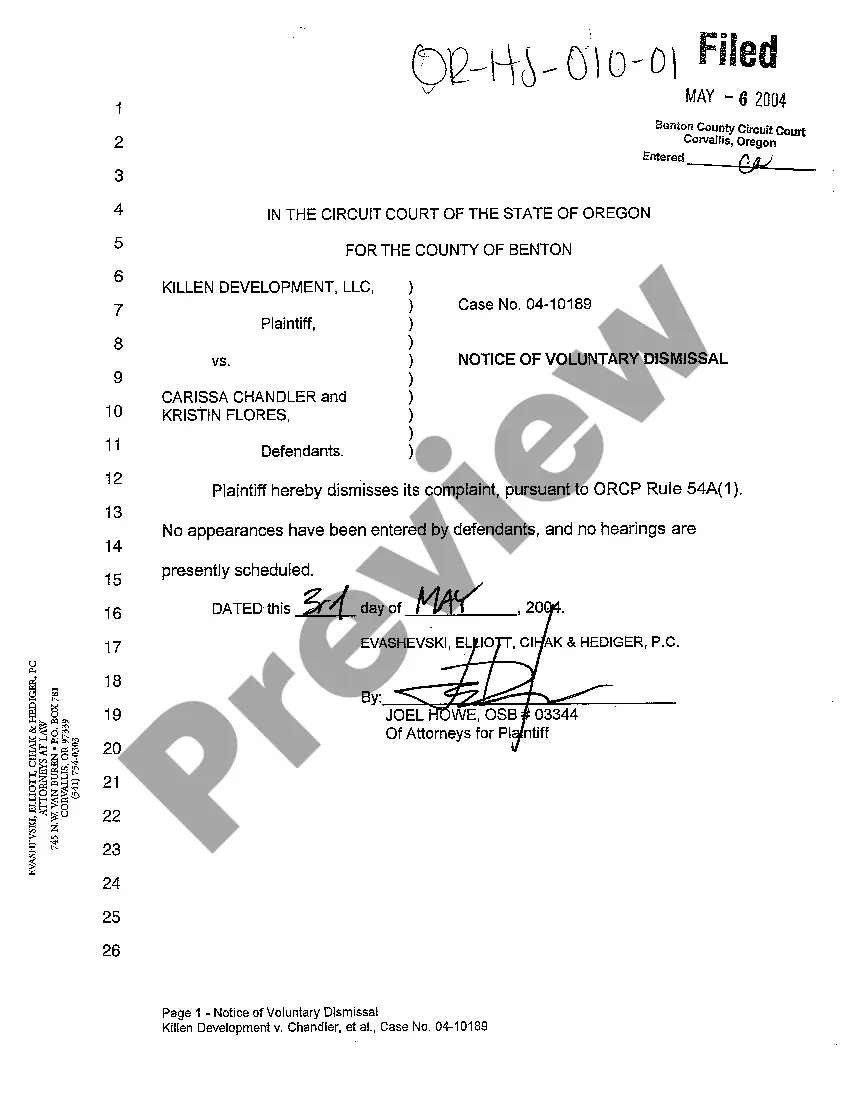
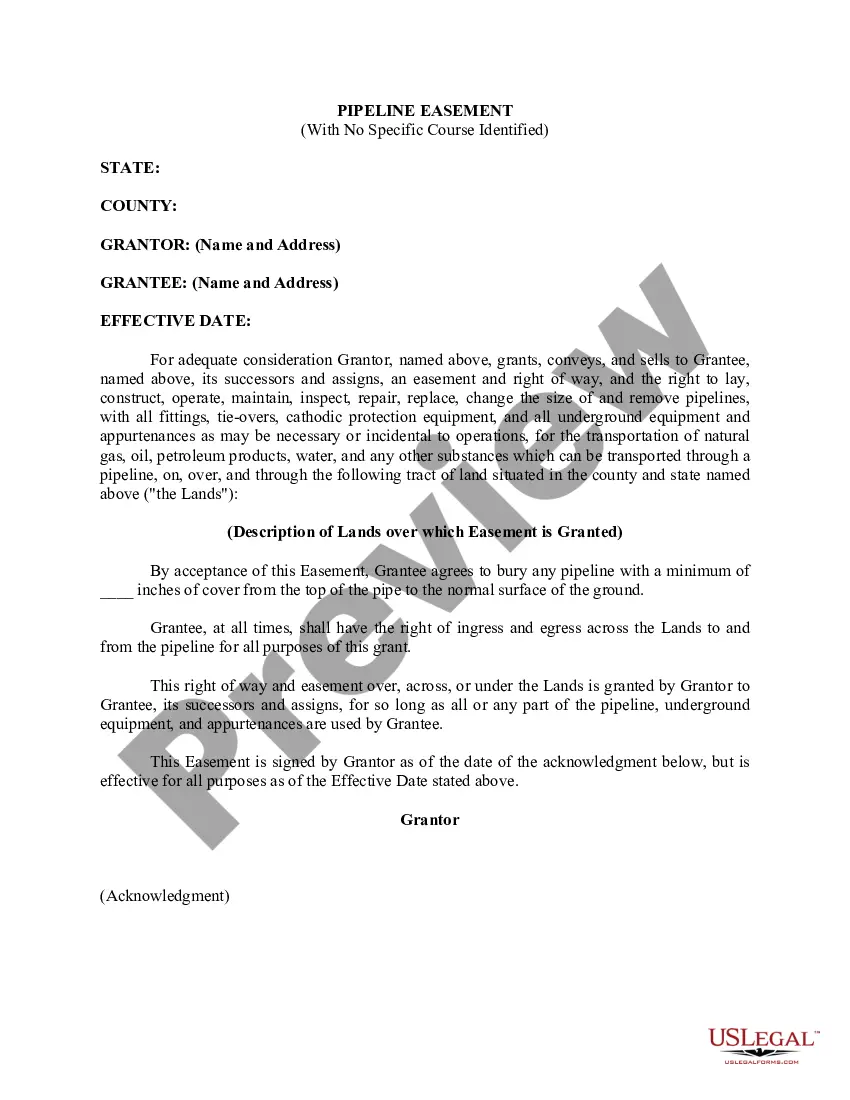
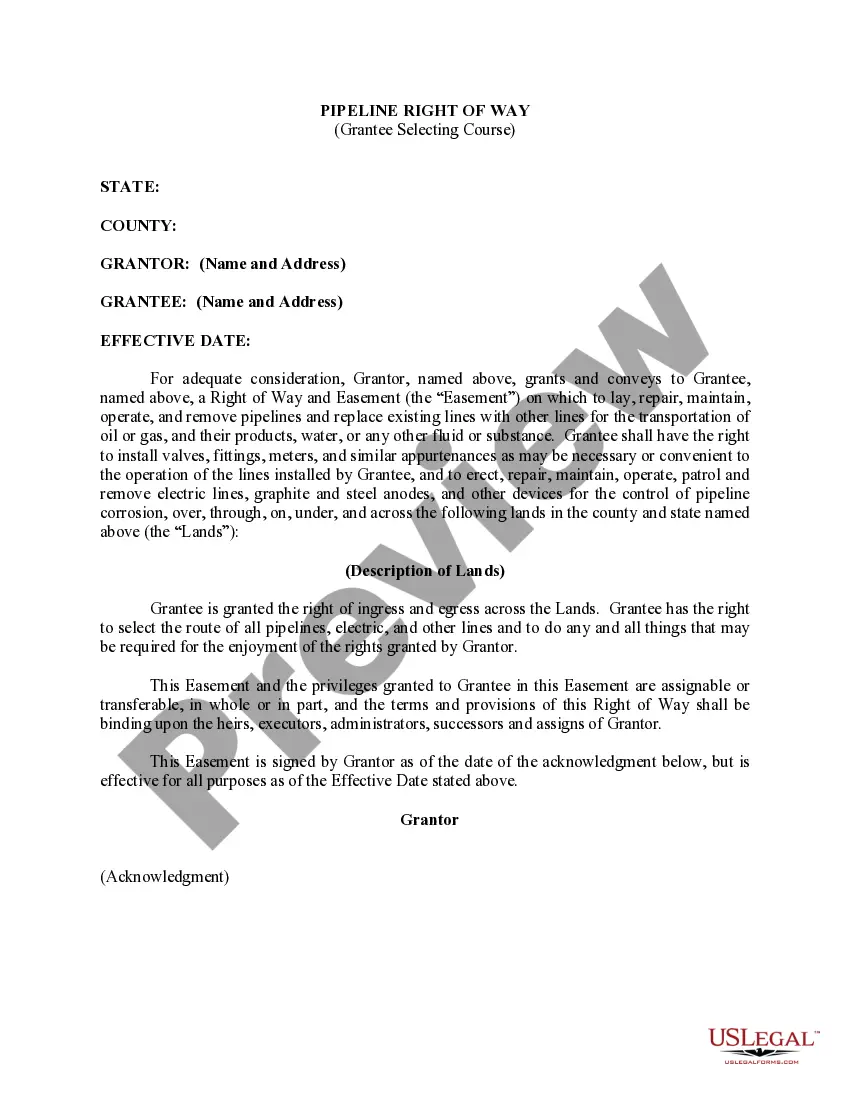
Pipeline Easement With No Specific Course Identified
Understanding this form
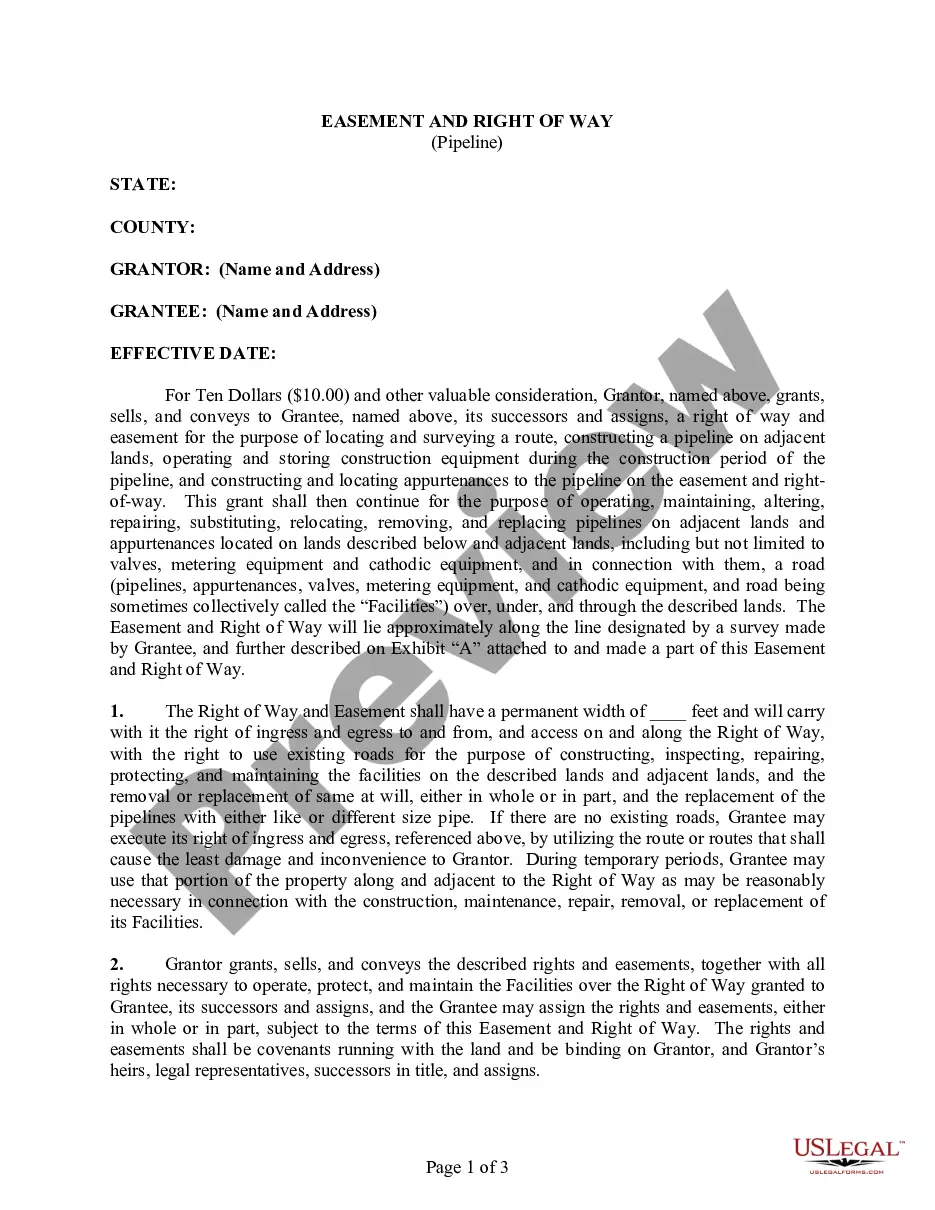
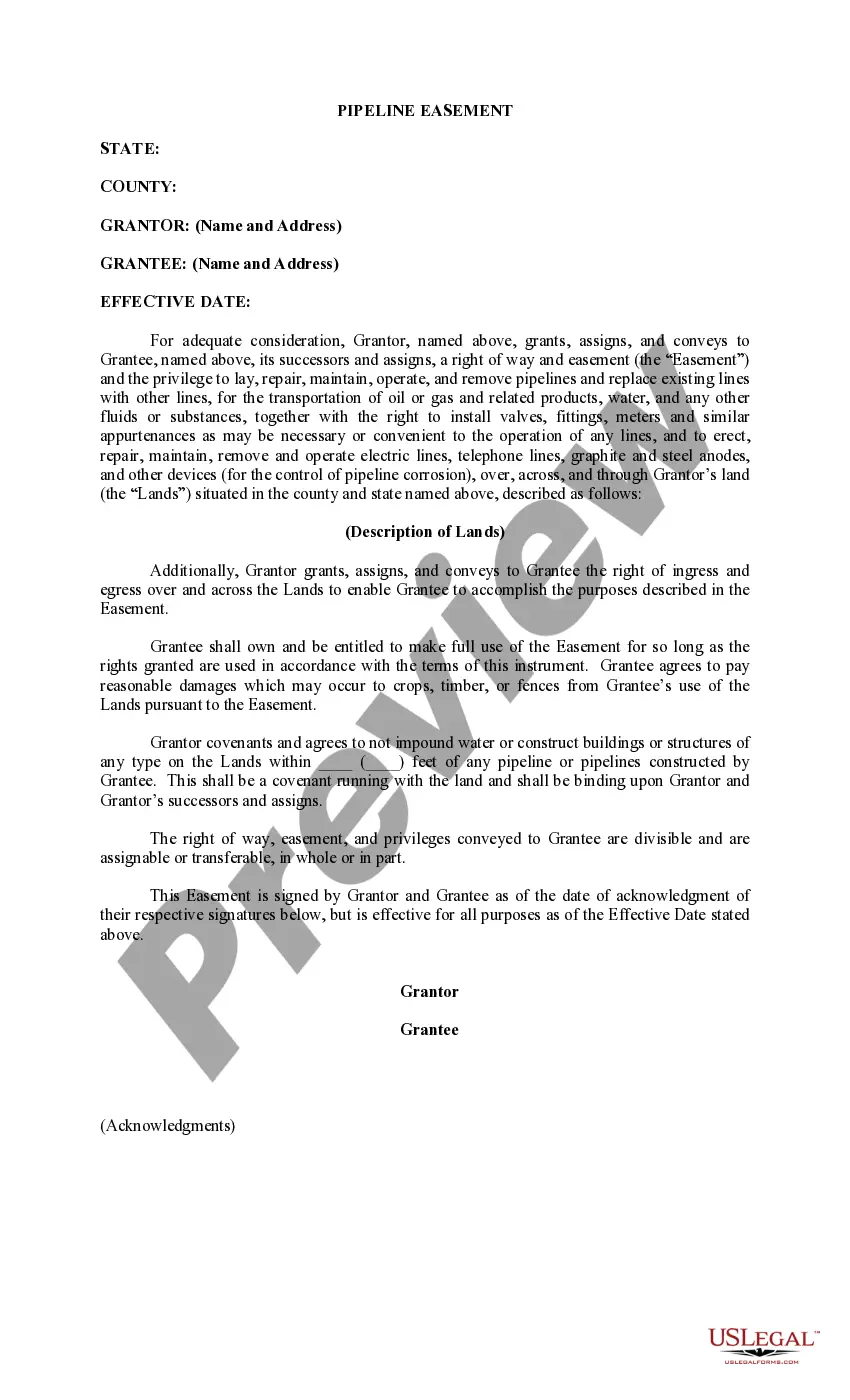
The Pipeline Easement With No Specific Course Identified form is a legal document that allows a Grantor to grant an easement to a Grantee for the installation and maintenance of pipelines. This form differs from other easement agreements by not specifying a particular course for the pipeline, offering flexibility in its placement. It is commonly used for transporting substances like natural gas, oil, and water across private land, ensuring the Grantee has the rights necessary for operation and maintenance activities.
Key parts of this document
- Identification of Grantor and Grantee, including names and addresses.
- Effective date of the easement agreement.
- Description of the land over which the easement is granted.
- Provisions for underground pipeline installation and maintenance, including depth specifications.
- Rights of ingress and egress for the Grantee to access the pipeline.
- Duration of the easement based on usage of the pipeline and associated equipment.
When this form is needed
This form is needed when a property owner (Grantor) wants to allow another party (Grantee) to lay and maintain pipelines on their land without specifying the precise location of the pipelines. It is commonly used in situations involving utility companies or developers who require the flexibility to install infrastructure needed to transport various substances above or below ground.
Who needs this form
- Property owners looking to grant easements for pipeline installation.
- Utility companies or developers needing legal rights to operate pipelines on private property.
- Landlords or land managers involved in agreements related to natural resource transportation.
Instructions for completing this form
- Identify and enter the names and addresses of both the Grantor and Grantee.
- Input the effective date of the easement agreement.
- Provide a detailed description of the land over which the easement is granted.
- Specify the required depth for burying the pipeline.
- Ensure both parties sign the document, acknowledging the terms of the easement.
Does this document require notarization?
This form must be notarized to be legally valid. US Legal Forms provides secure online notarization powered by Notarize, allowing you to complete the process through a verified video call.
Get your form ready online
Our built-in tools help you complete, sign, share, and store your documents in one place.
Make edits, fill in missing information, and update formatting in US Legal Forms—just like you would in MS Word.
Download a copy, print it, send it by email, or mail it via USPS—whatever works best for your next step.
Sign and collect signatures with our SignNow integration. Send to multiple recipients, set reminders, and more. Go Premium to unlock E-Sign.
If this form requires notarization, complete it online through a secure video call—no need to meet a notary in person or wait for an appointment.
We protect your documents and personal data by following strict security and privacy standards.

Make edits, fill in missing information, and update formatting in US Legal Forms—just like you would in MS Word.

Download a copy, print it, send it by email, or mail it via USPS—whatever works best for your next step.

Sign and collect signatures with our SignNow integration. Send to multiple recipients, set reminders, and more. Go Premium to unlock E-Sign.

If this form requires notarization, complete it online through a secure video call—no need to meet a notary in person or wait for an appointment.

We protect your documents and personal data by following strict security and privacy standards.
Avoid these common issues
- Failing to include complete and accurate descriptions of the property.
- Not specifying the required depth for the pipeline installation.
- Omitting signatures or dates, which can invalidate the easement.
Benefits of completing this form online
- Convenient access to professionally drafted legal documents.
- Editable templates allow for customization based on specific needs.
- Instantly downloadable forms simplify the legal process and save time.
Legal use & context
- The easement becomes effective upon signing, allowing the Grantee to operate legally.
- It is important to understand local regulations regarding easement rights and responsibilities.
- Disputes can arise if the easement is poorly defined or lacks clarity in its terms.
Key takeaways
- The Pipeline Easement With No Specific Course Identified form grants essential rights to a Grantee for pipeline operations.
- Accurate and clear documentation is crucial for legal protection and future operations.
- Utilizing the form online offers ease of access and potential for tailored solutions.
Looking for another form?


Form popularity
FAQ
An easement is a limited right to use another person's land for a stated purpose. Examples of easements include the use of private roads and paths, or the use of a landowner's property to lay railroad tracks or electrical wires.
An easement deed allows a party that is not the owner to use a portion of the land. It is a written agreement between two parties that spells out what part of the property is available for access and how it may be used. Since you are granting an easement to your land, you can set any terms and conditions you like.
In order to acquire a prescriptive easement over another's property, the following elements must be met: (1) actual use of the property; (2) open and notorious use of the property; (3) use that is hostile and adverse to the original owner; (4) continuous and uninterrupted use of the property; (5) use of the property
You are willing to either share in or bear the cost of land maintenance and are now ready to negotiate. Reducing the impact the easement has on the neighbor will help convince him to say yes. Include in the negotiations elements that include his continued use and rights to share that parcel of land with you.
An easement is a nonpossessory right to use and/or enter onto the real property of another without possessing it. It is "best typified in the right of way which one landowner, A, may enjoy over the land of another, B".
Thus, he must show that the user was open and notorious, that it was with the knowledge and acquisition of the owner of the servient tenement that the use was continuous and uninterrupted hostile and under a claim of right, exclusive and continued for the period requisite for the acquisition of an easement by
Give the document a simple title: Grant of Easement is sufficient. Identify the parties. You need to explain who the parties are to the agreement. The person granting the easement to his property is the Grantor and the person gaining access to the property is the Grantee.
Generally speaking, an easement is a more serious property right; it is the legal right to use someone else's land for a particular purpose. Easements are often recorded at the county clerk's office and encumber your property's title.Here, however, you probably do not need to take the step of granting an easement.
If an easement is 50 rods long, that is almost an acre. In a recent case, a pipeline company paid some owners $180 per rod and others $767 per rod for the same project.