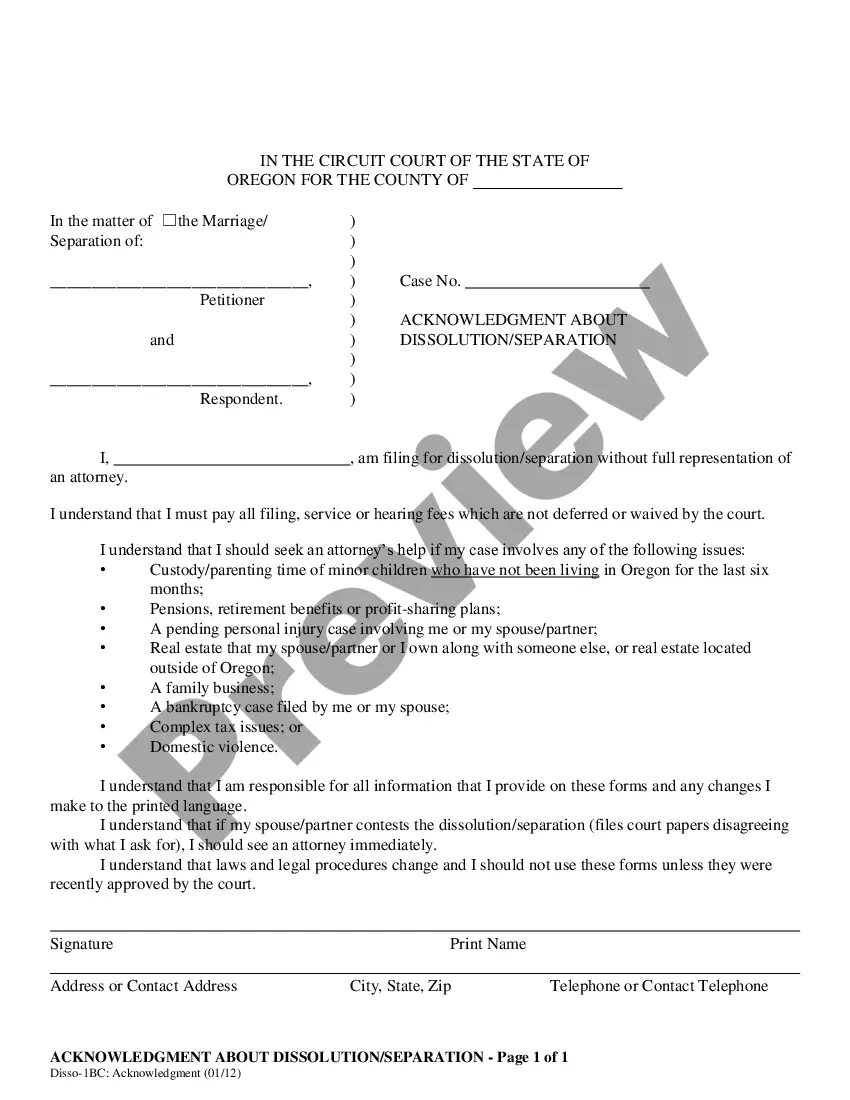
Oregon Acknowledgment About Dissolution / Divorce / Separation
What this document covers
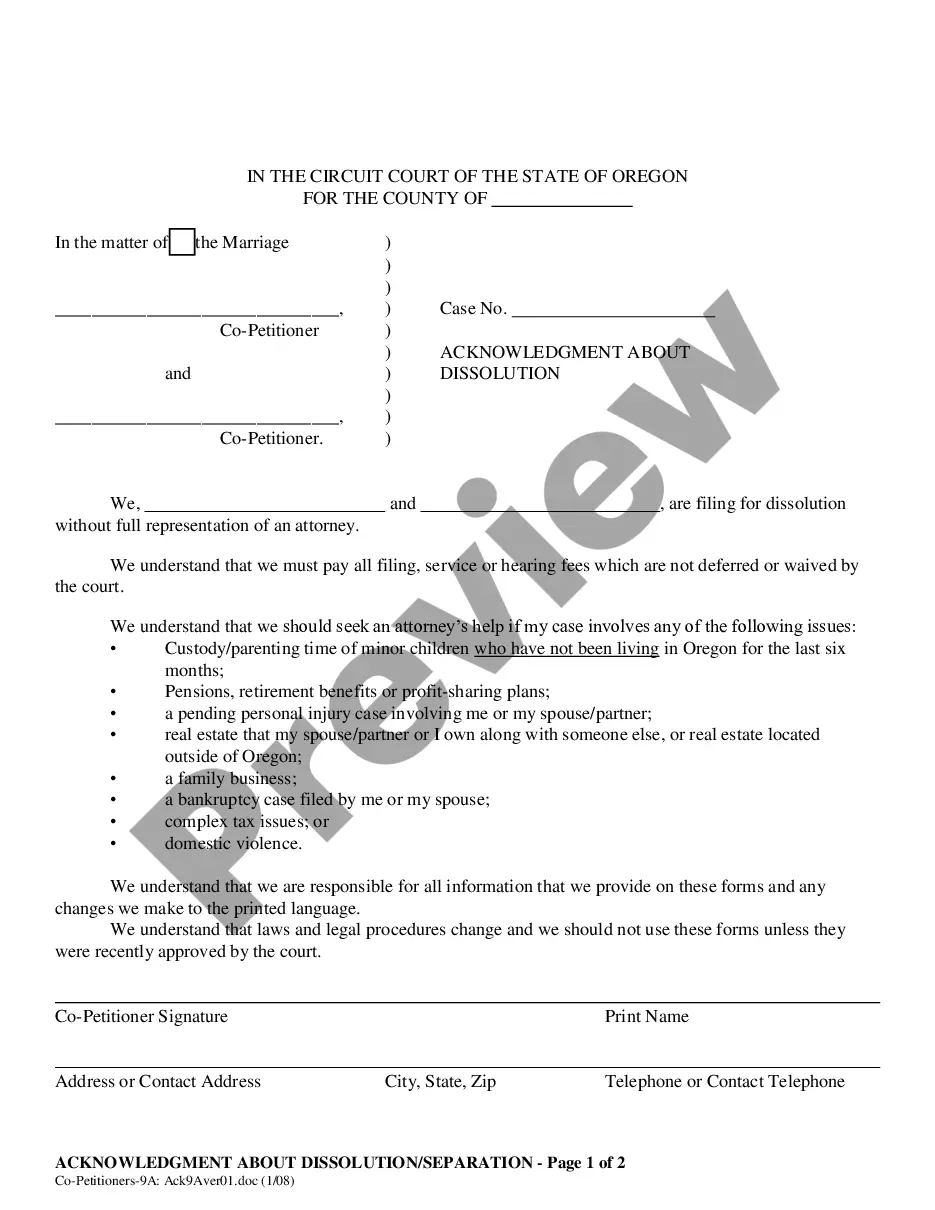
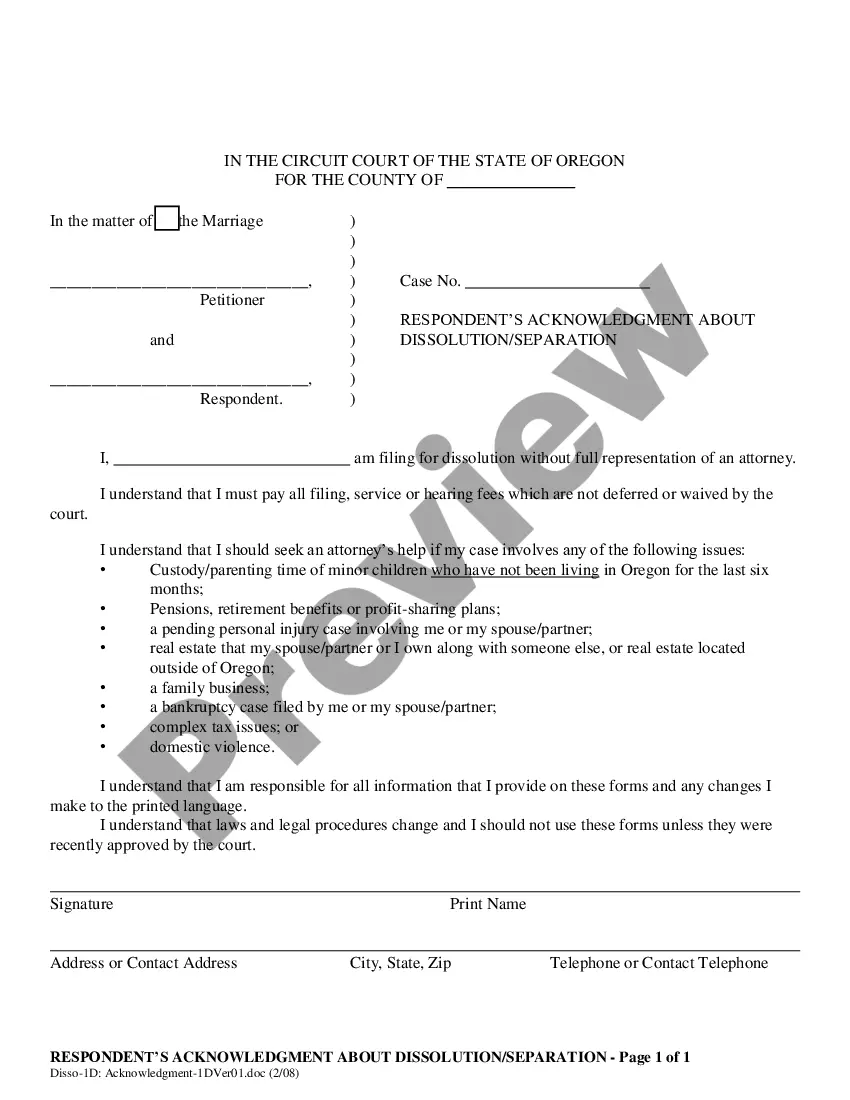
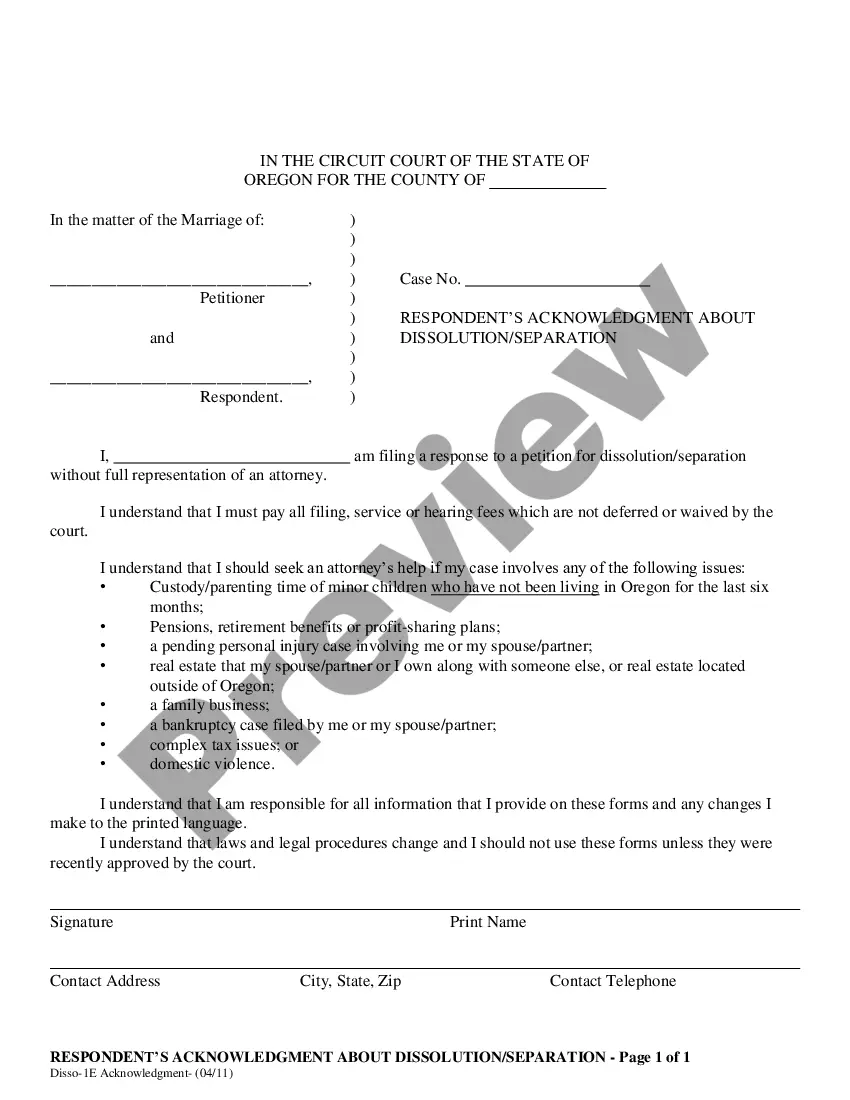
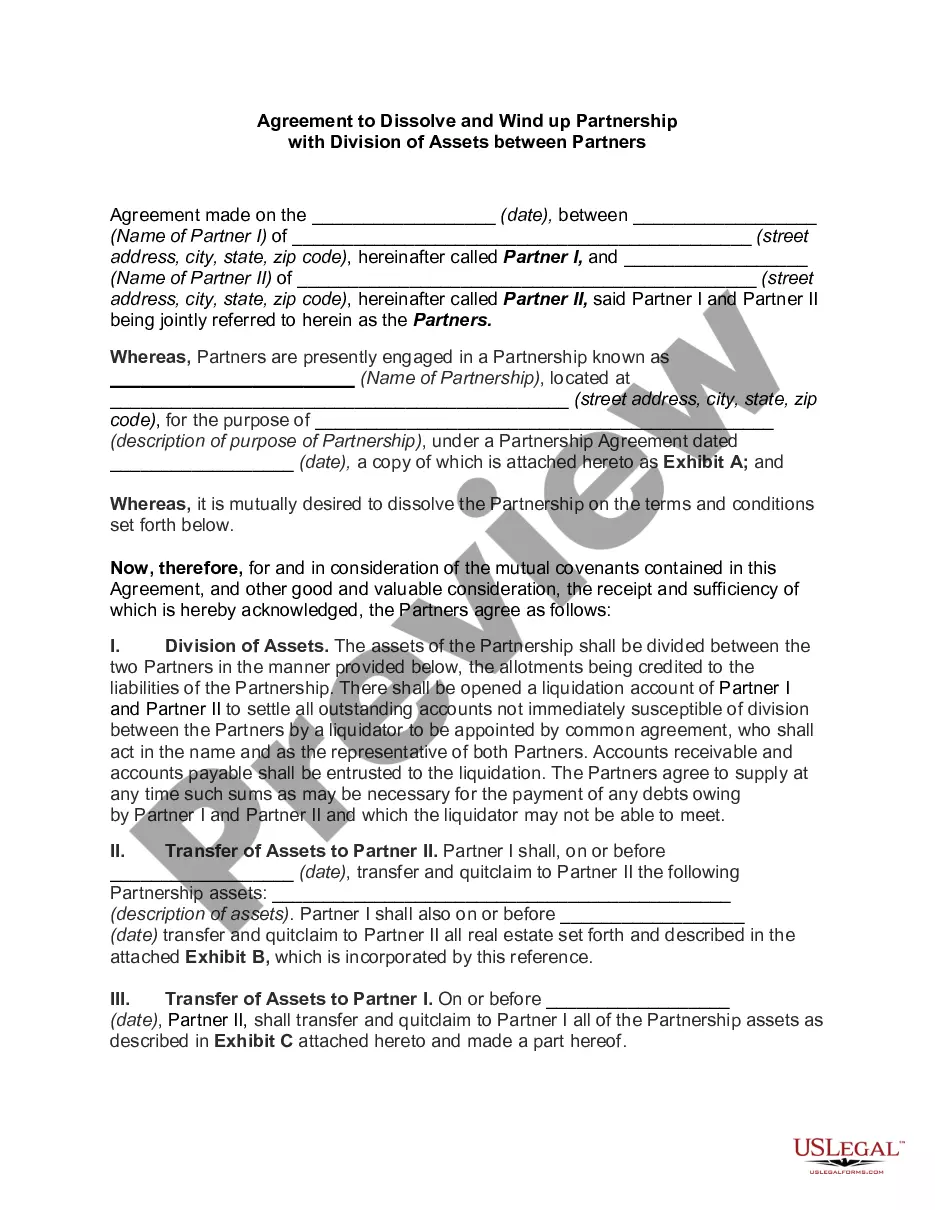
The Acknowledgment About Dissolution, Divorce, or Separation is a legal document that both parties must complete when filing for divorce without an attorney. This form confirms that each party understands they are responsible for filing fees and the potential need for legal representation should disagreements arise. It distinguishes this process from those involving full legal representation.
Main sections of this form
- Identification of the Petitioner and Respondent
- Statement of filing for dissolution/separation without legal representation
- Acknowledgment of responsibility for all court-related fees
- List of circumstances warranting consultation with an attorney
- Signature and printed name of the party filing
- Contact information for both parties

Situations where this form applies
This form is used when either party wishes to initiate a divorce or separation without the assistance of an attorney. It is specifically necessary when filing a divorce petition and serves as both an acknowledgment and a precaution should complications arise during the divorce proceedings.
Who can use this document
- Individuals filing for divorce or legal separation without an attorney.
- Couples who agree on the terms of the divorce and do not anticipate disputes.
- Parties who are aware of their responsibilities regarding court fees.
Instructions for completing this form
- Identify the petitioner's name and the respondentâs name at the top of the form.
- Complete the section confirming the filing without full attorney representation.
- List all known court fees you will be responsible for if applicable.
- Review the issues requiring legal advice and acknowledge your understanding.
- Provide your signature and printed name along with your contact information.
Is notarization required?
This form does not typically require notarization unless specified by local law. Make sure to check any additional requirements that may apply in your jurisdiction.
Get your form ready online
Our built-in tools help you complete, sign, share, and store your documents in one place.
Make edits, fill in missing information, and update formatting in US Legal Forms—just like you would in MS Word.
Download a copy, print it, send it by email, or mail it via USPS—whatever works best for your next step.
Sign and collect signatures with our SignNow integration. Send to multiple recipients, set reminders, and more. Go Premium to unlock E-Sign.
If this form requires notarization, complete it online through a secure video call—no need to meet a notary in person or wait for an appointment.
We protect your documents and personal data by following strict security and privacy standards.

Make edits, fill in missing information, and update formatting in US Legal Forms—just like you would in MS Word.

Download a copy, print it, send it by email, or mail it via USPS—whatever works best for your next step.

Sign and collect signatures with our SignNow integration. Send to multiple recipients, set reminders, and more. Go Premium to unlock E-Sign.

If this form requires notarization, complete it online through a secure video call—no need to meet a notary in person or wait for an appointment.

We protect your documents and personal data by following strict security and privacy standards.
Mistakes to watch out for
- Failing to sign and date the form, which can render it invalid.
- Not providing accurate contact information for both parties.
- Overlooking the list of issues that may require legal assistance.
- Assuming the form is valid without recent court approval.
Why complete this form online
- Immediate access to a legal template drafted by licensed attorneys.
- Convenient download that allows for easy editing and personal customization.
- Reliable format that complies with state regulations.
- Time-saving, as you can complete and submit the document at your own pace.
Looking for another form?
Form popularity
FAQ
Before you can seek a divorce in Oregon, one spouse must have lived continuously in the state for at least six months prior to filing a divorce petition. Legal separations only require that a spouse be currently living in the state. Financially, separations may make more sense than rushing into a divorce.
Actually, legally no one can stop their spouse from filing a divorce case because if a person really intends to divorce his/her spouse, it will most possible be granted to them.And then issuing parting can file for a contested divorce case.
In some states, a separation is required before you can get a divorce under certain grounds. Often a waiting period of six months or one year during which you live separate and apart is necessary before you can get a divorce. In other states, a legal separation can become the grounds for a divorce.
Mail or physically take your written response to the clerk of courts in the county where your spouse filed the initial divorce petition. Check your state's and county's requirements, as you may need to file additional forms such as a financial disclosure form when you file your written response.
Legal separation in Oregon establishes a binding agreement between married people regarding custody, child and spousal support, and division of property.The spouses may enter a separation agreement to live apart for at least one year or indefinitely.
People choose legal separation instead of divorce because of religious beliefs, a desire to keep the family together legally for the sake of children, the need for one spouse to keep the health insurance benefits that would be lost with a divorce, or simple aversion to divorcing despite the desire to live separate
It is possible for you to obtain a legal separation in Oregon prior to obtaining six months residency and then convert that to a divorce once you have lived in Oregon for at least six months.
The main difference between obtaining a legal separation and obtaining a dissolution of marriage is that in a legal separation you do not ask the court to terminate your marital status.Now, when you file for a dissolution of marriage, you are asking the court to terminate your marital status.
If you do decide, having received legal advice, that the right thing to do for you and your family, is to wait for two years before divorcing on that fact, then it will be advisable, in the intervening period, to try and resolve the division of the matrimonial finances, with that agreement being put down in a legal