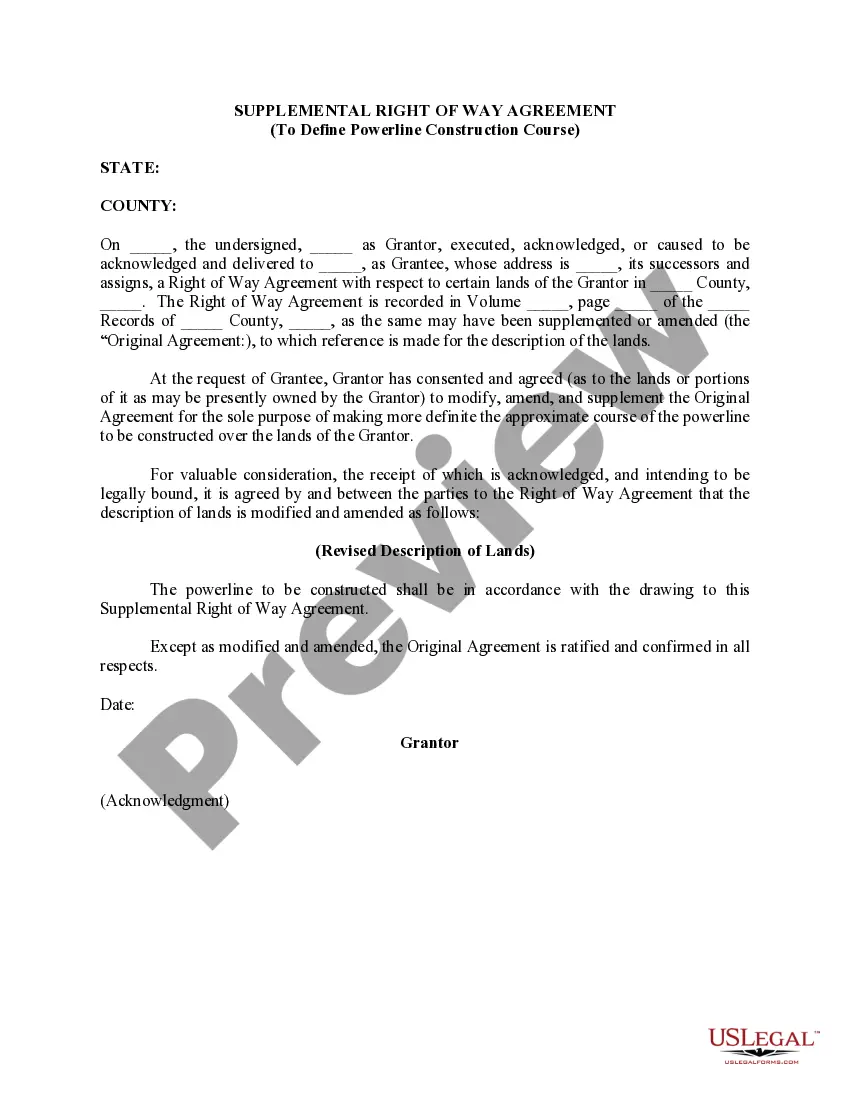
Supplemental Right of Way Agreement (To Define Powerline Construction Course)
Description
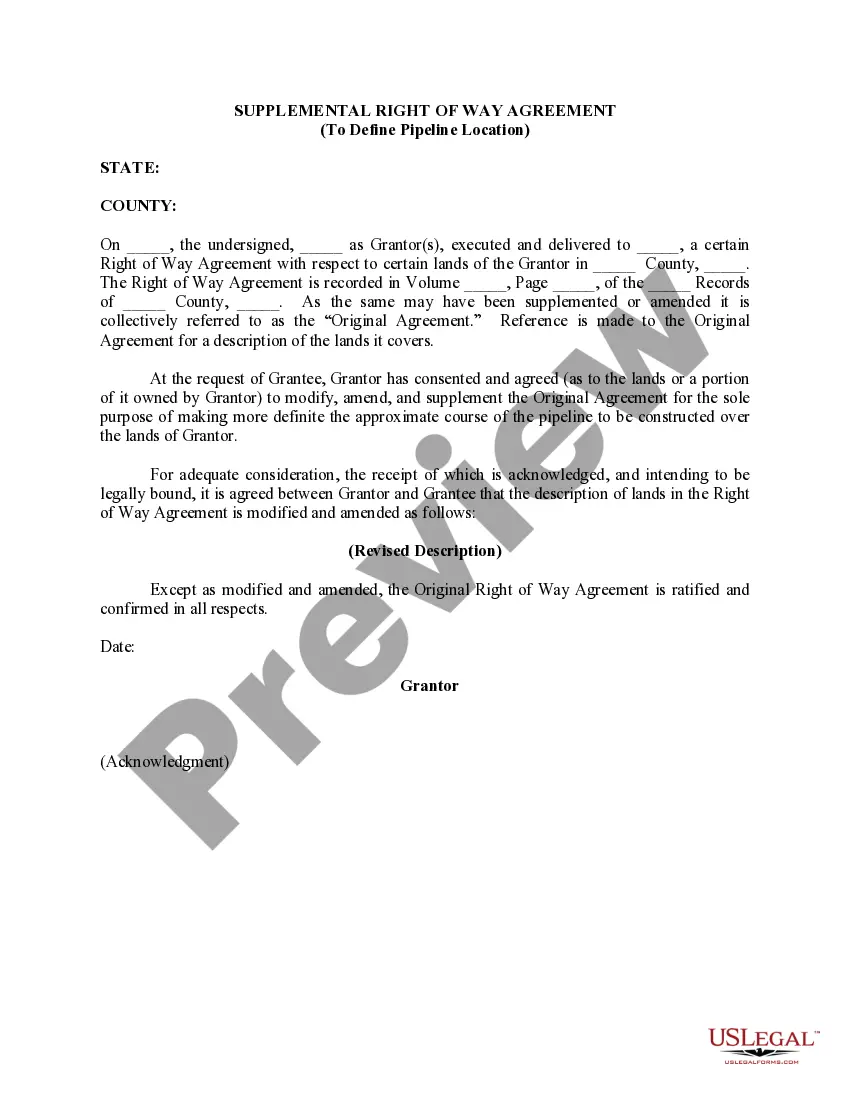
How to fill out Supplemental Right Of Way Agreement (To Define Powerline Construction Course)?
When it comes to drafting a legal form, it’s better to leave it to the specialists. However, that doesn't mean you yourself can’t get a sample to utilize. That doesn't mean you yourself can not get a template to utilize, nevertheless. Download Supplemental Right of Way Agreement (To Define Powerline Construction Course) straight from the US Legal Forms website. It provides numerous professionally drafted and lawyer-approved forms and templates.
For full access to 85,000 legal and tax forms, users just have to sign up and select a subscription. When you are signed up with an account, log in, find a specific document template, and save it to My Forms or download it to your device.
To make things easier, we have provided an 8-step how-to guide for finding and downloading Supplemental Right of Way Agreement (To Define Powerline Construction Course) promptly:
- Make sure the document meets all the necessary state requirements.
- If available preview it and read the description prior to buying it.
- Hit Buy Now.
- Select the suitable subscription for your requirements.
- Make your account.
- Pay via PayPal or by credit/credit card.
- Choose a preferred format if a few options are available (e.g., PDF or Word).
- Download the document.
After the Supplemental Right of Way Agreement (To Define Powerline Construction Course) is downloaded you can fill out, print out and sign it in any editor or by hand. Get professionally drafted state-relevant documents within a matter of seconds in a preferable format with US Legal Forms!
Form popularity
FAQ
The party gaining the benefit of the easement is the dominant estate (or dominant tenement), while the party granting the benefit or suffering the burden is the servient estate (or servient tenement). For example, the owner of parcel A holds an easement to use a driveway on parcel B to gain access to A's house.
A: Firstly you should establish whether there is any legal right of way to the property.With an easement your mother may insist your neighbour removes the fence obstructing her right of way. That access has been blocked for two years is likely to be irrelevant. Easements can also be abandoned.
"National roads shall have a right of way of not less than twenty (20) meters, provided, that such minimum width may be reduced at the discretion of the Minister of Public Highways to fifteen (15) meters in highly urbanized areas and that a right of way of at least sixty (60) meters shall be reserved for roads
Who maintains the property subject to an easement or right-of-way? Maintenance of the property is the responsibility of the landowner. If the holder of the easement or right-of-way causes any damage, they must restore the property to the original condition or pay damages.
A Any substantial interference with a right of way is a nuisance in common law. The owner of the right (known as the dominant owner) can apply to court for an injunction and damages if the landowner (or servient owner) blocks it.
The owner of the land that has the benefit of the right of way (the user) also has no obligation to maintain and repair but is entitled to maintain and repair the way but if he does so, he has to do so at his own cost.
What are Easements and Rights-of-Way? Easements are nonpossessory interests in real property. More simply, an easement is the right to use another's property for a specific purpose. Rights-of-way are easements that specifically grant the holder the right to travel over another's property.
Generally once an easement or right of way has arisen it will continue indefinitely unless it is extinguished or released.
It is well established that for a gate to be an obstruction to a private right of way it must substantially interfere with the right of way.However, as in this case, three gates within less than 100 meteres of each other did amount to a substantial interference with the private right of way.