Agreement to Execute Mutual or Joint and Mutual Will by Husband and Wife with Estate to Survivor
What is this form?
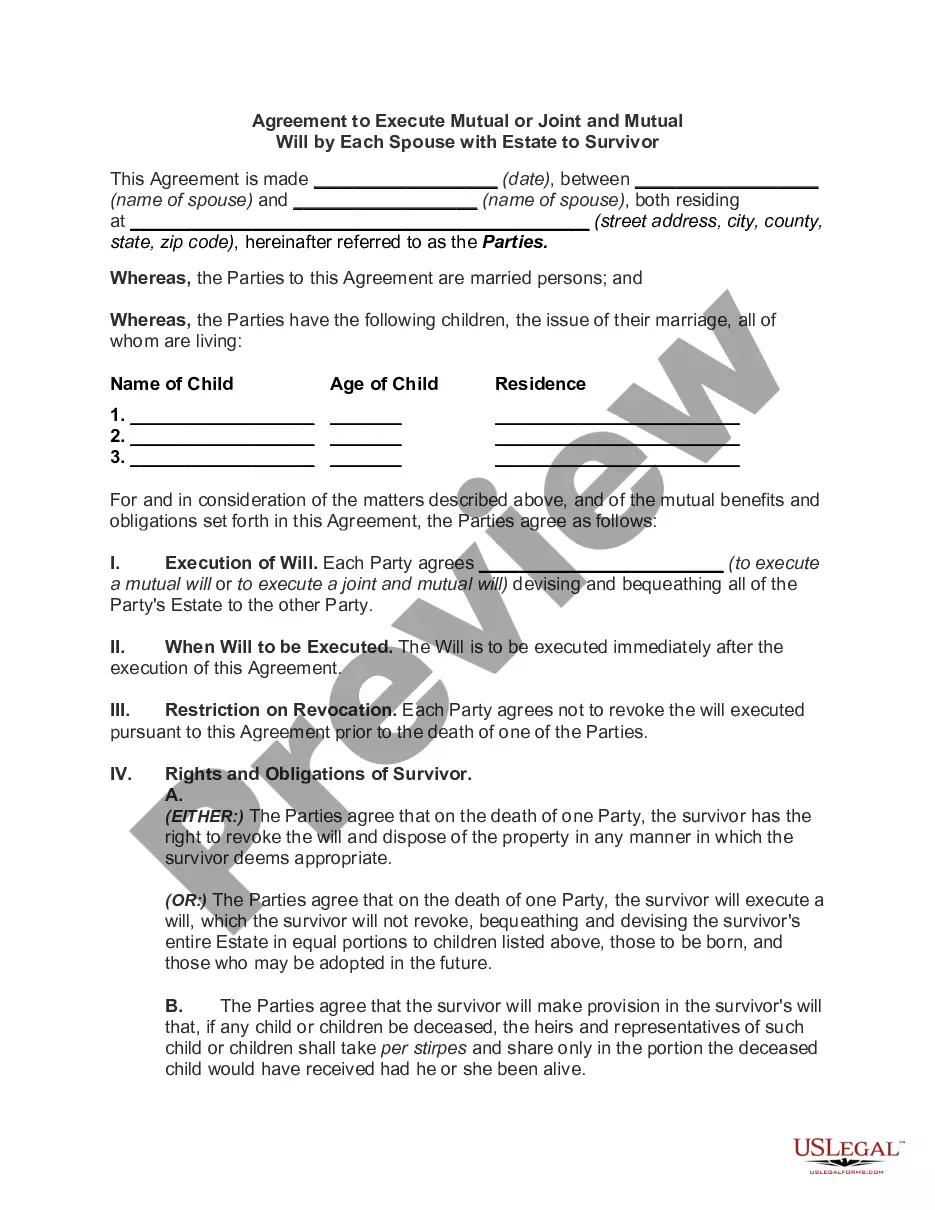
The Agreement to Execute Mutual or Joint and Mutual Will by Husband and Wife with Estate to Survivor is a legal document that outlines a mutual agreement between spouses to create wills that reflect their shared estate planning intentions. This form is essential in ensuring that one spouse bequeaths their estate to the other, helping to simplify inheritance and ensure that property is passed on according to their wishes. Unlike standard wills, this agreement contains specific provisions regarding the revocation and disposition of these wills after one spouse passes away, making it a vital tool for married couples looking to solidify their estate plans.
What’s included in this form
- Identification of the parties (husband and wife) and their residence.
- Provisions for executing mutual or joint wills that include estate bequeathments.
- Clauses regarding when the wills will be executed and restrictions on revocation.
- Rights of the surviving spouse related to the estate after one spouse's death.
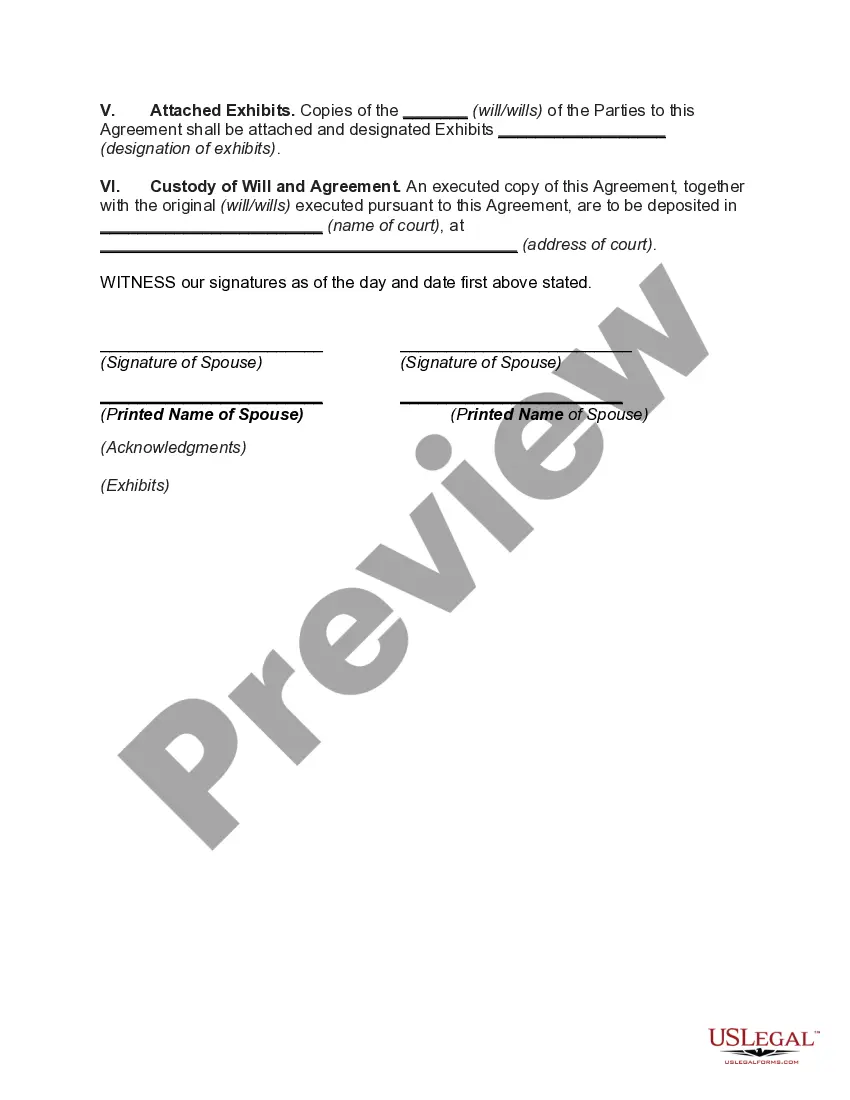
- Instructions for the custody of the executed wills.
When to use this form
This form should be used when a married couple wishes to ensure that their wills reflect a mutual agreement on estate distribution. It is particularly useful when both parties have children and would like to designate how their assets will be handled after one spouse's death. It helps to prevent potential disputes among heirs and ensures that the couple's intentions are clear regarding their shared estate.
Who needs this form
- Married couples wishing to specify mutual estate planning intentions.
- Individuals who want to ensure their spouse inherits their estate without complications.
- Couples with children looking to clarify the distribution of their estate.
- Couples interested in preventing potential probate disputes among heirs.
Completing this form step by step
- Identify the date of the agreement and the names of both parties (husband and wife).
- Provide the complete residential address of both parties.
- List any children, including their names, ages, and residences, as specified in the form.
- Specify whether each party will execute a mutual will or a joint and mutual will.
- Sign and date the agreement along with any required acknowledgments.
Notarization guidance
This form does not typically require notarization to be legally valid. However, some jurisdictions or document types may still require it. US Legal Forms provides secure online notarization powered by Notarize, available 24/7 for added convenience.
Get your form ready online
Our built-in tools help you complete, sign, share, and store your documents in one place.
Make edits, fill in missing information, and update formatting in US Legal Forms—just like you would in MS Word.
Download a copy, print it, send it by email, or mail it via USPS—whatever works best for your next step.
Sign and collect signatures with our SignNow integration. Send to multiple recipients, set reminders, and more. Go Premium to unlock E-Sign.
If this form requires notarization, complete it online through a secure video call—no need to meet a notary in person or wait for an appointment.
We protect your documents and personal data by following strict security and privacy standards.

Make edits, fill in missing information, and update formatting in US Legal Forms—just like you would in MS Word.

Download a copy, print it, send it by email, or mail it via USPS—whatever works best for your next step.

Sign and collect signatures with our SignNow integration. Send to multiple recipients, set reminders, and more. Go Premium to unlock E-Sign.

If this form requires notarization, complete it online through a secure video call—no need to meet a notary in person or wait for an appointment.

We protect your documents and personal data by following strict security and privacy standards.
Common mistakes to avoid
- Failing to list all children, which may lead to complications during estate distribution.
- Not notarizing the document when required by state law.
- Underestimating the importance of mutual consent on revocation terms.
- Leaving ambiguous language that could lead to disputes over the estate.
Why use this form online
- Convenient access to professionally drafted legal forms at any time.
- Editability allows users to customize the form to their specific situation.
- Assurance of legal compliance with state-specific requirements.
- Easy download and storage options for important documents.
Looking for another form?


Form popularity
FAQ
Making one will for two people is usually not advisable because it's irrevocable after the first spouse's death.Even though married couples often have the same goals in mind when making their estate plan, most attorneys advise against joint wills.
A joint will can be made with another person through an agreement but it cannot be revoked by one testator.At the same time if it can be proved that there is no such agreement made between the parties then the testator has the right to revoke the will.
A joint will is one that two people, typically a married couple, sign together.Most joint wills are written such that when one spouse dies, their portion of the estate passes to the other. Then the entire estate goes to their children when the second spouse passes away.
There is no restriction on how many times a Will can be made by a testator. However, only the last Will made before his death is enforceable.
Making one will for two people is usually not advisable because it's irrevocable after the first spouse's death.Even though married couples often have the same goals in mind when making their estate plan, most attorneys advise against joint wills.
The mutual wills can be revoked during the lifetimes of both testators, but, on the first death, the survivor is prevented from making a new will in the future.
Like most wills, a joint will lets the will-makers name who will get their property and assets after they die. Joint wills are usually created by married couples.After one spouse has died, all the couple's property will be left to the surviving spouse; and.
A mutual Will is where two (or more) testators make Wills which mirror the contents of the other(s). However, mutual Wills cannot be altered upon the death of one of the testators.
As per the law, the joint assets are owned by both individuals hence both individuals i.e. husband & wife should make a Will either two separate Wills or one single Joint Will.Hence Joint Will is ideal for couple having same wishes for their succession planning.