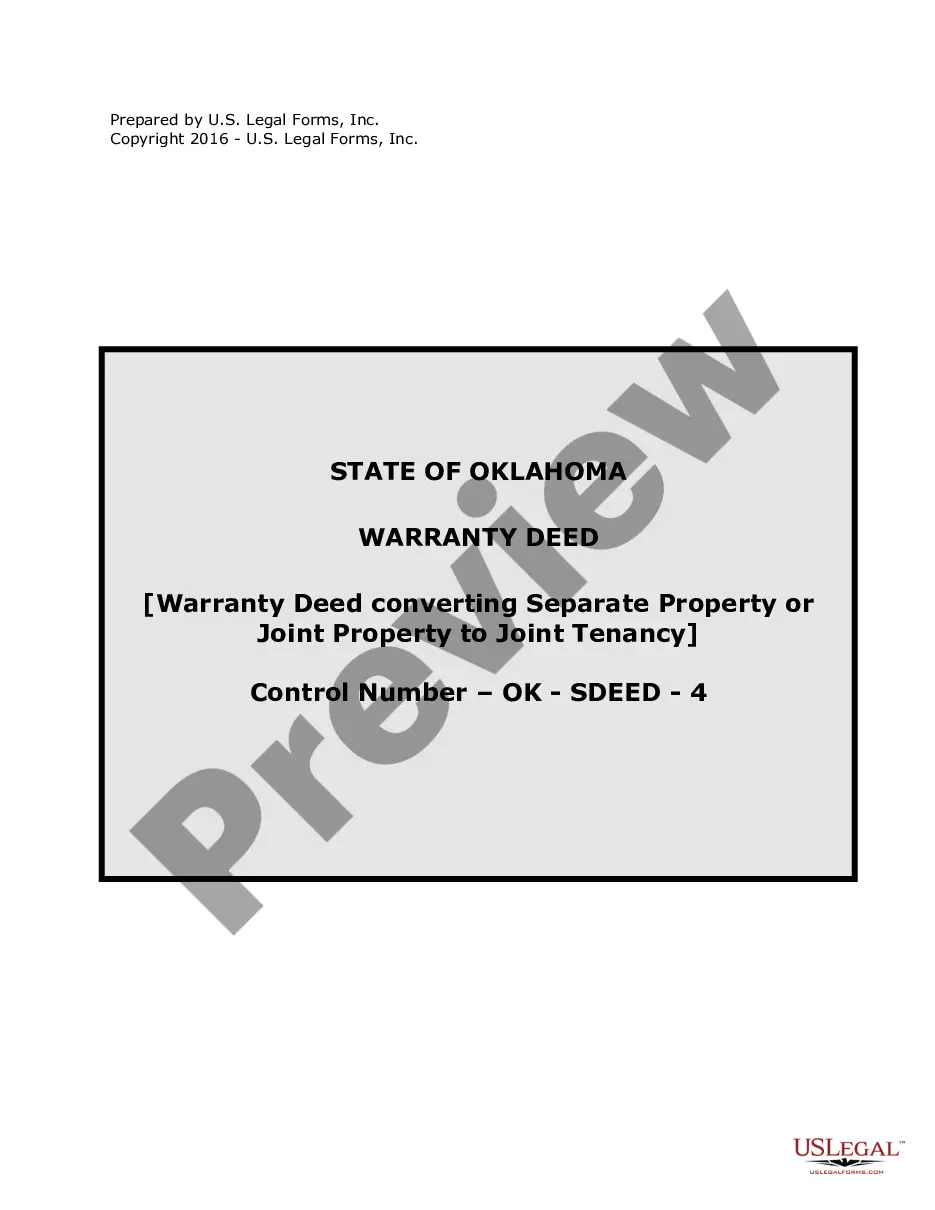
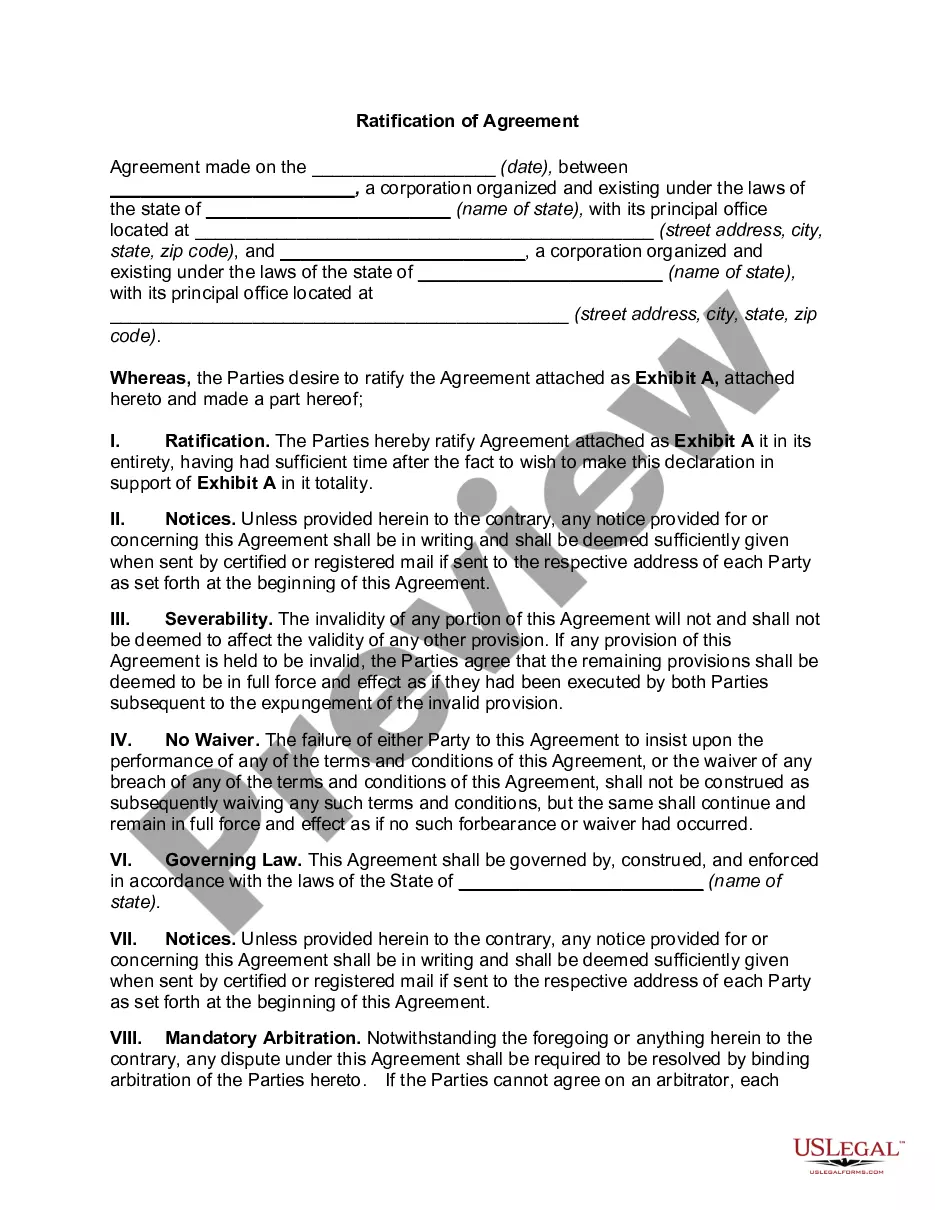
Ratification Agreement (Right of Way)
Understanding this form
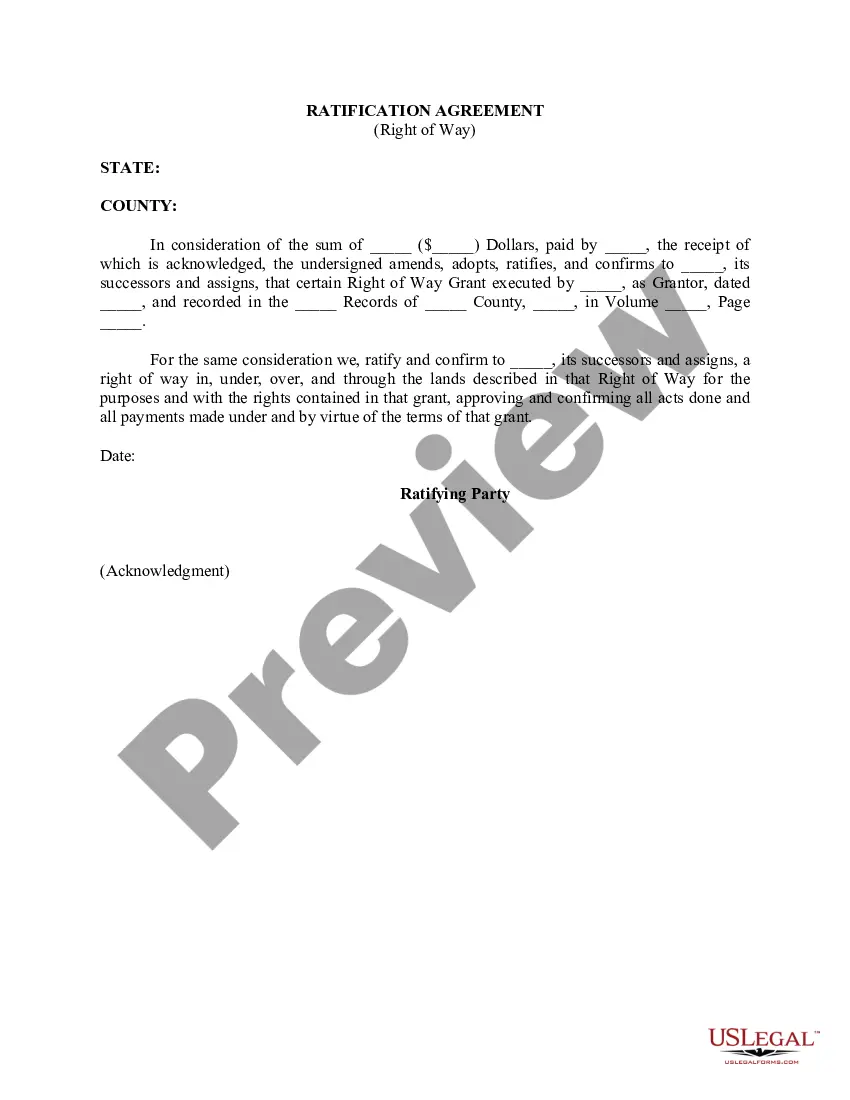
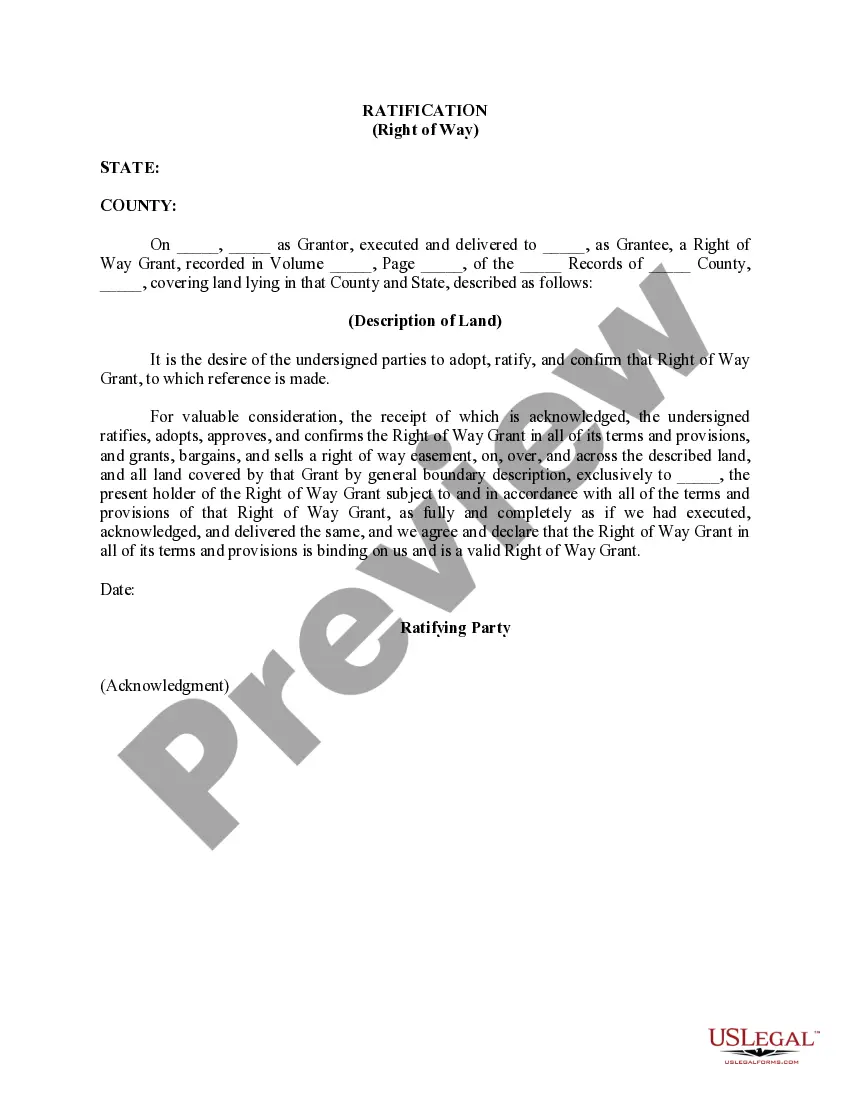
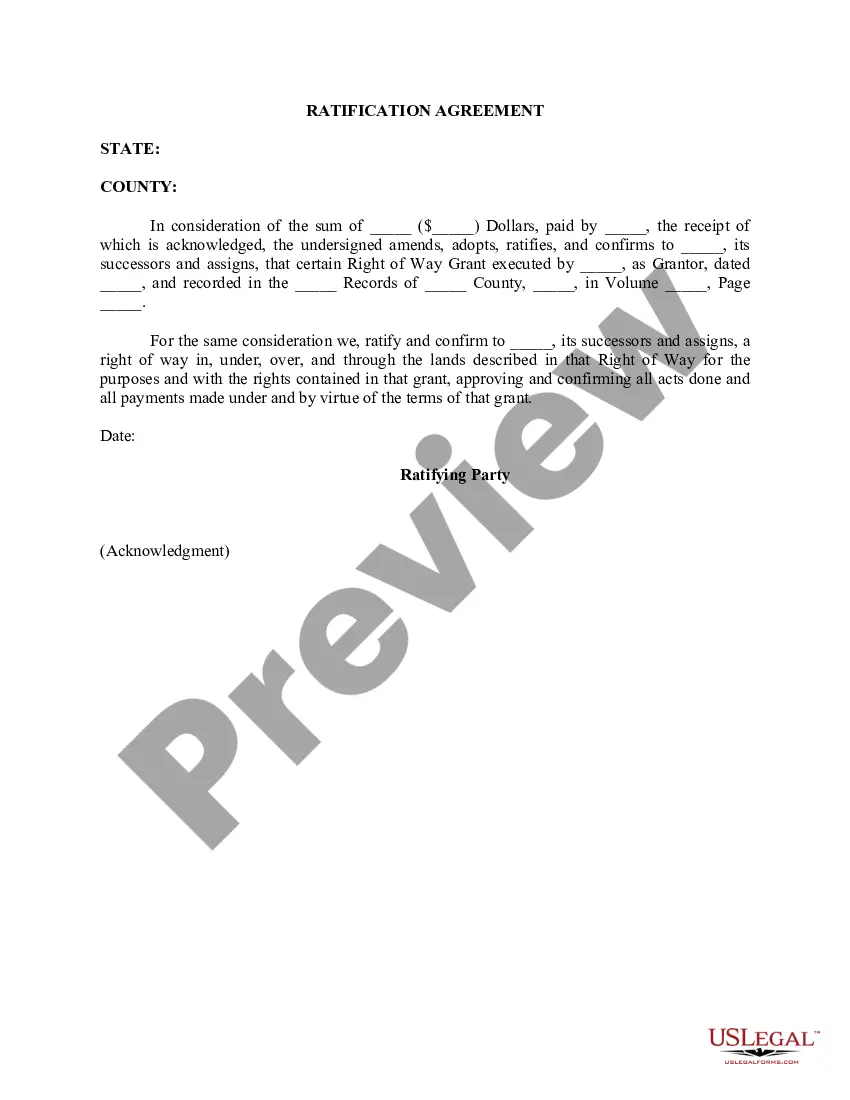
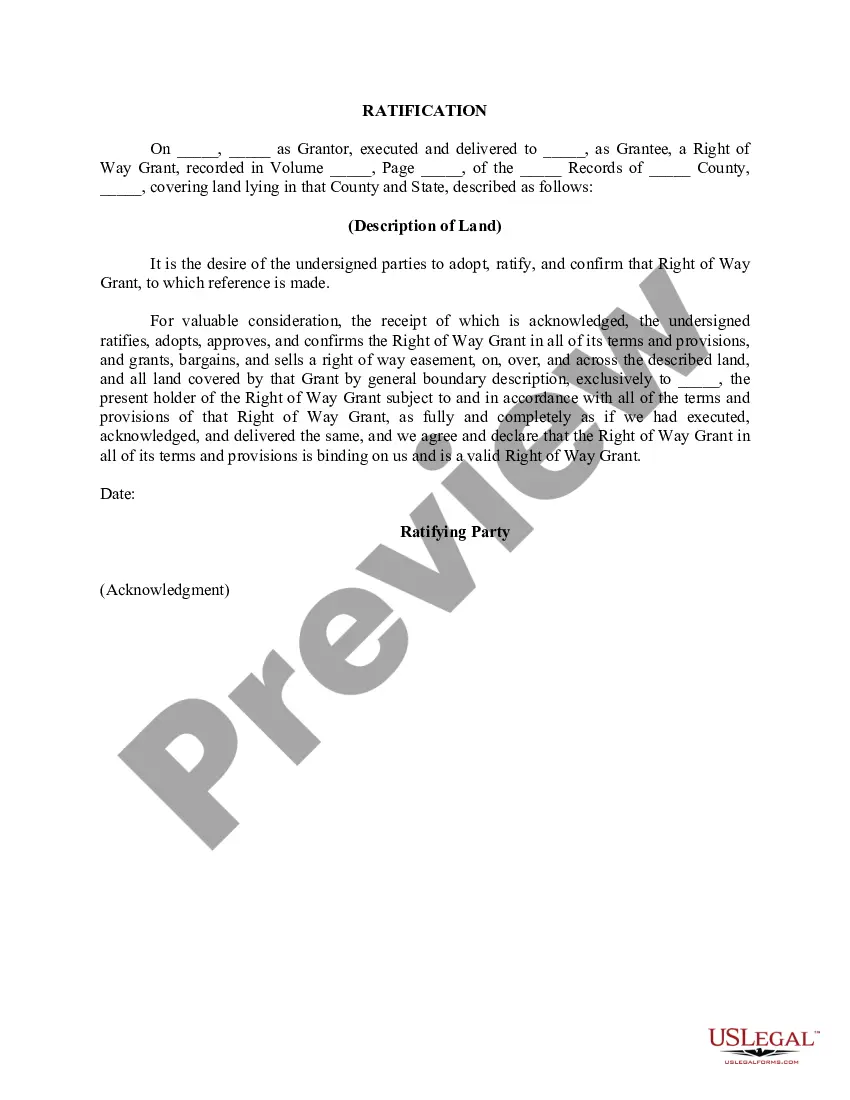
The Ratification Agreement (Right of Way) is a legal document used to confirm and amend a previously executed Right of Way Grant. This form serves to formalize the acknowledgment of terms related to access rights over a specified property, ensuring that all parties involved understand and accept the terms as laid out in the original grant. Unlike generic land use documents, this agreement specifically addresses the ratification of rights of way, making it crucial for property transactions or developments that require legal clarity regarding land access.
What’s included in this form
- Consideration: Specifies the amount paid for the rights conveyed, ensuring that a legal exchange of value has occurred.
- Parties Involved: Identifies the ratifying party and the party receiving the confirmed rights.
- Description of the original Right of Way Grant: Citations to specific records where the original document is filed, providing legal reference.
- Confirmation of rights: Outlines the rights being ratified, including access in, under, over, and through the specified lands.
- Date of ratification: Indicates when the ratification is executed, which is vital for legal record-keeping.
When this form is needed
This form is typically used when a party wants to confirm existing rights conveyed through a previously established Right of Way Grant. Situations may include real estate developments, infrastructure projects, or any scenario where land access is legally ambiguous or requires a formal acknowledgment for future transactions. It ensures all parties are aware of their rights and obligations regarding land access.
Who can use this document
- Property owners looking to secure or clarify access rights to their land.
- Developers needing to ratify access rights for construction projects.
- Legal professionals assisting clients with land use and access issues.
- Real estate brokers facilitating property transactions that involve right of way considerations.
Instructions for completing this form
- Identify the parties: Clearly state the names of the ratifying party and the entity benefiting from the right of way.
- Specify the consideration: Fill in the amount paid to confirm the ratification.
- Reference the original grant: Include details about the original Right of Way Grant, including the grantor's name, date, and recording information.
- Indicate the purpose and rights: Describe the rights being ratified regarding access to the property.
- Sign and date the form: Ensure that signatures are obtained from the ratifying parties and that the date of ratification is included for legal validation.
Notarization guidance
This form must be notarized to be legally valid. US Legal Forms provides secure online notarization powered by Notarize, allowing you to complete the process through a verified video call.
Get your form ready online
Our built-in tools help you complete, sign, share, and store your documents in one place.
Make edits, fill in missing information, and update formatting in US Legal Forms—just like you would in MS Word.
Download a copy, print it, send it by email, or mail it via USPS—whatever works best for your next step.
Sign and collect signatures with our SignNow integration. Send to multiple recipients, set reminders, and more. Go Premium to unlock E-Sign.
If this form requires notarization, complete it online through a secure video call—no need to meet a notary in person or wait for an appointment.
We protect your documents and personal data by following strict security and privacy standards.

Make edits, fill in missing information, and update formatting in US Legal Forms—just like you would in MS Word.

Download a copy, print it, send it by email, or mail it via USPS—whatever works best for your next step.

Sign and collect signatures with our SignNow integration. Send to multiple recipients, set reminders, and more. Go Premium to unlock E-Sign.

If this form requires notarization, complete it online through a secure video call—no need to meet a notary in person or wait for an appointment.

We protect your documents and personal data by following strict security and privacy standards.
Mistakes to watch out for
- Failing to include the correct reference to the original Right of Way Grant.
- Not specifying the consideration amount paid, which is critical for the ratification to be legally binding.
- Omitting signatures or dates, as this can invalidate the agreement.
- Using vague language when describing the rights being ratified.
Why use this form online
- Immediate availability: Download the form instantly without waiting for physical copies.
- Editability: Customize the form to your specific situation before printing.
- Accuracy: Forms are drafted by licensed attorneys to ensure compliance with legal standards.
- Convenience: Complete the form from the comfort of your home or office, saving time and effort.
Looking for another form?

Form popularity
FAQ
This preview shows page 1 - 3 out of 4 pages. (a) Express (oral or written) (b) Tacit (implied as from conduct implying a WAIVER). Tacit Ratification (a) A minor bought land, but sold the same, after reaching 21 years of age, to a 3rd person.
The Senate ratified the treaty. To ratify is to approve and give formal consent to something. When all the delegates sign a constitution, this is an example of a situation where they ratify the constitution.
An easement is a limited right to use another person's land for a stated purpose. Examples of easements include the use of private roads and paths, or the use of a landowner's property to lay railroad tracks or electrical wires.
The effect of ratification is to put the principal, agent, and the third party into the position that they would have been if the agent's acts had been authorized from the beginning. Ratification, in fact, relates back to the time of the unauthorized act, and not to the date when the principal ratified the said act.
Definition from Nolo's Plain-English Law Dictionary Approval or confirmation of a previous contract or other act that would not otherwise be binding in the absence of such approval.
Give the document a simple title: Grant of Easement is sufficient. Identify the parties. You need to explain who the parties are to the agreement. The person granting the easement to his property is the Grantor and the person gaining access to the property is the Grantee.
Look over the agreement and make sure you understand the terms and conditions. If you ratify one part of the contract, you have to ratify the entire agreement. Make an express or implied declaration that you accept the terms. Continue honoring the terms of the contract as normal.
Ratification is a principal's approval of an act of its agent that lacked the authority to bind the principal legally. Ratification defines the international act in which a state indicates its consent to be bound to a treaty if the parties intended to show their consent by such an act.
In the context of the United States government, ratification is used in two senses. First, there is the ratification of constitutional amendments. Second, there is the ratification of foreign treaties.