Curfews for Minors
What this document covers
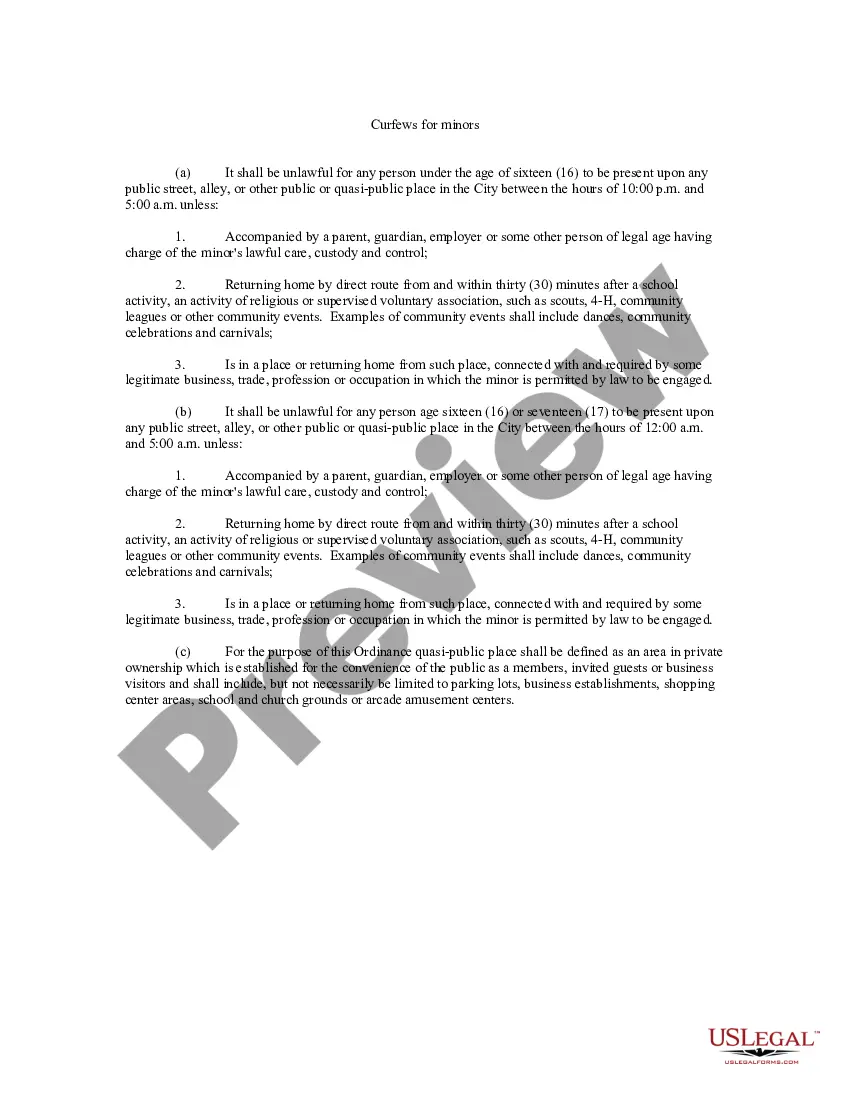
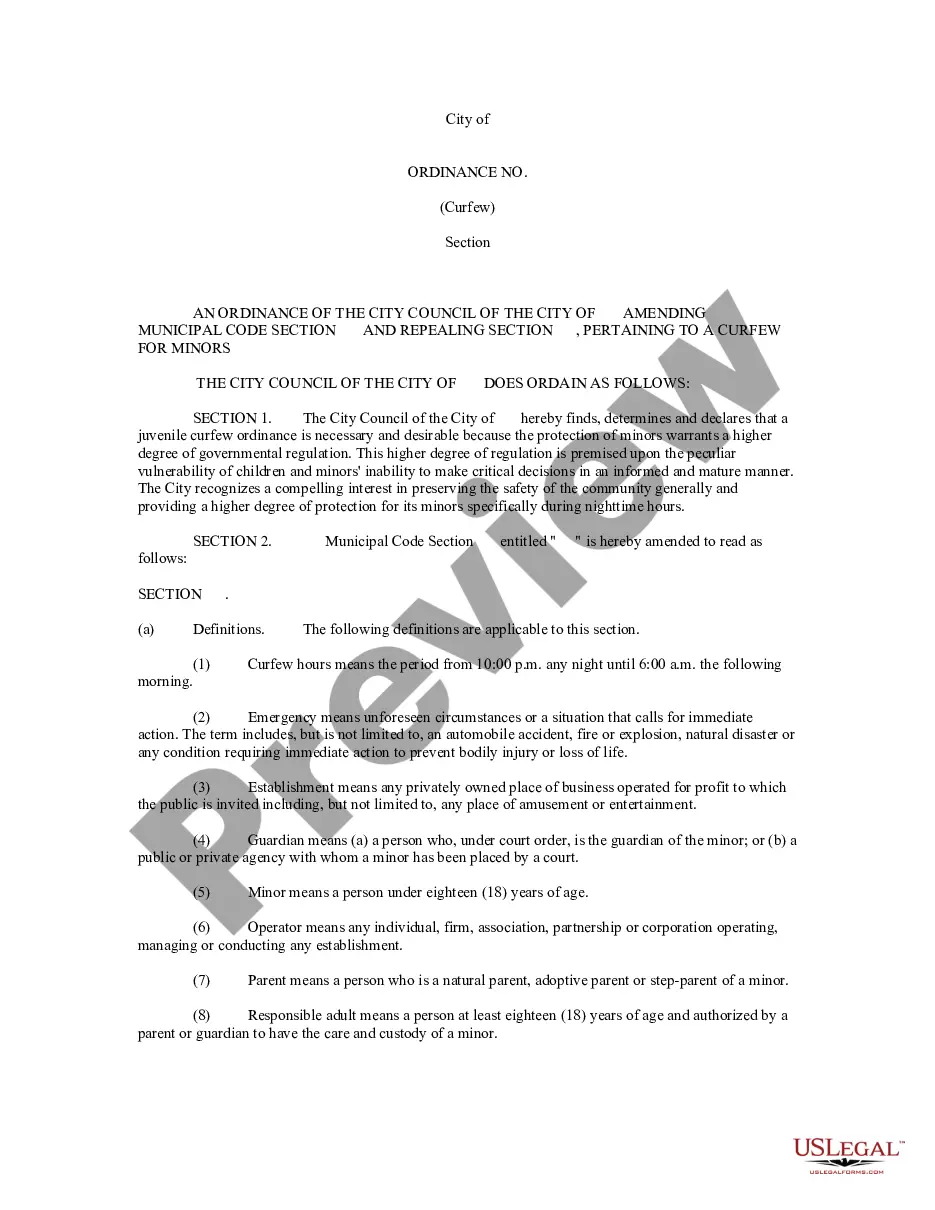
The Curfews for Minors form outlines local municipal codes regarding curfew regulations for individuals under the age of 18. It specifies the times minors may or may not be present in public areas without adult supervision. This form helps enforce community safety by regulating minor's night-time movements, distinguishing it from other legal documents that pertain to general child welfare or parental rights.
Key parts of this document
- Curfew times for minors under 16: prohibits presence in public places from 10:00 p.m. to 5:00 a.m.
- Curfew times for minors aged 16 and 17: restricts public presence from 12:00 a.m. to 5:00 a.m.
- Exceptions based on adult supervision or legitimate activities, such as returning from school events or community activities.
- Definition of quasi-public places, including areas with private ownership used by the public, like parking lots and shopping centers.
Situations where this form applies
This form is used when local governments wish to establish or update curfew ordinances for minors to ensure public safety. It is appropriate for municipalities seeking to address issues related to youth safety and community standards during late-night hours.
Who can use this document
- Local government officials or municipalities creating or modifying curfew laws.
- Community organizations involved in youth safety advocacy.
- Law enforcement agencies enforcing curfew regulations.
How to complete this form
- Review existing local laws to ensure compliance with state regulations.
- Define the specific hours minors are restricted from public areas.
- List acceptable exceptions for minors to be out during curfew hours.
- Include a definition of quasi-public places relevant to your municipality.
- Seek necessary approvals from relevant authorities before implementation.
Is notarization required?
In most cases, this form does not require notarization. However, some jurisdictions or signing circumstances might. US Legal Forms offers online notarization powered by Notarize, accessible 24/7 for a quick, remote process.
Get your form ready online
Our built-in tools help you complete, sign, share, and store your documents in one place.
Make edits, fill in missing information, and update formatting in US Legal Forms—just like you would in MS Word.
Download a copy, print it, send it by email, or mail it via USPS—whatever works best for your next step.
Sign and collect signatures with our SignNow integration. Send to multiple recipients, set reminders, and more. Go Premium to unlock E-Sign.
If this form requires notarization, complete it online through a secure video call—no need to meet a notary in person or wait for an appointment.
We protect your documents and personal data by following strict security and privacy standards.

Make edits, fill in missing information, and update formatting in US Legal Forms—just like you would in MS Word.

Download a copy, print it, send it by email, or mail it via USPS—whatever works best for your next step.

Sign and collect signatures with our SignNow integration. Send to multiple recipients, set reminders, and more. Go Premium to unlock E-Sign.

If this form requires notarization, complete it online through a secure video call—no need to meet a notary in person or wait for an appointment.

We protect your documents and personal data by following strict security and privacy standards.
Avoid these common issues
- Failing to specify exceptions clearly can lead to confusion.
- Not aligning the ordinance with state laws may result in legal challenges.
- Neglecting to publicly communicate changes to the community can hinder compliance.
Benefits of using this form online
- Convenient access to templates drafted by licensed attorneys.
- Editability allows customization to meet local community needs.
- Reliability from using standardized legal language.
Legal use & context
- Curfew laws must comply with constitutional protections and local ordinances.
- Enforcements should be applied consistently to avoid legal challenges.
- Local communities might need to adjust ordinances based on feedback and efficacy data.
What to keep in mind
- The form outlines essential curfew regulations for minors.
- It is critical for municipalities to adjust curfew ordinances based on local needs.
- Understanding the legal context can help enhance community safety and compliance.
Looking for another form?
Form popularity
FAQ
For seventeen-year-olds, curfew might be eleven p.m. on weekdays and midnight on weekends. For kids sixteen and younger, curfew is often 10 p.m. on weekdays and 11 p.m. on Friday and Saturday. Kids in this age range are to be home until six a.m. Have your kid look it up.
If allowed to sleep on their own schedule, many teens would get eight hours or more per night, sleeping from 11 p.m. or midnight until 8 or 9 a.m., but school start times18 in most school districts force teens to wake up much earlier in the morning.
Juvenile curfews are local ordinances or laws proscribing minors, generally within a specified age range, from occupying public areas and streets during particular times.In addition, curfew keeps them away from temptations such as drug use, violent acts, sexual risks, heavy partying, and alcohol intake.
As much as parents want an easy way to keep their children out of trouble, setting up a curfew isn't the way to go. Not only do curfews have no significant effect on crime rates or incidents, they put can strain parent-child relationships and harm a teenager's independence.
English Language Learners Definition of curfew : an order or law that requires people to be indoors after a certain time at night. : the period of time when such an order or law is in effect. chiefly US : the time set by a parent at which a child has to be back home after going out.
In this article, for advice on curfews and teenagers, it says, For teens between 14 and 16, the American Academy of Pediatrics recommends an 8 or 9 pm curfew on school nights and 10 or 11 pm on weekends2026
Speak to your daughter's friend's parents and tell them that you want your daughter to come home. If they continue to let her stay with them, call the police. You can also call DCF.
A curfew is a law, regulation, or ordinance that forbids particular people or particular classes of people from being outdoors in public places at certain specified times of the day.