Sample Letter to Client regarding Notice of Deposition - Discovery
Understanding this form
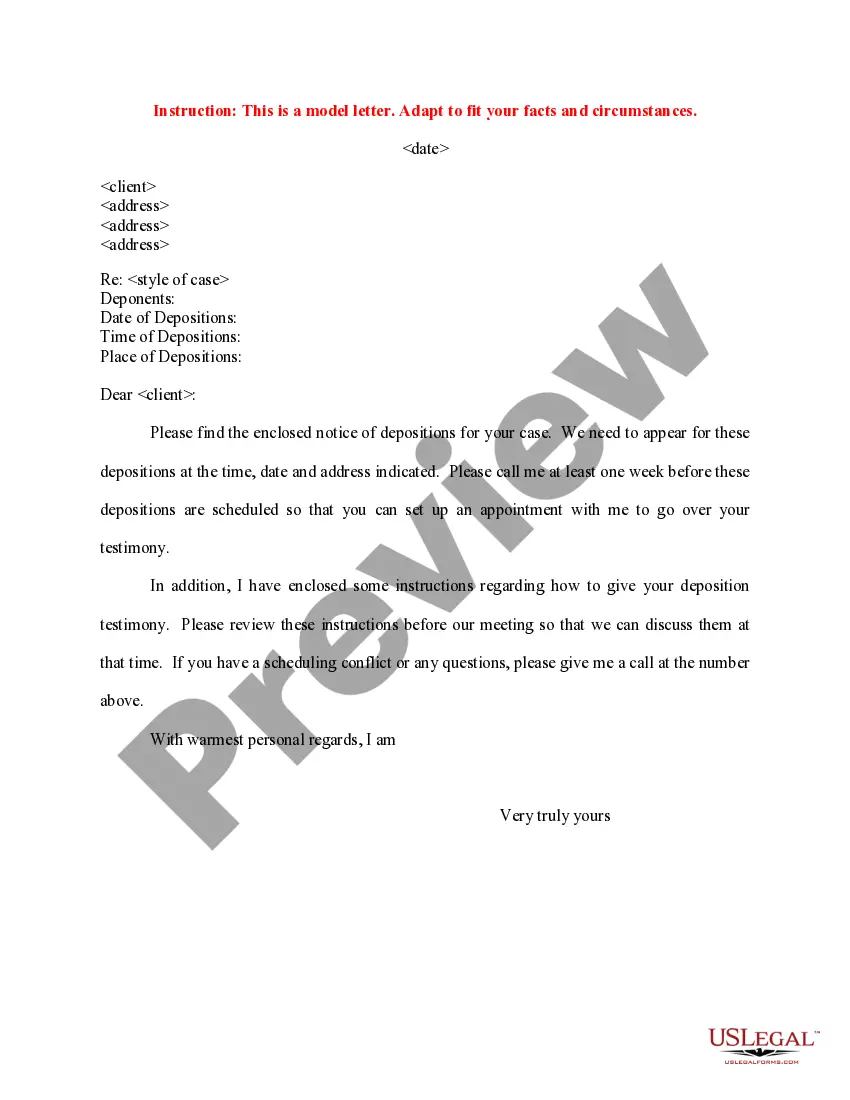
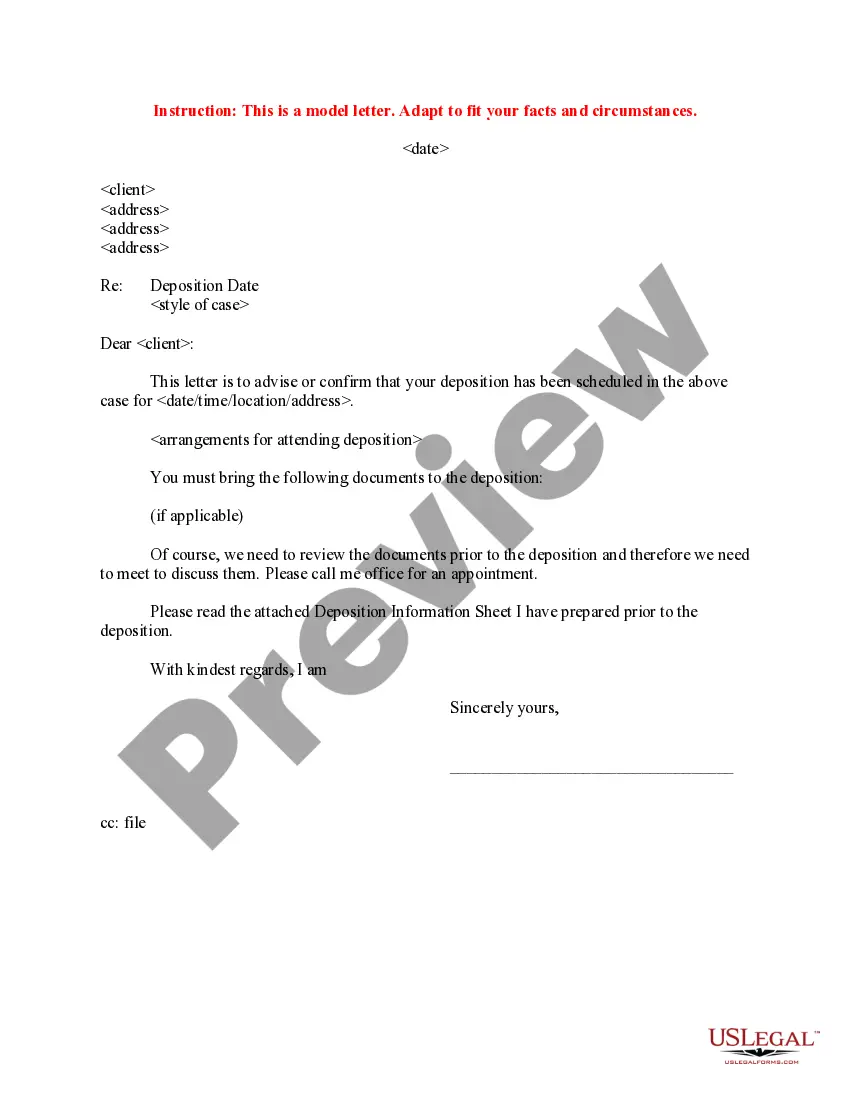
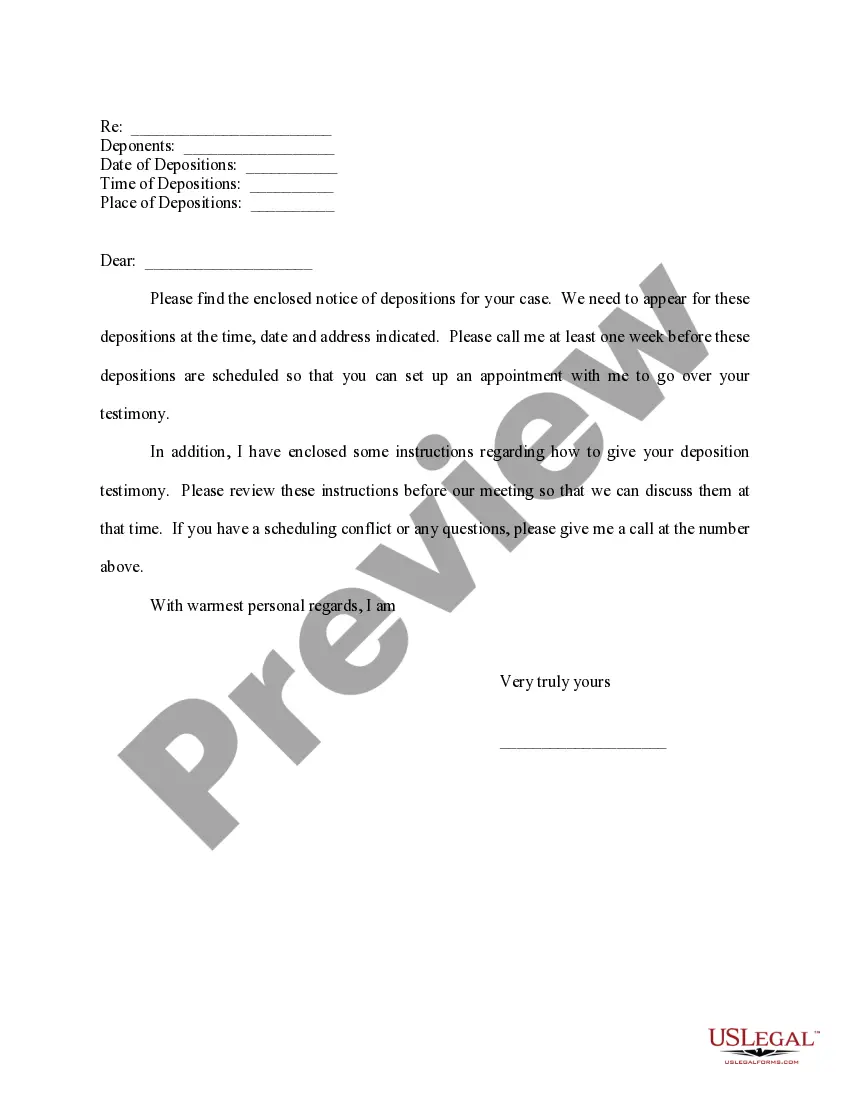
This Sample Letter to Client regarding Notice of Deposition is a communication tool used by attorneys to notify clients about their upcoming deposition as part of the discovery process. This letter outlines essential information pertaining to the deposition and provides clients with instructions on how to prepare for their testimony. It differs from other legal forms in that it specifically addresses client communication rather than legal procedures or event notifications.
Key parts of this document
- Date of the letter.
- Client's name and contact address.
- Subject line indicating the case style.
- Instructions for giving deposition testimony.
- Contact information for scheduling conflicts or questions.
Common use cases
This form is used when an attorney needs to formally notify a client about an upcoming deposition. It is relevant when the attorney has completed necessary legal preparations and requires the client to be informed of their role in the discovery process. This letter also serves as a reminder for clients to prepare adequately for their testimony.
Who needs this form
- Attorneys representing clients in legal proceedings.
- Clients who are required to give deposition testimony.
- Legal professionals involved in the discovery process.
Completing this form step by step
- Enter the date on which the letter is being prepared.
- Fill in the client's full name and address.
- Specify the case style and relevant details in the subject line.
- Provide clear instructions on how the client should prepare for their deposition.
- Include your contact information for any client inquiries or scheduling conflicts.
Does this form need to be notarized?
Notarization is not commonly needed for this form. However, certain documents or local rules may make it necessary. Our notarization service, powered by Notarize, allows you to finalize it securely online anytime, day or night.
Get your form ready online
Our built-in tools help you complete, sign, share, and store your documents in one place.
Make edits, fill in missing information, and update formatting in US Legal Forms—just like you would in MS Word.
Download a copy, print it, send it by email, or mail it via USPS—whatever works best for your next step.
Sign and collect signatures with our SignNow integration. Send to multiple recipients, set reminders, and more. Go Premium to unlock E-Sign.
If this form requires notarization, complete it online through a secure video call—no need to meet a notary in person or wait for an appointment.
We protect your documents and personal data by following strict security and privacy standards.

Make edits, fill in missing information, and update formatting in US Legal Forms—just like you would in MS Word.

Download a copy, print it, send it by email, or mail it via USPS—whatever works best for your next step.

Sign and collect signatures with our SignNow integration. Send to multiple recipients, set reminders, and more. Go Premium to unlock E-Sign.

If this form requires notarization, complete it online through a secure video call—no need to meet a notary in person or wait for an appointment.

We protect your documents and personal data by following strict security and privacy standards.
Common mistakes to avoid
- Failing to include the correct date, which can lead to confusion.
- Omitting essential contact details, making it difficult for clients to reach the attorney.
- Not providing sufficient instructions, leaving clients unprepared for their deposition.
Why use this form online
- Convenient access to pre-drafted templates saves time.
- Editability allows for customization to meet specific client needs.
- Reliability ensures that the letter meets legal standards and includes essential information.
Legal use & context
- This letter serves as a formal notice and is often required in the context of legal proceedings.
- Failure to provide proper notice may impact a client's ability to testify or bring potential challenges in court.
- It's vital to retain a copy for your legal records.
Looking for another form?
Form popularity
FAQ
Deposition testimony is a stressful but important process during the discovery phase of a lawsuit. Preparation by the physician can make later procedures easier and more efficient.
Tell the truth. Speak audibly. Talk slowly. Think before you speak. Do not volunteer information; answer only the question that is asked. Be professional and polite. Take breaks as necessary (usually one per hour) If you do not understand the question, then ask for clarification.
Skip three lines and enter "Deposition of name of person being questioned." Skip one line and enter "Court Reporter:" justified to the left and the name, address and phone number of the court reporter justified to the right. Set up your word processor to number lines and pages beginning on the second page.
1. What is a deposition? A deposition is a question and answer session. It is used to find out what a witness knows and to preserve testimony. It can be used at trial to refresh recollection or to ask a witness why trial testimony conflicts with what was said at the deposition.
Be prepared. Think before answering. Never volunteer information. Make sure you understand the question. You must tell the truth. Don't get rattled or upset. Don't guess. If you do not remember, say so.
Never Guess to Answer a Question. Avoid Any Absolute Statements. Do Not Use Profanity. Do Not Provide Additional Information. Avoid Making Light of the Situation. Never Paraphrase a Conversation. Do Not Argue or Act Aggressively. Avoid Providing Privileged Information.
Step 1: Research Each and Every Attendee. Step 2: Set a Main Goal and Objectives for the Meeting. Step 3: Plan the Agenda to Support Objectives. Step 4: Have a Plan B. Step 5: Plan Your Follow-Up Activities. Get a Head Start on Meeting Preparation.
Use Clear Language. Whether in court or in a conference room for a deposition, it is always advantageous to rely on using clear, concise language instead of a building complex, jargon-filled questions. Ask About the Basics. Don't allow the basics of the case to simply be assumed. Anticipate Answers.
Don't guess, speculate, or play a hunch. A deposition is sworn testimony; only say what you know to be true. On the other hand, don't use this tip to avoid giving testimony that you know. If you don't understand a question, ask for the questioner to rephrase it.