Noise Ordinance
What this document covers
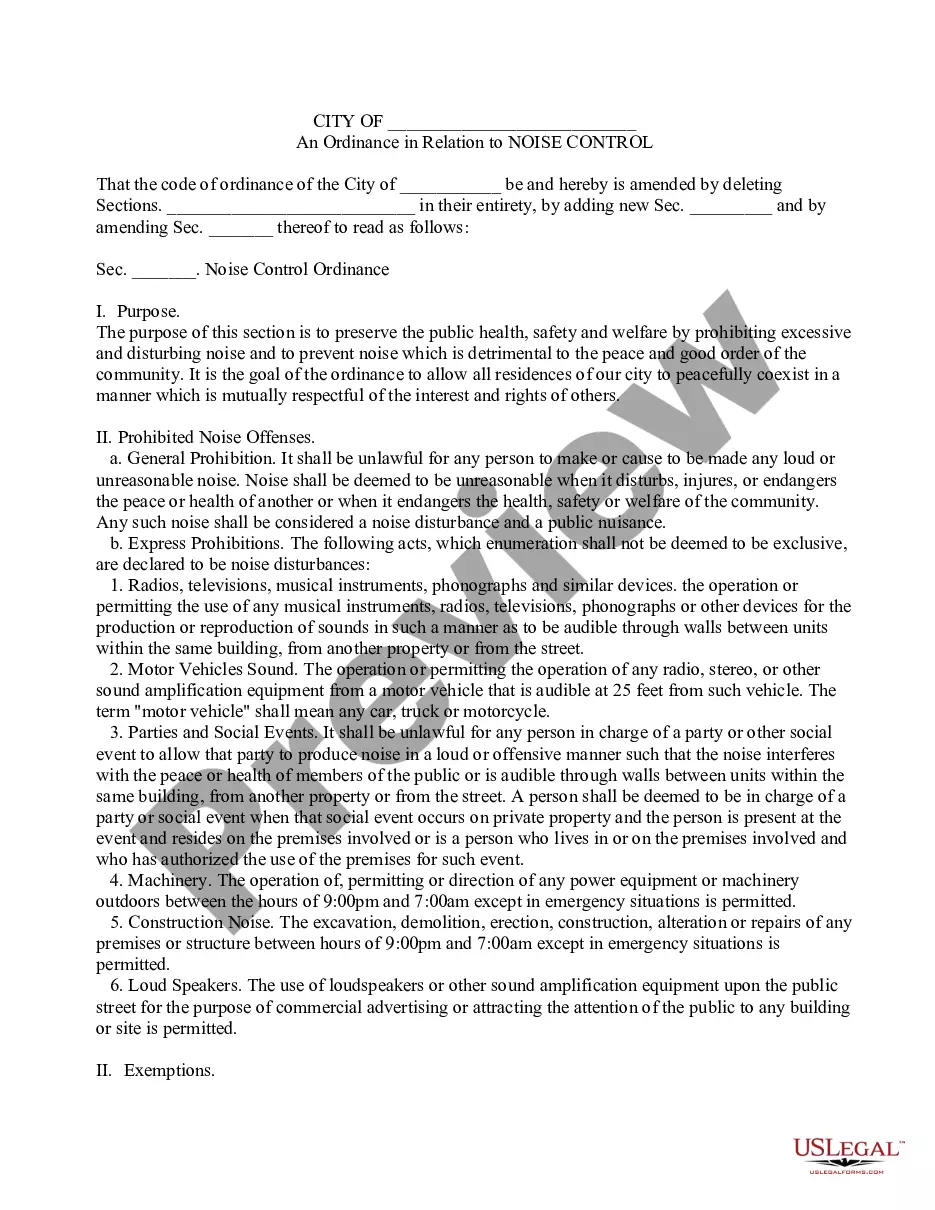
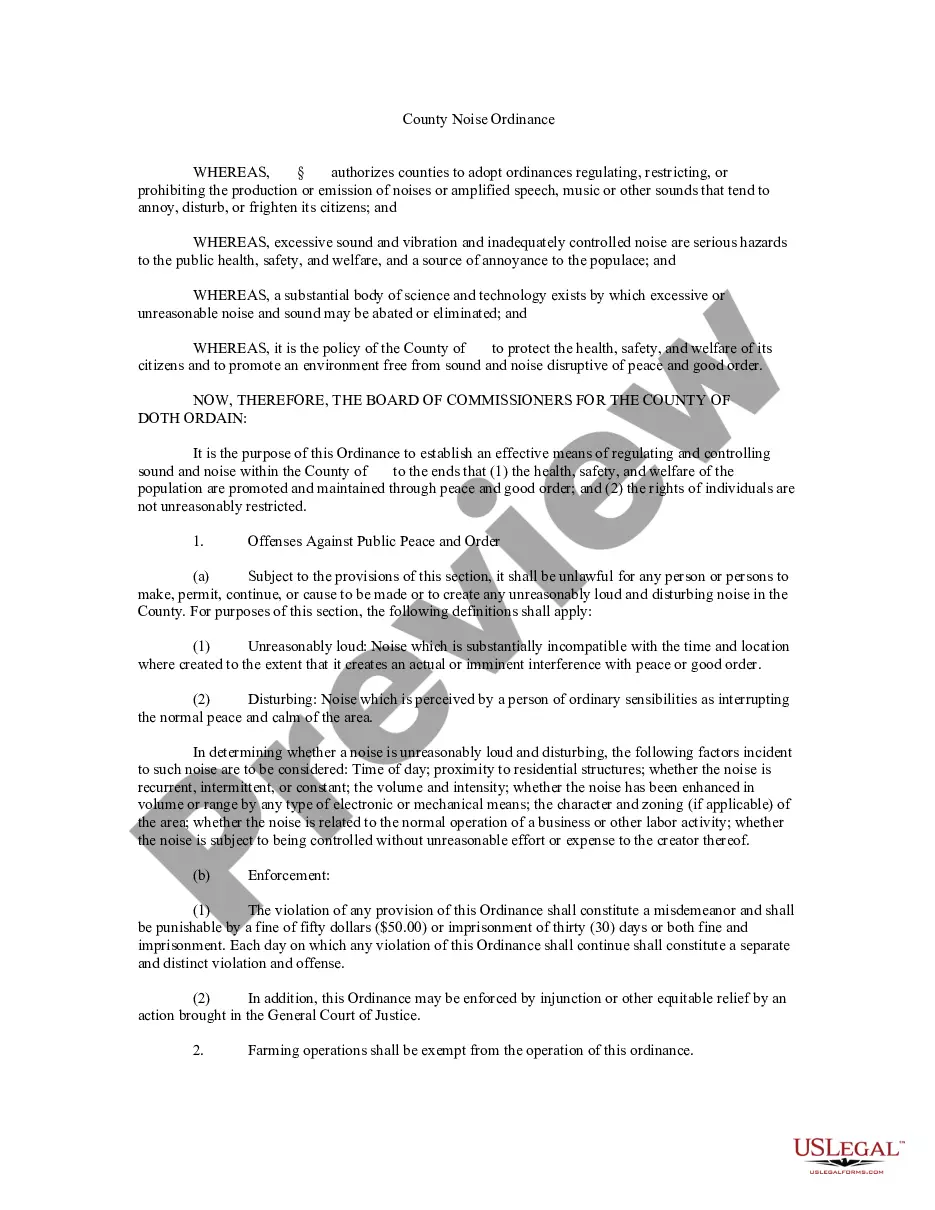
The Noise Ordinance is a municipal law designed to regulate the level and type of sound that can be emitted in a specific area at certain times. Its purpose is to maintain public health, safety, and welfare by minimizing excessive and disturbing noise, ensuring that the community can coexist peacefully. Unlike other legal forms that may address specific noise complaints, this ordinance establishes clear guidelines on what constitutes unacceptable noise levels and provides enforcement mechanisms to uphold community standards.
Main sections of this form
- Purpose: Outlines the intention to preserve public order and peace.
- Prohibited Noise Offenses: Specifies actions that qualify as noise disturbances.
- Express Prohibitions: Lists specific noisy activities that are prohibited, such as loud music or construction at night.
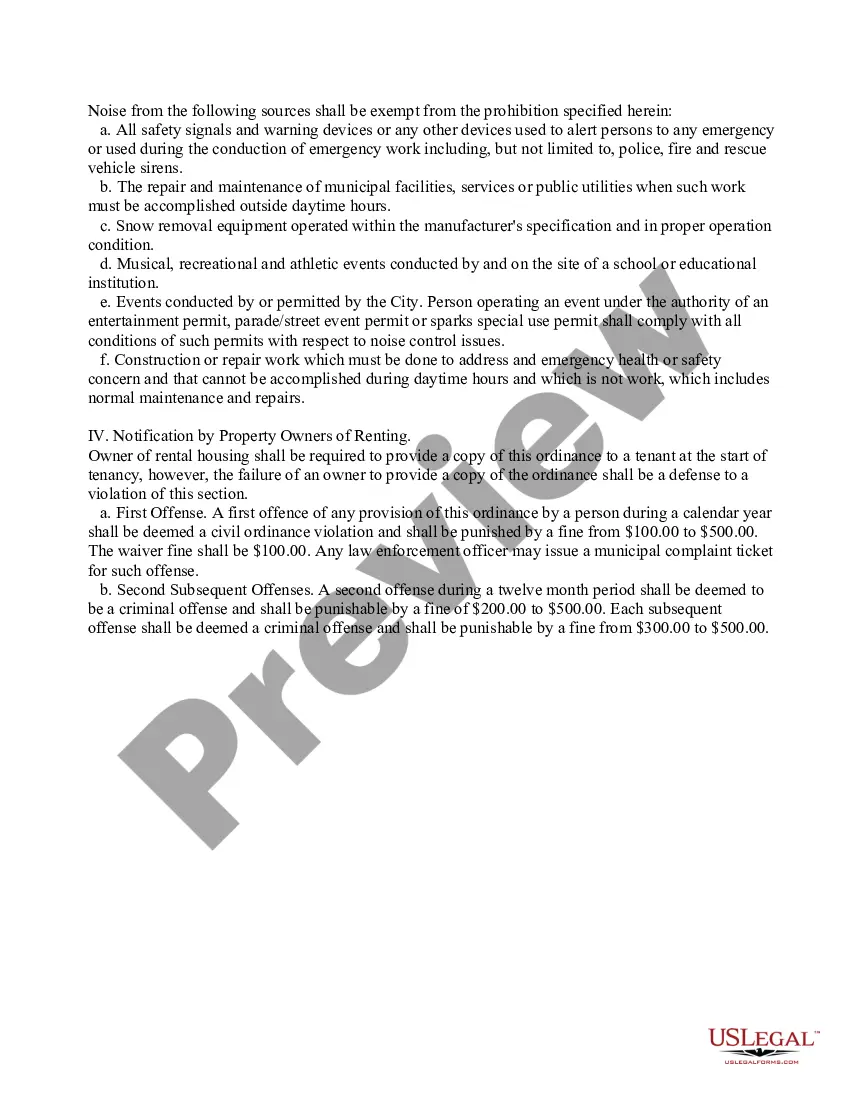
- Exemptions: Describes conditions under which certain noise is acceptable (e.g., emergency services).
- Penalties: Details fines for violations and the consequences of repeated offenses.
Common use cases
The Noise Ordinance should be used when a municipality needs to establish or update regulations regarding noise control. It is particularly useful in residential areas where peace and quiet are essential. This form may be required when community disturbances arise, or a local government aims to proactively address noise-related issues before they become problematic.
Intended users of this form
- City and municipal governments looking to implement noise regulations.
- Local authorities responsible for maintaining public order.
- Community leaders advocating for better noise control measures.
- Residents seeking to understand their rights regarding noise disturbances.
How to complete this form
- Identify the city name where the ordinance will apply.
- Delete or amend the specified sections as necessary to fit local needs.
- Clearly define prohibited noise offenses tailored to community standards.
- Enter any necessary exemptions relevant to your locality.
- Specify penalties for violations, ensuring they are enforceable.
Does this document require notarization?
This form does not typically require notarization unless specified by local law.
Get your form ready online
Our built-in tools help you complete, sign, share, and store your documents in one place.
Make edits, fill in missing information, and update formatting in US Legal Forms—just like you would in MS Word.
Download a copy, print it, send it by email, or mail it via USPS—whatever works best for your next step.
Sign and collect signatures with our SignNow integration. Send to multiple recipients, set reminders, and more. Go Premium to unlock E-Sign.
If this form requires notarization, complete it online through a secure video call—no need to meet a notary in person or wait for an appointment.
We protect your documents and personal data by following strict security and privacy standards.

Make edits, fill in missing information, and update formatting in US Legal Forms—just like you would in MS Word.

Download a copy, print it, send it by email, or mail it via USPS—whatever works best for your next step.

Sign and collect signatures with our SignNow integration. Send to multiple recipients, set reminders, and more. Go Premium to unlock E-Sign.

If this form requires notarization, complete it online through a secure video call—no need to meet a notary in person or wait for an appointment.

We protect your documents and personal data by following strict security and privacy standards.
Avoid these common issues
- Failing to specify clear definitions for noise disturbances.
- Not updating the ordinance to reflect current local conditions.
- Overlooking specific exemptions that might benefit community events.
Why use this form online
- Convenient access to legally drafted templates.
- Easy-to-edit format allows for quick customization to local needs.
- Compliance with local laws ensures enforceability.
Looking for another form?


Form popularity
FAQ
Weekends & Holidays: p.m. to a.m. During "quiet hours" it is unlawful to create noises louder than 55 decibels (dBA) at a residential receiving property line. At the 55 dBA level, two persons could conduct a normal conversation with a distance of ten feet between them.
The use or operation of any such radio, television, phonograph, jukebox, musical instrument or other device between the hours of p.m. and a.m. that is plainly audible shall be prima facie evidence of a violation of this chapter.
(dBA) On Sundays through Thursdays:from P.M. until A.M. the following morning.On Fridays and Saturdays:from P.M. until A.M. the following morning.
Most local ordinances include "quiet times." A typical ordinance prohibits loud noises between 11 p.m. and 7 or 8 a.m. on weekdays and 11 p.m. or midnight until 8 to 10 a.m. on Sundays and holidays. It is worthwhile to check your local ordinance before making formal complaint so that you can cite the law.
Quiet hours are in place from p.m. to a.m. Sunday through Thursday and from a.m. to a.m. Friday and Saturday.
Between the hours of p.m. and a.m. the following day on weekdays and Saturdays and between p.m. on Saturday evenings and a.m. on Sunday, which creates a noise disturbance, unless otherwise exempted in this ordinance, or by an act of Council. Power Equipment.
Most local ordinances include "quiet times." A typical ordinance prohibits loud noises between 11 p.m. and 7 or 8 a.m. on weekdays and 11 p.m. or midnight until 8 to 10 a.m. on Sundays and holidays. It is worthwhile to check your local ordinance before making formal complaint so that you can cite the law.
1. A person commits the crime of peace disturbance if: (1) He unreasonably and knowingly disturbs or alarms another person or persons by: (a) Loud noise; or 2. Peace disturbance is a class B misdemeanor upon the first conviction. Upon a second or subsequent conviction, peace disturbance is a class A misdemeanor.