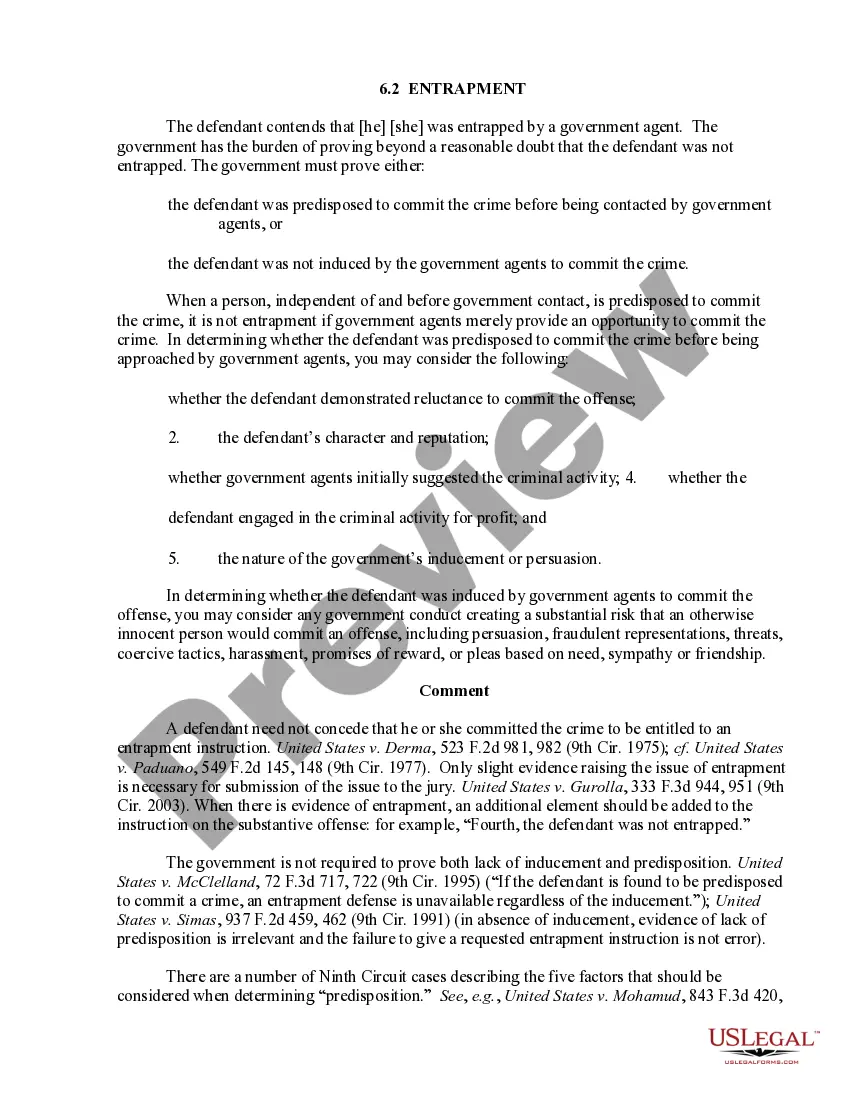
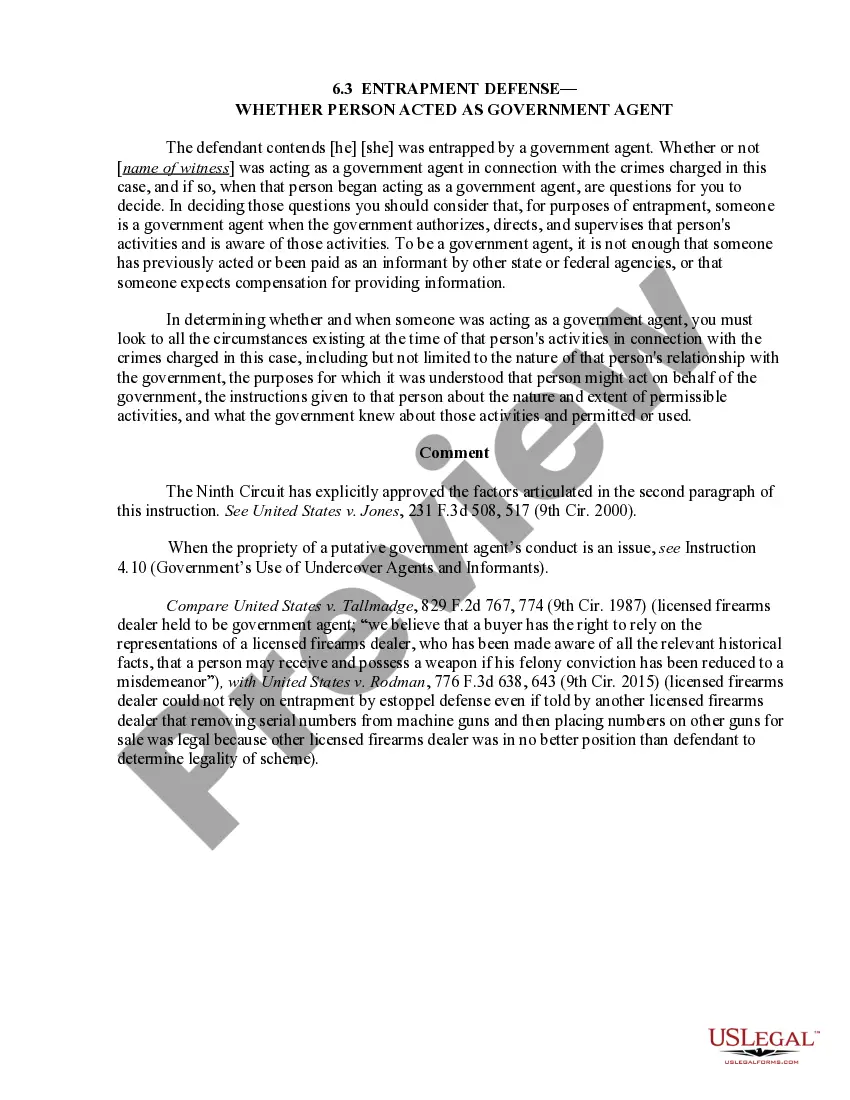
6.2A Sentencing Entrapment
Does this form need to be notarized?
This form does not typically require notarization to be legally valid. However, some jurisdictions or document types may still require it. US Legal Forms provides secure online notarization powered by Notarize, available 24/7 for added convenience.
Get your form ready online
Our built-in tools help you complete, sign, share, and store your documents in one place.
Make edits, fill in missing information, and update formatting in US Legal Forms—just like you would in MS Word.
Download a copy, print it, send it by email, or mail it via USPS—whatever works best for your next step.
Sign and collect signatures with our SignNow integration. Send to multiple recipients, set reminders, and more. Go Premium to unlock E-Sign.
If this form requires notarization, complete it online through a secure video call—no need to meet a notary in person or wait for an appointment.
We protect your documents and personal data by following strict security and privacy standards.

Make edits, fill in missing information, and update formatting in US Legal Forms—just like you would in MS Word.

Download a copy, print it, send it by email, or mail it via USPS—whatever works best for your next step.

Sign and collect signatures with our SignNow integration. Send to multiple recipients, set reminders, and more. Go Premium to unlock E-Sign.

If this form requires notarization, complete it online through a secure video call—no need to meet a notary in person or wait for an appointment.

We protect your documents and personal data by following strict security and privacy standards.
Looking for another form?
Form popularity
FAQ
Entrapment happens when police officers coerce or induce someone into committing a crime. Learn more. By Paul Bergman, UCLA Law School Professor. Defend your rights. We've helped 95 clients find attorneys today.
Sentencing entrapment occurs when official government conduct leads a defendant predisposed to deal only in small quantities of drugs to deal in larger quantities, leading to an increased sentence. United States v. Berg, 178 F. 3d 976, 981 (8th Cir.
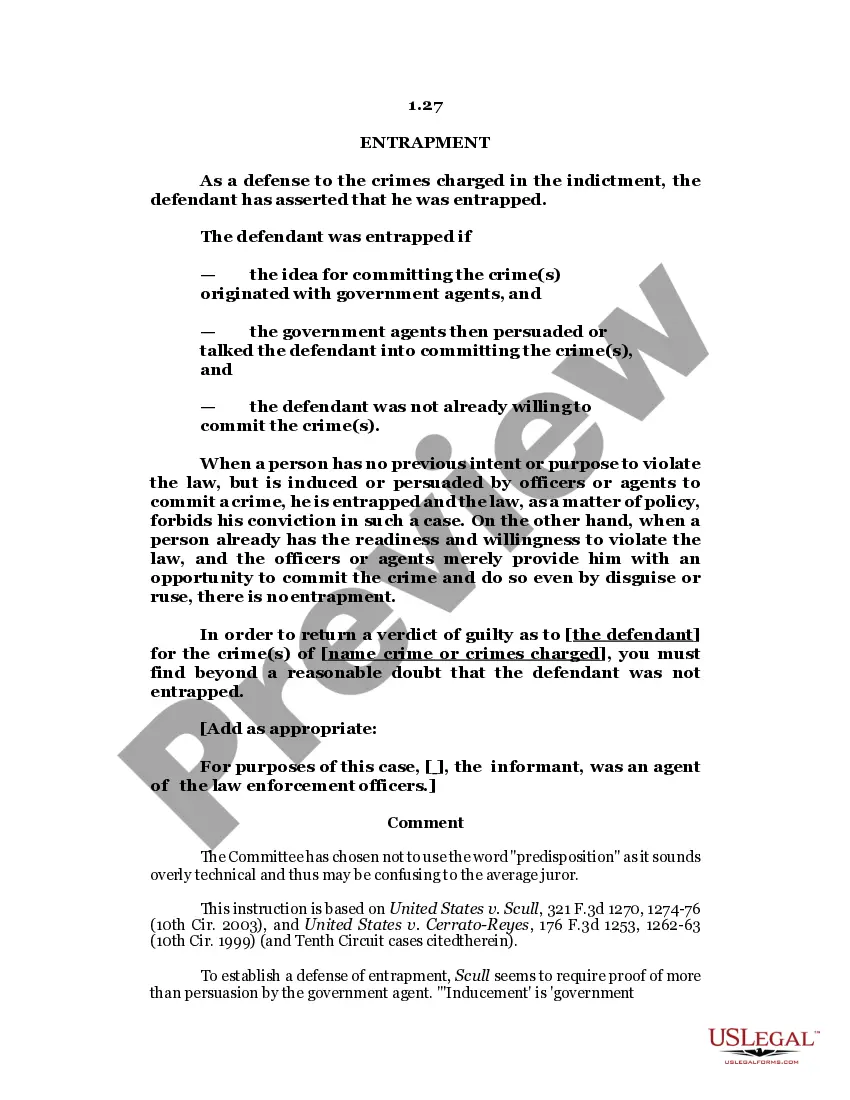
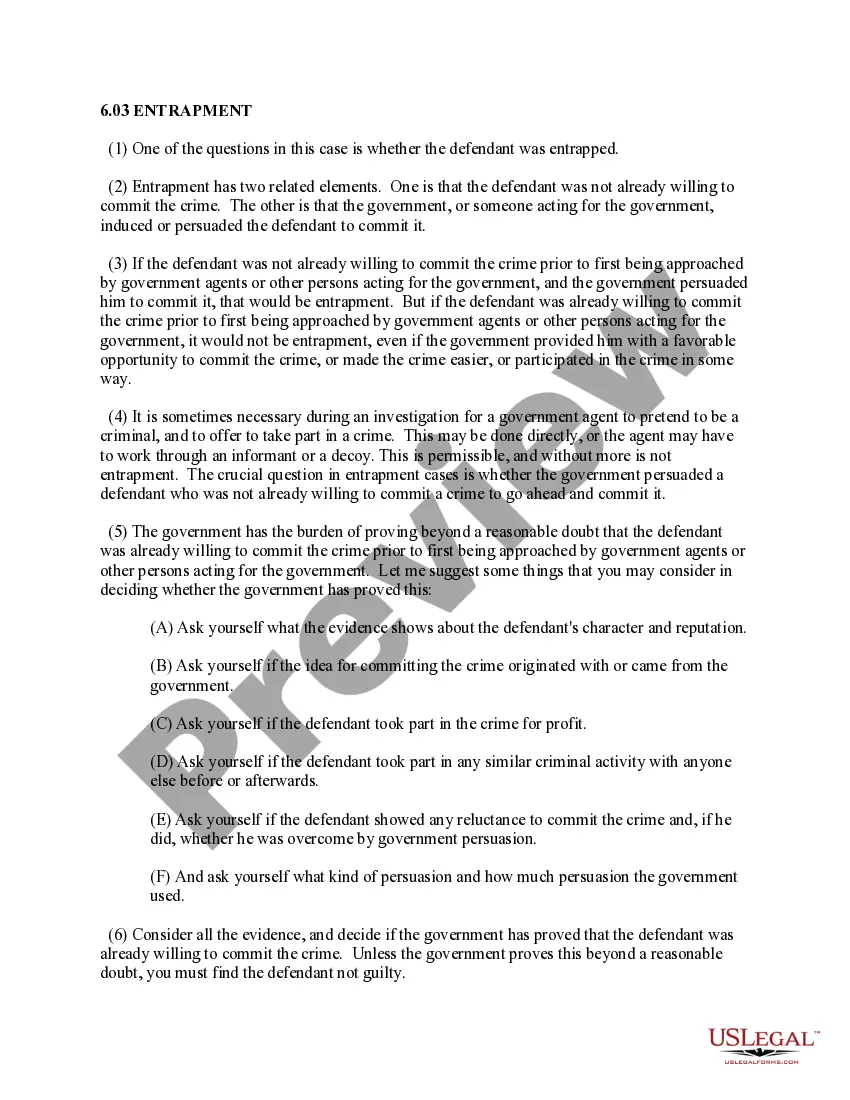
The Ninth Circuit has stated that an entrapment instruction should avoid instructing the jury that a person is not entrapped if the person was "already" willing to commit the crime because of the ambiguity resulting therefrom. United States v. Kim, 176 F. 3d 1126, 1128 (9th Cir.
Entrapment may result from the use of threats, intimidation, extended fraud, or any other means where the defendant was essentially forced to commit a crime. For example, law enforcement officers could set up a sting operation for a suspected criminal to commit a burglary.
In the most basic sense, it occurs when a government official, such as a police officer, uses threats, fraud, or harassment to induce or coerce someone to commit a crime they wouldn't ordinarily commit.
Sentencing entrapment is a separate defense from entrapment and, in appropriate cases, an issue for the jury. "A defendant 'bears the burden of proving sentencing entrapment by a preponderance of the evidence. '" United States v. Biao Huang, 687 F.
Entrapment by estoppel applies when an official tells a defendant that certain conduct is legal and the defendant believes that official. This defense applies even in cases of strict liability, because entrapment does not negate the intent element of an offense, it relies on the principle of fairness.