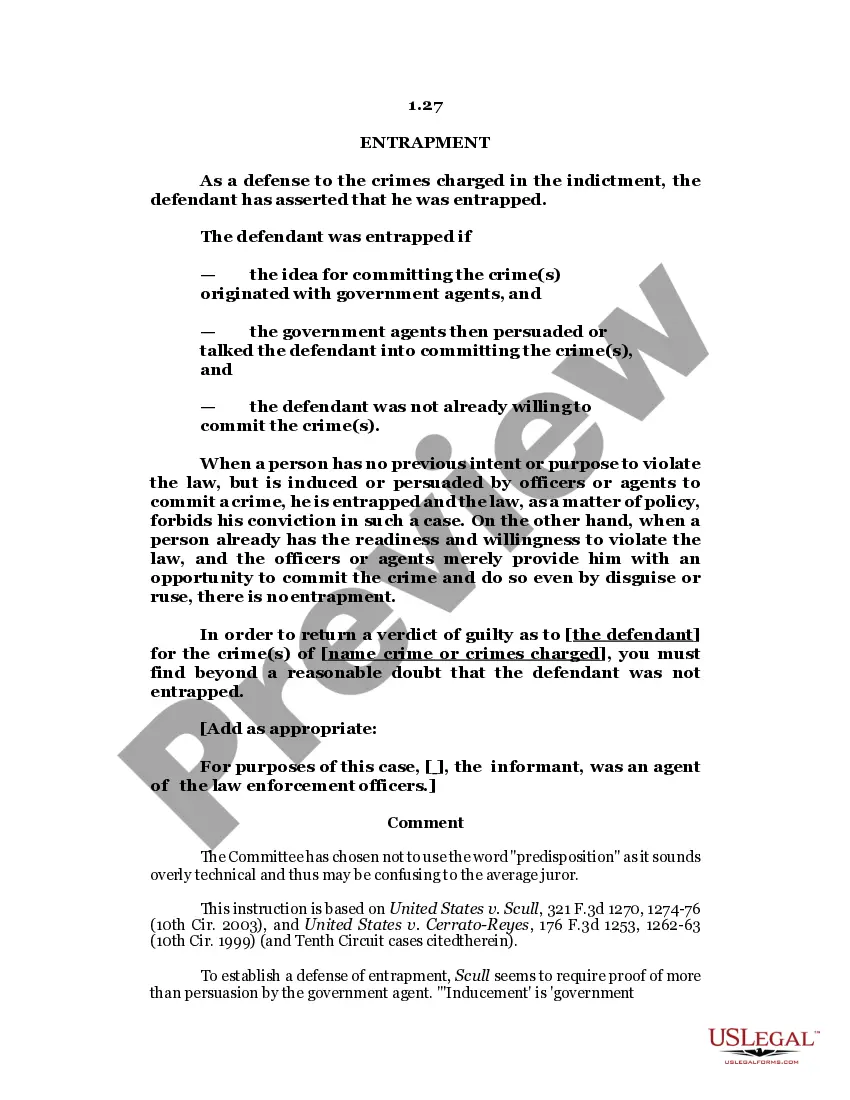
ENTRAPMENT
Understanding this form
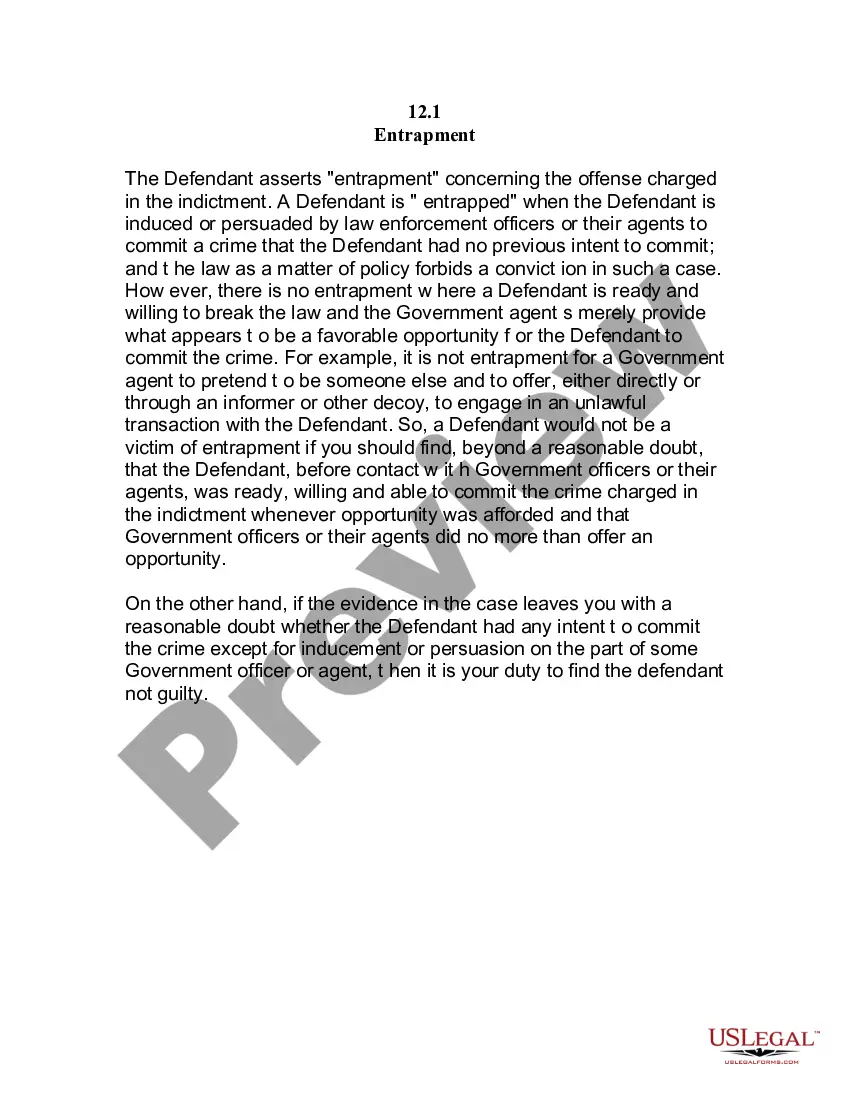
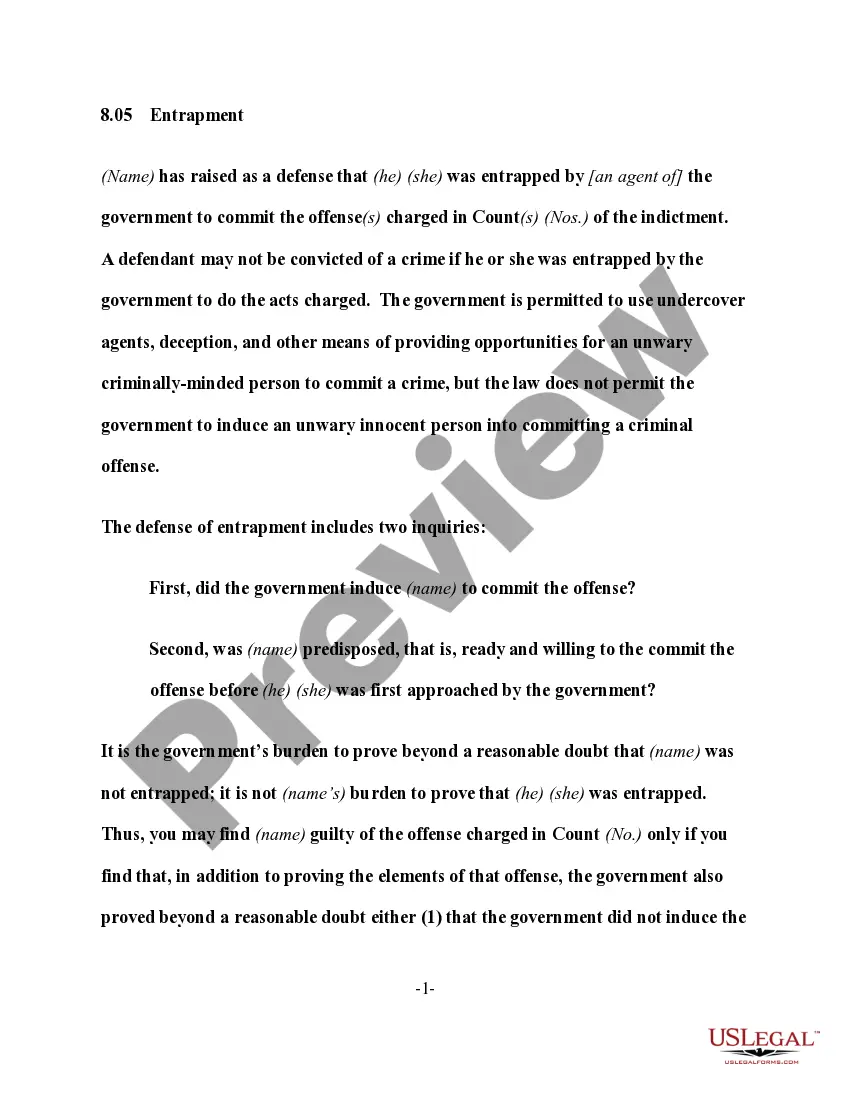
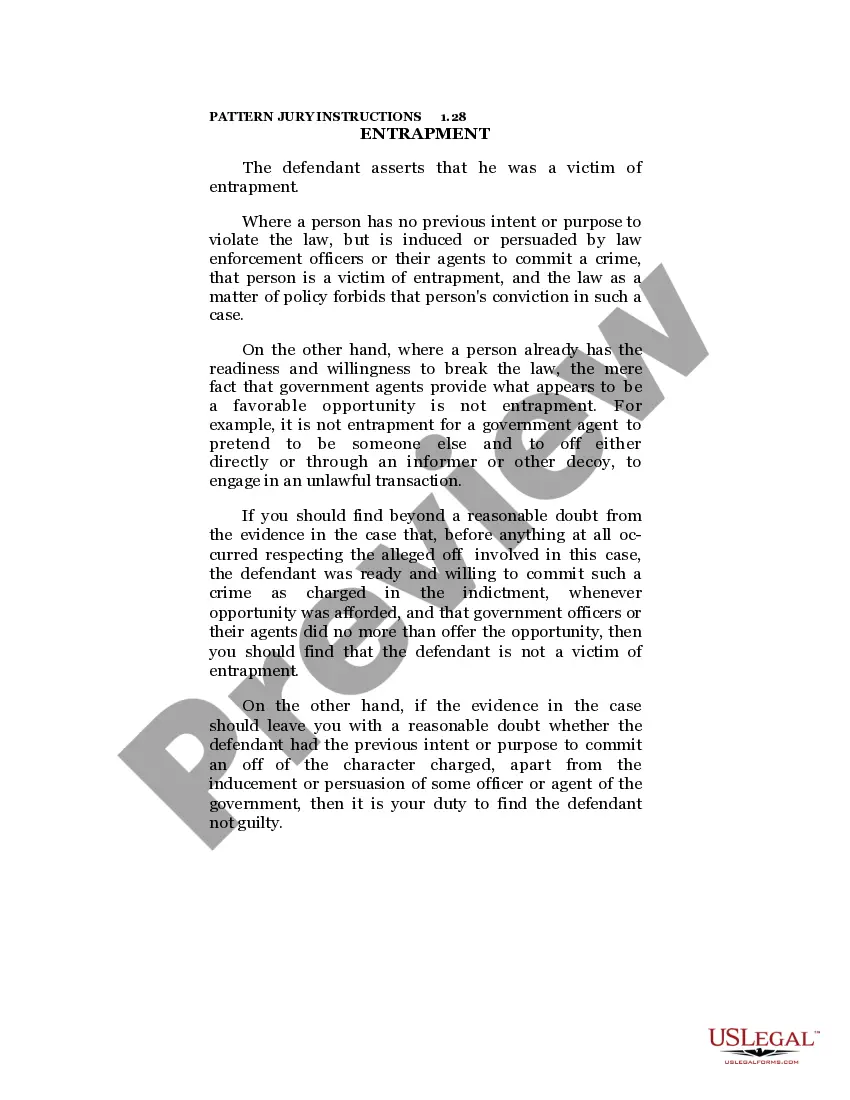
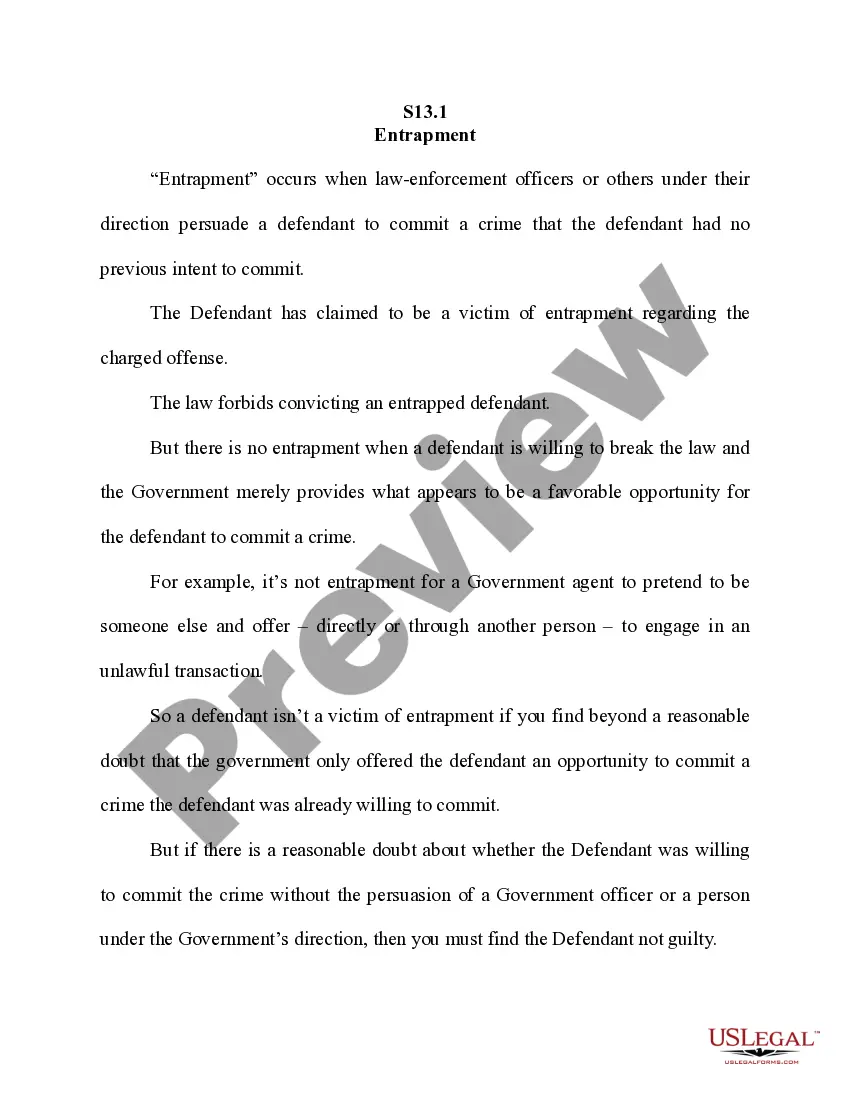
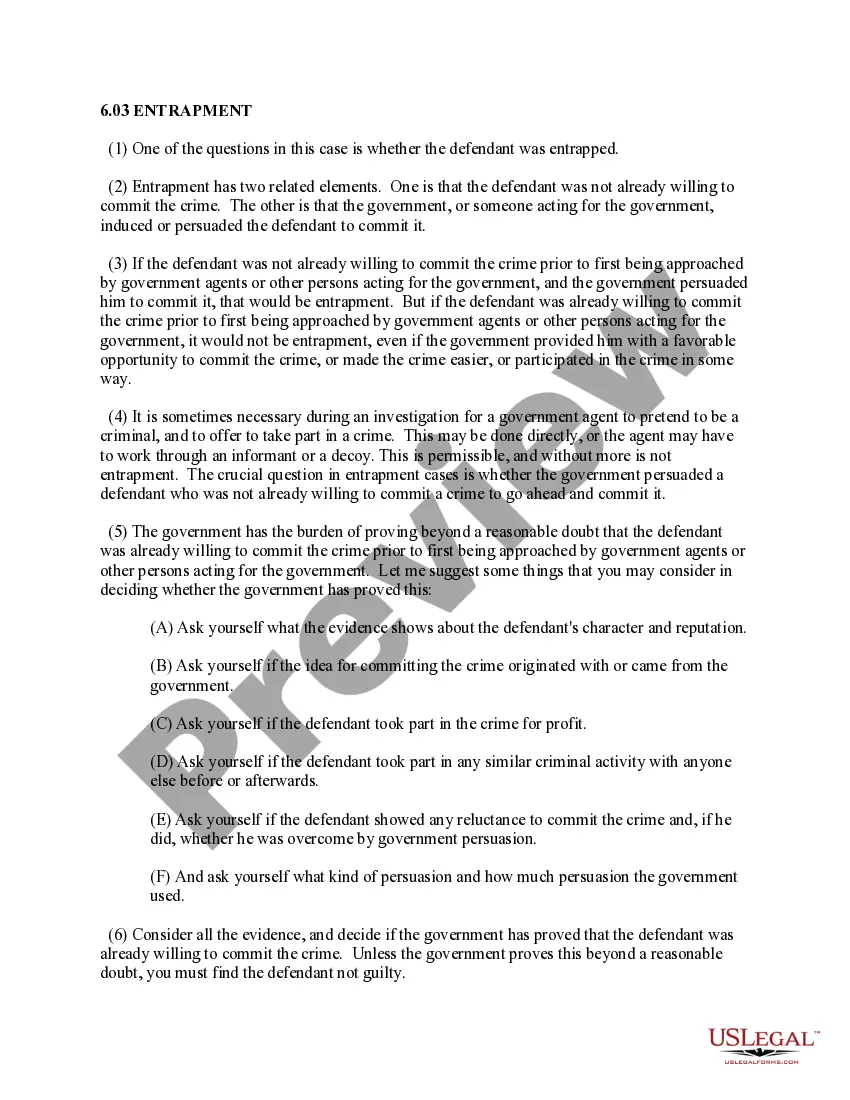
The entrapment form serves as a legal defense used by a defendant in criminal cases, asserting that they were induced to commit a crime by law enforcement agents. This form outlines the conditions under which a defendant can claim entrapment, distinguishing it from similar defenses. Its purpose is to establish that the idea to commit the crime originated from government agents who persuaded a willing individual to act against their original intent.
Form components explained
- Definition of entrapment, outlining the key criteria needed for the defense to apply.
- Clarification on the role of government agents in persuading the defendant to commit the crime.
- Explanation of the defendant's previous willingness to commit the crime, which negates the entrapment argument.
- Instructions on the jury's responsibility to determine if the defense of entrapment is valid.
- Contextual legal precedents supporting the entrapment defense.

When to use this document
This form is used in criminal cases where the defendant believes they were coerced into committing a crime by law enforcement agents. It is applicable in scenarios where an individual claims they had no intention of breaking the law before being persuaded by government agents. Typical situations may include sting operations or undercover investigations where the accused argues they would not have committed the crime without such undue influence.
Who can use this document
- Defendants in criminal cases who believe they were entrapped by law enforcement.
- Legal representatives building a defense strategy involving entrapment.
- Individuals unfamiliar with legal defenses who require a structured way to present their case.
Instructions for completing this form
- Identify the parties involved, including the defendant and the government agents.
- Specify the crime(s) with which the defendant is charged.
- Clearly express the circumstances under which the entrapment claim is being made.
- Document any evidence or testimony supporting the claim of coercion by law enforcement.
- Submit the form to the court as part of the defense strategy during the trial.
Notarization requirements for this form
This form does not typically require notarization unless specified by local law. It is essential to confirm the notarization requirements based on the jurisdiction where the case is filed.
Get your form ready online
Our built-in tools help you complete, sign, share, and store your documents in one place.
Make edits, fill in missing information, and update formatting in US Legal Forms—just like you would in MS Word.
Download a copy, print it, send it by email, or mail it via USPS—whatever works best for your next step.
Sign and collect signatures with our SignNow integration. Send to multiple recipients, set reminders, and more. Go Premium to unlock E-Sign.
If this form requires notarization, complete it online through a secure video call—no need to meet a notary in person or wait for an appointment.
We protect your documents and personal data by following strict security and privacy standards.

Make edits, fill in missing information, and update formatting in US Legal Forms—just like you would in MS Word.

Download a copy, print it, send it by email, or mail it via USPS—whatever works best for your next step.

Sign and collect signatures with our SignNow integration. Send to multiple recipients, set reminders, and more. Go Premium to unlock E-Sign.

If this form requires notarization, complete it online through a secure video call—no need to meet a notary in person or wait for an appointment.

We protect your documents and personal data by following strict security and privacy standards.
Common mistakes
- Failing to provide sufficient evidence of coercion by law enforcement agents.
- Not clearly establishing the defendant's lack of predisposition to commit the crime.
- Submitting the form without consulting legal counsel for completeness.
Why use this form online
- Convenient access allows for quick reference and completion at any time.
- Templates are easily editable to fit specific scenarios or legal requirements.
- Reliable formatting ensures the information presented meets legal standards.
Quick recap
- The entrapment defense is crucial for defendants who feel they were forced into committing a crime by law enforcement.
- Understanding the key components helps present a strong case for entrapment.
- Consulting a legal professional is advisable for effectively utilizing this form.
Looking for another form?

Form popularity
FAQ
Further, the entrapment defense is only available where the entrapment was committed by either a law enforcement officer or someone working in cooperation with a law enforcement officer. Thus, if a person is induced to commit a crime by a private citizen, he cannot use the entrapment defense.
Entrapment may result from the use of threats, intimidation, extended fraud, or any other means where the defendant was essentially forced to commit a crime. For example, law enforcement officers could set up a sting operation for a suspected criminal to commit a burglary.
Entrapment is a complete defense to a criminal charge, on the theory that "Government agents may not originate a criminal design, implant in an innocent person's mind the disposition to commit a criminal act, and then induce commission of the crime so that the Government may prosecute." Jacobson v.
Entrapment can be difficult to prove in court. However, if the defense can show that the criminal conduct was the result of entrapment, the charges against the defendant may be dropped, or the defendant may be acquitted at trial. Important to note: there is a standard for an entrapment defense.
Another special rule for entrapment is that private citizens cannot entrap others. A private individual inducing another person to commit an illegal act has not committed entrapment, but has rather aided and/or abetted the crime in the eyes of the court.
Entrapment is illegal, while sting operations are legal. That's why entrapment is a legal defense to criminal charges but can only be applied in certain cases. By definition, entrapment prohibits government agents from: Originating a criminal design.
Entrapment is defined as a situation in which a normally law-abiding individual is induced into committing a criminal act they otherwise would not have committed because of overbearing harassment, fraud, flattery or threats made by an official police source.