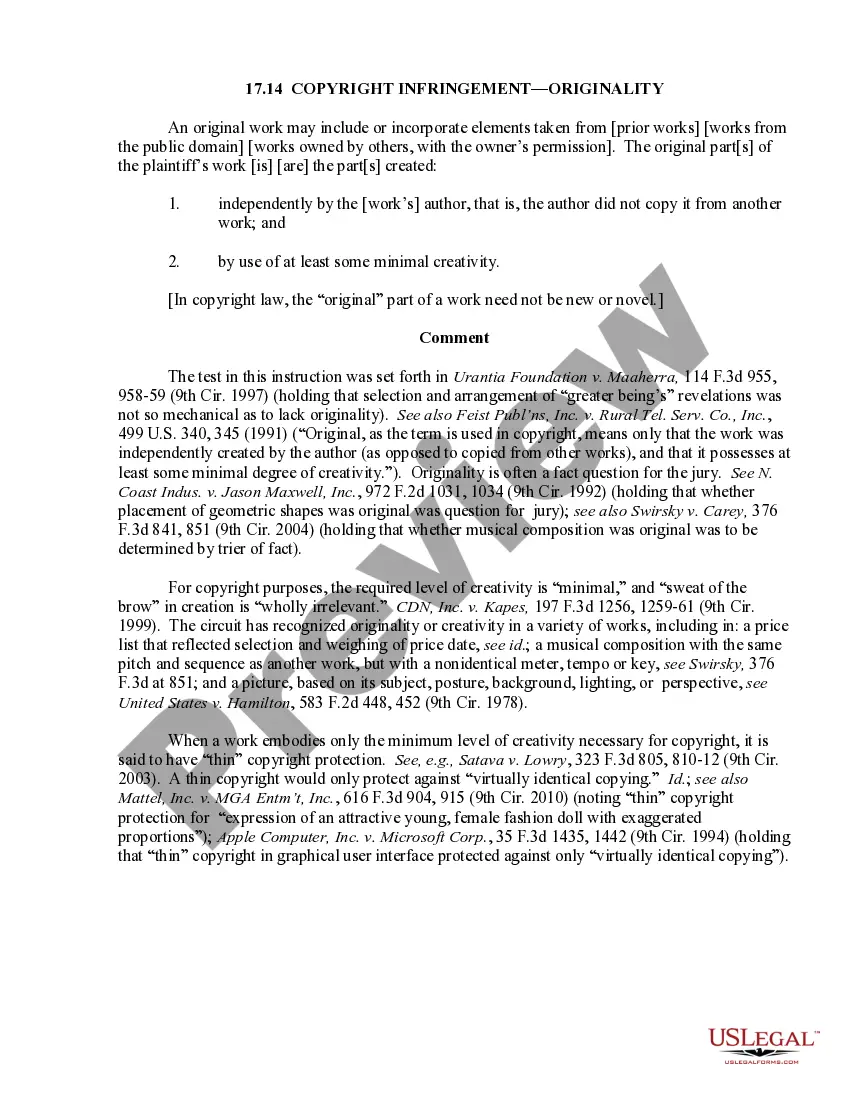
17.14 Copyright Infringement-Originality
Notarization requirements for this form
This form does not typically require notarization to be legally valid. However, some jurisdictions or document types may still require it. US Legal Forms provides secure online notarization powered by Notarize, available 24/7 for added convenience.
Get your form ready online
Our built-in tools help you complete, sign, share, and store your documents in one place.
Make edits, fill in missing information, and update formatting in US Legal Forms—just like you would in MS Word.
Download a copy, print it, send it by email, or mail it via USPS—whatever works best for your next step.
Sign and collect signatures with our SignNow integration. Send to multiple recipients, set reminders, and more. Go Premium to unlock E-Sign.
If this form requires notarization, complete it online through a secure video call—no need to meet a notary in person or wait for an appointment.
We protect your documents and personal data by following strict security and privacy standards.

Make edits, fill in missing information, and update formatting in US Legal Forms—just like you would in MS Word.

Download a copy, print it, send it by email, or mail it via USPS—whatever works best for your next step.

Sign and collect signatures with our SignNow integration. Send to multiple recipients, set reminders, and more. Go Premium to unlock E-Sign.

If this form requires notarization, complete it online through a secure video call—no need to meet a notary in person or wait for an appointment.

We protect your documents and personal data by following strict security and privacy standards.
Looking for another form?


Form popularity
FAQ
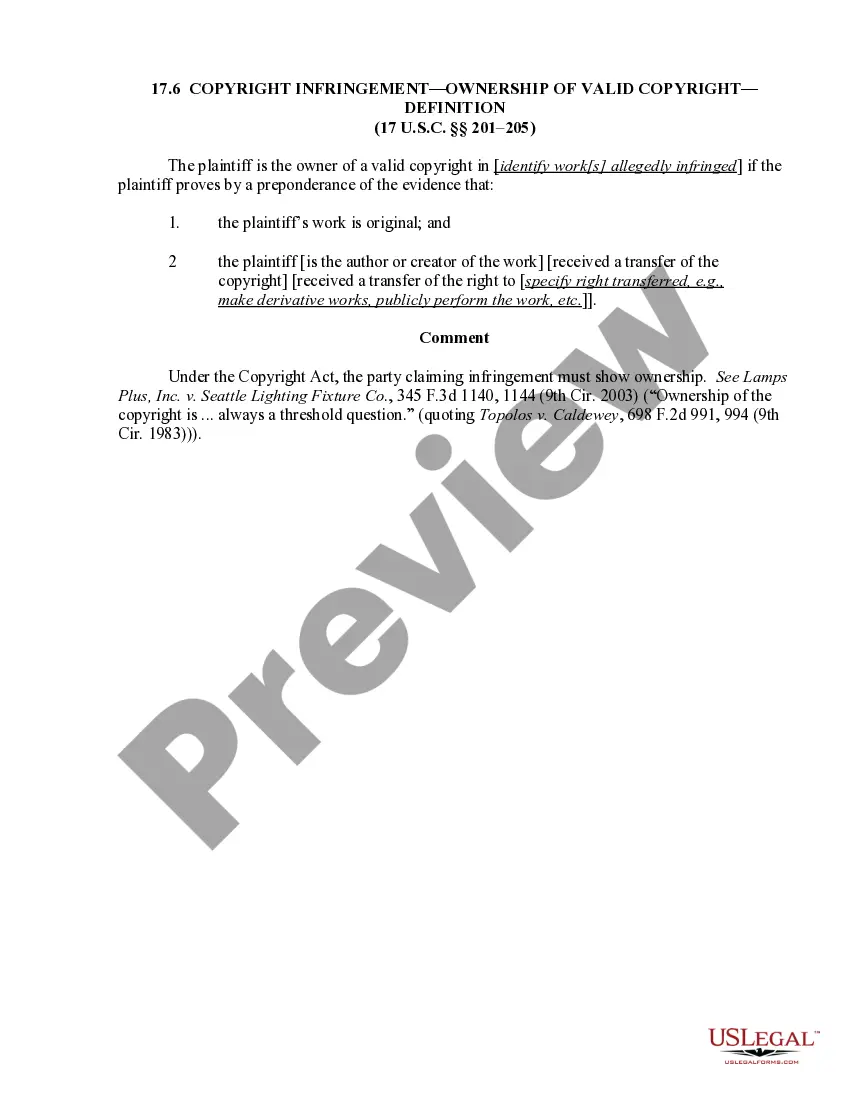
To prove copyright infringement, the plaintiff must prove (1) ownership of a valid copyright (usually through the showing of a certificate of registration); (2) the defendant has copied the worN; and (3) such copying constitutes unlawful appropriation.
At 361 (?To establish infringement, two elements must be proven: (1) ownership of a valid copyright, and (2) copying of constituent elements of the work that are original.?); see also Seven Arts Filmed Entm't Ltd. v.
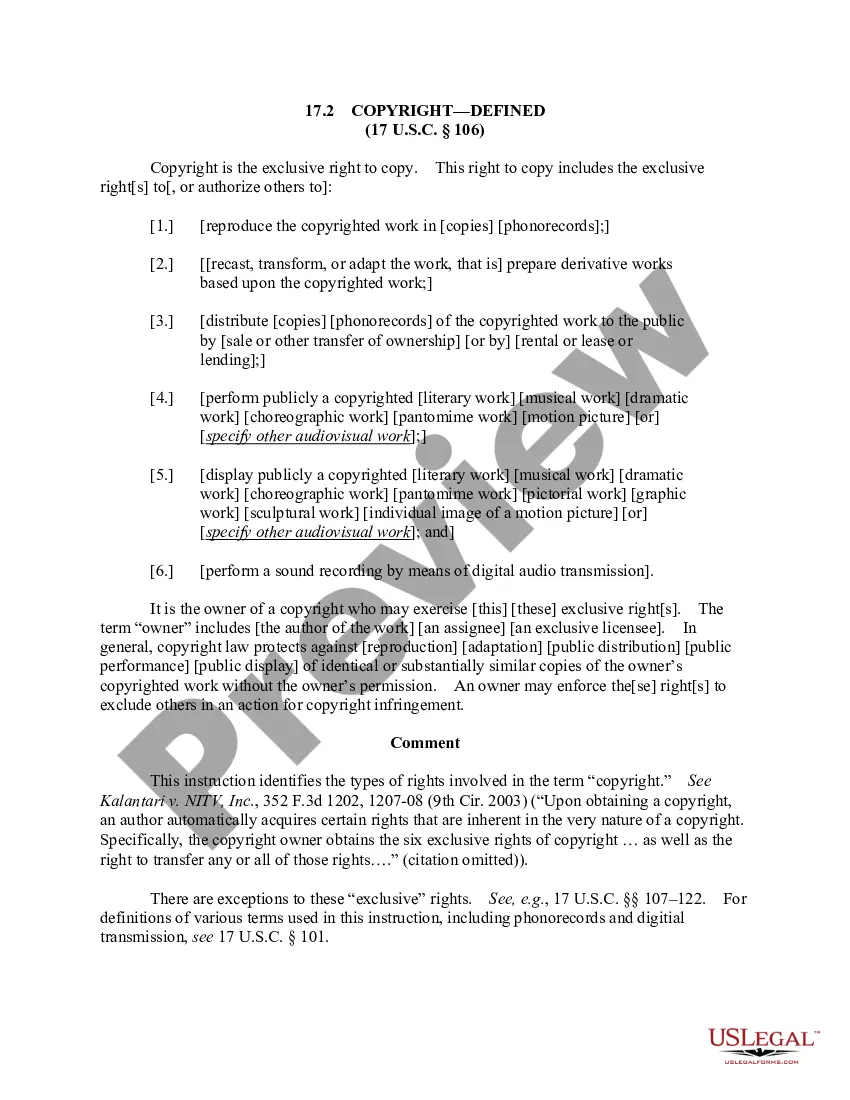
The United States Copyright Office defines Direct Copyright Infringement as the violation of a copyright holder's exclusive rights, which include the impermissible reproduction, distribution, performance, public display, or creation of a derivative work of copyrighted work.
In a case of direct infringement, the patent holder must prove that the defendant made, used, sold, offered for sale or imported the claimed invention. Direct infringement can be proven through literal infringement or through the doctrine of equivalents.
There are two types of infringement: primary and secondary. A primary infringement involves a direct infringement by the defendant. Secondary infringement happens if someone facilitates another person or group in infringing on a copyright.
In order to bring a copyright infringement claim, the plaintiff must prove that they hold the copyright interest through creation, assignment, or license. The plaintiff must also plead that the complaint is of an unlawful copy of the original element of the copyrighted work.
The three basic elements of copyright: originality, creativity, and fixation. There are three basic elements that a work must possess in order to be protected by copyright in the US: Originality: To get a copyright, a work must be the original work of the author.
In copyright law, direct infringement occurs when a person, without authorization, reproduces, distributes, displays, or performs a copyrighted work, or prepares a derivative work based on a copyrighted work.