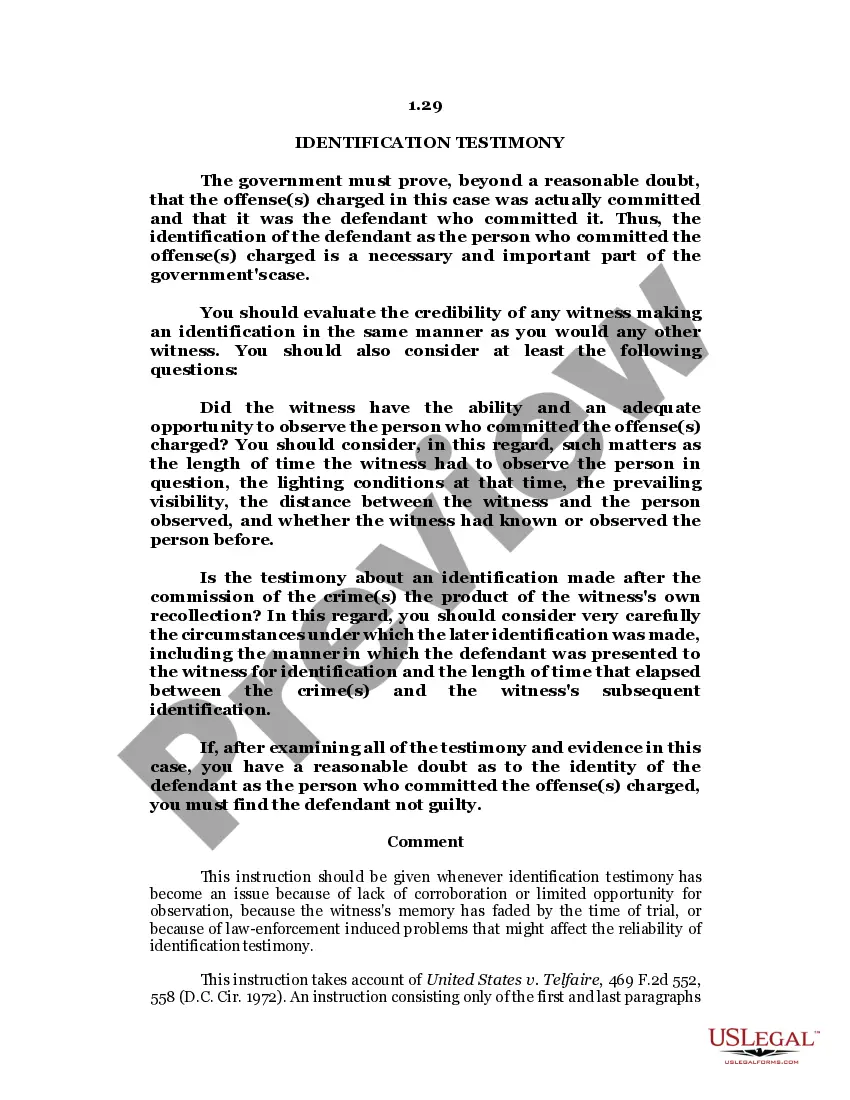
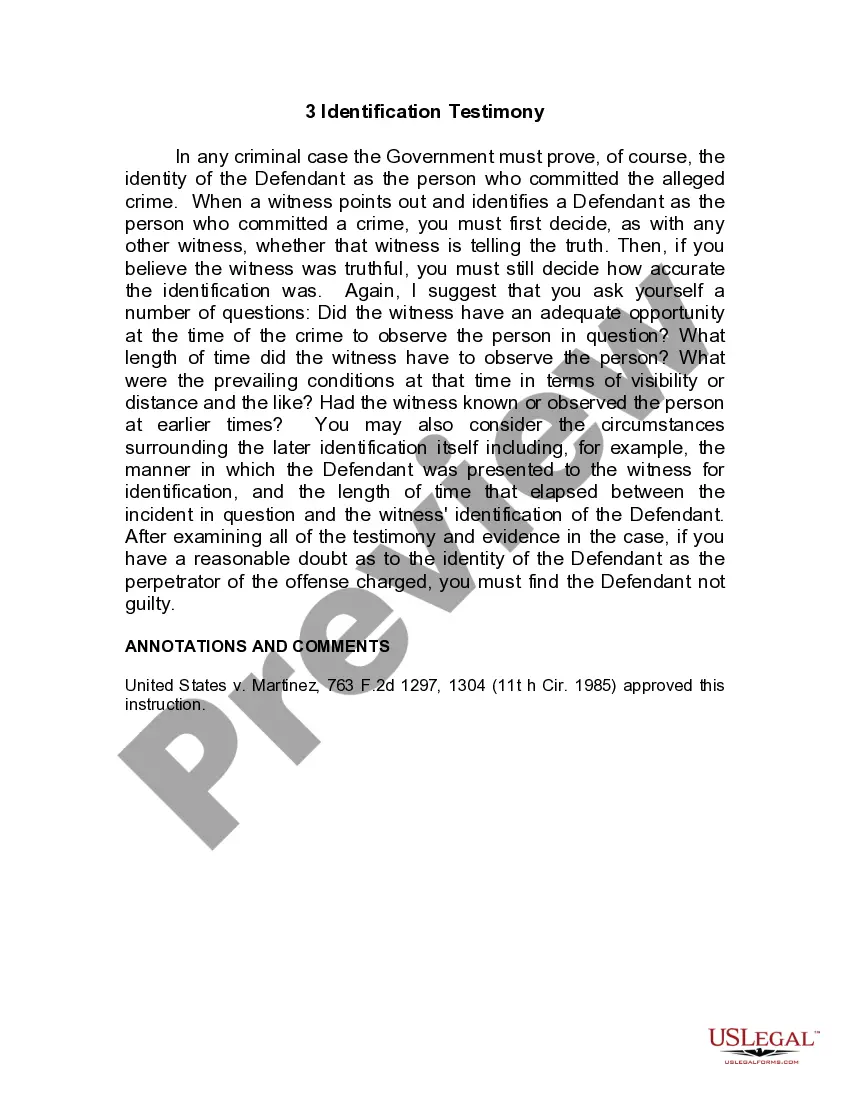
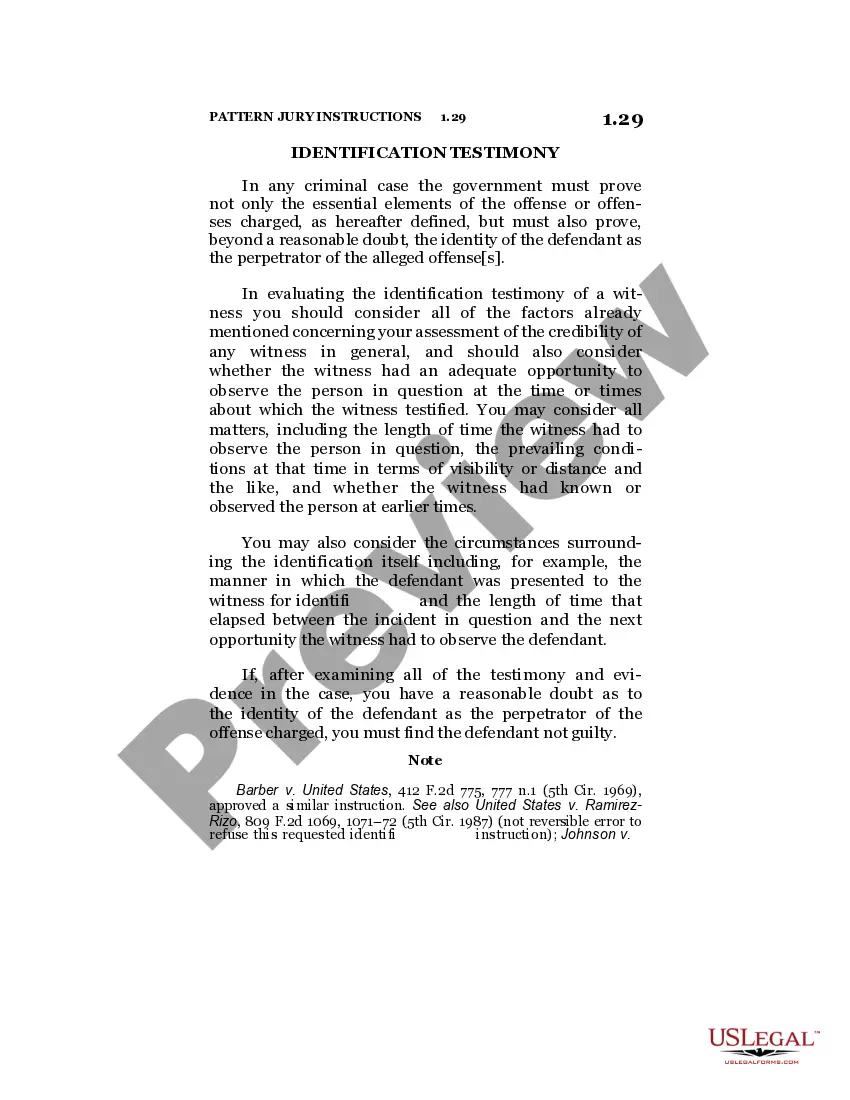
IDENTIFICATION TESTIMONY
About this form
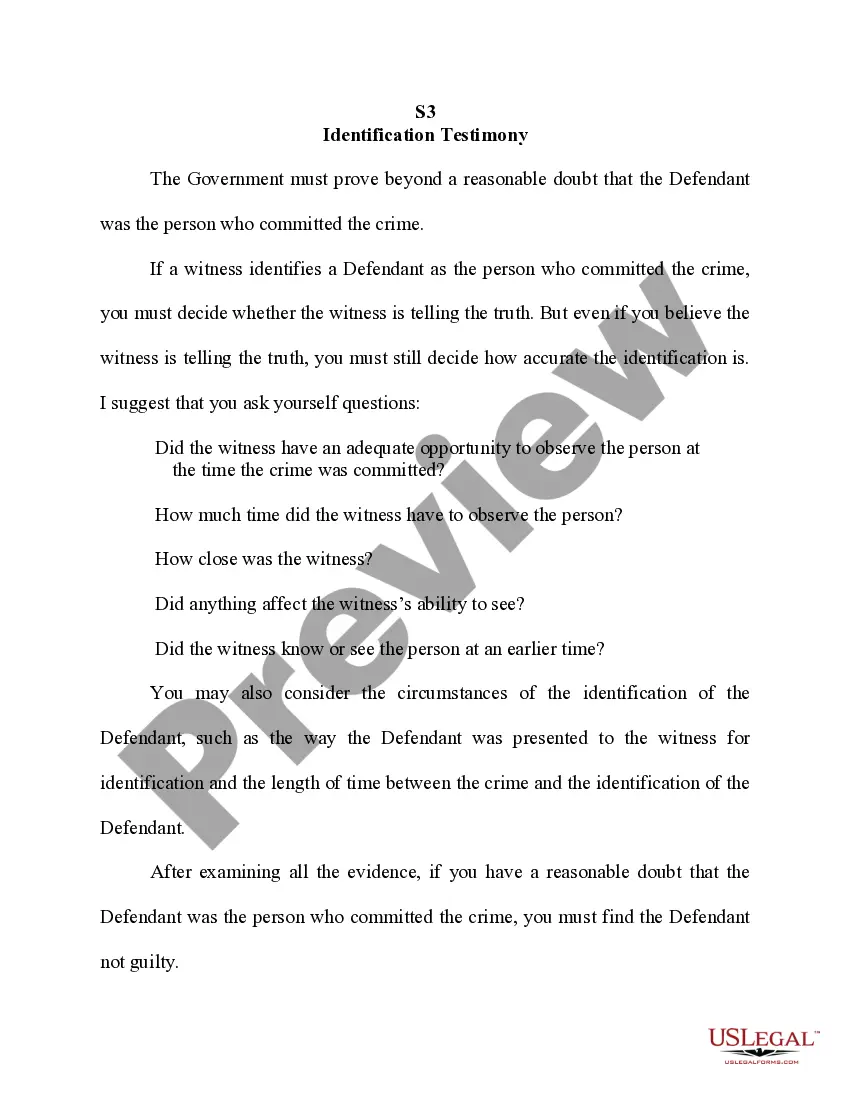
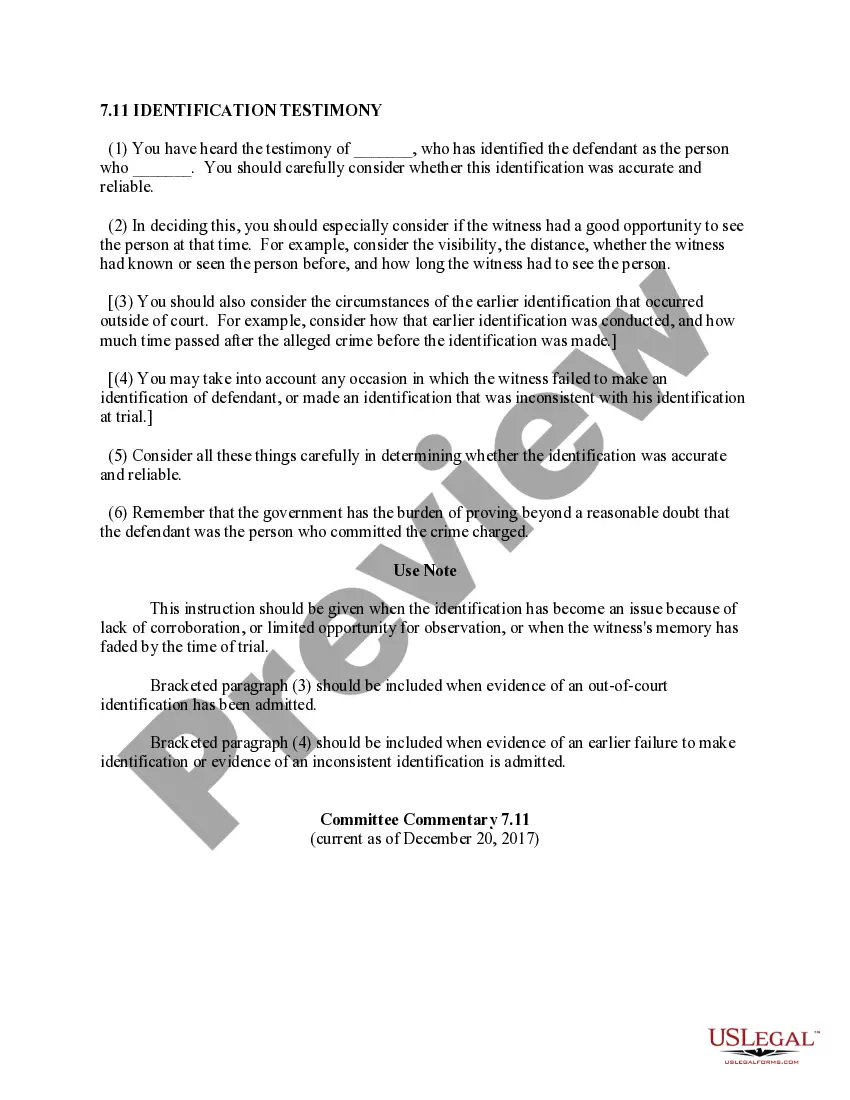
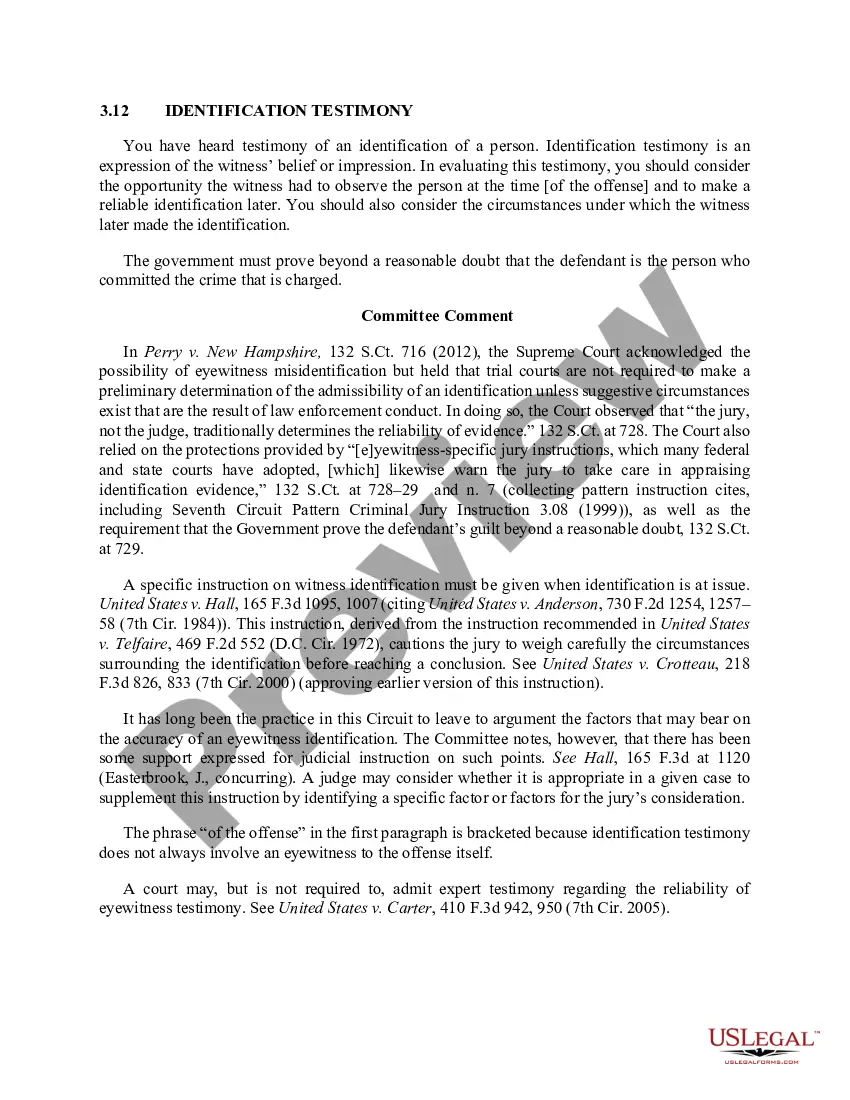
The Identification Testimony form is a legal document that outlines the standards for evaluating witness identification in criminal cases. It is crucial for determining whether the defendant is indeed the person who committed the alleged offenses. This form provides clarity on how jurors should assess the credibility of identification witnesses and the circumstances surrounding their testimonies. This differs from other legal forms that may deal with contracts or agreements, as it is specific to jury instructions in the context of legal trial processes.
Key parts of this document
- Definition of the government's burden of proof regarding the identity of the defendant.
- Guidelines for evaluating witness credibility and reliability of identification.
- Factors that influence the accuracy of witness recollection, such as observation conditions.
- Instructions for jurors on how to handle reasonable doubt regarding identification.
- Comments on when to utilize this instruction based on trial circumstances.


When to use this document
This form is used in legal trials where witness identification plays a significant role in proving the defendant's guilt. It should be referenced when there are concerns about the reliability of a witness's identification due to insufficient observation time, poor visibility, fading memory, or suggestive police procedures that could affect the witness's recollection. This ensures that jurors critically assess identification evidence before reaching a verdict.
Intended users of this form
- Jury members in criminal trials where identification testimony is presented.
- Judges who provide instructions to jurors on how to consider identification evidence.
- Legal practitioners who prepare cases involving eyewitness testimonies.
Steps to complete this form
- Review the criteria outlined to establish the burden of proof regarding identity.
- Ensure all relevant factors influencing witness credibility are considered.
- Identify and articulate any doubts regarding the reliability of witness testimonies.
- Incorporate additional comments or instructions as necessary based on trial circumstances.
- Present the instruction clearly to assist jurors in their deliberation process.
Is notarization required?
Notarization is generally not required for this form. However, certain states or situations might demand it. You can complete notarization online through US Legal Forms, powered by Notarize, using a verified video call available anytime.
Get your form ready online
Our built-in tools help you complete, sign, share, and store your documents in one place.
Make edits, fill in missing information, and update formatting in US Legal Forms—just like you would in MS Word.
Download a copy, print it, send it by email, or mail it via USPS—whatever works best for your next step.
Sign and collect signatures with our SignNow integration. Send to multiple recipients, set reminders, and more. Go Premium to unlock E-Sign.
If this form requires notarization, complete it online through a secure video call—no need to meet a notary in person or wait for an appointment.
We protect your documents and personal data by following strict security and privacy standards.

Make edits, fill in missing information, and update formatting in US Legal Forms—just like you would in MS Word.

Download a copy, print it, send it by email, or mail it via USPS—whatever works best for your next step.

Sign and collect signatures with our SignNow integration. Send to multiple recipients, set reminders, and more. Go Premium to unlock E-Sign.

If this form requires notarization, complete it online through a secure video call—no need to meet a notary in person or wait for an appointment.

We protect your documents and personal data by following strict security and privacy standards.
Avoid these common issues
- Failing to fully consider the circumstances under which the identification was made.
- Overlooking the importance of witness opportunity to observe during the crime.
- Neglecting to discuss the potential influence of law enforcement procedures on identification.
Advantages of online completion
- Convenient access to legal instructions tailored for identification testimony.
- Editability allows for adjustments to fit specific case scenarios easily.
- Reliability of forms drafted by licensed attorneys ensures legal accuracy.
Looking for another form?
Form popularity
FAQ
Eyewitness testimony is a legal term that refers to an account given by people of an event they have witnessed. For example, they may be required to describe a trial of a robbery or a road accident someone has seen. This includes the identification of perpetrators, details of the crime scene, etc.
(a) Definitions. (1) ?Eyewitness Identification? means witness testimony or conduct in a criminal trial that identifies the defendant as the person who committed a charged crime.
Eyewitnesses can provide very compelling legal testimony, but rather than recording experiences flawlessly, their memories are susceptible to a variety of errors and biases. They (like the rest of us) can make errors in remembering specific details and can even remember whole events that did not actually happen.
A common method for authorities to identify the perpetrator of a crime is the use of a photo lineup. In a photo lineup a witness is shown many photos of people, including the person accused of committing the crime.
Survey findings indicate that prosecutors generally feel that eyewitness identification is relatively accurate and is given the appropriate emphasis by judges and juries. Defense attorneys, on the other hand, tend to view eyewitness evidence as often inaccurate and as having too much weight in courtroom deliberations.
Despite a high rate of error (as many as 1 in 4 stranger eyewitness identifications are wrong), eyewitness identifications are considered some of the most powerful evidence against a suspect.
There are three primary forms of eyewitness identification: lineup, showup, and photographic identification.
Time Sensitive. Lastly, our Miami criminal defense attorney wants to highlight that eyewitness testimony is time-sensitive. Memories can change over time, and so can the details they recall when they speak to the police. This often leads to an improper identification of a suspect.