Identification Testimony
What this document covers
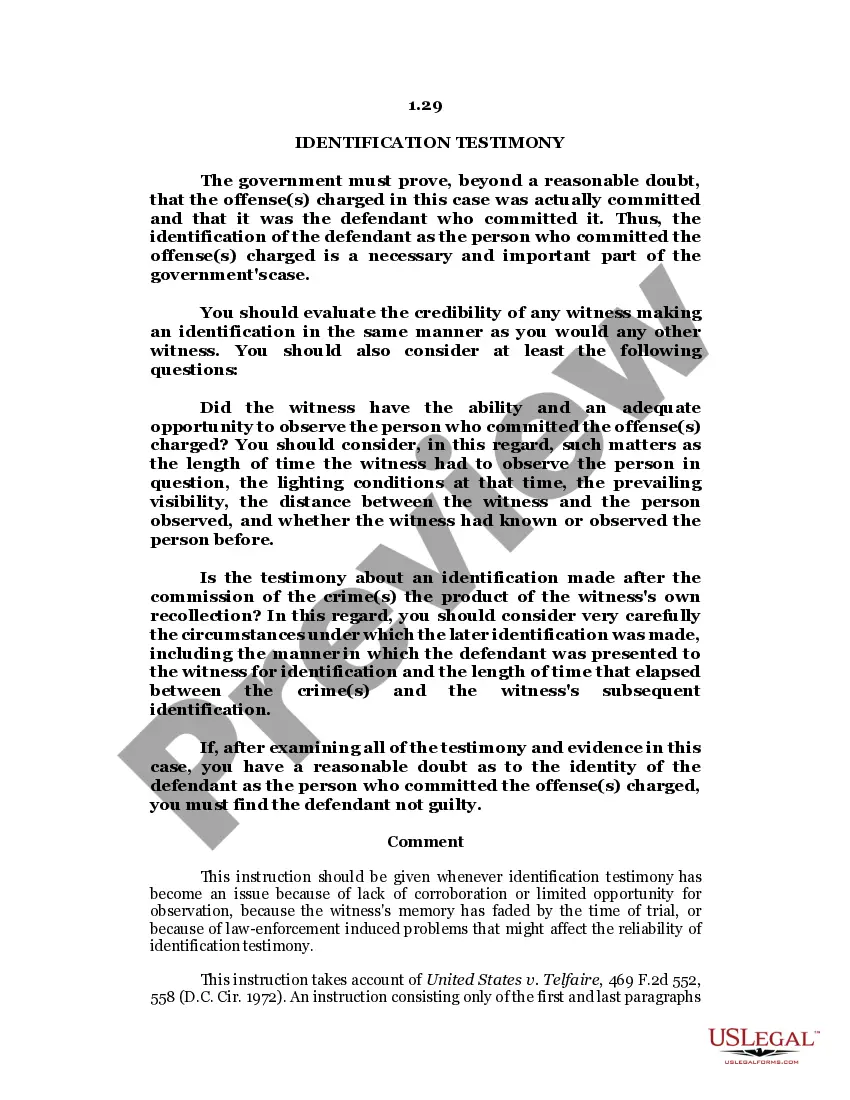
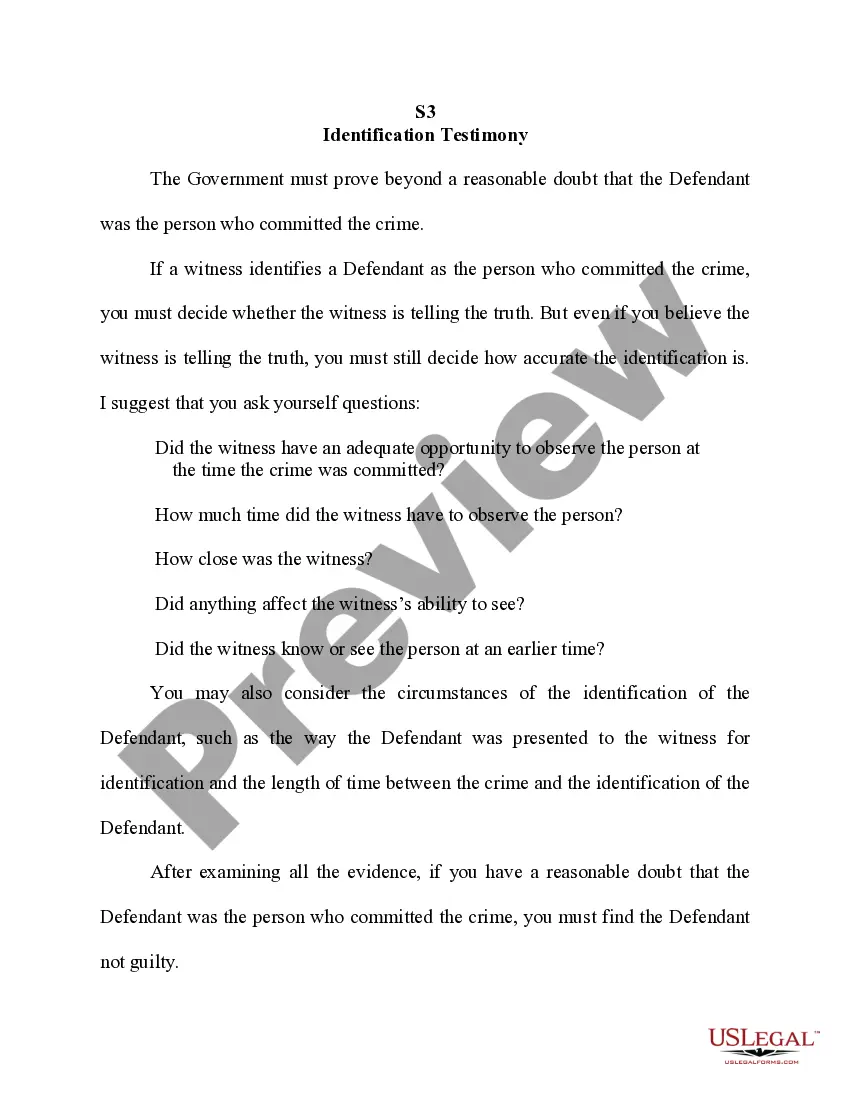
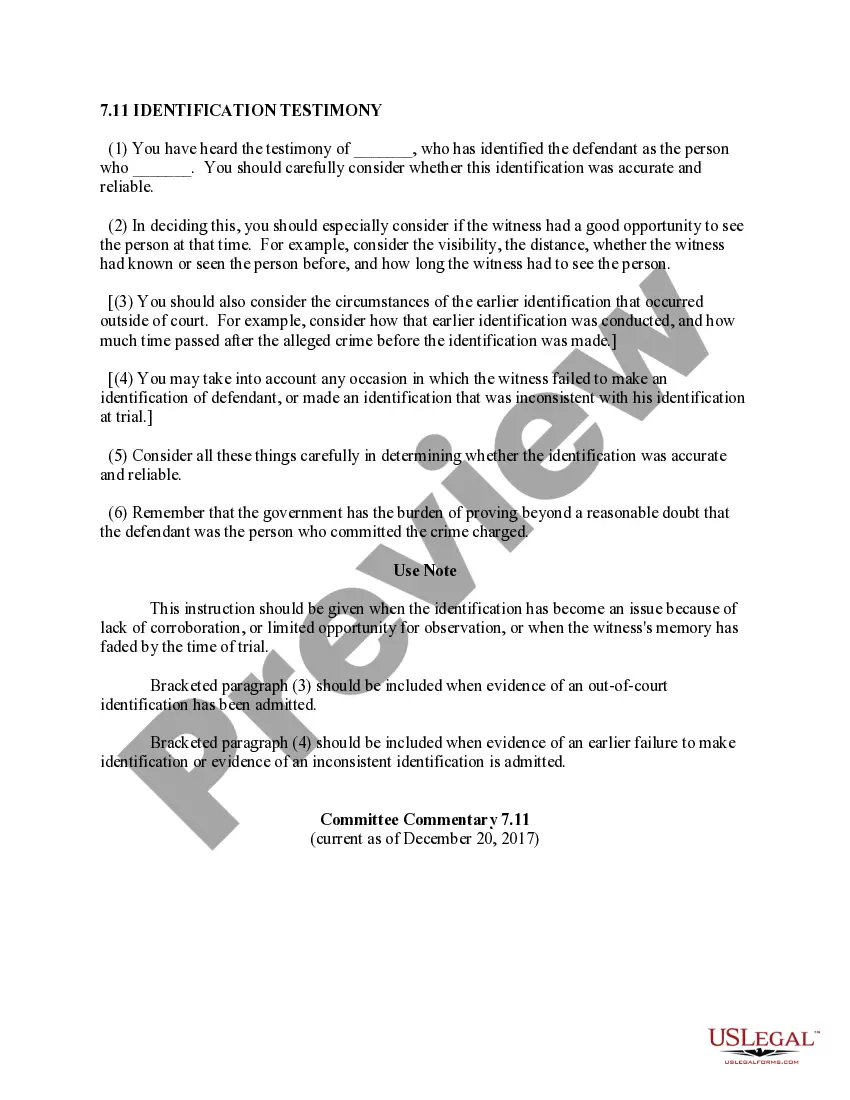
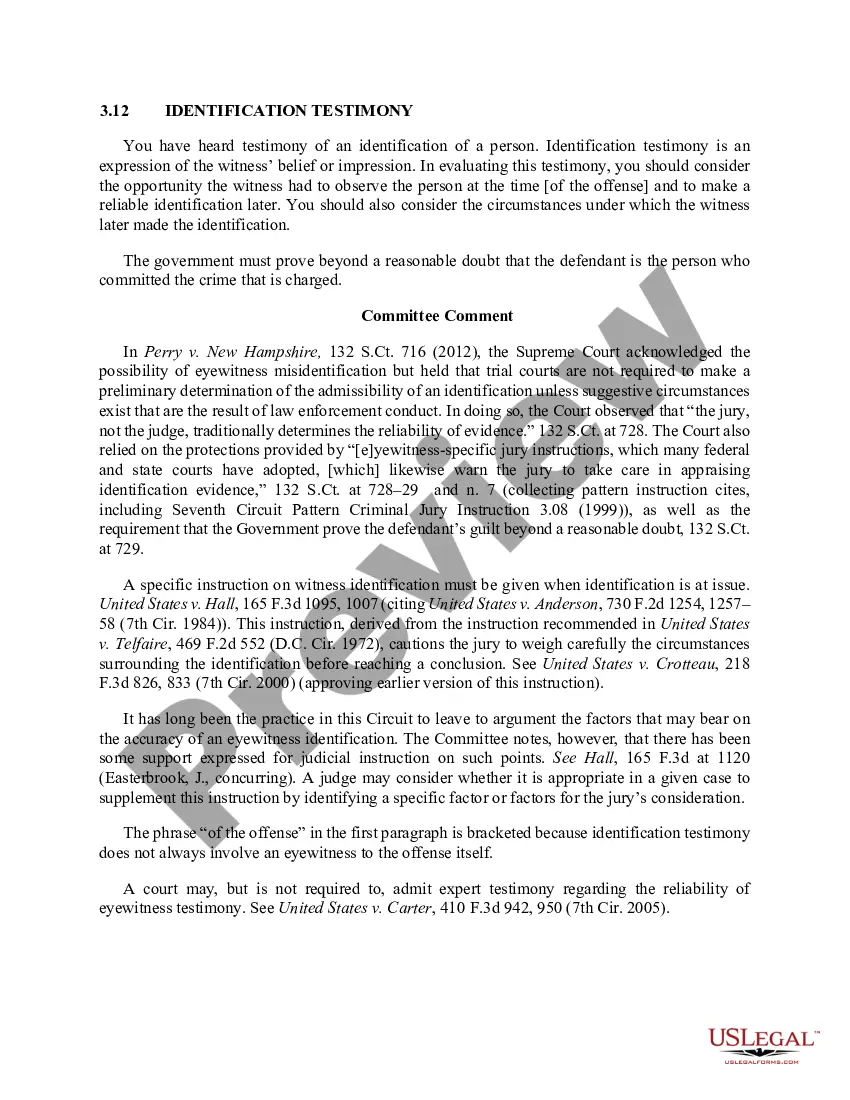
The Identification Testimony form is a legal document used in criminal cases to outline how witnesses can identify the defendant as the perpetrator of an alleged offense. This form emphasizes the importance of the witness's ability to observe the defendant at the time of the crime, distinguishing it from other forms that do not specifically address identification issues. Its precise use is crucial in ensuring that identification evidence meets the required legal standards.
Key parts of this document
- Instructions on evaluating witness credibility.
- Factors for assessing observation opportunities by witnesses.
- Guidelines on the conditions affecting visibility and distance.
- Considerations for the timing of the identification relative to the incident.
- Citations of relevant case law and legal precedents.

Common use cases
This form should be utilized in criminal trials where witness identification of the defendant is critical. It is commonly used in cases involving theft, assault, or other crimes where eyewitness testimony plays a significant role in proving the identity of the perpetrator. Using this form helps establish the reliability of witness accounts and their accuracy in identifying the defendant.
Who this form is for
- Prosecutors managing criminal cases.
- Defense attorneys seeking to challenge identification evidence.
- Judges overseeing criminal trials.
- Law students or legal practitioners researching criminal identification standards.
How to prepare this document
- Identify the witness and the defendant involved in the case.
- Assess and document the conditions under which the witness observed the defendant.
- Compile the witness's prior knowledge of the defendant if applicable.
- Include any relevant legal precedents or case law supporting the identification process.
- Gather and present the identification evidence clearly and concisely.
Notarization guidance
This form does not typically require notarization unless specified by local law. However, confirming this with legal counsel is advisable to ensure compliance with jurisdictional requirements.
Get your form ready online
Our built-in tools help you complete, sign, share, and store your documents in one place.
Make edits, fill in missing information, and update formatting in US Legal Forms—just like you would in MS Word.
Download a copy, print it, send it by email, or mail it via USPS—whatever works best for your next step.
Sign and collect signatures with our SignNow integration. Send to multiple recipients, set reminders, and more. Go Premium to unlock E-Sign.
If this form requires notarization, complete it online through a secure video call—no need to meet a notary in person or wait for an appointment.
We protect your documents and personal data by following strict security and privacy standards.

Make edits, fill in missing information, and update formatting in US Legal Forms—just like you would in MS Word.

Download a copy, print it, send it by email, or mail it via USPS—whatever works best for your next step.

Sign and collect signatures with our SignNow integration. Send to multiple recipients, set reminders, and more. Go Premium to unlock E-Sign.

If this form requires notarization, complete it online through a secure video call—no need to meet a notary in person or wait for an appointment.

We protect your documents and personal data by following strict security and privacy standards.
Avoid these common issues
- Failing to adequately document the witness's opportunity to observe the defendant.
- Not considering the conditions affecting the witness's view of the defendant.
- Overlooking necessary legal precedents that may impact identification credibility.
Benefits of using this form online
- Convenient access to legally reviewed templates for immediate use.
- Editability allows customization to specific case needs.
- Reliable formatting that adheres to legal standards across jurisdictions.
Looking for another form?
Form popularity
FAQ
What Is Eyewitness Testimony? Eyewitness testimony is what happens when a person witnesses a crime (or accident, or other legally important event) and later gets up on the stand and recalls for the court all the details of the witnessed event.
There are three primary forms of eyewitness identification: lineup, showup, and photographic identification.
What factors affect the accuracy of eyewitness testimony? Memory reconstruction. It is a common misconception that the human memory works like a video recording, allowing people to replay events in their minds just as they occurred.Lineup issues.Visual characteristics.Anxiety and stress.Obtaining legal representation.
(a) Definitions. (1) ?Eyewitness Identification? means witness testimony or conduct in a criminal trial that identifies the defendant as the person who committed a charged crime.
For instance, if an eyewitness sees an incident in poor lighting or from a distance, his or her recollections are less likely to reliable. A person's biases can affect the accuracy of his or her memories, and so can stress factors, such as the presence of a gun during an assault or violent crime.
Eyewitness testimony is a legal term that refers to an account given by people of an event they have witnessed. For example, they may be required to describe a trial of a robbery or a road accident someone has seen. This includes the identification of perpetrators, details of the crime scene, etc.
Survey findings indicate that prosecutors generally feel that eyewitness identification is relatively accurate and is given the appropriate emphasis by judges and juries. Defense attorneys, on the other hand, tend to view eyewitness evidence as often inaccurate and as having too much weight in courtroom deliberations.