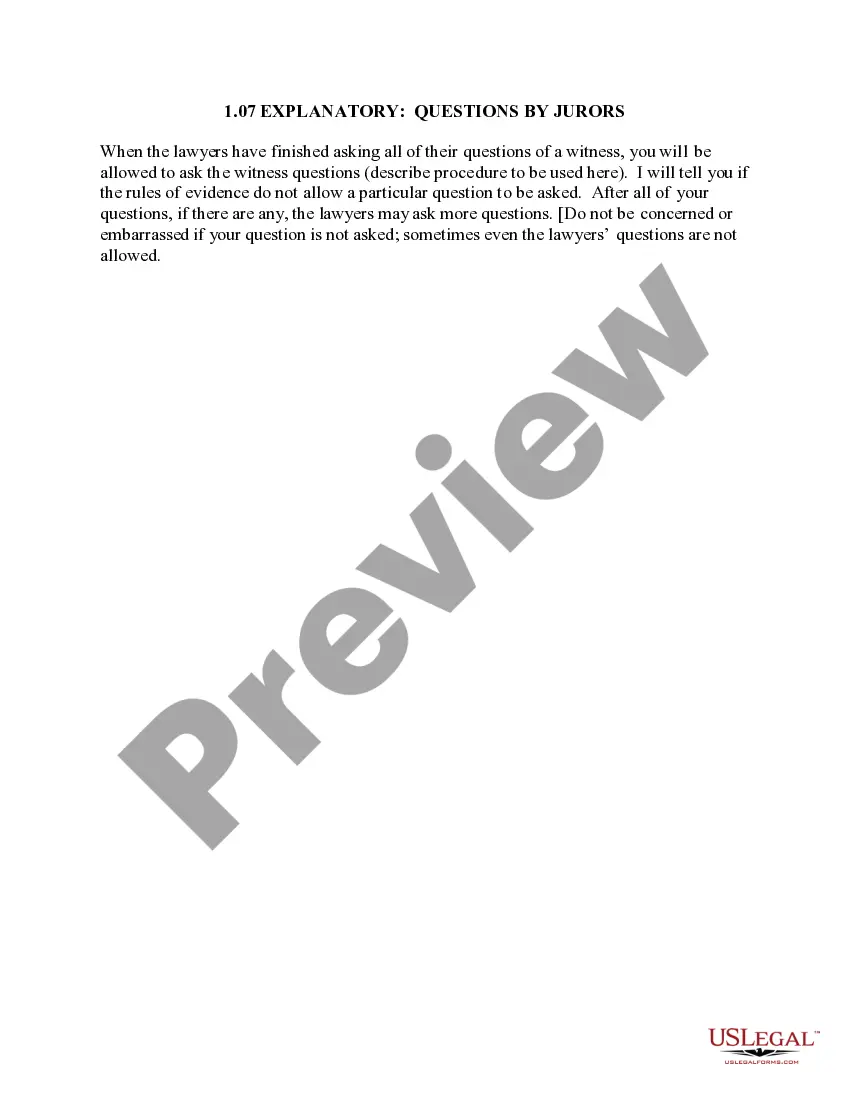
1.07 EXPLANATORY: QUESTIONS BY JURORS
About this form
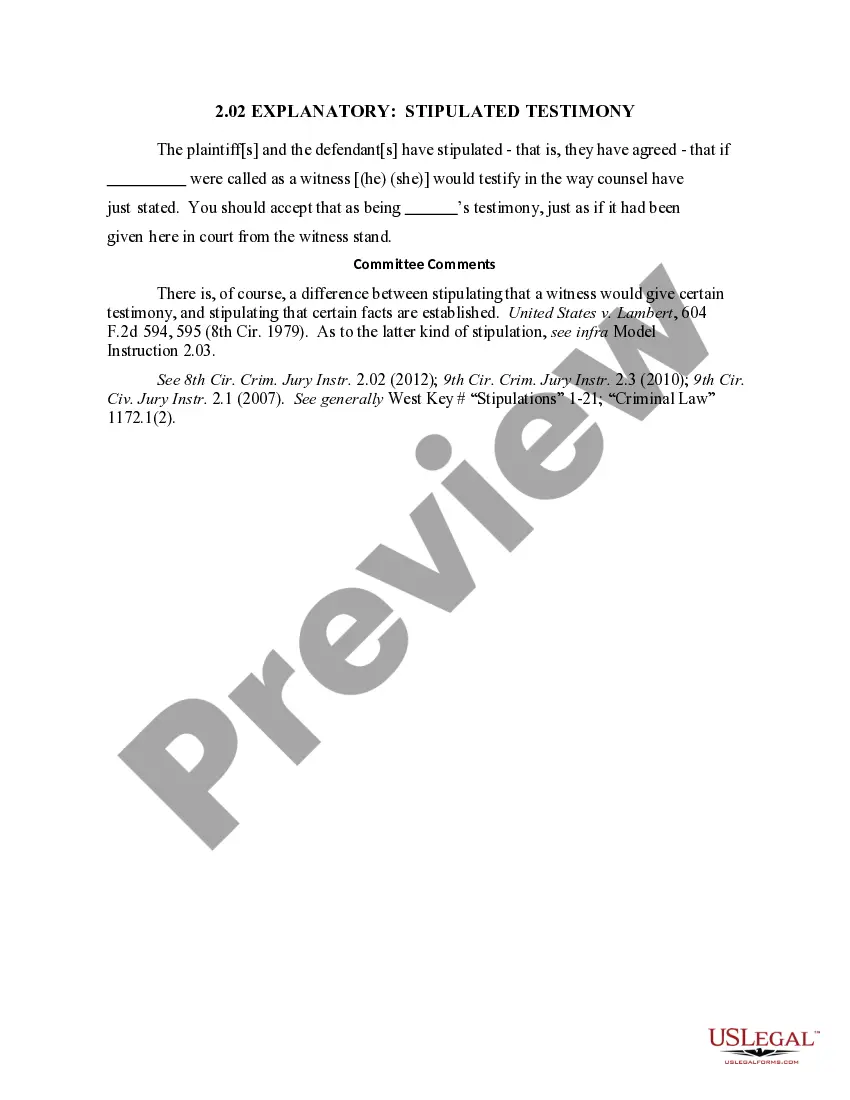
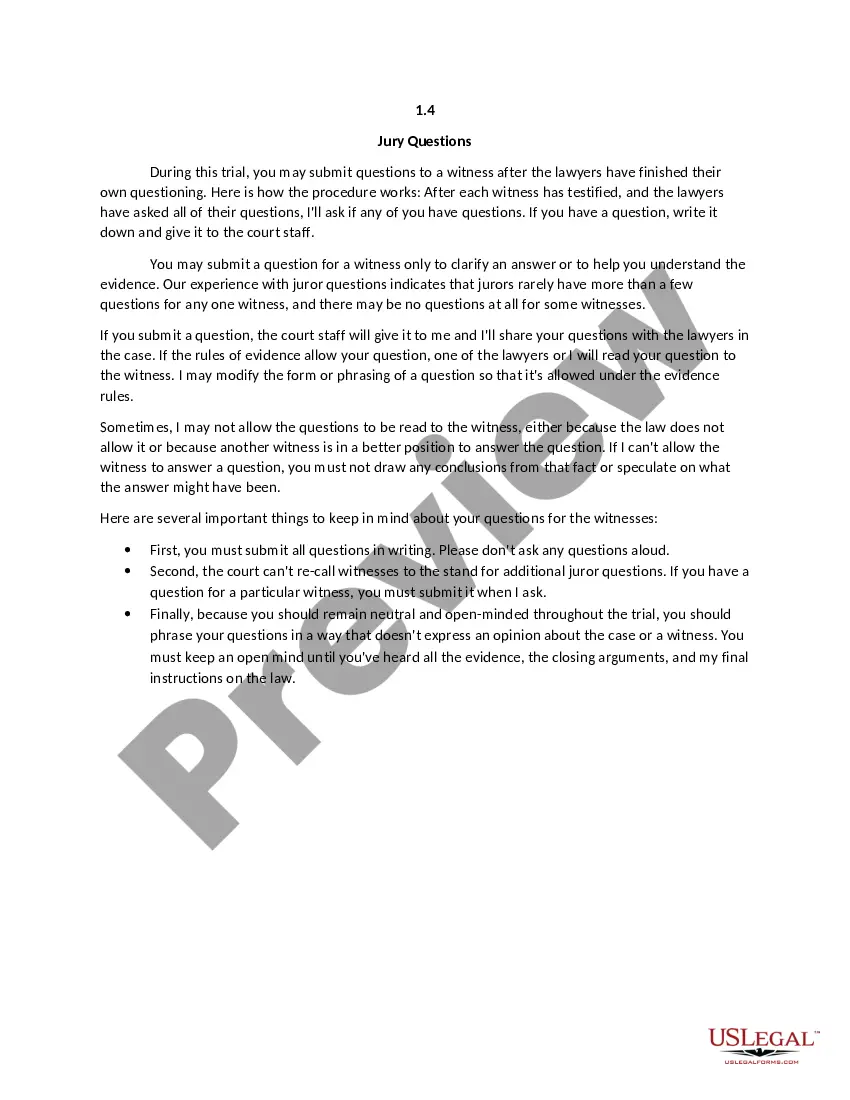
The 1.07 Explanatory: Questions by Jurors form is a legal template that guides jurors on how to ask questions of witnesses during a trial. This form is crucial in ensuring that jurors can seek clarification on evidence and testimonies while adhering to legal protocols. It differs from other legal forms by focusing specifically on the procedure for juror inquiries and the boundaries set by the rules of evidence.
Main sections of this form
- Directions for jurors on how to pose questions to witnesses.
- Explanation of the court's role in determining the admissibility of questions.
- Reassurance to jurors about the confidentiality of their questions.
- Information on follow-up questions from lawyers after juror inquiries.

Situations where this form applies
This form should be used during a trial when jurors have completed their initial review of evidence and testimonies and are allowed to engage directly with witnesses through questions. It ensures that jurors can clarify points of confusion to better understand the case before reaching a verdict.
Who this form is for
- Jurors participating in a trial.
- Judges providing guidelines to jurors on question procedures.
- Attorneys wanting to understand juror interactions with witnesses.
How to prepare this document
- Review the instructions for jurors provided in the form.
- Take note of the procedure for submitting questions.
- Formulate questions based on observations during the trial.
- Submit your questions to the court for review before asking the witness.
Does this form need to be notarized?
Notarization is generally not required for this form. However, certain states or situations might demand it. You can complete notarization online through US Legal Forms, powered by Notarize, using a verified video call available anytime.
Get your form ready online
Our built-in tools help you complete, sign, share, and store your documents in one place.
Make edits, fill in missing information, and update formatting in US Legal Forms—just like you would in MS Word.
Download a copy, print it, send it by email, or mail it via USPS—whatever works best for your next step.
Sign and collect signatures with our SignNow integration. Send to multiple recipients, set reminders, and more. Go Premium to unlock E-Sign.
If this form requires notarization, complete it online through a secure video call—no need to meet a notary in person or wait for an appointment.
We protect your documents and personal data by following strict security and privacy standards.

Make edits, fill in missing information, and update formatting in US Legal Forms—just like you would in MS Word.

Download a copy, print it, send it by email, or mail it via USPS—whatever works best for your next step.

Sign and collect signatures with our SignNow integration. Send to multiple recipients, set reminders, and more. Go Premium to unlock E-Sign.

If this form requires notarization, complete it online through a secure video call—no need to meet a notary in person or wait for an appointment.

We protect your documents and personal data by following strict security and privacy standards.
Common mistakes
- Asking questions that are outside the scope of evidence.
- Failing to submit questions for approval before asking.
- Feeling discouraged if a question is not allowed.
Benefits of using this form online
- Easy access to legal guidelines ensuring proper question procedure.
- Editable format allows jurors to draft and refine questions before submission.
- Convenience of downloading and using the form at any time.
Legal use & context
- This form is designed to facilitate the interaction between jurors and witnesses within legal constraints.
- It ensures that all questions align with the rules of evidence, enhancing the trial's fairness and integrity.
What to keep in mind
- The 1.07 Explanatory: Questions by Jurors form outlines the process for jurors to ask questions of witnesses.
- Understanding the proper procedure helps maintain courtroom order and respect legal boundaries.
- This form can be utilized across multiple states, but users should consult local rules for specifics.
Looking for another form?
Form popularity
FAQ
Judges fulfill this responsi- bility during voir dire by questioning jurors about their ability to be fair and impartial, listening care- fully to their responses, and excusing those individuals whom the judge and lawyers agree would have difficulty serving.
Types of Questions Asked During Juror Voir Dire General Biographical Information. Often, jurors will be asked to state the neighborhood or area they live in, their profession, whether they have children, are married, and so on.Prior Experiences.Special Knowledge.
This is why the concept of brutal honesty with yourself?and the introduction of this exact phrase at the beginning of voir dire?is essential. You must show the jurors you are willing to be brutally honest with them, and help them feel comfortable and safe to be brutally honest with you.
Each voir dire begins with questions about the jurors' background and case-related experiences, and builds toward more sensitive questions about jurors' attitudes toward your client and the key issues in your case.
This is called "challenging a juror". There are two types of challenges: a challenge for cause and a peremptory challenge.
It is not required that the government prove guilt beyond all possible doubt. A reasonable doubt is a doubt based upon reason and common sense and is not based purely on speculation. It may arise from a careful and impartial consideration of all the evidence, or from lack of evidence.
Voir dire is the process used by the parties to select a fair and impartial jury. During voir dire, the jury panel is questioned by both parties' lawyers. The questions are intended to help the lawyers in the jury selection process. After voir dire, the jury is selected from the panel.
During voir dire the lawyers may ask the judge to excuse a juror from sitting on the case. This is called "challenging a juror". There are two types of challenges: a challenge for cause and a peremptory challenge.