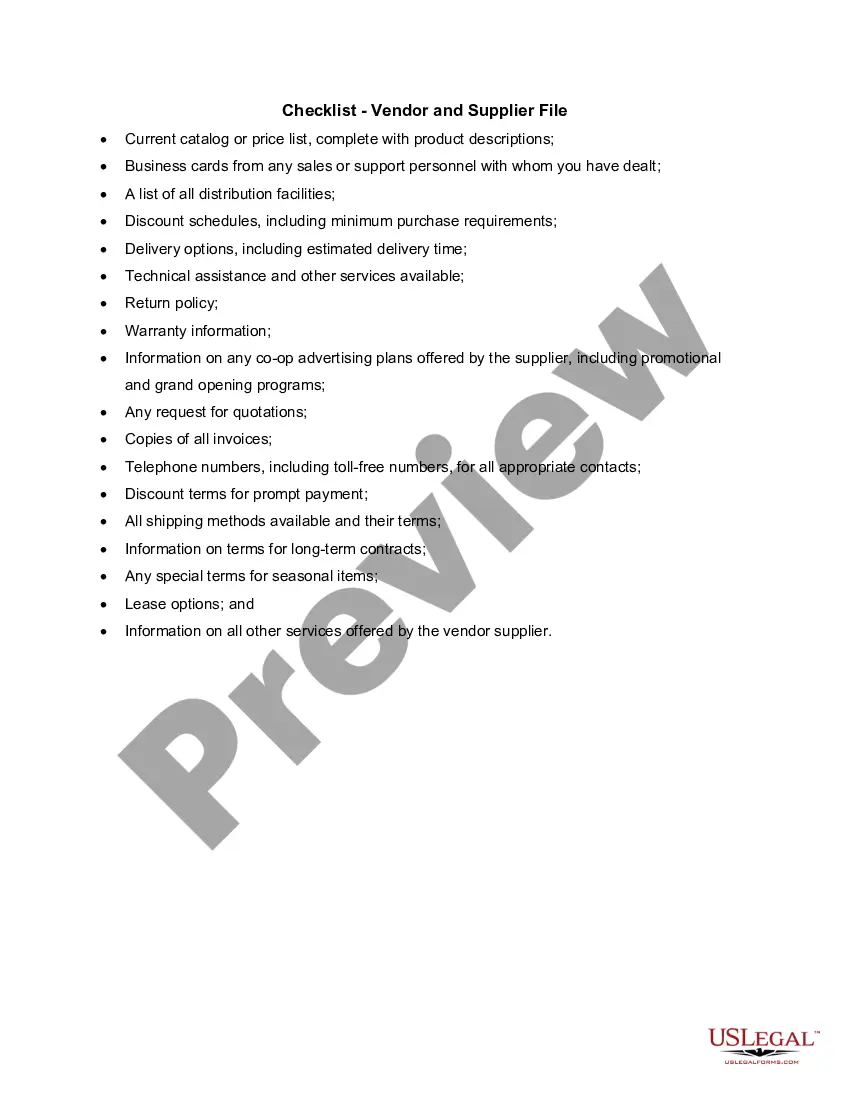
Checklist - Vendor and Supplier File
Understanding this form
The Vendor and Supplier File Checklist is a legal template designed to help you maintain organized records for all of your vendors and potential suppliers. Unlike other forms, this checklist focuses specifically on key aspects of vendor relationships, ensuring that you collect and store critical information needed for effective interactions and transactions. Using this form helps streamline vendor management and ensure compliance with business practices.
Form components explained
- Current catalog or price list, including product descriptions
- Business cards from sales or support personnel
- A list of all distribution facilities
- Discount schedules and minimum purchase requirements
- Delivery options with estimated delivery times
- Technical assistance and services offered
- Return policies and warranty information
- Co-op advertising plans and promotional programs
- Copies of all invoices
- Telephone numbers for appropriate contacts
- Shipping methods and terms
- Contract terms, including seasonal items and lease options
When to use this document
This checklist should be used whenever you are entering into a new vendor relationship or reevaluating an existing supplier. It allows you to gather essential information that will help you make informed decisions regarding purchasing, negotiation, and contract management. Consider using this form during vendor selection processes, audits of current supplier relationships, or while planning for future procurement needs.
Who should use this form
The following individuals or entities should use this form:
- Business owners managing multiple suppliers
- Procurement teams looking to maintain comprehensive vendor records
- Financial officers responsible for vendor payments and agreements
- Small to medium-sized enterprises needing structured vendor management
- Anyone involved in the supply chain or purchasing process
How to complete this form
- Gather basic vendor information such as name, contact details, and business cards.
- Compile a current catalog or price list, ensuring all product descriptions are included.
- List all distribution facilities and shipping methods available from the vendor.
- Document discount schedules, including any minimum purchase requirements.
- Record details about delivery options and estimated timelines for shipment.
- Include any technical services or support the vendor offers, along with warranties and return policies.
Does this form need to be notarized?
This form usually doesn’t need to be notarized. However, local laws or specific transactions may require it. Our online notarization service, powered by Notarize, lets you complete it remotely through a secure video session, available 24/7.
Get your form ready online
Our built-in tools help you complete, sign, share, and store your documents in one place.
Make edits, fill in missing information, and update formatting in US Legal Forms—just like you would in MS Word.
Download a copy, print it, send it by email, or mail it via USPS—whatever works best for your next step.
Sign and collect signatures with our SignNow integration. Send to multiple recipients, set reminders, and more. Go Premium to unlock E-Sign.
If this form requires notarization, complete it online through a secure video call—no need to meet a notary in person or wait for an appointment.
We protect your documents and personal data by following strict security and privacy standards.

Make edits, fill in missing information, and update formatting in US Legal Forms—just like you would in MS Word.

Download a copy, print it, send it by email, or mail it via USPS—whatever works best for your next step.

Sign and collect signatures with our SignNow integration. Send to multiple recipients, set reminders, and more. Go Premium to unlock E-Sign.

If this form requires notarization, complete it online through a secure video call—no need to meet a notary in person or wait for an appointment.

We protect your documents and personal data by following strict security and privacy standards.
Common mistakes
- Failing to keep the checklist updated with the latest vendor information.
- Neglecting to collect contact information for all key personnel.
- Omitting important clauses from vendor agreements based on this checklist.
- Not reviewing the checklist regularly to ensure compliance with business needs.
Advantages of online completion
- Convenience of accessing and editing your vendor file checklist online.
- Reduced risk of losing physical documents, ensuring data permanence.
- Simple sharing capabilities for collaboration within teams.
- Automatic updates to ensure all your vendor information is current.
Key takeaways
- The Vendor and Supplier File Checklist helps you manage vendor information effectively.
- Properly maintaining this checklist can improve vendor relationships and business operations.
- Regular updates and reviews of the vendor information are essential for compliance.
Looking for another form?

Form popularity
FAQ
Value for your investment (ROI) Quality. Delivery. Service. Commitment to growth and feedback. Partnership mindset. Complaint history. Financial and operational stability.
5 Supplier Evaluation Methods. There are number of approaches being used to assist the supplier performance evaluation. Categorical Method. Weighted-Point Method. Cost Ratio Method. Dimensional Analysis Method. Analytical Hierarchy Process (AHP)
Go to Navigation pane > Modules > Procurement and sourcing > Vendors > All vendors. Click New. In the Vendor account field, type a value. In the Name field, enter or select a value. In the Group field, enter or select a value. In the Number of employees field, enter a number.
Basic vendor information (locations, size, etc.) Vendor background and experience. Product or service details, capabilities and differentiators. Customer experience policies. Technical and security information.
Examples of Vendors A manufacturer that turns raw material into a finished good is a vendor to wholesalers and retailers that sell the product to a consumer. In turn, retailers are a vendor for the end customer. For example, Target is a vendor for a person looking for home appliances or other products.
Preliminary Review of All Vendor Proposals. Record Business Requirements and Vendor Requirements. Assign Importance Value for Each Requirement. Assign a Performance Value for Each Requirement. Calculate a Total Performance Score. Select a Winning Vendor.
Vendor evaluation is a system for recording and ranking the performance of a supplier in terms of a variety of issues, which may include delivery performance and thequality of the items. A process of vendor rating is essential to effective purchasing.
Devise an Evaluation Method: There are common methods to rate a supplier's performance including evaluation forms, surveys, system metrics, and software applications. Company professionals can craft a survey where they ask their own employees to answer questions and to rate suppliers and vendors.