Business Deductions Checklist
What this document covers
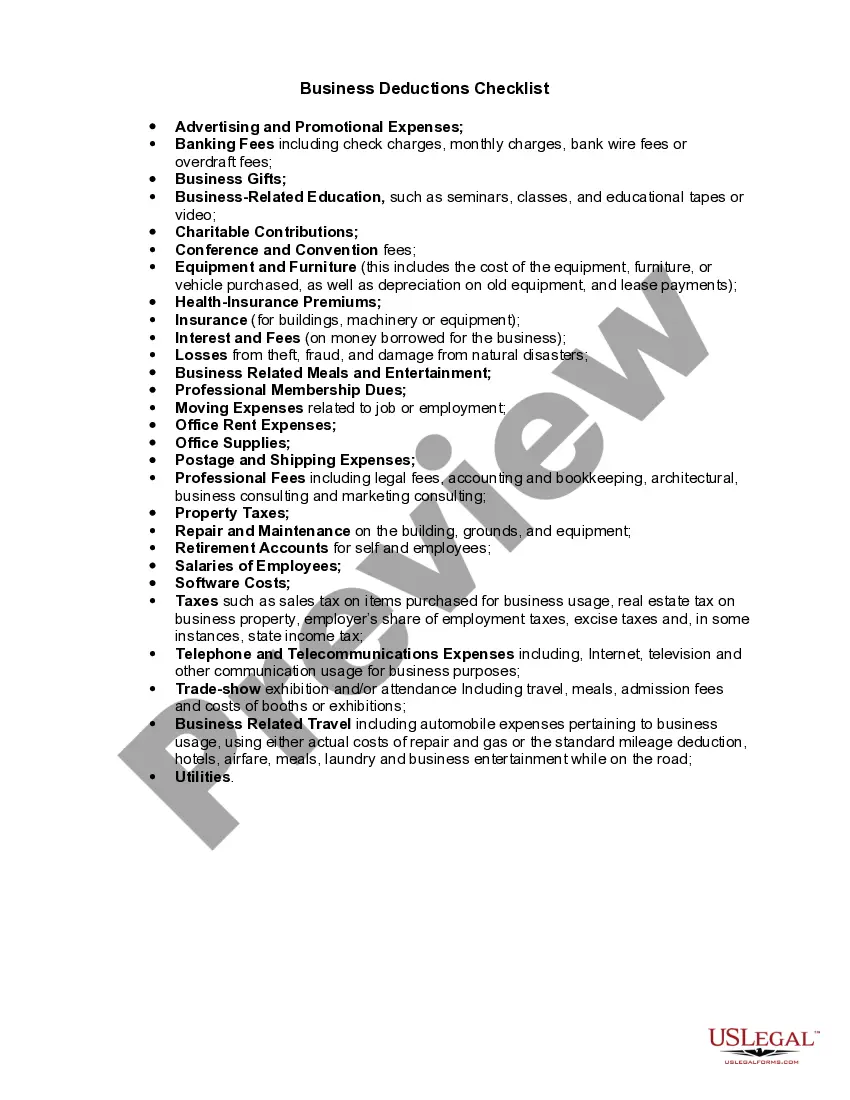
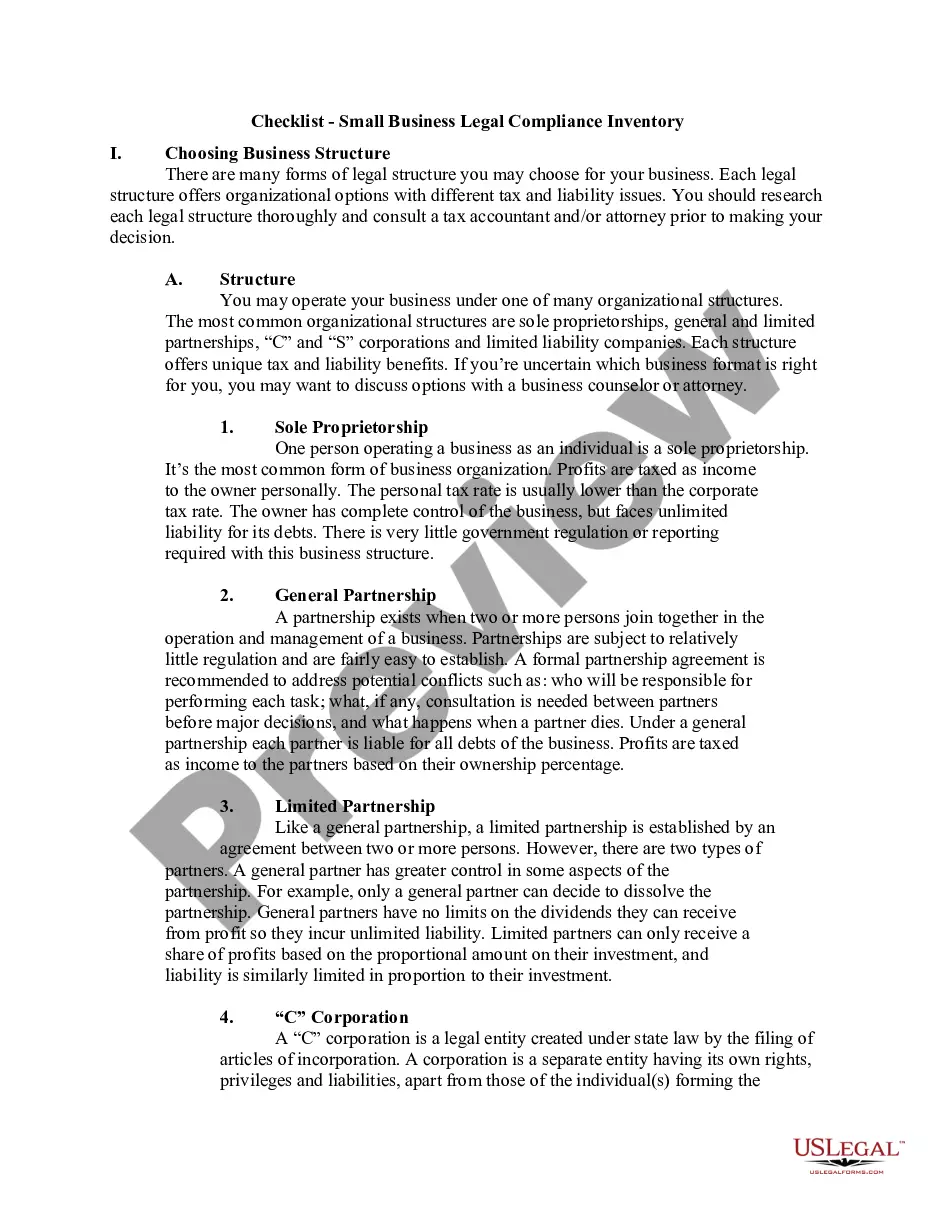
The Business Deductions Checklist is an essential tool for small business owners seeking to maximize their income tax deductions. This form outlines various expenses that are typically deductible, helping business owners identify which costs can reduce their taxable income. Unlike other tax forms, this checklist specifically categorizes and lists deductible business expenses, enabling users to easily navigate the complexities of tax deductions associated with their operations.
What’s included in this form
- Advertising and promotional expenses
- Banking fees and charges
- Business gifts
- Educational expenses related to business
- Conference and convention fees
- Equipment and furniture costs, including depreciation
- Health-insurance premiums
- Interest and fees on borrowed money
- Professional fees like legal or accounting services
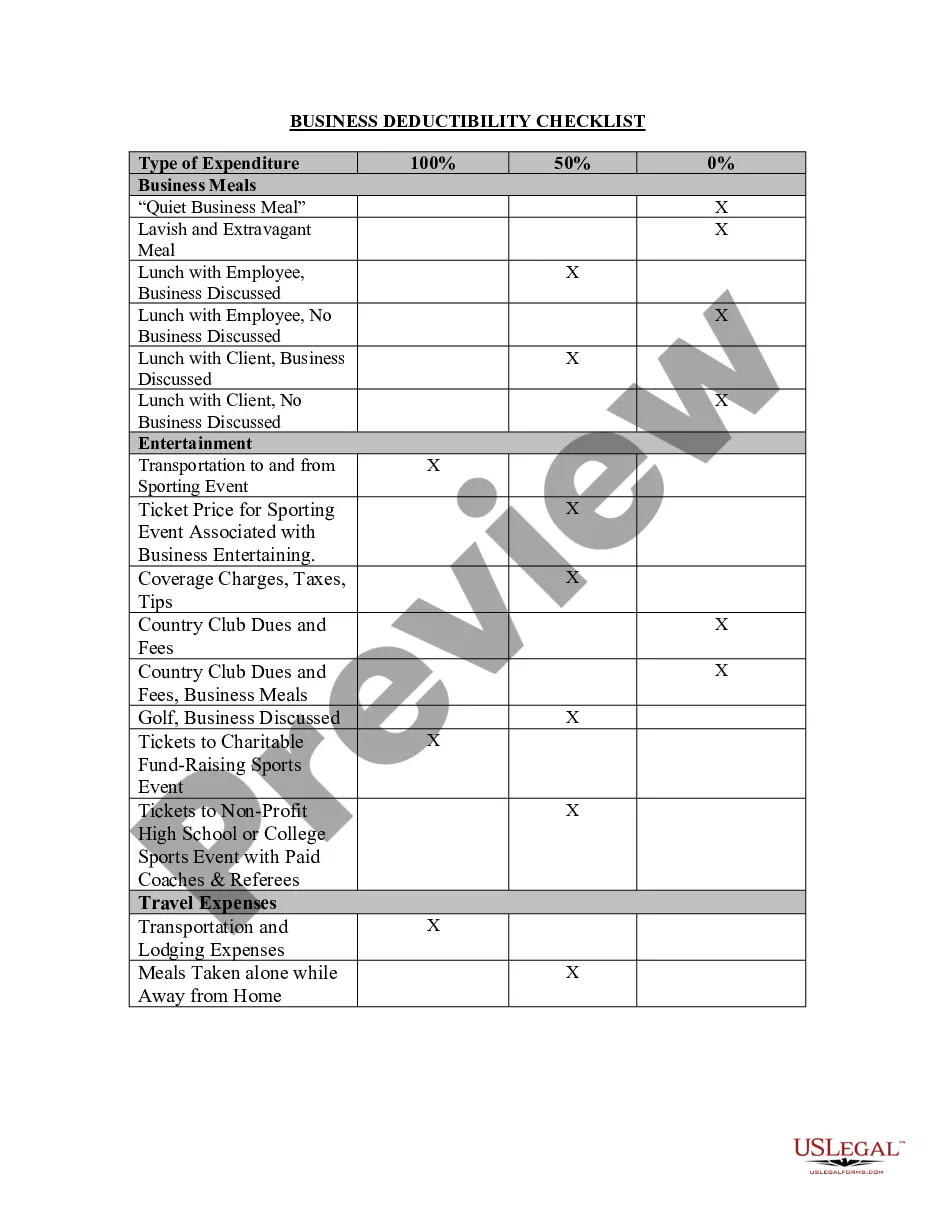
- Business-related meals and entertainment expenses
When to use this document
This checklist is useful for small business owners during the tax preparation process, especially when they want to ensure they are claiming all eligible deductions for the tax year. It helps identify ordinary and necessary business expenses that can significantly lower taxable income. Many users will benefit from this form before filing their annual tax returns or when reviewing their finances to optimize deductions.
Who needs this form
- Small business owners looking to identify tax-deductible expenses
- Freelancers and independent contractors
- Entrepreneurs at various stages of their business development
- Tax professionals seeking a comprehensive checklist for clients
Steps to complete this form
- Review the key sections of deductible expenses provided in the checklist.
- Identify expenses your business incurred throughout the tax year.
- Document each expense in the corresponding category on the checklist.
- Consult with your accountant to validate your deductions.
- Use the completed checklist as a guide during your tax filing process.
Is notarization required?
This form does not typically require notarization to be legally valid. However, some jurisdictions or document types may still require it. US Legal Forms provides secure online notarization powered by Notarize, available 24/7 for added convenience.
Get your form ready online
Our built-in tools help you complete, sign, share, and store your documents in one place.
Make edits, fill in missing information, and update formatting in US Legal Forms—just like you would in MS Word.
Download a copy, print it, send it by email, or mail it via USPS—whatever works best for your next step.
Sign and collect signatures with our SignNow integration. Send to multiple recipients, set reminders, and more. Go Premium to unlock E-Sign.
If this form requires notarization, complete it online through a secure video call—no need to meet a notary in person or wait for an appointment.
We protect your documents and personal data by following strict security and privacy standards.

Make edits, fill in missing information, and update formatting in US Legal Forms—just like you would in MS Word.

Download a copy, print it, send it by email, or mail it via USPS—whatever works best for your next step.

Sign and collect signatures with our SignNow integration. Send to multiple recipients, set reminders, and more. Go Premium to unlock E-Sign.

If this form requires notarization, complete it online through a secure video call—no need to meet a notary in person or wait for an appointment.

We protect your documents and personal data by following strict security and privacy standards.
Avoid these common issues
- Failing to keep receipts or documentation for deductible expenses.
- Ignoring specific state tax deduction rules that may apply.
- Overlooking deductions for home office or workspace that may qualify.
- Confusing personal and business-related expenses.
Advantages of online completion
- Easy access to a comprehensive list of tax-deductible expenses.
- Editable format allows for individual customization based on your unique business needs.
- Convenient download option for offline use when preparing taxes.
- Peace of mind knowing that the checklist has been developed with legal insight.
Legal use & context
- This checklist serves as a guideline for tax planning and compliance.
- It does not replace professional advice; always consult a tax expert.
- Maintaining accurate records of expenses enhances your ability to claim deductions.
Summary of main points
- The Business Deductions Checklist helps identify eligible tax deductions.
- Utilizing this checklist can improve tax savings for small businesses.
- Consultation with a tax professional is advisable to ensure all deductions are claimed appropriately.
Looking for another form?
Form popularity
FAQ
A tax deduction (or tax write-off) is an expense that you can deduct from your taxable income. You take the amount of the expense and subtract that from your taxable income. Essentially, tax write-offs allow you to pay a smaller tax bill. But the expense has to fit the IRS criteria of a tax deduction.
Generally, for 2020 taxes a single individual under age 65 only has to file if their adjusted gross income exceeds $12,400. However, if you are self-employed you are required to file a tax return if your net income from your business is $400 or more.
Can I write off business expenses if I don't have an LLC or an S-Corp? Yes, even if you are filing as an individual, you can still write off business expenses. All businesses can deduct ordinary and necessary expenses from their revenue. The IRS will tax you as a sole proprietor if you are the only owner.
A write-off is an expense that can be claimed as a tax deduction. Tax write-offs are deducted from total revenue to determine total taxable income for a small business.Small business owners try to write-off as many expenses as possible to decrease the amount of tax they need to pay.
By writing off the assets in the same year they're purchased, the money you're investing in your business equipment comes directly off your taxable income, which decreases your tax payable. By purchasing business assets up to $20,000, you are decreasing your taxable income by that same amount.
CCPCs that have taxable capital of between $10 million and $15 million in the previous tax year are eligible for the Small Business Deduction but their business limit is reduced on a straight-line basis.
Business Meals. As a small business, you can deduct 50 percent of food and drink purchases that qualify. Work-Related Travel Expenses. Work-Related Car Use. Business Insurance. Home Office Expenses. Office Supplies. Phone and Internet Expenses. Business Interest and Bank Fees.
You should file a Schedule C. You do not need to have a business license to file a Schedule C.
Rental expense. LLCs can deduct the amount paid to rent their offices or retail spaces. Charitable giving. Doing good is good for tax purposes. Insurance. Tangible property. Professional expenses. Meals and entertainment. Independent contractors. Cost of goods sold.