Bribing a Public Official
Overview of this form
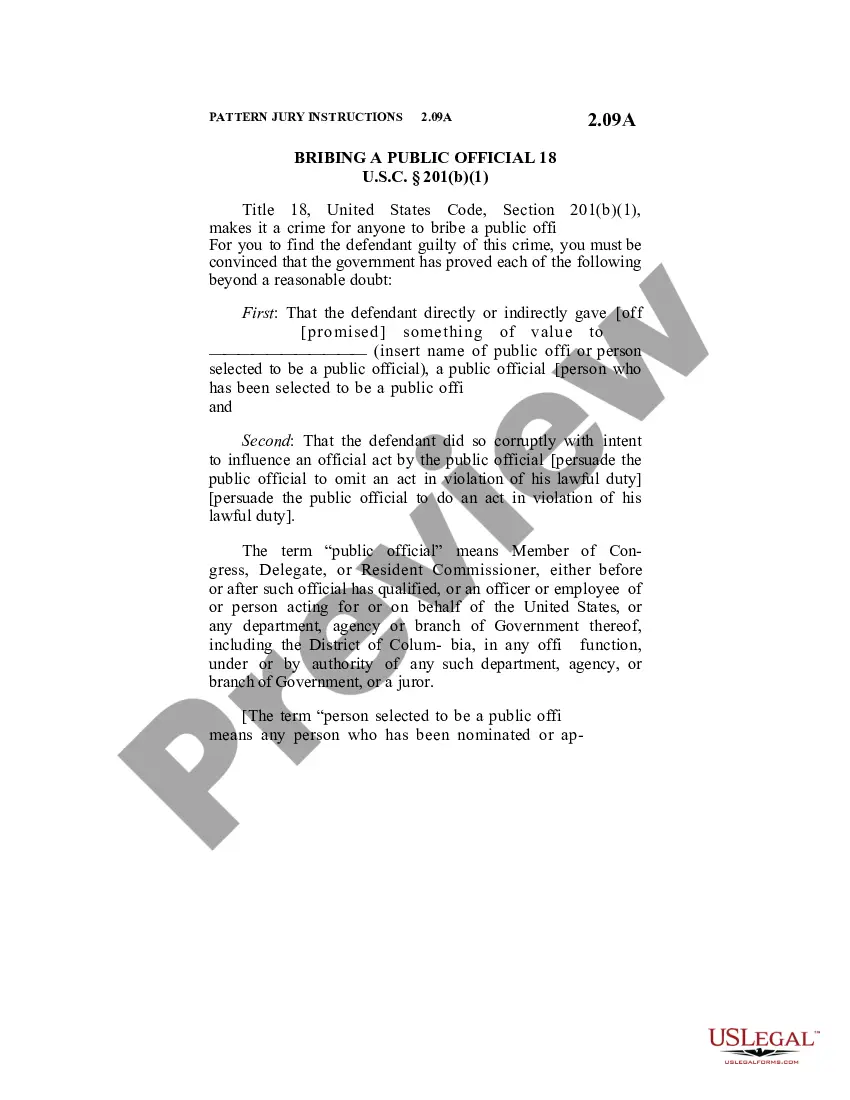
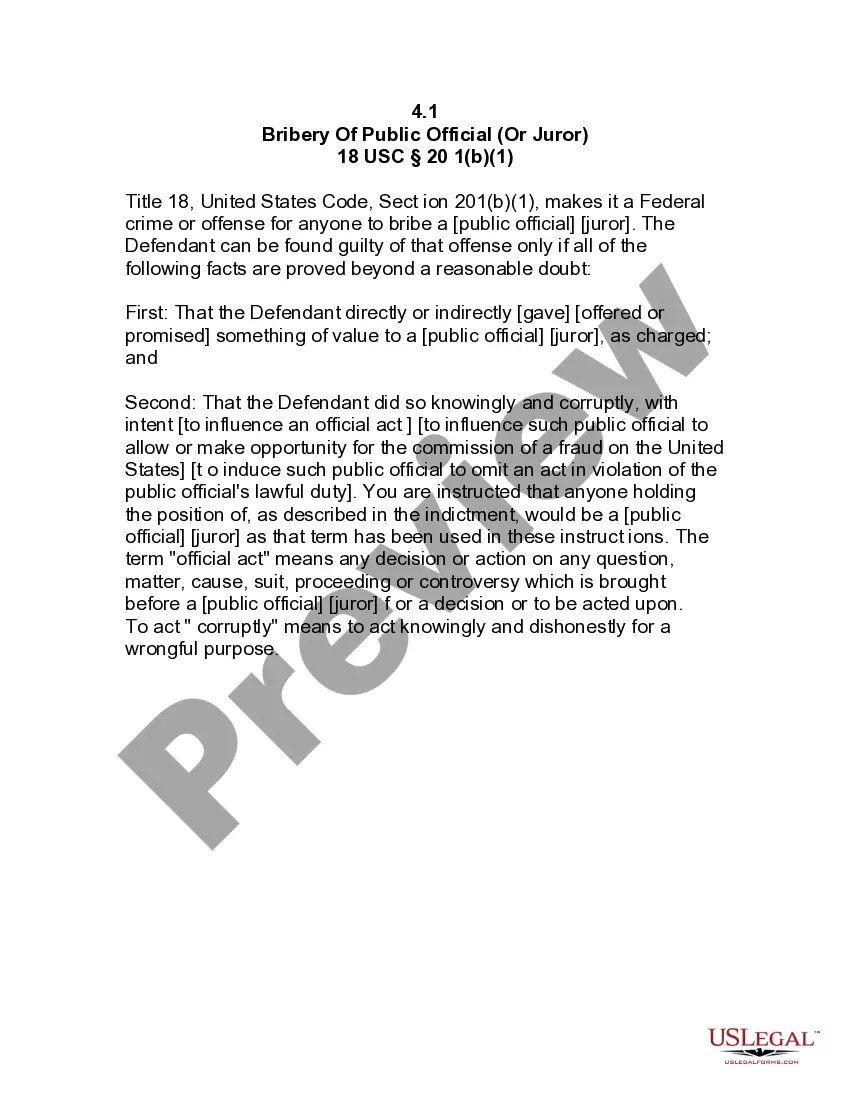
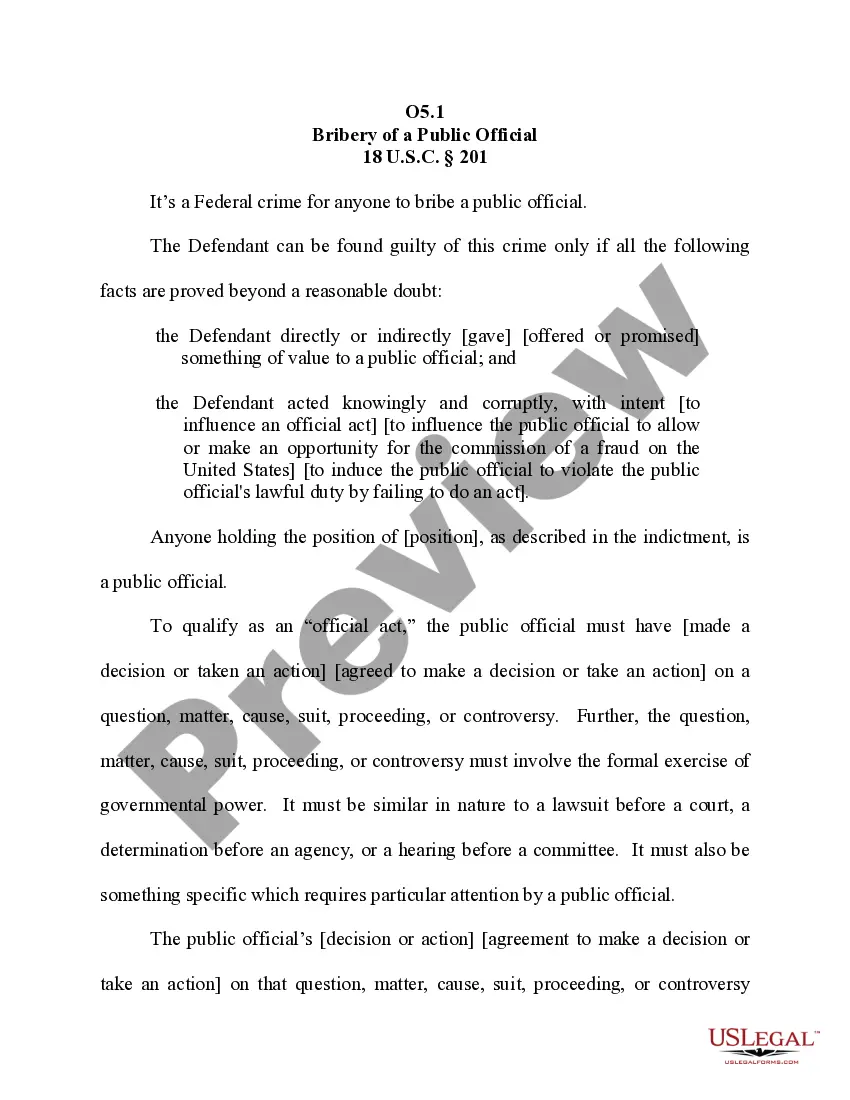
The bribing a public official form is a legal document designed to outline the federal offense of bribery under Title 18, United States Code, Section 201(b)(1). This form clarifies the elements required to prove the crime of bribing a public official, emphasizing the unlawful exchange of value intended to influence official acts. It differs from similar forms by focusing specifically on the federal standards governing bribery in the United States, applicable to various parties, including public officials and those selected to be public officials.
Key parts of this document
- Description of bribery and public officials as outlined in federal law
- Criteria for establishing guilt beyond a reasonable doubt
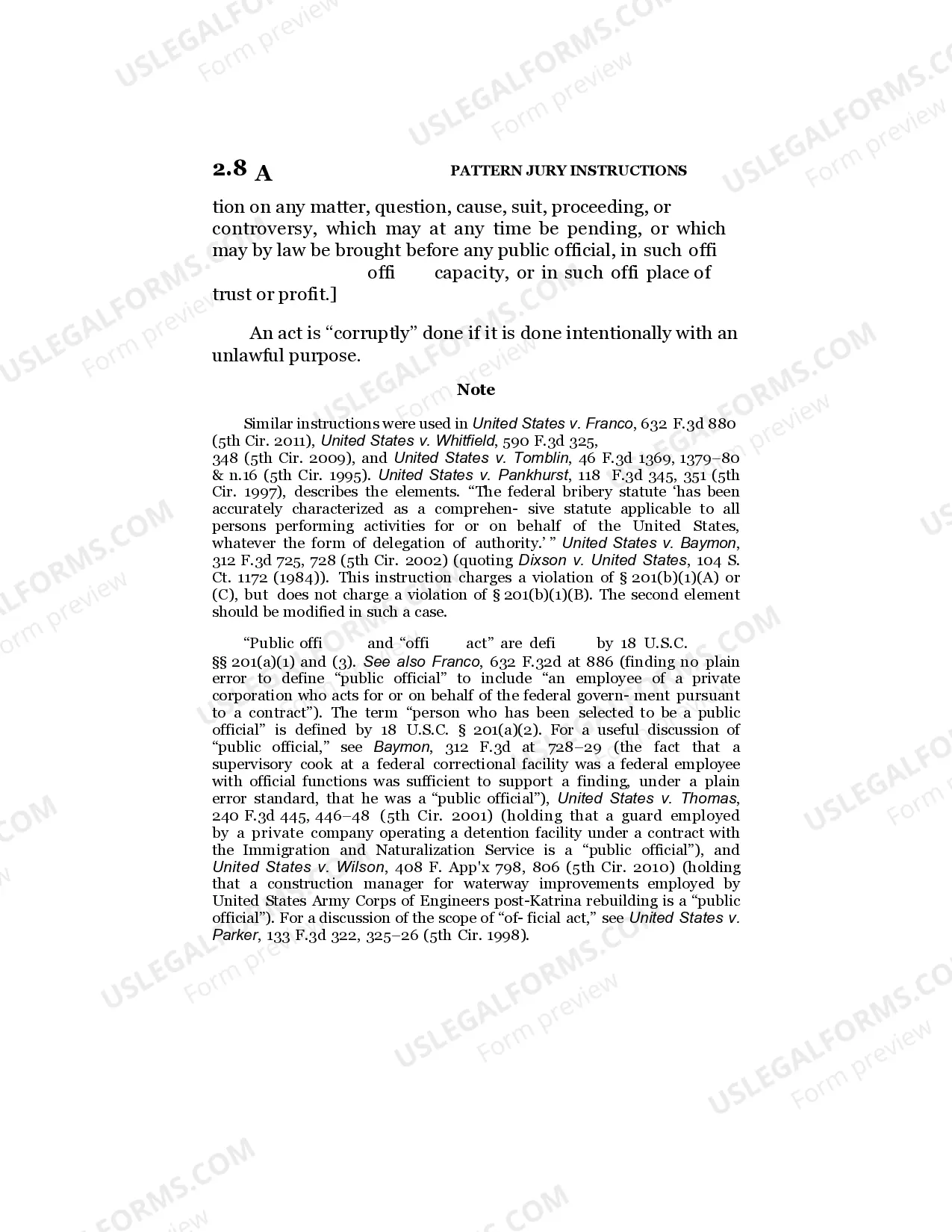
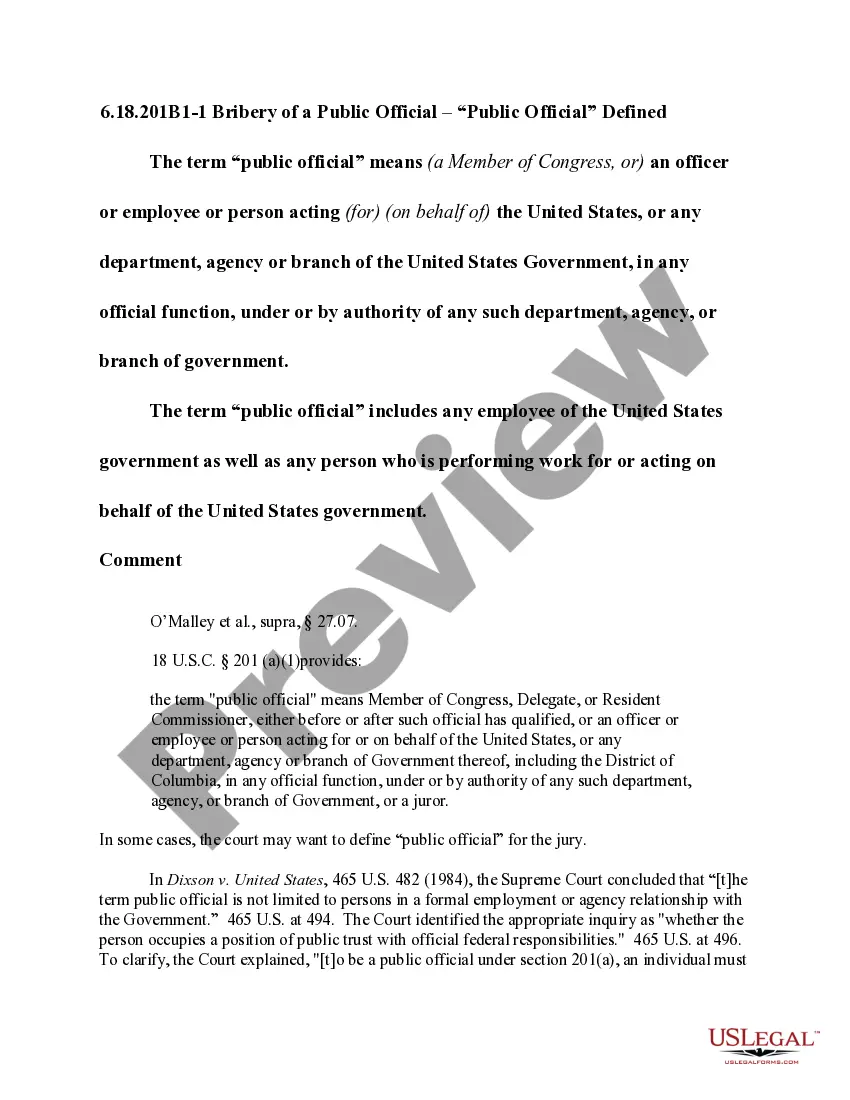
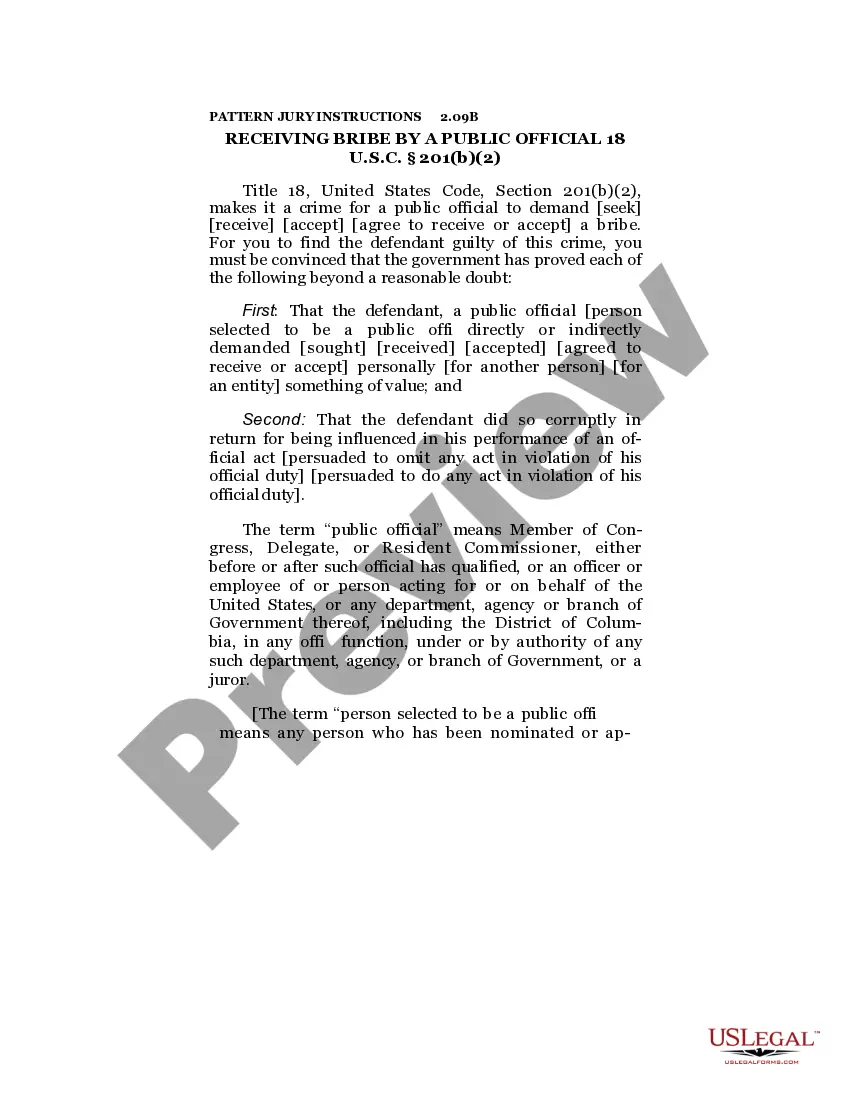
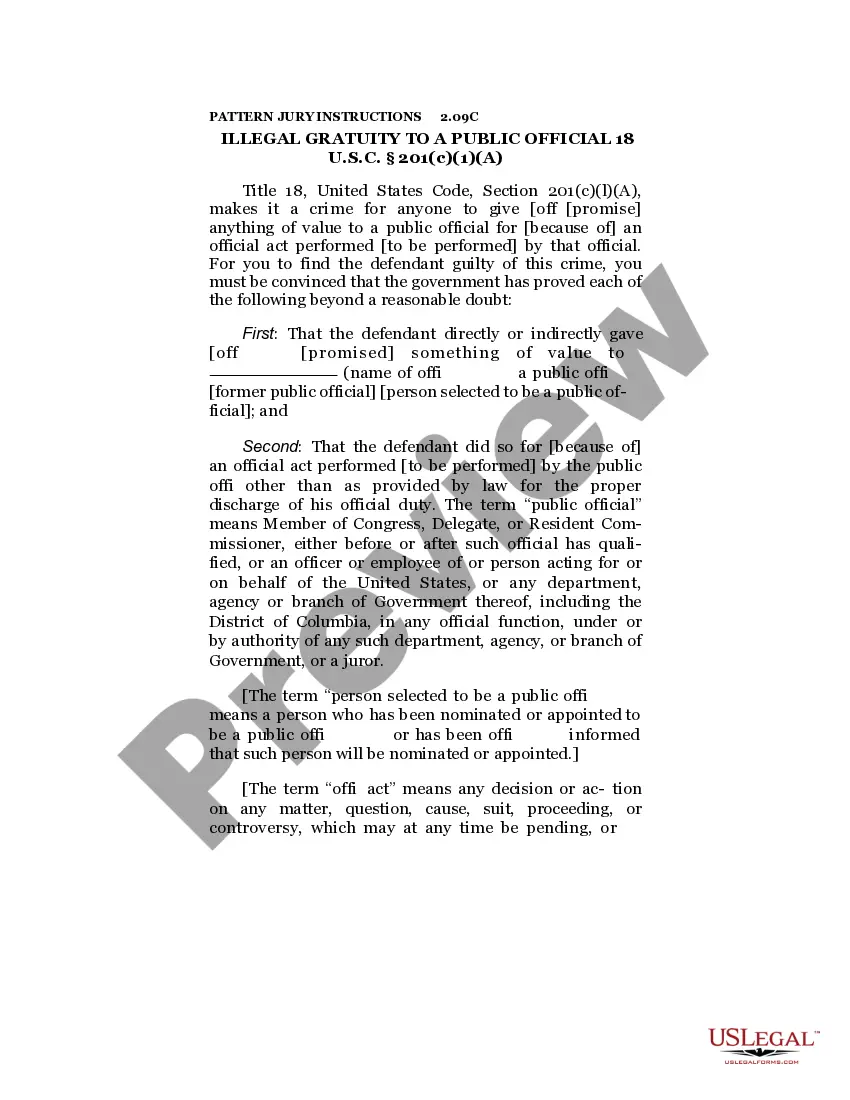
- Definitions of key terms like "corruptly" and "public official"
- Specific acts considered as bribery under the law
- Legal precedents relevant to the interpretation of bribery statutes
When to use this document
This form should be used in legal contexts where allegations of bribery against a public official are being investigated or prosecuted. It is applicable during criminal trials to establish the elements of the offense and can be relevant when attorneys prepare legal arguments, or when defendants need to understand the legal implications of their actions concerning public officials.
Who needs this form
- Attorneys representing clients in bribery cases
- Defendants accused of bribing a public official
- Legal scholars studying federal bribery laws
- Law enforcement officials gathering evidence related to bribery allegations
- Individuals seeking to understand the legal framework surrounding public corruption
Instructions for completing this form
- Identify the public official involved, including their name and title.
- Clearly state the item or value that was allegedly offered or promised.
- Specify the intent behind the act, indicating the desire to influence an official action.
- Include relevant details concerning the context of the alleged bribery.
- Ensure all statements are accurate and reflect the actual circumstances to maintain legal integrity.
Does this document require notarization?
Notarization is not commonly needed for this form. However, certain documents or local rules may make it necessary. Our notarization service, powered by Notarize, allows you to finalize it securely online anytime, day or night.
Get your form ready online
Our built-in tools help you complete, sign, share, and store your documents in one place.
Make edits, fill in missing information, and update formatting in US Legal Forms—just like you would in MS Word.
Download a copy, print it, send it by email, or mail it via USPS—whatever works best for your next step.
Sign and collect signatures with our SignNow integration. Send to multiple recipients, set reminders, and more. Go Premium to unlock E-Sign.
If this form requires notarization, complete it online through a secure video call—no need to meet a notary in person or wait for an appointment.
We protect your documents and personal data by following strict security and privacy standards.

Make edits, fill in missing information, and update formatting in US Legal Forms—just like you would in MS Word.

Download a copy, print it, send it by email, or mail it via USPS—whatever works best for your next step.

Sign and collect signatures with our SignNow integration. Send to multiple recipients, set reminders, and more. Go Premium to unlock E-Sign.

If this form requires notarization, complete it online through a secure video call—no need to meet a notary in person or wait for an appointment.

We protect your documents and personal data by following strict security and privacy standards.
Common mistakes
- Failing to explicitly state the intent to influence an official act.
- Omitting critical details that clarify the nature of the exchange.
- Confusing "public official" with other types of officials, which may lead to legal misunderstandings.
- Not providing supporting evidence or context for the actions described.
Why complete this form online
- Immediate access to official legal templates drafted by licensed attorneys.
- Easy to download and customize for individual cases.
- Access to legal guidance ensures proper form completion.
- Convenience of obtaining forms without the need for in-person visits to legal offices.
Looking for another form?

Form popularity
FAQ
Public officers are offered bribes to enable evasion of taxes and the corresponding liabilities at an individual or company level.
Yes, bribery is illegal. Bribery can be a crime under federal or state law, depending on who and what is involved. Most states have several types of bribery charges, such as bribery of public officials, witnesses, jurors, corporations, and sports officials.
In the context of political corruption, a bribe may involve a payment given to a government official in exchange of his use of official powers. Bribery requires two participants: one to give the bribe, and one to take it.
Generally, bribery is the practice of offering, giving, receiving, or soliciting something of value to influence another person's official actions in the discharge of their public or legal duties.
Bribery Penalties The penalties for bribery of a public official includes a fine of up to three times the value of the bribe, and imprisonment for up to 15 years in a federal penitentiary. A conviction can also disqualify the individual from holding any office of honor, trust or profit under the United States.
Contractors for the federal, state, and local governments frequently appear in the news for bribing government officials in hopes of landing lucrative contracts.
However, in the United State, bribery of public officials is a criminal act, for both the person offering the bribe, and for the individual who solicits or accepts a bribe. Bribery generally involves giving some item of value, such as a gift or money, in order to gain influence with the recipient.
Some examples of bribes might include: A construction guaranteeing an elected official ten percent in kickback money in exchange for a large public infrastructure contract. A manufacturing firm paying foreign officials money for preferential treatment or to smuggle unregistered goods across a border.