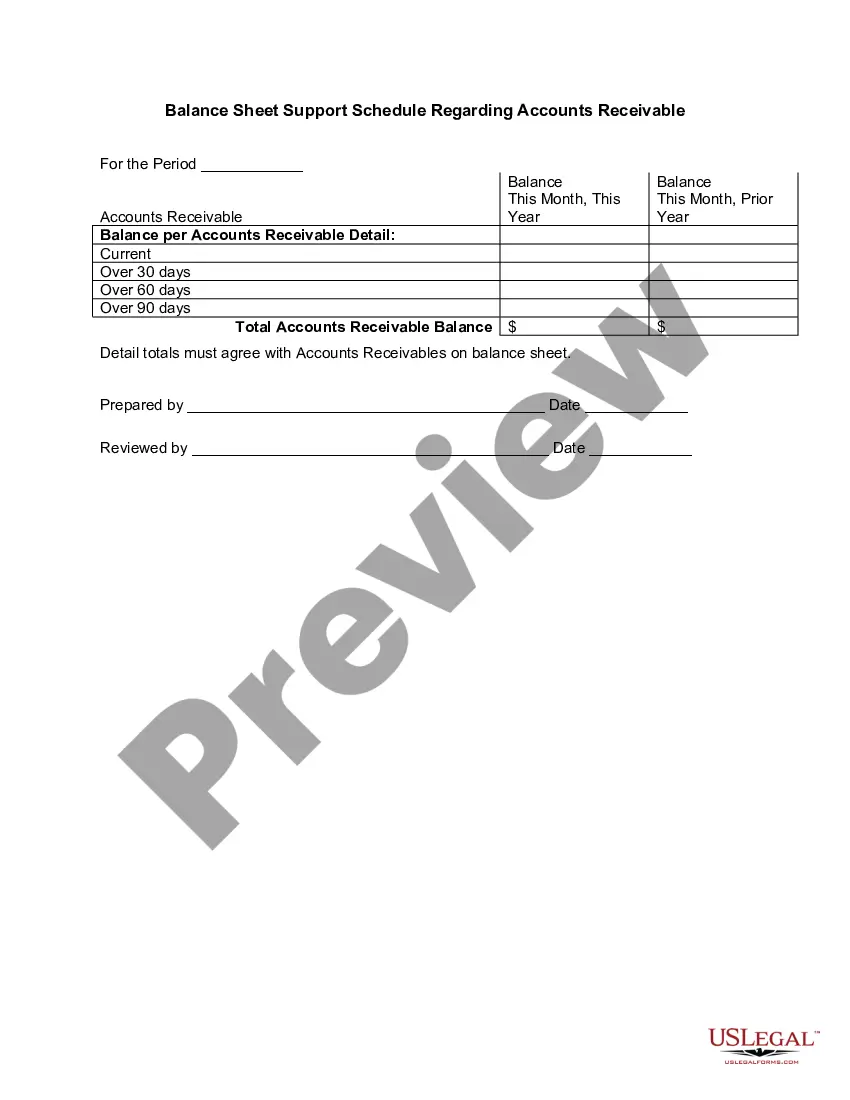
Balance Sheet Support Schedule Regarding Accounts Receivable
What is this form?
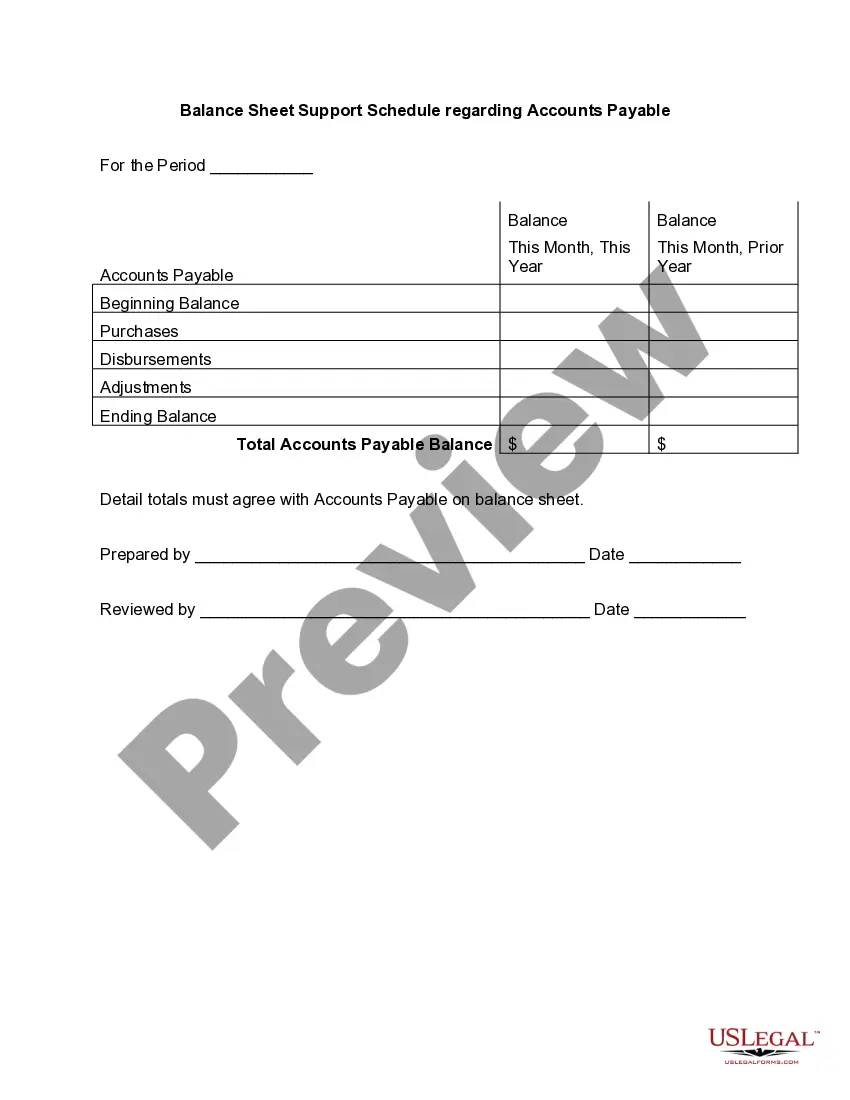
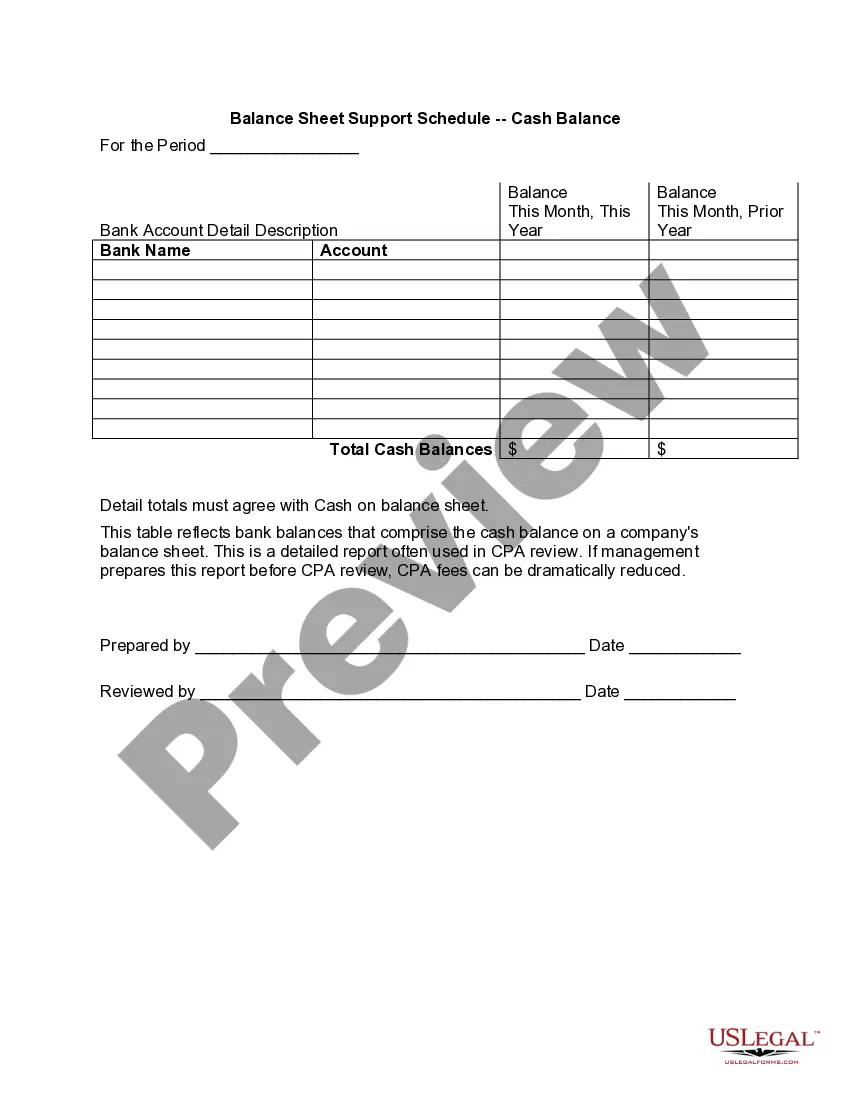
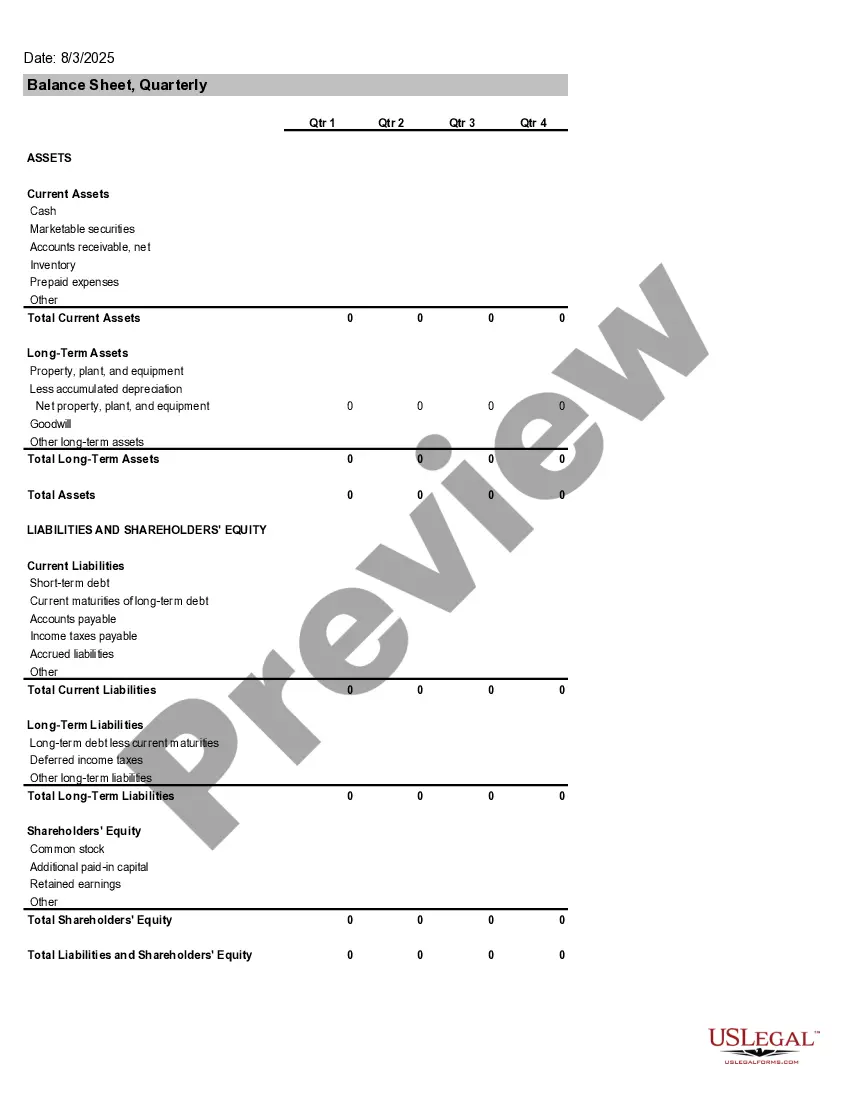
The Balance Sheet Support Schedule Regarding Accounts Receivable is a financial document that aids businesses in summarizing and detailing the money owed to them by customers for goods and services delivered but not yet paid for. This form is utilized in conjunction with a balance sheet and serves to clarify the components of accounts receivable, ensuring accuracy in financial reporting. It helps organizations maintain a clear understanding of their assets and liabilities, distinguishing it from other financial forms that may focus on different aspects of business operations.
Main sections of this form
- Period of the accounts receivable balance being reported.
- Breakdown of accounts receivable into current and aged categories (e.g., current, over 30 days, over 60 days, over 90 days).
- Total accounts receivable balance that must align with the main balance sheet.
- Prepared by and reviewed by sections for accountability and verification.
- Date fields to document when the form was completed and reviewed.
When to use this form
This form should be used whenever a business needs to provide a detailed account of its accounts receivable for specific periods, such as monthly, quarterly, or annually. It is particularly useful during financial audits, the preparation of financial statements, or when assessing the health of the business. It can also be needed when preparing for a sale or transition of ownership, as it provides vital insight into the company's financial obligations.
Intended users of this form
- Business owners who need to assess their financial standing.
- Accountants or financial officers responsible for preparing balance sheets and financial reports.
- Consultants advising businesses on financial transactions or during audits.
- Any individual or entity managing a company's accounts receivable to ensure proper financial reporting.
How to prepare this document
- Enter the period for which the accounts receivable balance is being calculated.
- Fill in the current balance and compare it with prior year balances.
- Detail the accounts receivable breakdown according to the specified age categories.
- Verify that the total accounts receivable balance matches with the main balance sheet.
- Complete the fields for the preparer and reviewer, including dates to foster accountability.
Does this form need to be notarized?
Notarization is generally not required for this form. However, certain states or situations might demand it. You can complete notarization online through US Legal Forms, powered by Notarize, using a verified video call available anytime.
Get your form ready online
Our built-in tools help you complete, sign, share, and store your documents in one place.
Make edits, fill in missing information, and update formatting in US Legal Forms—just like you would in MS Word.
Download a copy, print it, send it by email, or mail it via USPS—whatever works best for your next step.
Sign and collect signatures with our SignNow integration. Send to multiple recipients, set reminders, and more. Go Premium to unlock E-Sign.
If this form requires notarization, complete it online through a secure video call—no need to meet a notary in person or wait for an appointment.
We protect your documents and personal data by following strict security and privacy standards.

Make edits, fill in missing information, and update formatting in US Legal Forms—just like you would in MS Word.

Download a copy, print it, send it by email, or mail it via USPS—whatever works best for your next step.

Sign and collect signatures with our SignNow integration. Send to multiple recipients, set reminders, and more. Go Premium to unlock E-Sign.

If this form requires notarization, complete it online through a secure video call—no need to meet a notary in person or wait for an appointment.

We protect your documents and personal data by following strict security and privacy standards.
Avoid these common issues
- Failing to ensure the total balances agree with those on the main balance sheet.
- Neglecting to update balances from previous periods for accurate comparisons.
- Overlooking the need for signatures from both the preparer and reviewer to validate the document.
Why use this form online
- Convenient access to fill out and download from anywhere at any time.
- Editable fields allowing for accurate and immediate updates to financial data.
- Prepared templates drafted by licensed attorneys to ensure compliance and reliability.
Looking for another form?



Form popularity
FAQ
It is a summary of what the business owns (assets) and owes (liabilities). Balance sheets are usually prepared at the close of an accounting period such as month-end, quarter-end, or year-end. New business owners should not wait until the end of 12 months or the end of an operating cycle to complete a balance sheet.
To record a journal entry for a sale on account, one must debit a receivable and credit a revenue account. When the customer pays off their accounts, one debits cash and credits the receivable in the journal entry. The ending balance on the trial balance sheet for accounts receivable is usually a debit.
You can find accounts receivable under the 'current assets' section on your balance sheet or chart of accounts. Accounts receivable are classified as an asset because they provide value to your company. (In this case, in the form of a future cash payment.)
The schedule of accounts receivable is a report that lists all amounts owed by customers. The report lists each outstanding invoice as of the report date, aggregated by customer.The collections team examines the schedule to determine which invoices are overdue, and then makes collection calls to customers. Credit.
Cash Flow. Although accounts receivable appears on your balance sheet as an asset, it can negatively affect your cash flow. To provide products and services to your customers, you must pay for inventory and labor. If you are not paid promptly, you might find yourself short of money.
Schedule I Capital: Schedule II Reserves and Surplus: Schedule III Deposits: Schedule IV Borrowings: Schedule V Other Liabilities & Provisions: Schedule VI Cash and Balance with RBI: Schedule VII Balance with Banks and Money at Call & Short Notice: Schedule VIII Investments:
The order of the balance sheet is as follows: Current Asset, Non-Current Assets, Current Liabilities, Non-Current Liabilites, Owner's Equity, Offsets on the Balance Sheet and also in the order of their liquidy, with the most liquid terms (those closest to cash) first.
On a company's balance sheet, accounts receivable is the money owed to that company by entities outside of the company.Account receivables are classified as current assets, assuming that they are due within one calendar year or fiscal year.