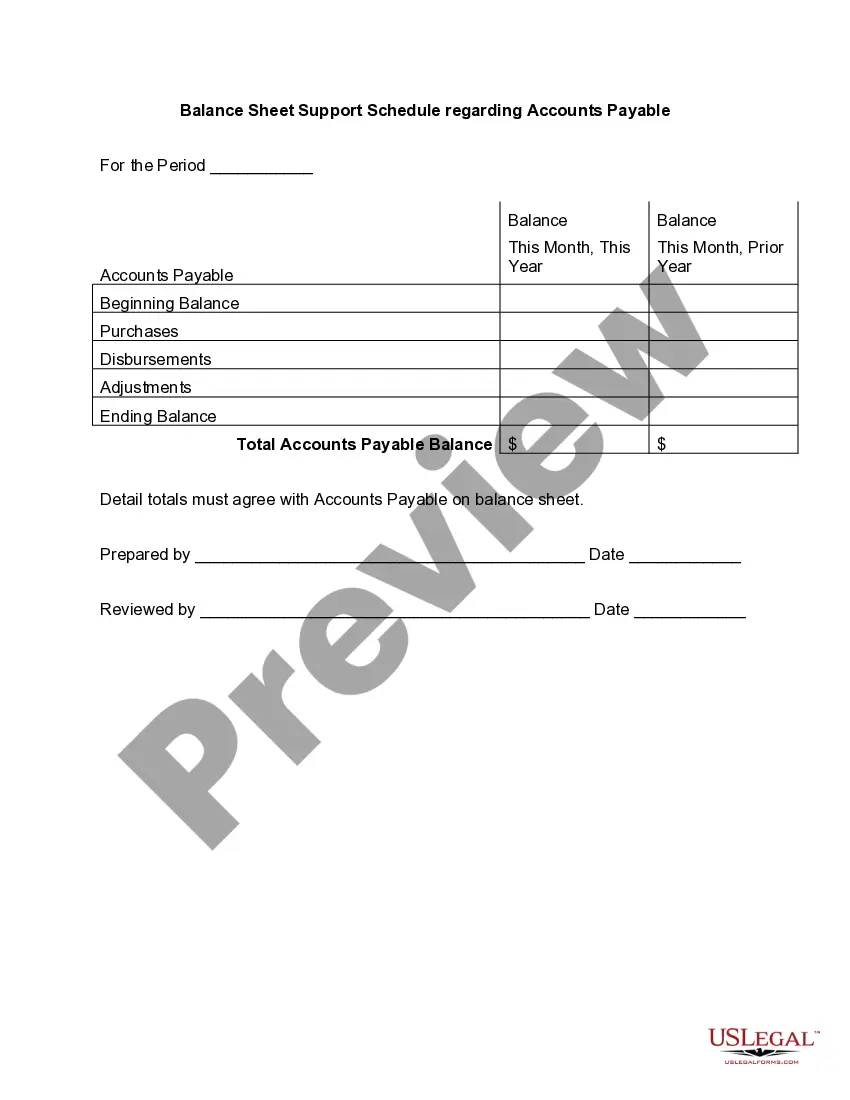
Balance Sheet Support Schedule regarding Accounts Payable
About this form
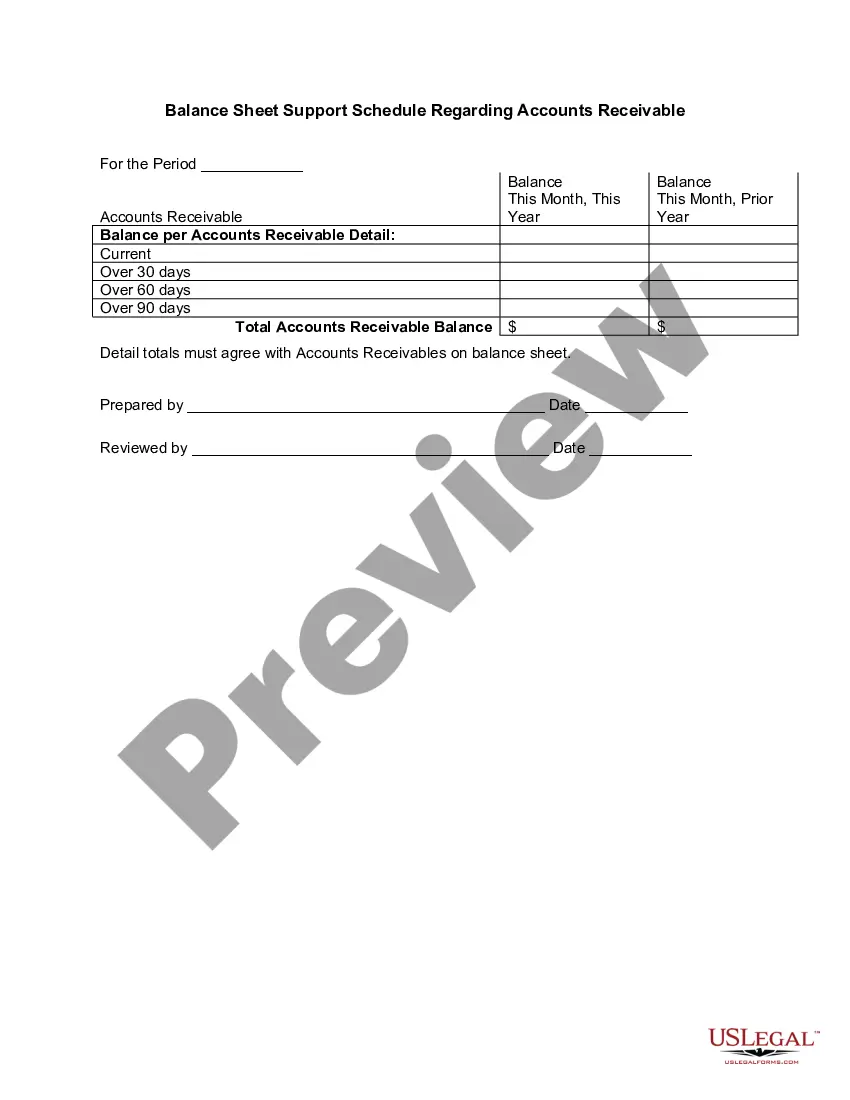
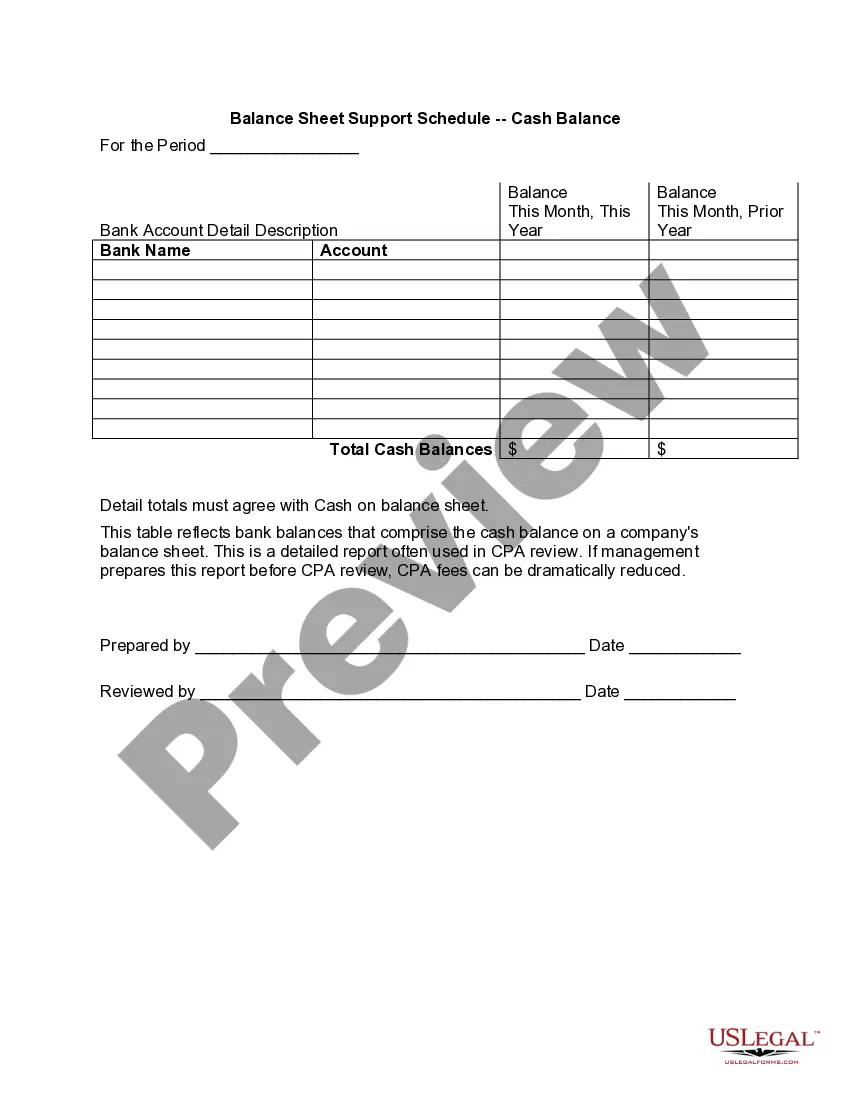
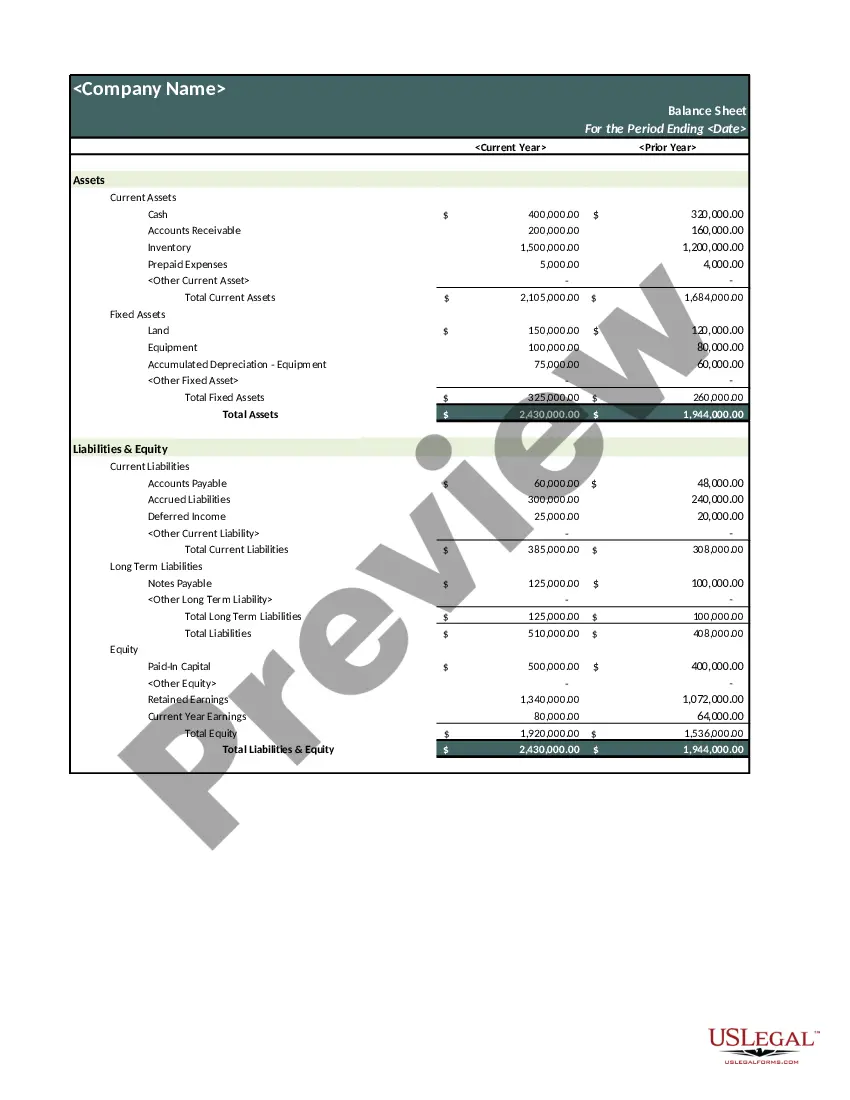
The Balance Sheet Support Schedule regarding Accounts Payable is a financial document that details the amounts a business owes to its creditors at a specified time. Its primary purpose is to support the balance sheet by providing a detailed breakdown of accounts payable, ensuring accuracy in reporting. Unlike other financial forms, this schedule focuses exclusively on liabilities stemming from trade and operational expenses, which helps in analyzing a company's short-term financial health.
Form components explained
- Period covered by the accounts payable
- Current month's accounts payable balance
- Beginning balance of accounts payable
- Total purchases and disbursements during the period
- Adjustments to accounts payable necessitated by financial changes
- Ending balance of accounts payable
- Signature fields for preparation and review
When to use this document
This form should be used when preparing financial statements at the end of a month, quarter, or year to accurately reflect the company's financial obligations. It is particularly useful during audits, financial reviews, or when assessing the company's liquidity and operational performance, especially if there are significant changes in accounts payable.
Intended users of this form
- Small business owners managing their financial statements
- Accountants preparing monthly or annual reports for businesses
- Financial analysts conducting assessments of company liabilities
- Treasurers managing cash flow for organizations
How to prepare this document
- Identify the period for which you are reporting accounts payable.
- Fill in the current month's balance and the prior year's balance.
- Enter the beginning balance of accounts payable from the previous period.
- Document total purchases and disbursements made during the reporting period.
- Make any necessary adjustments and calculate the ending balance.
- Ensure that all totals align with the main balance sheet and sign the form in the prepared and reviewed sections.
Does this document require notarization?
This form does not typically require notarization unless specified by local law. It is primarily used for internal financial reporting and does not necessitate authenticated signatures for validity.
Get your form ready online
Our built-in tools help you complete, sign, share, and store your documents in one place.
Make edits, fill in missing information, and update formatting in US Legal Forms—just like you would in MS Word.
Download a copy, print it, send it by email, or mail it via USPS—whatever works best for your next step.
Sign and collect signatures with our SignNow integration. Send to multiple recipients, set reminders, and more. Go Premium to unlock E-Sign.
If this form requires notarization, complete it online through a secure video call—no need to meet a notary in person or wait for an appointment.
We protect your documents and personal data by following strict security and privacy standards.

Make edits, fill in missing information, and update formatting in US Legal Forms—just like you would in MS Word.

Download a copy, print it, send it by email, or mail it via USPS—whatever works best for your next step.

Sign and collect signatures with our SignNow integration. Send to multiple recipients, set reminders, and more. Go Premium to unlock E-Sign.

If this form requires notarization, complete it online through a secure video call—no need to meet a notary in person or wait for an appointment.

We protect your documents and personal data by following strict security and privacy standards.
Avoid these common issues
- Failing to update the opening balance from the previous period.
- Incorrectly calculating total purchases or disbursements.
- Neglecting to reconcile the balance with the main financial statement.
- Not documenting adjustments made during the accounting period.
Benefits of using this form online
- Easy access to editable templates that save time and effort.
- High reliability and accuracy, drafted by licensed attorneys.
- Convenient download options to suit various reporting needs.
- Assurance that the form complies with current legal and financial standards.
Legal use & context
- This form serves as a reliable tool for documenting accounts payable, which is crucial for financial audits.
- Accurate accounts payable schedules help maintain transparent financial records in a business.
- While this form is important for internal management, it may also be requested by external auditors and investors.
Summary of main points
- The Balance Sheet Support Schedule regarding Accounts Payable is critical for understanding business liabilities.
- Accurate tracking and reporting can help manage cash flow effectively.
- Completing this form correctly ensures compliance with financial reporting standards.
Looking for another form?

Form popularity
FAQ
It is a summary of what the business owns (assets) and owes (liabilities). Balance sheets are usually prepared at the close of an accounting period such as month-end, quarter-end, or year-end. New business owners should not wait until the end of 12 months or the end of an operating cycle to complete a balance sheet.
The order of the balance sheet is as follows: Current Asset, Non-Current Assets, Current Liabilities, Non-Current Liabilites, Owner's Equity, Offsets on the Balance Sheet and also in the order of their liquidy, with the most liquid terms (those closest to cash) first.
To calculate accounts payable on your balance sheet, add up the totals of all the invoices you have approved but not yet paid.
As a liability account, Accounts Payable is expected to have a credit balance. Hence, a credit entry will increase the balance in Accounts Payable and a debit entry will decrease the balance. A bill or invoice from a supplier of goods or services on credit is often referred to as a vendor invoice.
The schedule of accounts payable is a detailed listing of all the vendors that your company owes money.The schedule of accounts payable tells you who must be paid and how much money is owed.
When you pay off the invoice, the amount of money you owe decreases (accounts payable). Since liabilities are decreased by debits, you will debit the accounts payable. And, you need to credit your cash account to show a decrease in assets.
The schedule of accounts payable can be prepared to show all the outstanding accounts payable, who is owed the money, and how much is owed.The schedule of accounts payable can also be used to prove out the subsidiary and control accounts payable accounts at the end of a period.
Schedule I Capital: Schedule II Reserves and Surplus: Schedule III Deposits: Schedule IV Borrowings: Schedule V Other Liabilities & Provisions: Schedule VI Cash and Balance with RBI: Schedule VII Balance with Banks and Money at Call & Short Notice: Schedule VIII Investments:
Verify that the accounts payable journal was properly posted to the general ledger. Verify that the aged accounts payable report was printed after all posting was completed. Verify that the general ledger is set to the correct reporting period.