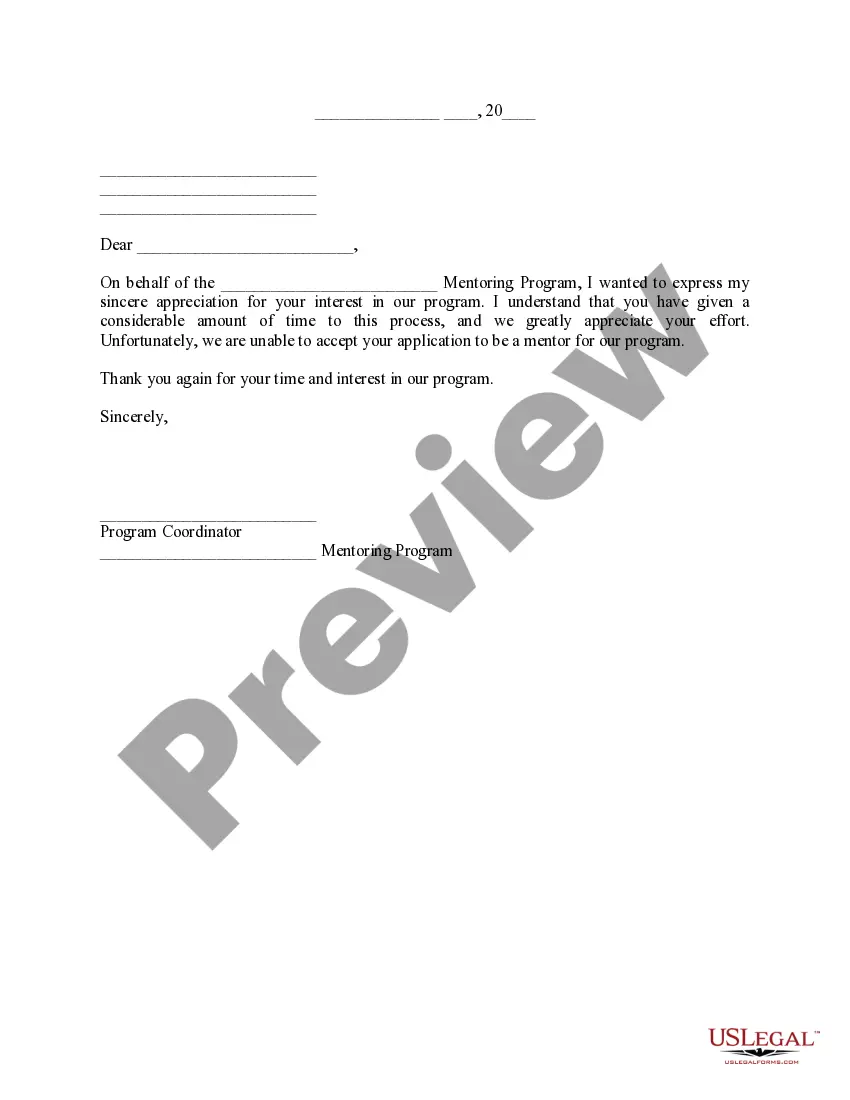
Mentor Rejection Letter Form for Mentorship Program
Understanding this form
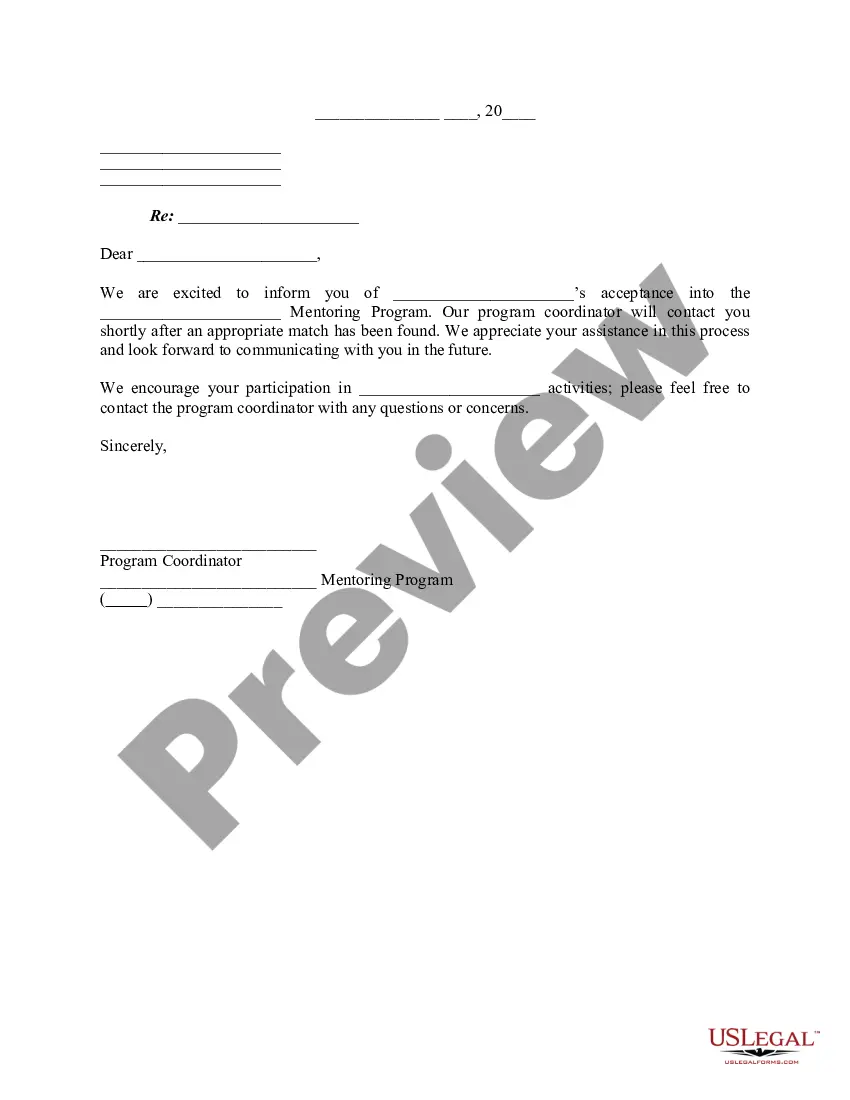
The Mentor Rejection Letter Form for Mentorship Program is a formal letter used by mentorship programs to notify individuals that their applications to become mentors have not been accepted. This letter ensures clear communication, expresses gratitude for the applicant's interest and time, and differs from acceptance letters by formally addressing the rejection.
Main sections of this form
- Date of the letter.
- Name and contact information of the mentorship program.
- Recipient's name.
- Expression of appreciation for the applicant's interest.
- Notification of application rejection.
- Signature from the program coordinator.
Common use cases
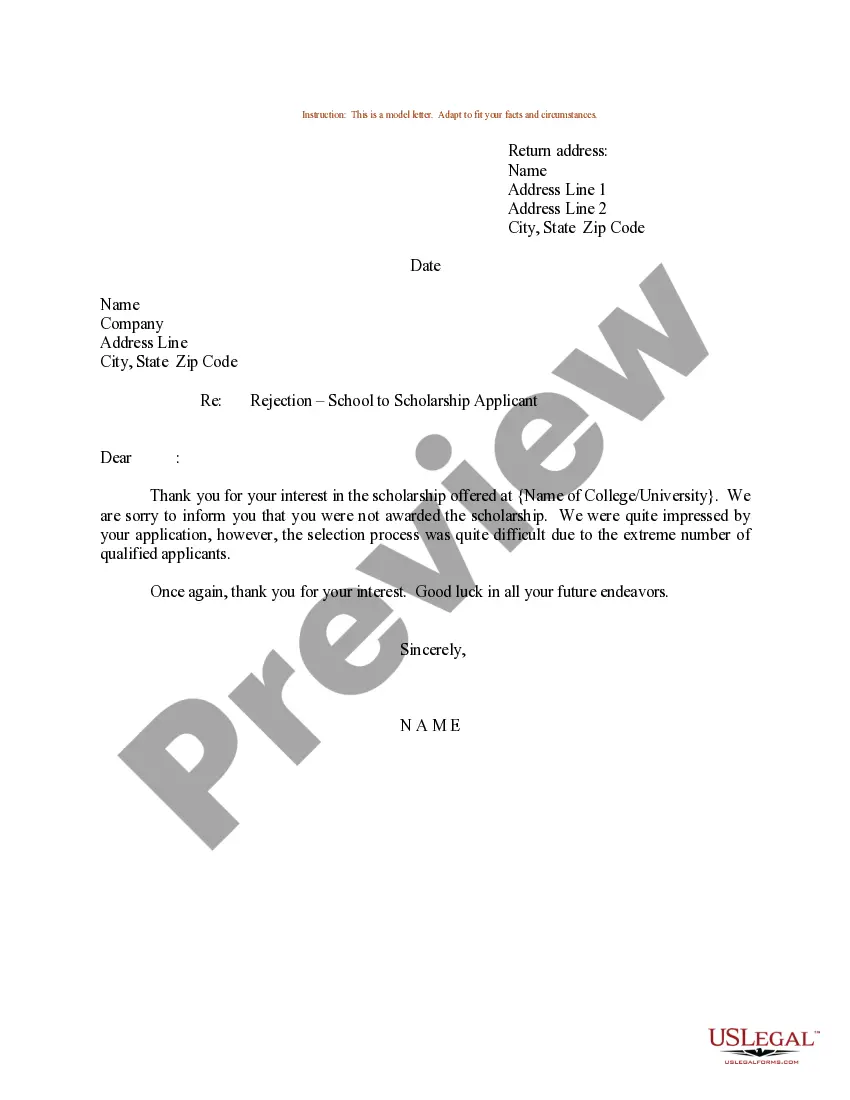
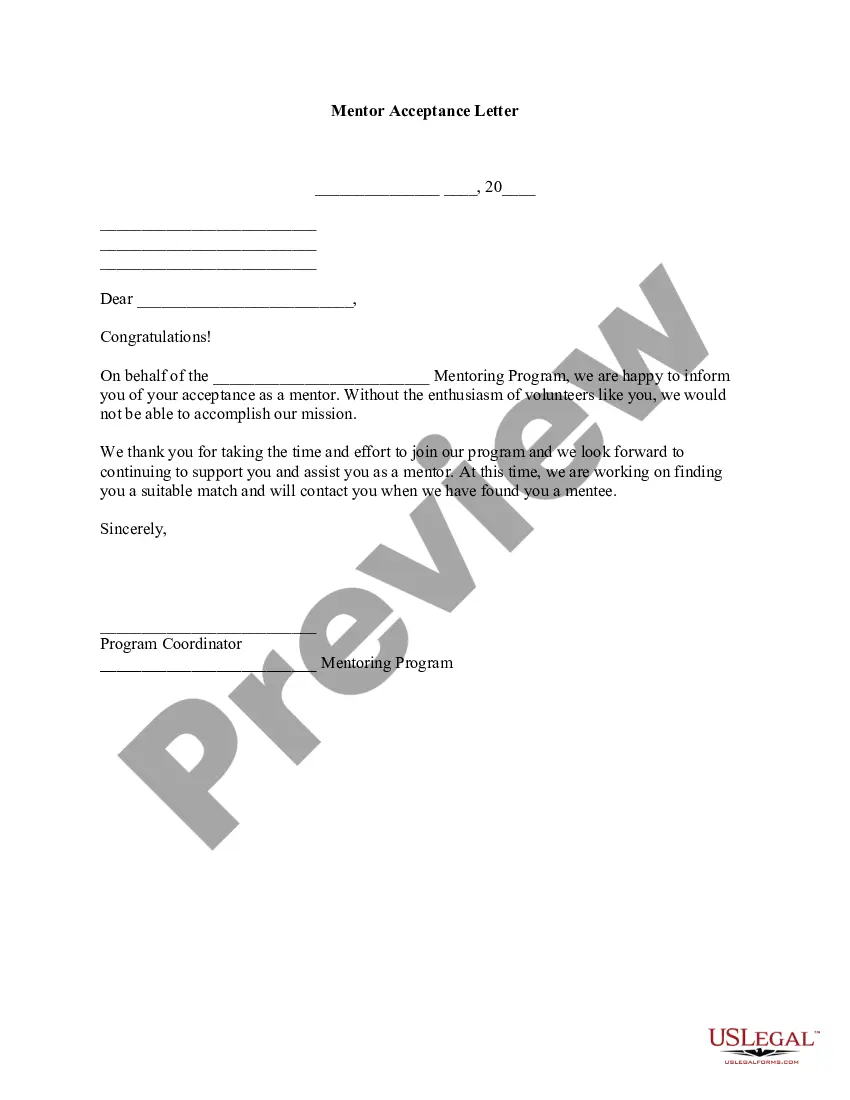
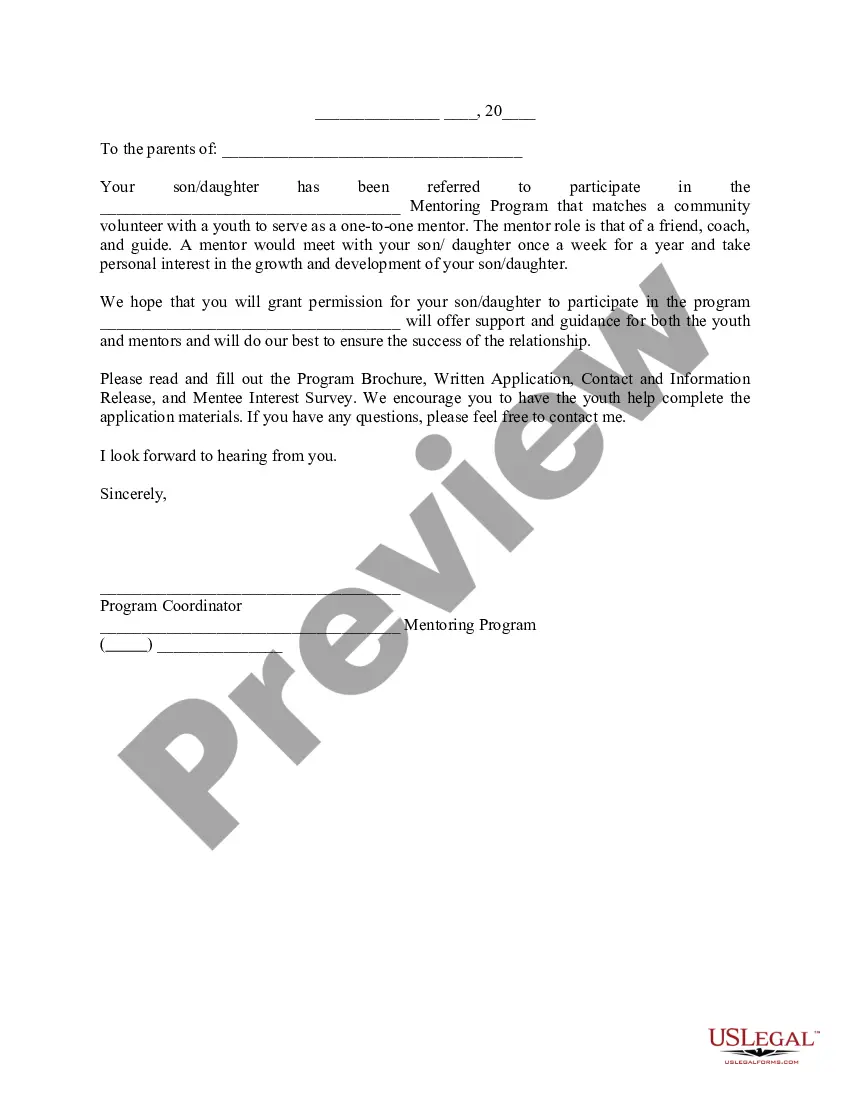
This form should be used when a mentorship program needs to inform a prospective mentor that their application has not been accepted. It is ideal for ensuring that the communication is professional, maintains a positive tone, and leaves the door open for future opportunities.
Who can use this document
- Mentorship program coordinators.
- Administrators of educational or professional mentorship programs.
- Organizations that conduct mentoring activities and require formal communication.
Instructions for completing this form
- Enter the date at the top of the letter.
- Fill in the name and address of the mentorship program.
- Input the recipient's name in the greeting.
- Express appreciation for their interest and effort in the letter body.
- Clearly state the rejection of the application.
- Sign the letter and include your title as the program coordinator.
Is notarization required?
This form does not typically require notarization unless specified by local law. Ensure compliance with any specific legal requirements in your jurisdiction before sending the communication.
Get your form ready online
Our built-in tools help you complete, sign, share, and store your documents in one place.
Make edits, fill in missing information, and update formatting in US Legal Forms—just like you would in MS Word.
Download a copy, print it, send it by email, or mail it via USPS—whatever works best for your next step.
Sign and collect signatures with our SignNow integration. Send to multiple recipients, set reminders, and more. Go Premium to unlock E-Sign.
If this form requires notarization, complete it online through a secure video call—no need to meet a notary in person or wait for an appointment.
We protect your documents and personal data by following strict security and privacy standards.

Make edits, fill in missing information, and update formatting in US Legal Forms—just like you would in MS Word.

Download a copy, print it, send it by email, or mail it via USPS—whatever works best for your next step.

Sign and collect signatures with our SignNow integration. Send to multiple recipients, set reminders, and more. Go Premium to unlock E-Sign.

If this form requires notarization, complete it online through a secure video call—no need to meet a notary in person or wait for an appointment.

We protect your documents and personal data by following strict security and privacy standards.
Mistakes to watch out for
- Failing to proofread the letter before sending.
- Using informal language instead of maintaining a professional tone.
- Omitting essential contact information of the mentorship program.
- Not personalizing the letter with the recipientâs name.
Benefits of using this form online
- Convenient access to editable templates.
- Time-saving with quick download options.
- Reliable legal language drafted by licensed attorneys.
Looking for another form?
Form popularity
FAQ
1) Thank the other person for reaching out to you and acknowledge that you understand that it took a great deal of initiative and courage to do so. 2) Review their profile and compliment one of their experiences or skills. 3) Be honest about your reason for declining the invitation.
If you've come to an agreed upon end date and are ready to close your relationship, you can follow this easy 3-step plan: Evaluate your progress. Think about the goals you've set and the progress you've made.Get feedback. Meet with your mentor and compare notes.Plan next steps.
Mentor Exit Tips: Ending the Formal Relationship Set expectations of your relationship moving forward. Acknowledge progress and growth in the mentee. Recognize the challenges your mentee has faced or overcame. Help your mentee set goals for the future. Ask your mentee to identify how he will accomplish his future goals.
I want to reach my full potential in my future jobs and promote my personal and professional development, which could be achieved by a good mentoring in a strategic and supportive way. I desire to develop my employee skills from this program that will remain valuable beyond the duration of this mentoring partnership.
How to Break Up with Your Mentor What the Experts Say.Take stock of your needs and goals.Consider giving your mentor a second chance.Don't draw it out.Disengage with gratitude.Be transparent and direct.Keep the door open.Principles to Remember.
Simply saying thank you is a good way to let someone know that you appreciate them and their time (regardless of the length and depth of the mentoring relationship). It is also a nice way to end the relationship on a positive note, as you never know ? you may cross paths again in the future.
Signs that a mentoring relationship may not be working: Mentee/mentor cancels appointments, fails to turn up or regularly rearranges at the last minute. Mentee/mentor consistently fails to make progress on actions identified in meetings. Mentee/mentor appears distracted in sessions or cuts sessions short.
Strategy: While finding a mismatch is regrettable, it is a problem that is relatively simple to correct. If both the mentor and the mentee believe that a switch is desirable, the mentee can work with his or her division chief, department chair, and even the current mentor to help identify a more appropriate mentor.