Florida Living Trust Property Record
Overview of this form
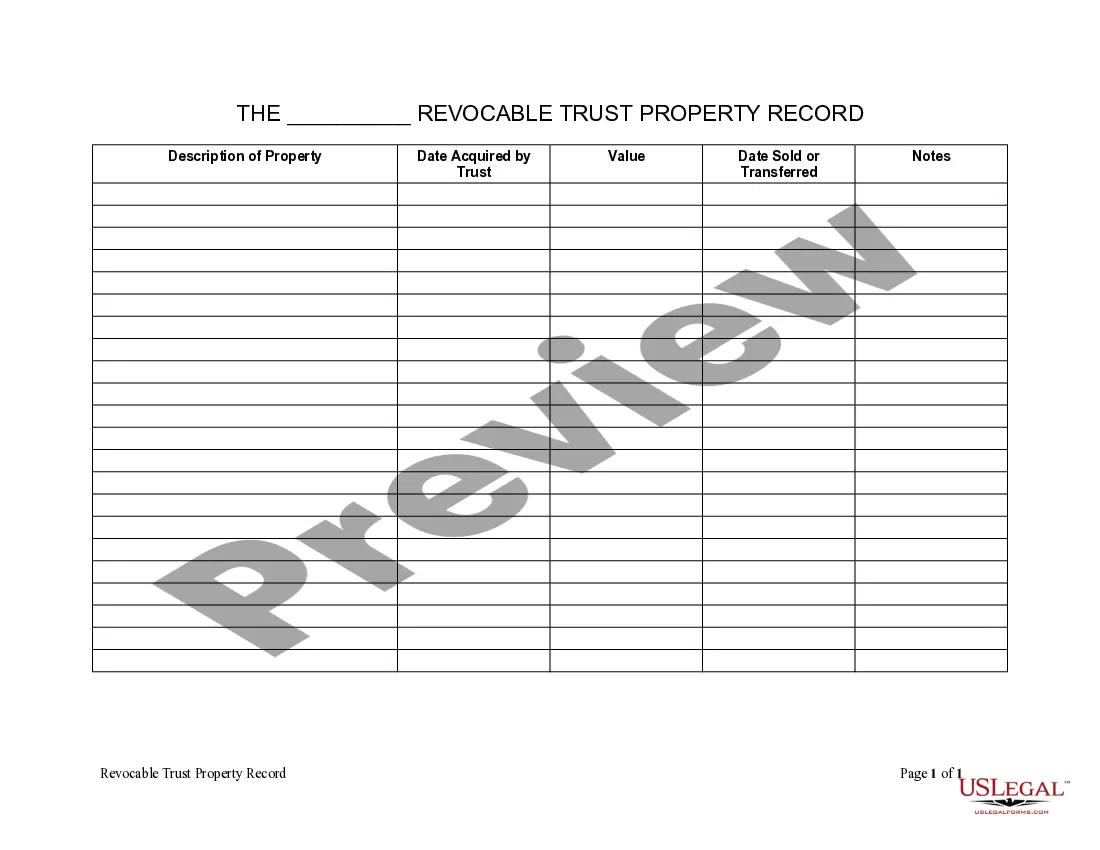
The Living Trust Property Record is a legal document designed to help trustees accurately inventory and manage the assets placed within a living trust. A living trust is established during a person's lifetime to facilitate estate planning by designating how assets will be distributed after death. This form differs from other trust-related documents by focusing specifically on documenting property held in the trust, allowing for consistent record-keeping of real, personal, and intellectual property.
Key parts of this document
- Description of Property: A detailed entry for each asset in the trust.
- Date Acquired by Trust: The date when the property was transferred into the trust.
- Value: An estimated worth of each asset recorded.
- Date Sold or Transferred: The date when any property is sold or moved out of the trust.
- Signature of Trustee: The signature verifying the accuracy of the information.

When to use this form
This form is particularly useful when establishing or updating a living trust, helping the trustee maintain accurate records of the trust property. It is appropriate in situations where a person wants to organize their assets for efficient management or future distribution, particularly during estate planning or after the acquisition of new assets.
Who can use this document
- Trustees responsible for managing a living trust.
- Individuals creating or modifying a living trust.
- Estate planners looking to maintain detailed inventory records of trust assets.
- Beneficiaries wishing to understand the assets held within the trust.
How to prepare this document
- Identify the property: List each asset held in the trust with a clear description.
- Enter the date acquired: Document when each asset was transferred into the trust.
- Specify the value: Include the estimated market value for each property.
- Record any sales or transfers: If an asset is sold or transferred, note the date of that change.
- Sign as trustee: The trustee must sign the document to confirm its accuracy.
Notarization requirements for this form
This form does not typically require notarization unless specified by local law. However, it's important to check your jurisdiction's requirements to ensure compliance.
Get your form ready online
Our built-in tools help you complete, sign, share, and store your documents in one place.
Make edits, fill in missing information, and update formatting in US Legal Forms—just like you would in MS Word.
Download a copy, print it, send it by email, or mail it via USPS—whatever works best for your next step.
Sign and collect signatures with our SignNow integration. Send to multiple recipients, set reminders, and more. Go Premium to unlock E-Sign.
If this form requires notarization, complete it online through a secure video call—no need to meet a notary in person or wait for an appointment.
We protect your documents and personal data by following strict security and privacy standards.

Make edits, fill in missing information, and update formatting in US Legal Forms—just like you would in MS Word.

Download a copy, print it, send it by email, or mail it via USPS—whatever works best for your next step.

Sign and collect signatures with our SignNow integration. Send to multiple recipients, set reminders, and more. Go Premium to unlock E-Sign.

If this form requires notarization, complete it online through a secure video call—no need to meet a notary in person or wait for an appointment.

We protect your documents and personal data by following strict security and privacy standards.
Mistakes to watch out for
- Failing to update the record when assets are sold or new ones are acquired.
- Not including complete descriptions of the property.
- Omitting signatures from the trustee.
- Underestimating or overestimating the values of assets.
Why use this form online
- Immediate access: Downloadable forms are available instantly.
- Editable templates: Customize the form to fit specific needs easily.
- Guidance from licensed attorneys: Legal accuracy is ensured through professionally drafted templates.
- Convenience: Complete the form anytime, anywhere, without the need for appointments.
Summary of main points
- The Living Trust Property Record is essential for trustees to accurately track assets in a living trust.
- Maintain updated records to ensure clarity and legal compliance.
- Utilize the form online for convenience and access to professional guidance.
- Understand state-specific requirements to fully comply with local regulations.
Looking for another form?
Form popularity
FAQ
You typically do not need to record a living trust, as recording is not required in Florida. By keeping the trust private, you can avoid additional costs and protect sensitive information. However, if your trust holds real estate, you may need to prepare a deed for that property to reflect the trust's ownership. Consider using uslegalforms to guide you through the necessary steps.
In Florida, living trusts are not recorded with the court. Instead, they act as private documents, which means they remain confidential and do not become part of the public Florida Living Trust Property Record. This privacy allows you to manage your assets without worrying about public disclosure. If you need help managing your living trust, uslegalforms offers resources to simplify the process.
To get a copy of a trust document in Florida, you should contact the trustee directly, as they are responsible for providing copies to beneficiaries or interested parties. The trustee can guide you through the steps needed to officially request this document. If you run into issues, consulting an attorney may help you navigate your options. Remember, maintaining your Florida Living Trust Property Record is crucial for ensuring your estate planning wishes are honored.
While putting your house in a trust offers benefits, there are some disadvantages to consider. You may face initial costs associated with creating the trust and transferring property. Additionally, there are potential complications in managing the trust over time. It’s essential to weigh these factors against the benefits when dealing with your Florida Living Trust Property Record.
As mentioned earlier, trust documents are not public records in Florida. This privacy allows you to maintain control over your assets without unwanted scrutiny. Knowing this, you can make informed decisions about your estate planning. For more insights on managing your Florida Living Trust Property Record, USLegalForms offers supportive resources.
To obtain a certificate of trust, the trust's trustee must prepare it, which outlines basic details of the trust without revealing its contents. This document can help in various transactions or dealings when the full trust document is not necessary. Engaging with a legal professional may streamline this process, ensuring your Florida Living Trust Property Record is properly handled and documented.
To obtain a copy of a trust document in Florida, you need to contact the trustee listed in the document. The trustee has the authority to provide you with copies as required, typically for beneficiaries or interested parties. If no documents are available, you might want to consider contacting legal professionals for assistance. Managing your Florida Living Trust Property Record effectively often involves clear communication with your trustee.
Trust documents are generally private and not considered public records in Florida. This means that others can’t freely access or review the details contained within your trust. If you are establishing a living trust, understanding this privacy can help you plan your estate more securely. For assistance with your Florida Living Trust Property Record, consider seeking help from professionals who specialize in estate planning.
You cannot typically access trust documents online as they are not filed with the county recorder's office. Trusts are private documents, meaning their contents are not publicly available. However, some services, like USLegalForms, can guide you through the process of managing these records and understanding their implications. It's important to know your options when looking for specific information related to your Florida Living Trust Property Record.
In Florida, putting property in a living trust generally does not trigger a reassessment. The property continues to receive the same tax treatment as before, provided the ownership remains unchanged. This means that you can manage your assets without facing property tax spikes. For more detailed information, consult with an estate planning professional to ensure your Florida Living Trust Property Record stays intact.