Issues-Acting in Concert
Understanding this form
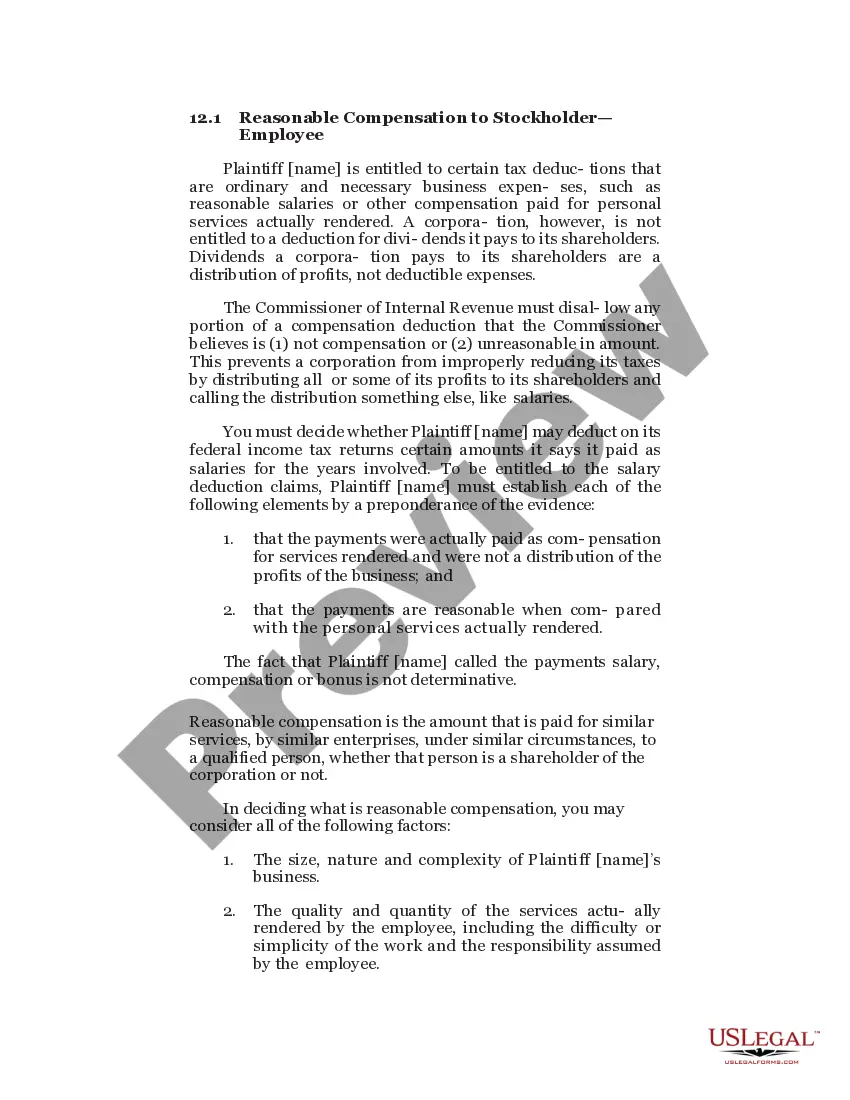
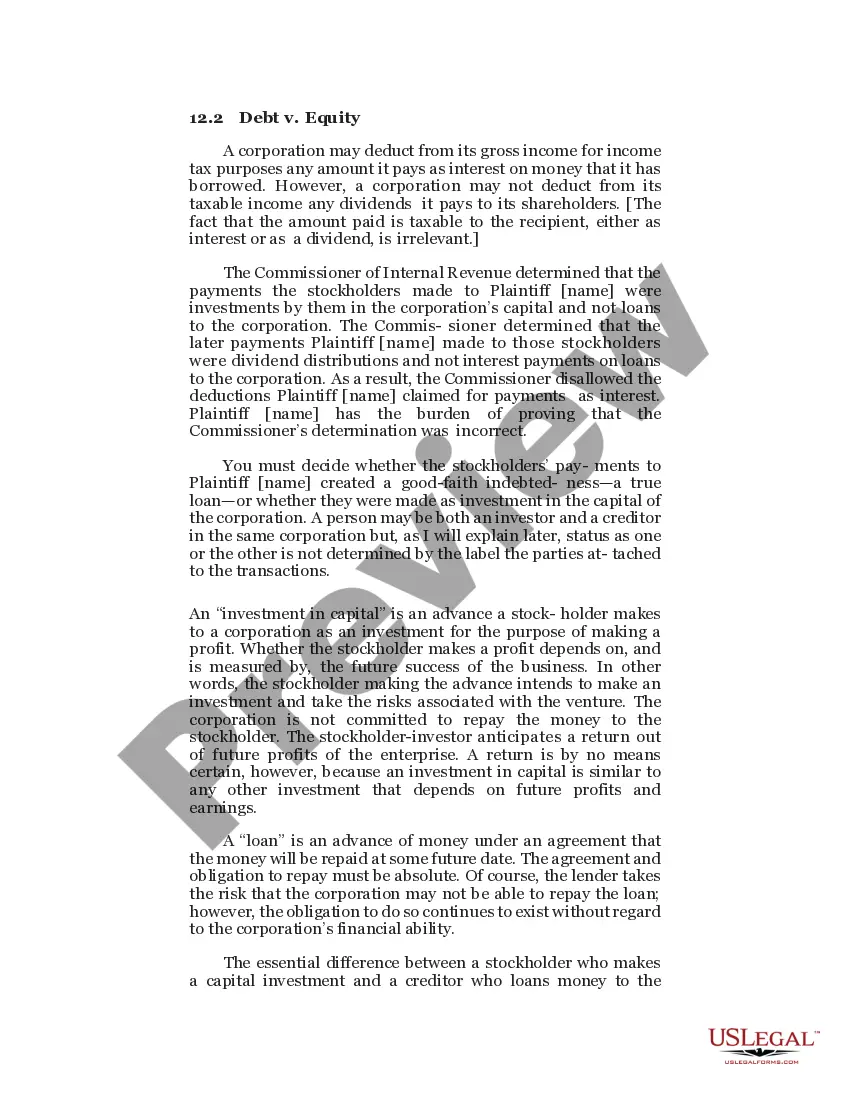
The Issues-Acting in Concert form is a legal document used by corporations to determine the deductibility of amounts paid as compensation to shareholders who also act as employees. Its primary purpose is to establish whether the payments classified as salaries are legitimate business expenses and not merely distributions of profits. This form is essential to navigate the tax implications associated with shareholder compensation, differentiating it from similar tax deduction forms.
Main sections of this form
- Identification of the plaintiff and the amounts claimed as salaries for tax deductions.
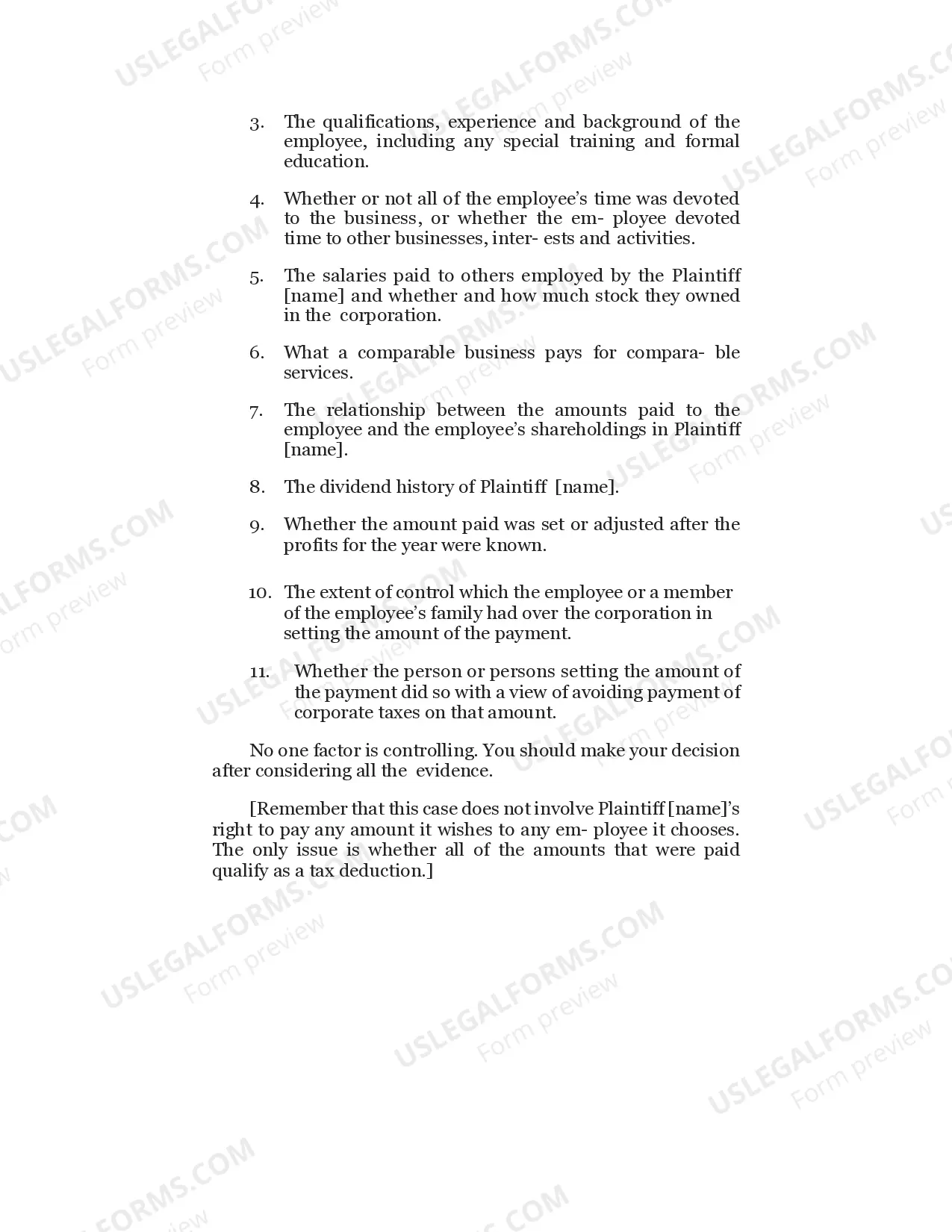
- Criteria for establishing reasonable compensation for services rendered.
- Factors to consider when determining the legitimacy of the salary deductions.
- Documentation requirements to prove the nature of the payments made.
- Clarifications on the distinction between salary and dividends.
When this form is needed
This form should be utilized when a corporation needs to validate its claims for tax deductions on salary payments made to shareholders employed by the company. It is particularly relevant when the IRS challenges the reasonableness of compensation or when the corporation's financial practices are being scrutinized for tax purposes. Businesses may need this form during tax audits or when preparing their federal income tax returns to ensure compliance with tax regulations.
Who can use this document
- Corporations that employ shareholders and pay them salaries.
- Business owners seeking to claim tax deductions on payments made as compensation.
- Financial officers or accountants managing corporate tax filings.
- Legal representatives or advisors providing guidance on tax matters.
Instructions for completing this form
- Identify the plaintiff by entering the corporate name and relevant tax identification information.
- Detail the amounts paid as compensation to the shareholder for personal services rendered.
- Provide evidence substantiating that these payments are reasonable compared to similar services in the industry.
- Include any supporting documents that verify the employee's qualifications and duties.
- Review the submission thoroughly before filing with the IRS or as part of the corporate tax return.
Does this document require notarization?
This form usually doesn’t need to be notarized. However, local laws or specific transactions may require it. Our online notarization service, powered by Notarize, lets you complete it remotely through a secure video session, available 24/7.
Get your form ready online
Our built-in tools help you complete, sign, share, and store your documents in one place.
Make edits, fill in missing information, and update formatting in US Legal Forms—just like you would in MS Word.
Download a copy, print it, send it by email, or mail it via USPS—whatever works best for your next step.
Sign and collect signatures with our SignNow integration. Send to multiple recipients, set reminders, and more. Go Premium to unlock E-Sign.
If this form requires notarization, complete it online through a secure video call—no need to meet a notary in person or wait for an appointment.
We protect your documents and personal data by following strict security and privacy standards.

Make edits, fill in missing information, and update formatting in US Legal Forms—just like you would in MS Word.

Download a copy, print it, send it by email, or mail it via USPS—whatever works best for your next step.

Sign and collect signatures with our SignNow integration. Send to multiple recipients, set reminders, and more. Go Premium to unlock E-Sign.

If this form requires notarization, complete it online through a secure video call—no need to meet a notary in person or wait for an appointment.

We protect your documents and personal data by following strict security and privacy standards.
Mistakes to watch out for
- Failing to maintain documentation to support claims for reasonable compensation.
- Confusing salary payments with dividend distributions.
- Not adequately comparing compensation against industry standards.
- Neglecting to provide evidence of services rendered by the employee.
Benefits of using this form online
- Easy access to fillable templates that can be downloaded and printed at convenience.
- The ability to edit and customize forms to suit specific business needs.
- Quick retrieval of updated legal guidelines ensuring compliance and accuracy.
- Peace of mind knowing that forms are created and vetted by licensed attorneys.
Looking for another form?
Form popularity
FAQ
Penal Code § 31 PC is the California statute that addresses aiding and abetting. This is defined as encouraging, facilitating or aiding in the commission of a criminal act. A person who aids and abets a crime faces the same punishment as the one who directly commits the crime.
(a) Acting in concert means knowing participation in a joint activity or parallel action towards a common goal of acquiring control of a covered institution whether or not pursuant to an express agreement.
Persons acting in concert comprise persons who, pursuant to an agreement or understanding (whether formal or informal), co-operate to obtain or consolidate control of a company or to frustrate the successful outcome of an offer for a company.
The two parties had to be acting together or in concert in the crime of affray. The only way you could rig it was by acting in concert. Do you think they were acting in concert? As we all know, these two forces have not acted in concert.
: a rule in criminal law that holds an aider and abettor liable for commission of a criminal act by the principal. Note: Concert of action does not apply where the crime requires more than one person for its commission.
This rule is in some ways similar to aiding and abetting, and conspiracy however, typically those charges carry consequences that are a level lower than the underlying crime that it centers around, while acting in concert carries the full force and all the consequences of the underlying crime.
The people involved in acting in concert are called concert parties. For instance, consider the example of David, who offers Sharon to buy her car for $6000, and Sharon agrees to sell her car for the same amount. Here, David and Sharon are parties acting in concert.
A person and each of its affiliated persons will be deemed to be acting in concert with each other. The Code also presumes that certain categories of person will be acting in concert unless the contrary is shown.