Issues-Imputed Conduct-Burden of Proof
About this form
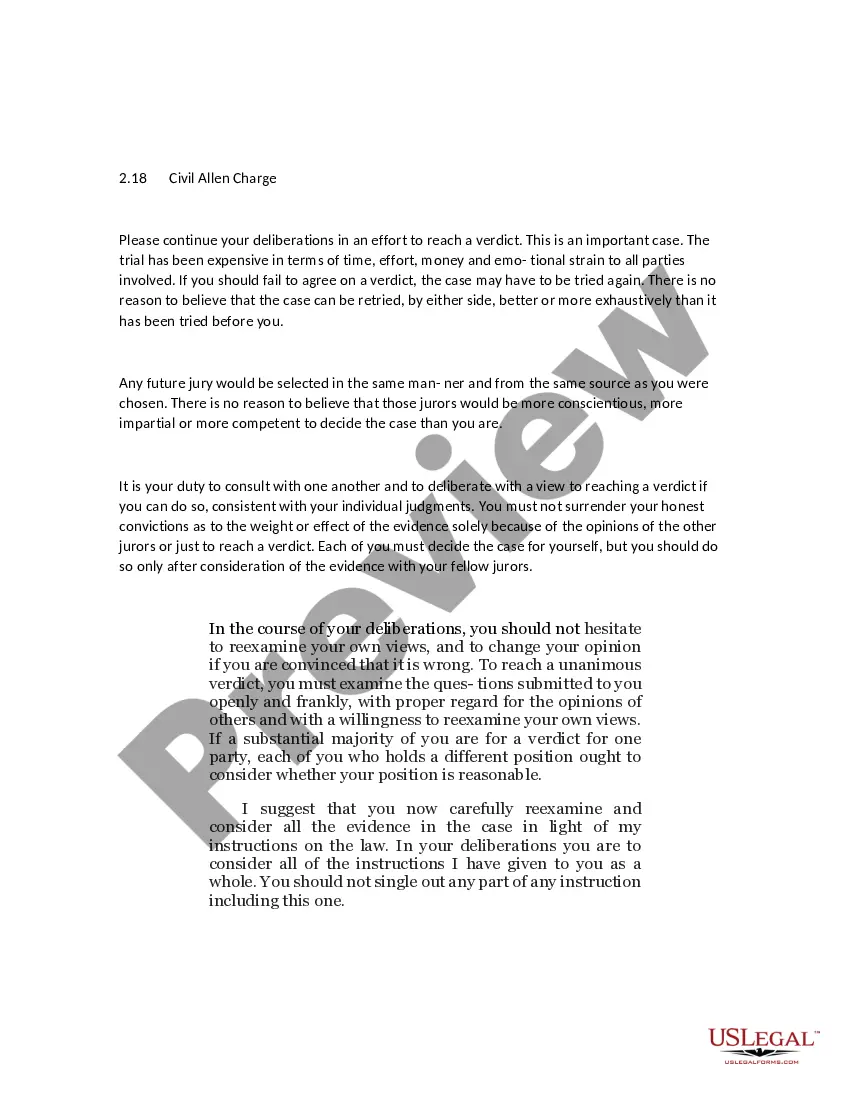
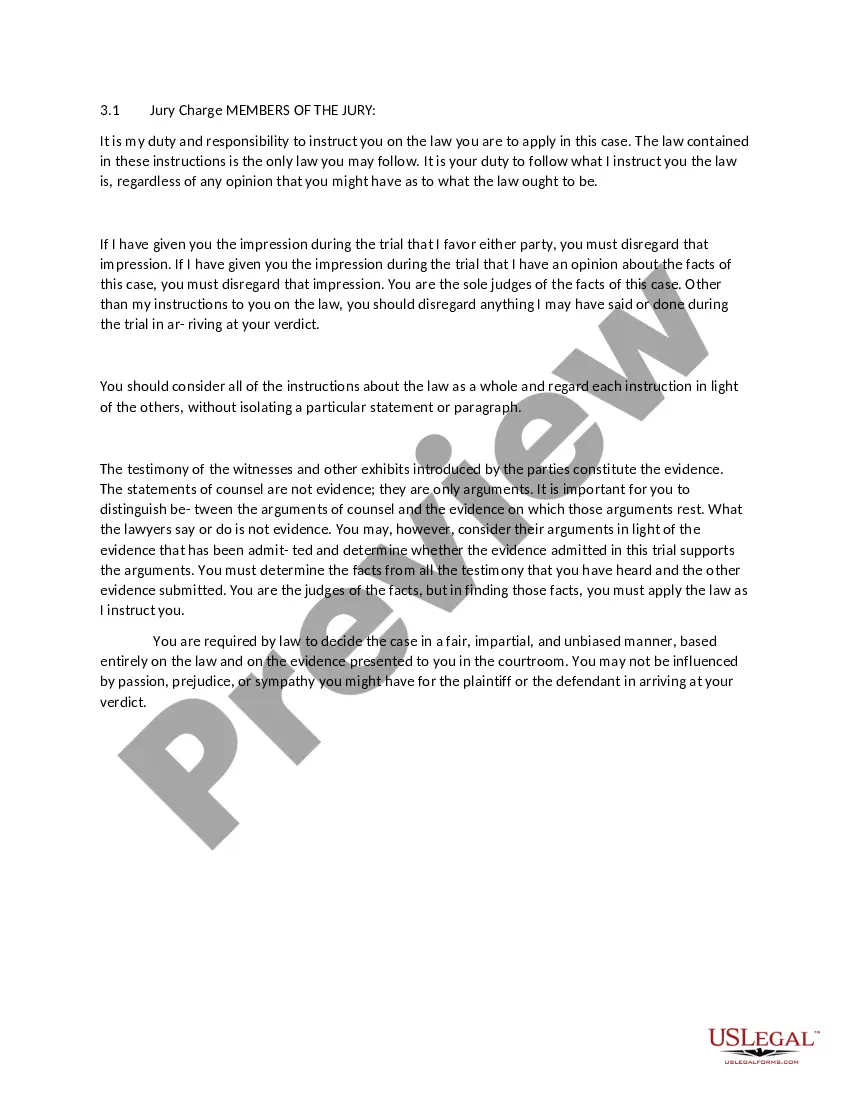
The Issues-Imputed Conduct-Burden of Proof form is a legal template focused on guiding jurors in their deliberations within a trial. This form details the necessary process for jurors to assess evidence and reach a verdict, emphasizing the importance of collective discussions while maintaining individual judgments. Unlike similar forms, this template is specifically designed to address the complexities surrounding imputed conduct and the burden of proof required in legal cases.
Main sections of this form
- Instructions on the significance of reaching a verdict.
- Guidance on jury deliberation processes and ethical considerations.
- Encouragement for jurors to reexamine their views in light of evidence.
- Emphasis on the requirement for a unanimous verdict.
- Reminders to consider all provided legal instructions collectively.



Common use cases
This form should be used in criminal or civil jury trials where jurors need clear instructions regarding their deliberation process, specifically in cases involving imputed conduct and the burden of proof. It serves to facilitate legal processes by ensuring jurors understand their roles and responsibilities in reaching a fair verdict.
Who this form is for
- Judges overseeing jury trials.
- Legal practitioners involved in preparing jury instructions.
- Jurors who require clarification on guiding principles during deliberations.
Instructions for completing this form
- Review the case details to understand the context of the trial.
- Carefully read the instructions provided to jurors.
- Encourage discussions among jurors to clarify their interpretations of the evidence.
- Reexamine each juror's opinion before reaching a final verdict.
- Ensure that all instructions are taken into account collectively during deliberation.
Does this form need to be notarized?
In most cases, this form does not require notarization. However, some jurisdictions or signing circumstances might. US Legal Forms offers online notarization powered by Notarize, accessible 24/7 for a quick, remote process.
Get your form ready online
Our built-in tools help you complete, sign, share, and store your documents in one place.
Make edits, fill in missing information, and update formatting in US Legal Forms—just like you would in MS Word.
Download a copy, print it, send it by email, or mail it via USPS—whatever works best for your next step.
Sign and collect signatures with our SignNow integration. Send to multiple recipients, set reminders, and more. Go Premium to unlock E-Sign.
If this form requires notarization, complete it online through a secure video call—no need to meet a notary in person or wait for an appointment.
We protect your documents and personal data by following strict security and privacy standards.

Make edits, fill in missing information, and update formatting in US Legal Forms—just like you would in MS Word.

Download a copy, print it, send it by email, or mail it via USPS—whatever works best for your next step.

Sign and collect signatures with our SignNow integration. Send to multiple recipients, set reminders, and more. Go Premium to unlock E-Sign.

If this form requires notarization, complete it online through a secure video call—no need to meet a notary in person or wait for an appointment.

We protect your documents and personal data by following strict security and privacy standards.
Avoid these common issues
- Jurors overlooking the necessity of a unanimous decision.
- Failing to engage in open discussions about differing opinions.
- Ignoring the importance of consulting all instructions as a whole.
Why complete this form online
- Convenience of accessing and downloading the form from any location.
- Editability allows for customization based on specific case requirements.
- Reliability from templates drafted by licensed attorneys, ensuring legal compliance.
Legal use & context
- Understanding of imputed conduct is crucial in many legal situations.
- The burden of proof significantly influences jury decisions.
- Careful adherence to jury instructions can impact the outcome of a case.
Looking for another form?
Form popularity
FAQ
The employer is automatically liable for harassment by a supervisor that results in a negative employment action such as termination, failure to promote or hire, and loss of wages.
?Strict Liability? means that the employer's liability arises regardless of the employer's own lack of knowledge or the employer's attempts to remedy the situation, such as by publishing a policy against sexual harassment.
An employer is vicariously liable for a hostile work environment created by a supervisor.
The vicarious liability category for employer liability occurs when the sexual harassing supervisor purports to act on the employer's behalf and there is reliance upon his or her apparent authority or because the harasser was aided in his or her misconduct by the existence of the agency relationship with the employer.
The U.S. Supreme Court has ruled that an employer is always liable for a hostile work environment created by a supervisor when the discrimination takes the form of a tangible employment action?defined as a significant change in employment status.
Under California law, employers are strictly liable for a harasser's conduct when the harasser is a supervisor. What this means that if it is established that a supervisor harassed an employee, the worker can recover damages from the employer for the harassment.
The tangible employment action is the promotion. Employers are strictly liable (no defense available) when workplace harassment involves a tangible employment action. This means that the employer need only prove that the unlawful harassment and the tangible employment action occurred.
The California courts have held that supervisors can be held liable for harassing actions towards employees. However, supervisors cannot be held liable for discriminatory or retaliatory actions. Liability for discrimination and retaliation would fall directly on the employer.