False Statements
What is this form?
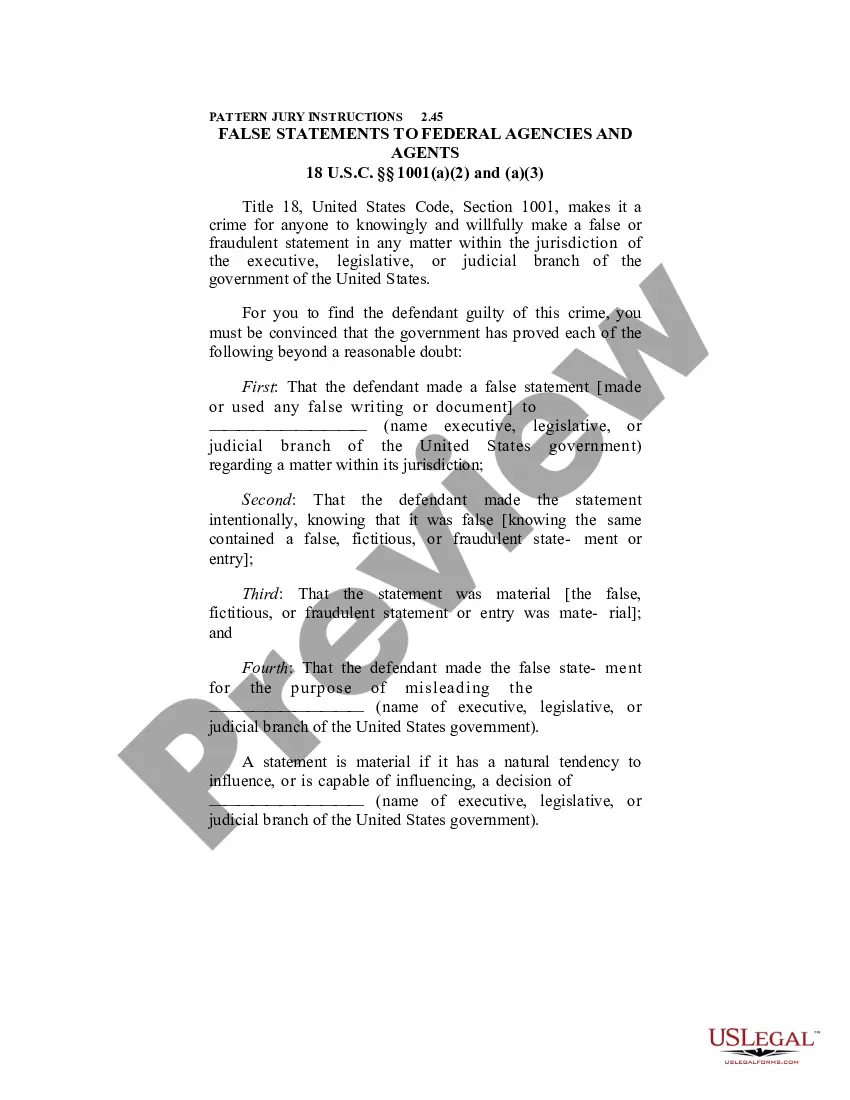
The False Statements form is a legal document used to address the criminal offense of making false material statements on an income tax return. This form ensures that individuals are aware of the serious implications of providing inaccurate information to the Internal Revenue Service (IRS). The law under Title 26, United States Code, Section 7206(1) specifies that such false statements can result in criminal charges, making compliance essential for taxpayers.
Key parts of this document
- Written declaration stating the return is made under penalties of perjury.
- Specific material matters that were falsely stated, such as income amounts.
- Confirmation that the defendant knew the statement was false.
- Definition of materiality, indicating its relevance to tax reporting.
- Evidence that the false statement was made willfully and with intent to violate the law.


Common use cases
This form is needed when a taxpayer is accused of making false statements on their income tax return. Situations may arise during an IRS audit or investigation where clarity on the evidence of willfulness and materiality is required. It is crucial in defending against allegations of tax fraud or false reporting.
Who this form is for
- Taxpayers accused of providing false information on their income tax returns.
- Individuals seeking to understand the legal implications of misreporting income.
- Tax professionals advising clients on potential legal risks associated with tax returns.
Instructions for completing this form
- Review the income tax return in question for any false statements.
- Gather evidence to demonstrate knowledge of the false information.
- Clearly articulate the material matters that were falsely stated.
- Establish intent to defraud or violate legal obligations.
- Ensure the declaration is signed under penalties of perjury.
Does this document require notarization?
In most cases, this form does not require notarization. However, some jurisdictions or signing circumstances might. US Legal Forms offers online notarization powered by Notarize, accessible 24/7 for a quick, remote process.
Get your form ready online
Our built-in tools help you complete, sign, share, and store your documents in one place.
Make edits, fill in missing information, and update formatting in US Legal Forms—just like you would in MS Word.
Download a copy, print it, send it by email, or mail it via USPS—whatever works best for your next step.
Sign and collect signatures with our SignNow integration. Send to multiple recipients, set reminders, and more. Go Premium to unlock E-Sign.
If this form requires notarization, complete it online through a secure video call—no need to meet a notary in person or wait for an appointment.
We protect your documents and personal data by following strict security and privacy standards.

Make edits, fill in missing information, and update formatting in US Legal Forms—just like you would in MS Word.

Download a copy, print it, send it by email, or mail it via USPS—whatever works best for your next step.

Sign and collect signatures with our SignNow integration. Send to multiple recipients, set reminders, and more. Go Premium to unlock E-Sign.

If this form requires notarization, complete it online through a secure video call—no need to meet a notary in person or wait for an appointment.

We protect your documents and personal data by following strict security and privacy standards.
Common mistakes
- Failing to understand the definition of materiality in tax law.
- Not accurately stating the facts pertaining to income reporting.
- Overlooking the requirement for a written declaration under penalties of perjury.
- Assuming that assistance from a tax preparer absolves responsibility.
- Inadequately demonstrating willfulness in the act of misreporting.
Benefits of using this form online
- Convenient download and access from any device at any time.
- Editability allows for customization to meet specific legal needs.
- Reliable templates drafted by licensed attorneys ensure legal accuracy.
- No need for physical travel, saving time and resources.
Looking for another form?

Form popularity
FAQ
DIFFERENCES BETWEEN PERJURY & MAKING FALSE STATEMENTS And for perjury, the statement must be literally false and made with intent to deceive or mislead. In contrast, making false statements applies when people lie to the government regardless of whether it's under oath or not.
Examples of false statements John told his little brother that sea otters aren't mammals, but fish, even though John himself was a marine biologist and knew otherwise.
: a statement that is known or believed by its maker to be incorrect or untrue and is made especially with intent to deceive or mislead. submitted a false statement to obtain the loan.
In short, a false statement is perjury when it is made under oath or made under penalty of perjury. Two separate statutes define the crime of perjury under federal law. Both statutes, 18 U.S.C. §1621 and 18 U.S.C. §1623, criminalize essentially the same conduct.
DIFFERENCES BETWEEN PERJURY & MAKING FALSE STATEMENTS And for perjury, the statement must be literally false and made with intent to deceive or mislead. In contrast, making false statements applies when people lie to the government regardless of whether it's under oath or not.
A lie is a statement that is known to be untrue and is used to mislead. A false statement is a statement that is untrue but not necessarily told to mislead, as a statement given by someone who does not know it is untrue.
A lie is a type of deception in the form of an untruthful statement made or offered with the intention to deceive others.