Concealing or Harboring Aliens
Overview of this form
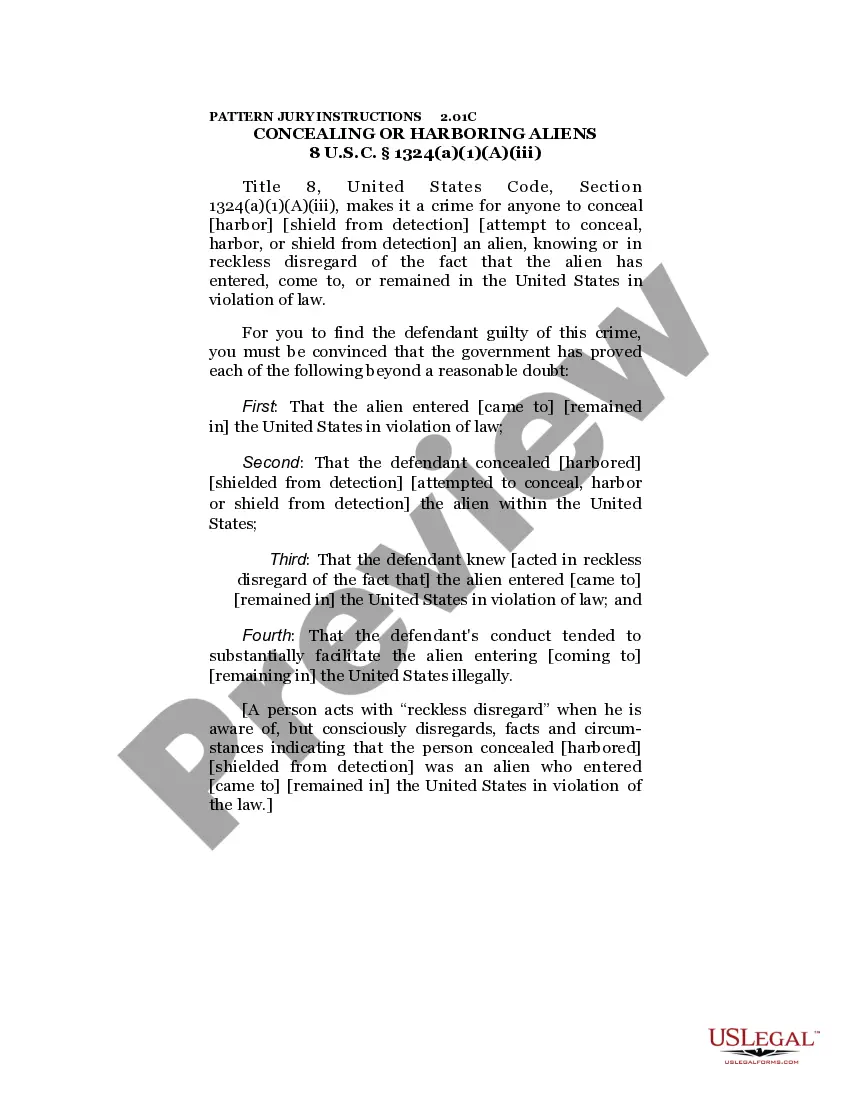
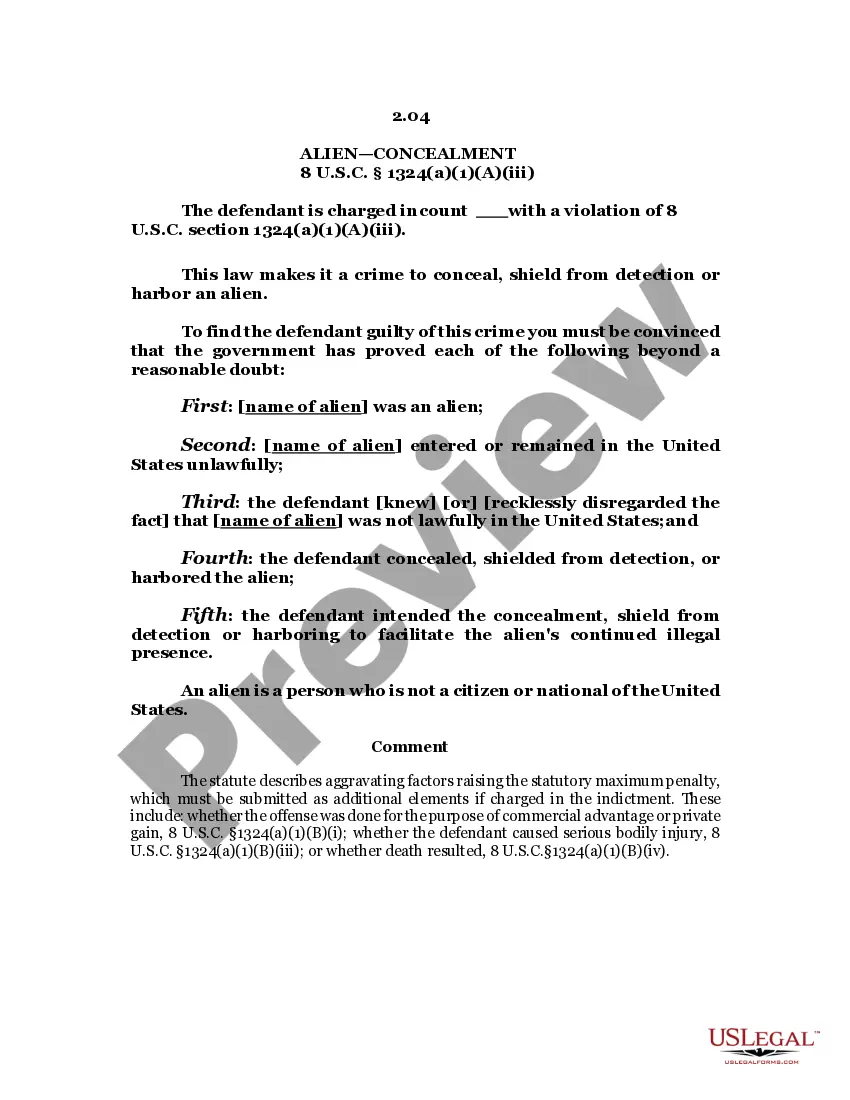
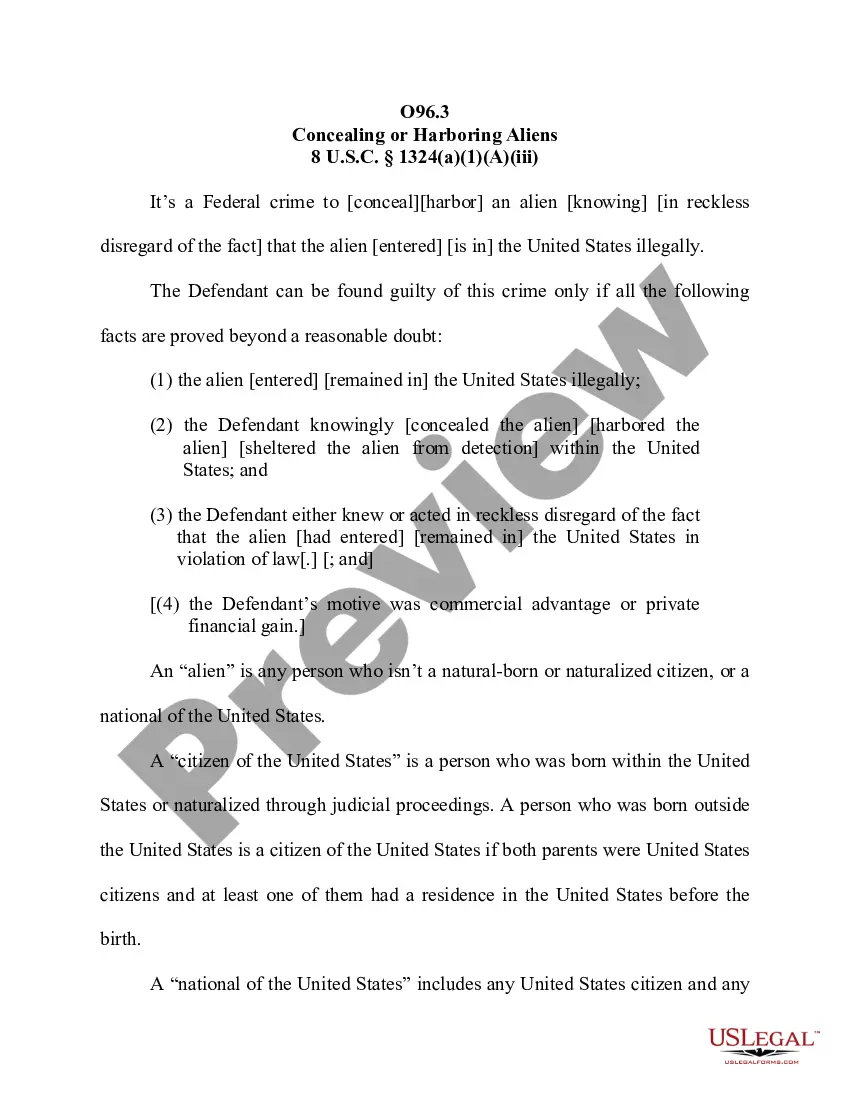
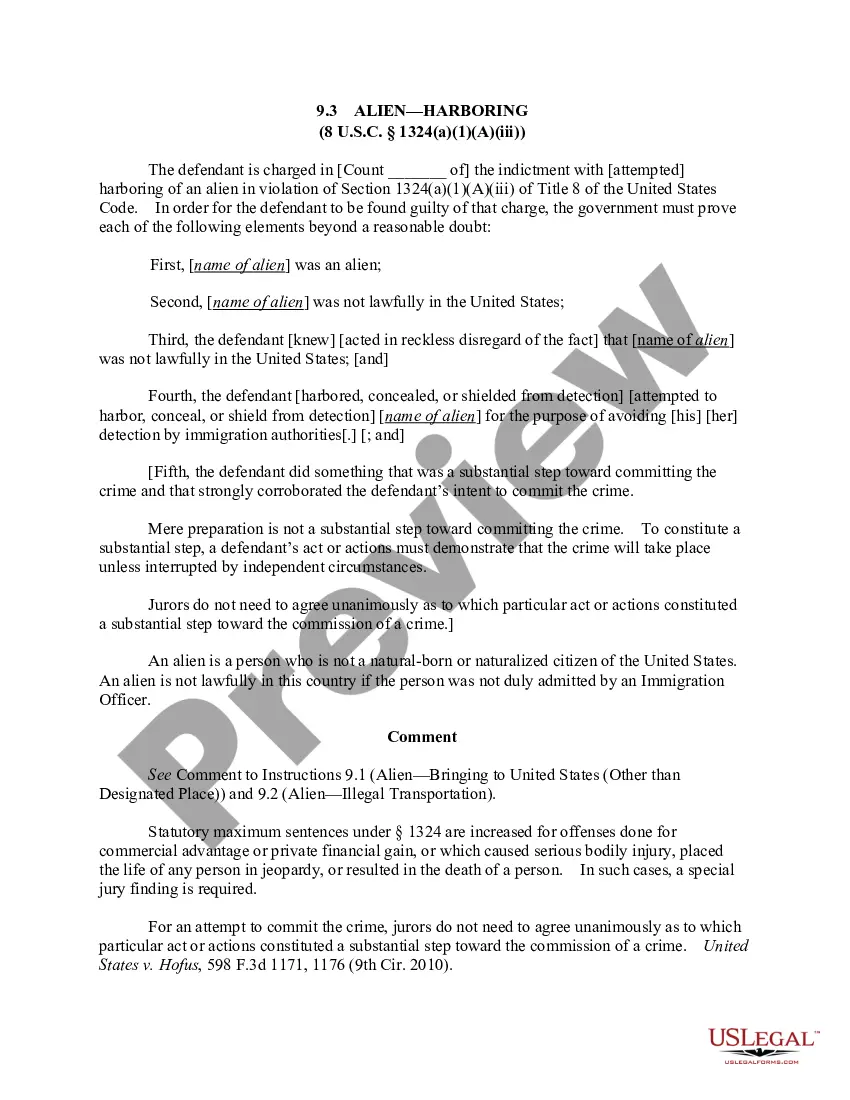
The Concealing or Harboring Aliens form is a legal document associated with Title 8, United States Code, Section 1324(a)(1)(A)(iii). This form addresses the legal implications of concealing or harboring an alien who has entered or remained in the United States unlawfully. It specifies the necessary elements for proving this offense, distinguishing it from other immigration-related forms. This form is essential for understanding the legal responsibilities and potential consequences surrounding the act of harboring undocumented individuals.
Main sections of this form
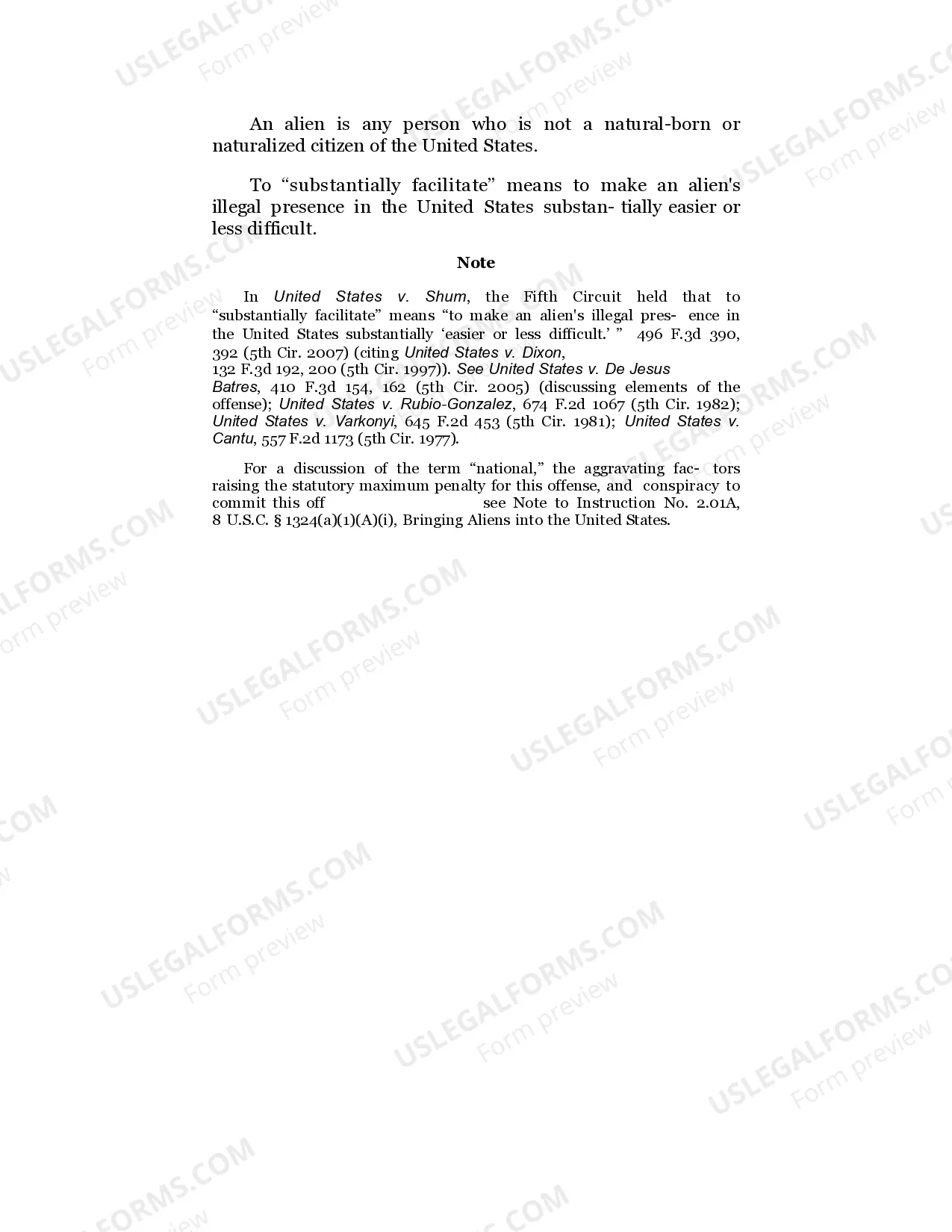
- Definition of an alien: Clarifies the legal status of individuals who are not U.S. citizens.
- Elements of the offense: Outlines the criteria that must be met to prove guilt, including knowledge and actions taken to conceal an alien.
- Legal standards: Establishes that the government must prove each element beyond a reasonable doubt for a conviction.
- Reckless disregard: Explains the meaning of acting with reckless disregard for the law regarding an alien's status.
- Court case references: Provides citations of relevant legal cases that clarify the terms and application of the law.

When to use this document
This form is needed in scenarios where an individual may be implicated in the crime of concealing or harboring undocumented aliens. If you are involved in legal matters concerning undocumented individuals, or if you suspect you might face accusations under U.S. immigration laws, completing this form can help clarify your position and responsibilities.
Who can use this document
- Individuals suspected of harboring undocumented aliens.
- Legal professionals representing clients in immigration-related cases.
- Anyone wanting to understand their legal obligations under U.S. immigration law.
- Defendants in cases involving allegations of concealing or harboring aliens.
How to prepare this document
- Identify the facts surrounding the case, including the status of the alien involved.
- Determine if the conduct of the defendant meets the criteria of concealing or harboring.
- Gather evidence to establish the defendant's knowledge of the alien's unlawful status.
- Consult legal resources or professionals to ensure accurate completion per applicable laws.
- Submit the form to the appropriate legal authority as required by law.
Does this form need to be notarized?
This form does not typically require notarization unless specified by local law.
Get your form ready online
Our built-in tools help you complete, sign, share, and store your documents in one place.
Make edits, fill in missing information, and update formatting in US Legal Forms—just like you would in MS Word.
Download a copy, print it, send it by email, or mail it via USPS—whatever works best for your next step.
Sign and collect signatures with our SignNow integration. Send to multiple recipients, set reminders, and more. Go Premium to unlock E-Sign.
If this form requires notarization, complete it online through a secure video call—no need to meet a notary in person or wait for an appointment.
We protect your documents and personal data by following strict security and privacy standards.

Make edits, fill in missing information, and update formatting in US Legal Forms—just like you would in MS Word.

Download a copy, print it, send it by email, or mail it via USPS—whatever works best for your next step.

Sign and collect signatures with our SignNow integration. Send to multiple recipients, set reminders, and more. Go Premium to unlock E-Sign.

If this form requires notarization, complete it online through a secure video call—no need to meet a notary in person or wait for an appointment.

We protect your documents and personal data by following strict security and privacy standards.
Common mistakes
- Failing to understand the legal definitions of "concealing" and "harboring."
- Inadequately documenting actions taken regarding the undocumented individual.
- Not verifying the applicable laws before completing the form.
- Neglecting to gather sufficient evidence to support the case.
Advantages of online completion
- Convenience: Access and fill out the form anytime, from anywhere.
- Editability: Easily modify the form to fit specific circumstances without hassle.
- Reliability: Obtain forms drafted by licensed attorneys, ensuring legal accuracy.
Looking for another form?


Form popularity
FAQ
Knowing or in reckless disregard of the fact than an alien has come to, entered, or remains in the United States in violation of law, conceals, harbors, or shields from detection, or attempts to conceal, harbor, or shield from detection, such alien in any place, including any building or any means of transportation.
Section 1072 makes it an offense to willfully harbor or conceal a prisoner after his escape from the custody of the Attorney General or from a Federal penal or correctional institution. An offender is subject to a maximum term of imprisonment of three years, and a fine under Title 18.
When immigrating to the US, there are four different types of immigration status categories that individuals may fall into: citizens, residents, non-immigrants, and undocumented immigrants.
Any alien who at any time knowingly has encouraged, induced, assisted, abetted, or aided any other alien to enter or to try to enter the United States in violation of law is inadmissible.
In law, an alien is any person (including an organization) who is not a citizen or a national of a specific country, although definitions and terminology differ to some degree depending upon the continent or region. More generally, however, the term "alien" is perceived as synonymous with foreign national.
Legal immigrants are foreign-born people legally admitted to the U.S. Undocumented immigrants, also called illegal aliens, are foreign-born people who do not possess a valid visa or other immigration documentation, because they entered the U.S. without inspection, stayed longer than their temporary visa permitted, or
There are different categories of aliens: resident and nonresident, immigrant and nonimmigrant, asylee and refugee, documented and undocumented.
Alien Smuggling: If you are convicted of illegal alien smuggling in federal court, you face a maximum of 10 years in federal prison. If, during and in relation to the offense, you cause serious bodily injury or put in jeopardy the life of any person, the penalty can be increased to a maximum of 20 years.