Testamentary Trust Provision for the Establishment of a Trust for a Charitable Institution for the Care and Treatment of Disabled Children
What is this form?
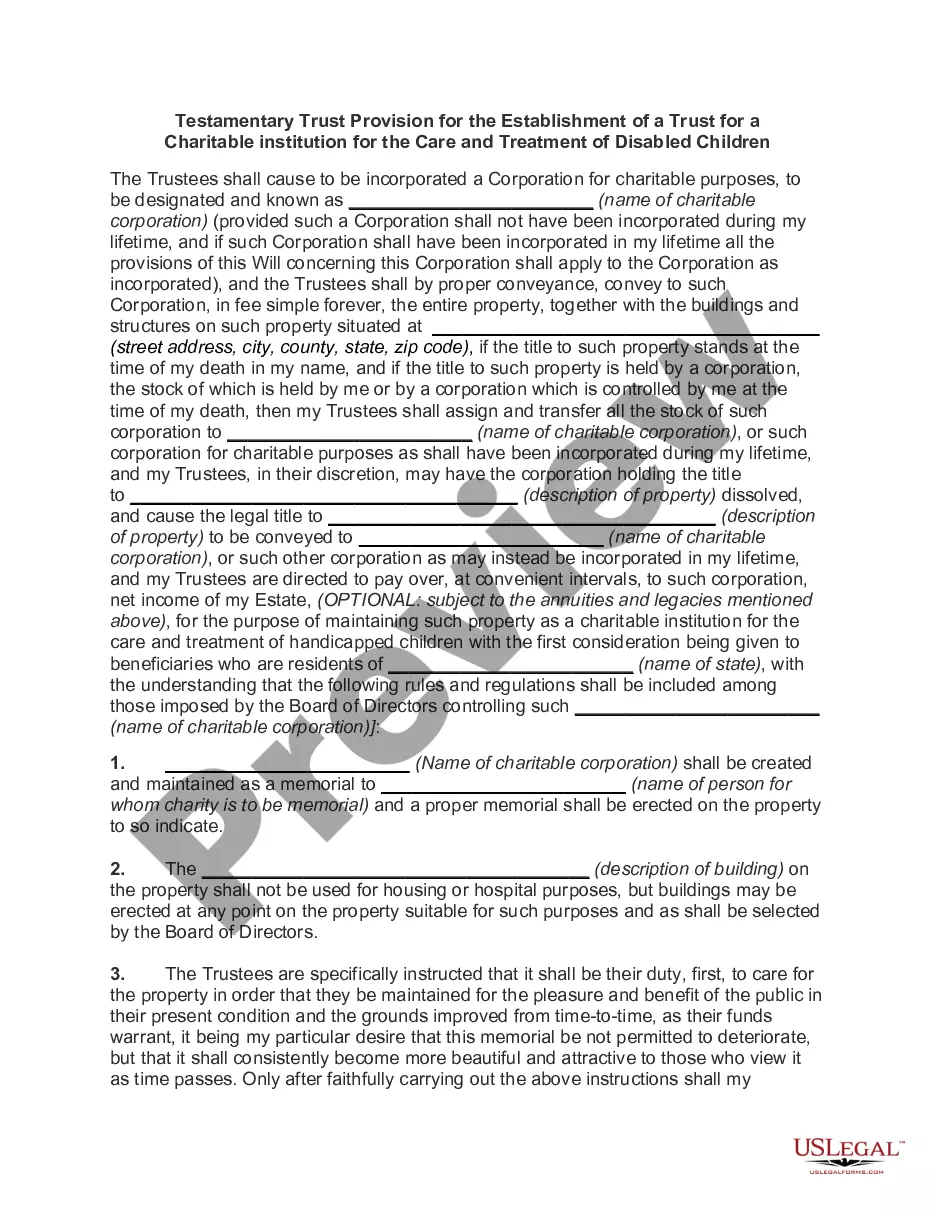
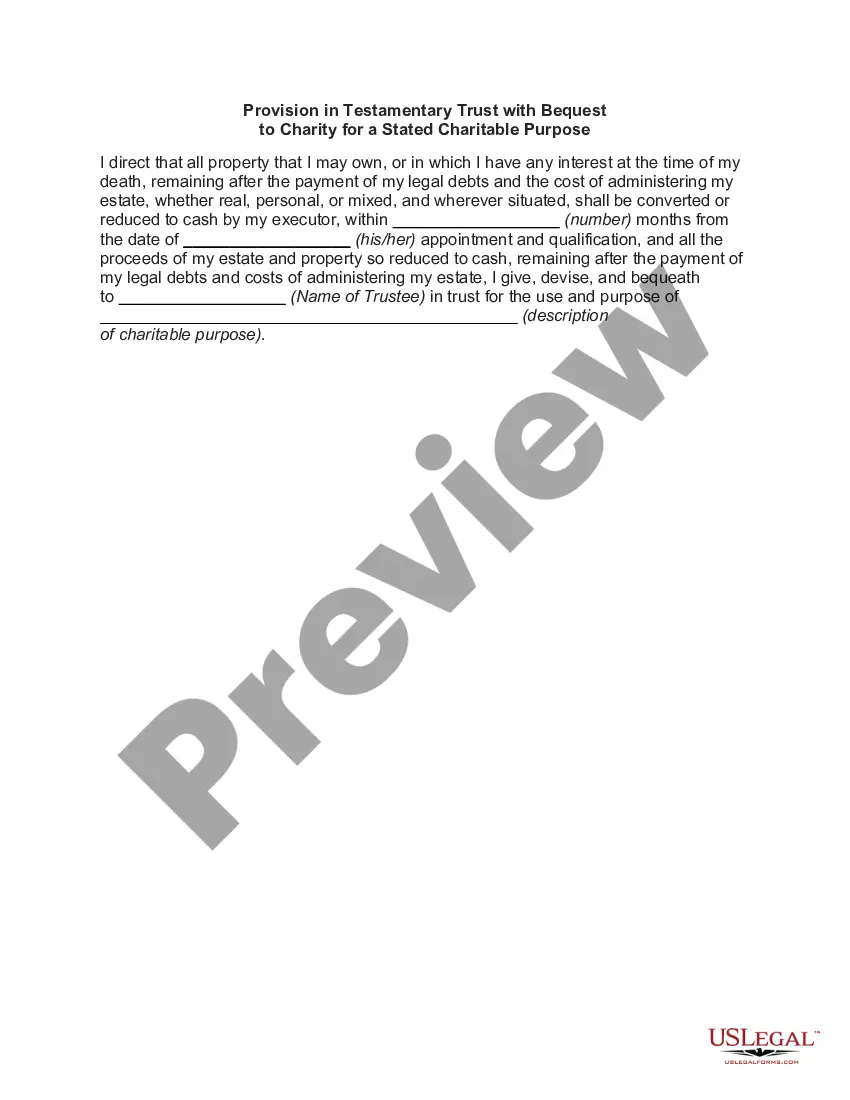
This form is a testamentary trust provision specifically designed for establishing a trust for a charitable institution dedicated to the care and treatment of disabled children. Unlike other legal forms, this document outlines the specific powers and responsibilities of trustees, focusing on the maintenance and management of property donated to the charity. It ensures that the assets are used for their intended charitable purposes, providing structured oversight and direction for the charitable organization.
What’s included in this form
- Trustee responsibilities, including incorporating a charitable corporation.
- Details regarding the property to be conveyed to the charitable organization.
- Instructions on maintaining the property as a memorial and charitable institution.
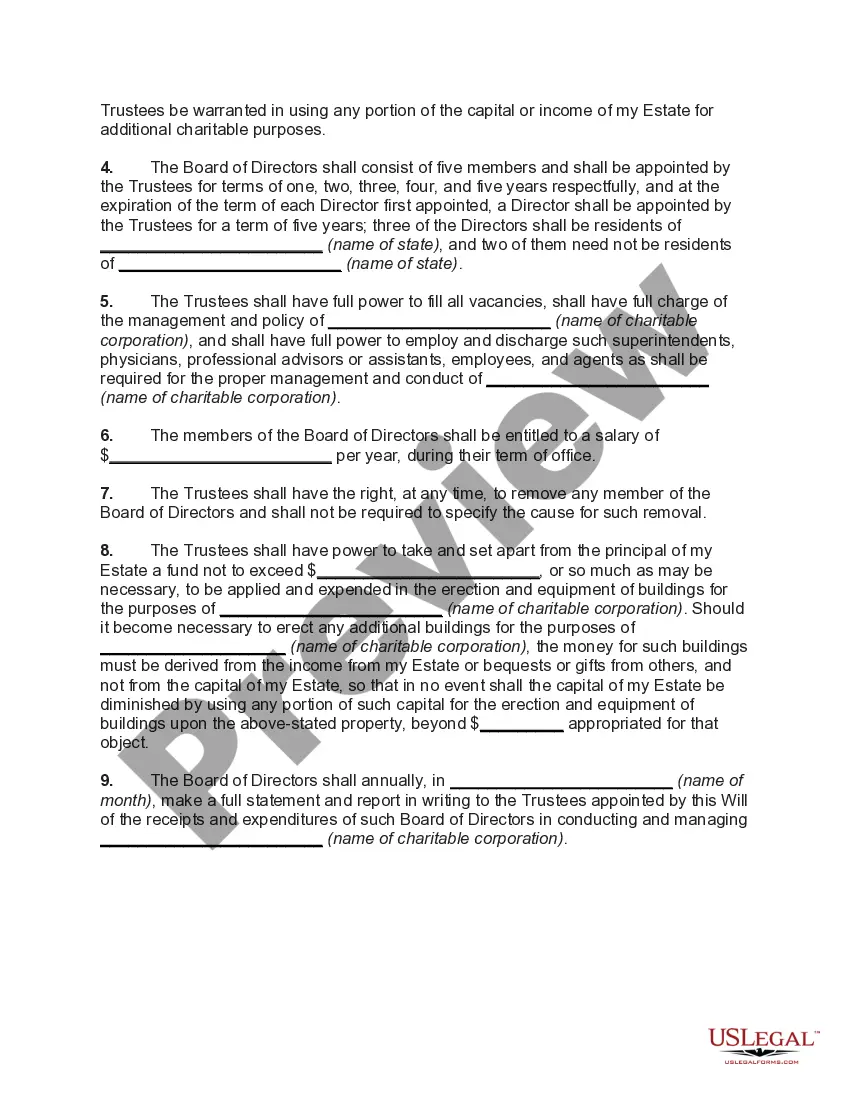
- Guidelines on the composition and terms of the Board of Directors.
- Provisions for financial oversight, including annual reporting requirements.
- Authority granted to trustees regarding management and operations of the charitable corporation.

When this form is needed
This form is ideal for individuals who wish to create a lasting legacy by dedicating their estate to a charitable cause, particularly for the care of disabled children. It is used during estate planning to ensure that specific wishes regarding property and funds are legally recognized and fulfilled after one's passing. Additionally, it is suitable for anyone looking to establish structured guidelines for the management of a charitable organization in a compassionate manner.
Intended users of this form
- Individuals who want to leave a portion of their estate to a charitable organization.
- People looking to create a trust specifically for the care and treatment of disabled children.
- Estate planners and legal representatives managing charitable bequests in wills.
How to complete this form
- Identify the name of the charitable corporation to be established.
- Specify the property to be conveyed, including the full address.
- Detail the management structure, including the names and terms of the Board of Directors.
- Outline the financial provisions, including income distribution timelines and additional funding sources.
- Sign and date the form according to your local legal requirements.
Does this document require notarization?
This form does not typically require notarization unless specified by local law. However, notarization can provide an additional layer of validation to ensure the formâs authenticity and intent.
Get your form ready online
Our built-in tools help you complete, sign, share, and store your documents in one place.
Make edits, fill in missing information, and update formatting in US Legal Forms—just like you would in MS Word.
Download a copy, print it, send it by email, or mail it via USPS—whatever works best for your next step.
Sign and collect signatures with our SignNow integration. Send to multiple recipients, set reminders, and more. Go Premium to unlock E-Sign.
If this form requires notarization, complete it online through a secure video call—no need to meet a notary in person or wait for an appointment.
We protect your documents and personal data by following strict security and privacy standards.

Make edits, fill in missing information, and update formatting in US Legal Forms—just like you would in MS Word.

Download a copy, print it, send it by email, or mail it via USPS—whatever works best for your next step.

Sign and collect signatures with our SignNow integration. Send to multiple recipients, set reminders, and more. Go Premium to unlock E-Sign.

If this form requires notarization, complete it online through a secure video call—no need to meet a notary in person or wait for an appointment.

We protect your documents and personal data by following strict security and privacy standards.
Typical mistakes to avoid
- Failing to clearly identify the charitable corporation and its purpose.
- Not specifying the property details accurately.
- Overlooking the requirements for appointing the Board of Directors.
- Neglecting to review the form for state-specific legal language.
Benefits of using this form online
- Convenience of immediate access to legal forms without the need for in-person consultations.
- Editability allows for quick adjustments to tailor the form to specific needs.
- Reliability of having forms drafted by licensed attorneys, ensuring legal compliance.
Summary of main points
- The form facilitates the creation of a charitable trust specifically for disabled children.
- It defines clear responsibilities for trustees and sets guidelines for property management.
- Utilizing this form ensures that charitable intentions are legally binding and fulfilled.
Looking for another form?
Form popularity
FAQ
A testamentary trust does not take effect until the settlor dies. To create a testamentary trust, the settlor first must select the trustee and the beneficiary and specify the assets that are to be placed in trust. The settlor also has the ability to specify when and how to disburse the trust to the beneficiary.
A: A testamentary trust is created by a will, which begins its existence upon the death of the person making the will, when property is transferred from the decedent's estate. Testamentary trusts are generally simple or complex trusts.
Example of a Testamentary Trust in a Will You specified that upon your death, Bob will manage your assets for the benefit of your daughter until she reaches the age of 21.When your daughter turns 21, she will receive the remaining assets, and the trust will terminate.
List Your Assets and Decide Which You'll Include in the Trust. Gather the Paperwork. Decide Whether You Will Be the Sole Grantor. Choose Beneficiaries. Choose a Successor Trustee. Choose Someone to Manage Property for Minor Children. Prepare the Trust Document. Sign and Notarize.
Like all other trusts, a testamentary trust assigns a trustee to manage distribution of the trust's assets.While the primary purpose of most living trusts is to avoid probate, testamentary trusts, unlike living trusts, do not avoid probate. A will must go through probate before the testamentary trust is created.
A living trust allows a person to choose beneficiaries to receive their assets upon their death without a probate. In such case, there is no need for letters testamentary or letters of administration to distribute the assets of a trust.
Pick a type of living trust. If you're married, you'll first need to decide whether you want a single or joint trust. Take stock of your property. Choose a trustee. Draw up the trust document. Sign the trust. Transfer your property to the trust.
The Trusts can also provide tax benefits, in particular to beneficiaries who are minors. However, before setting up a Testamentary Trust, the cost of the Trust should be considered. Firstly, to draft a Testamentary Trust, the legal fees would be anywhere between $2,000.00 to $5,000.00 or above per Will.
The adult pays the top marginal tax rate on their non-inheritance income. the beneficiaries of the testamentary trust include three. the low income rebate applies to the distributions to minors and.