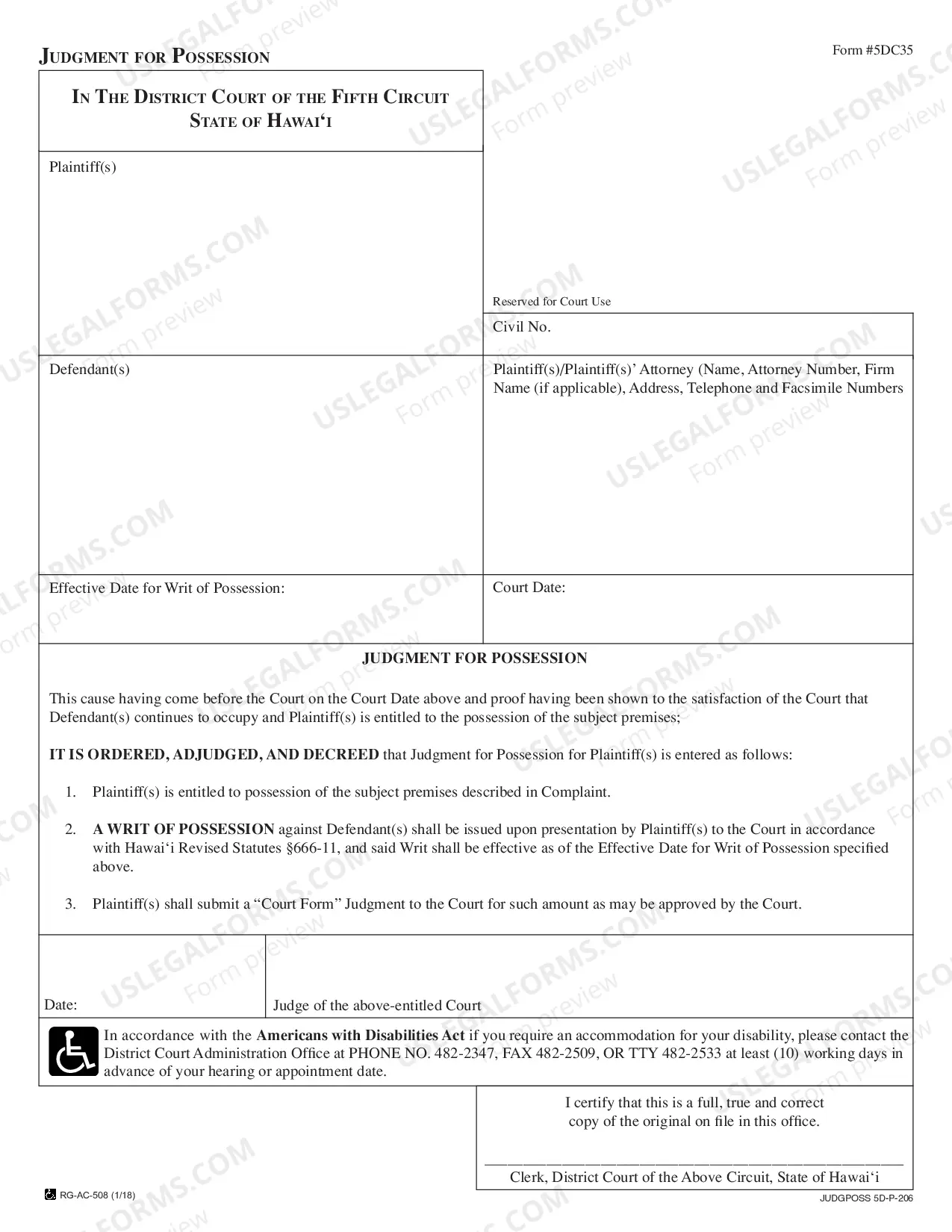
Provisions for Testamentary Charitable Remainder Unitrust for One Life
Understanding this form
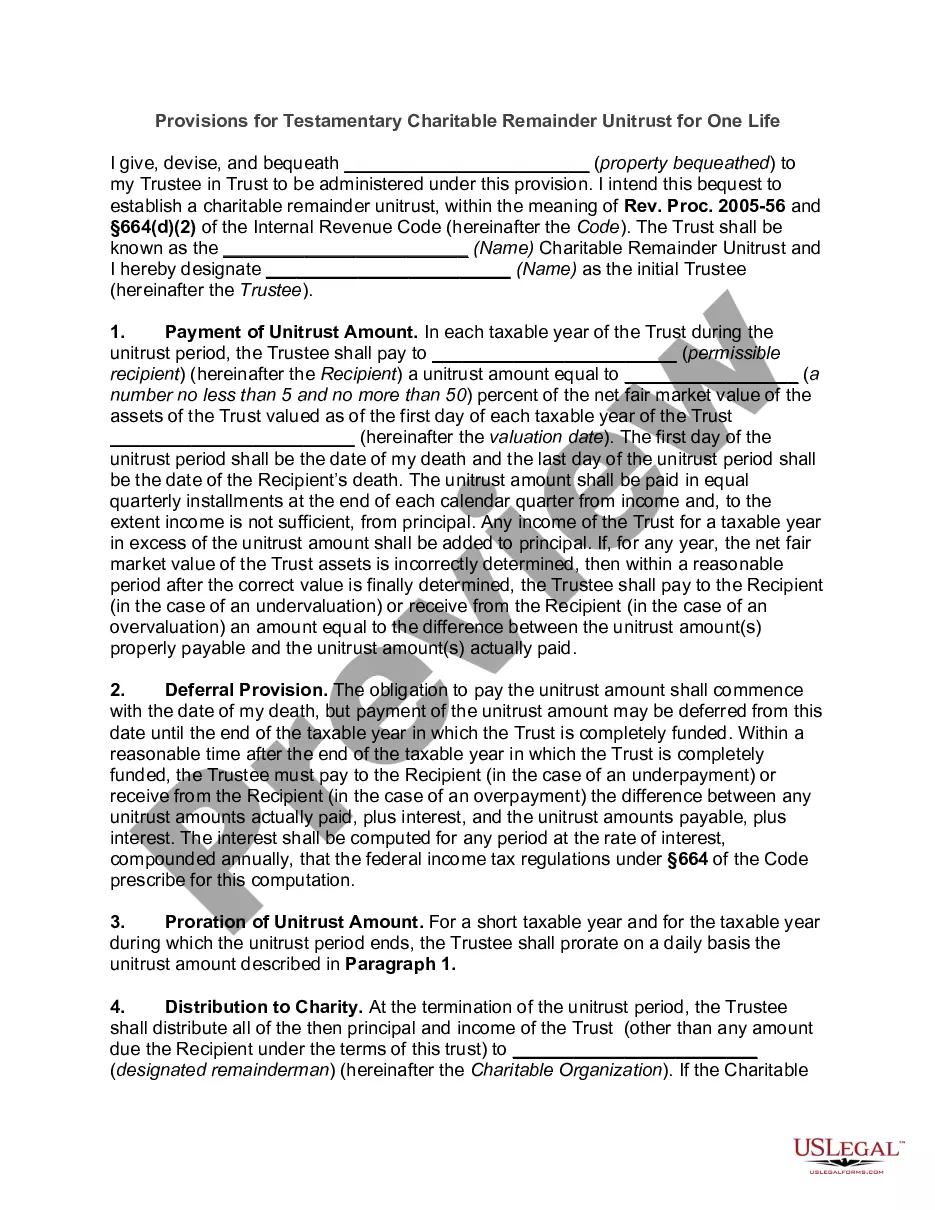
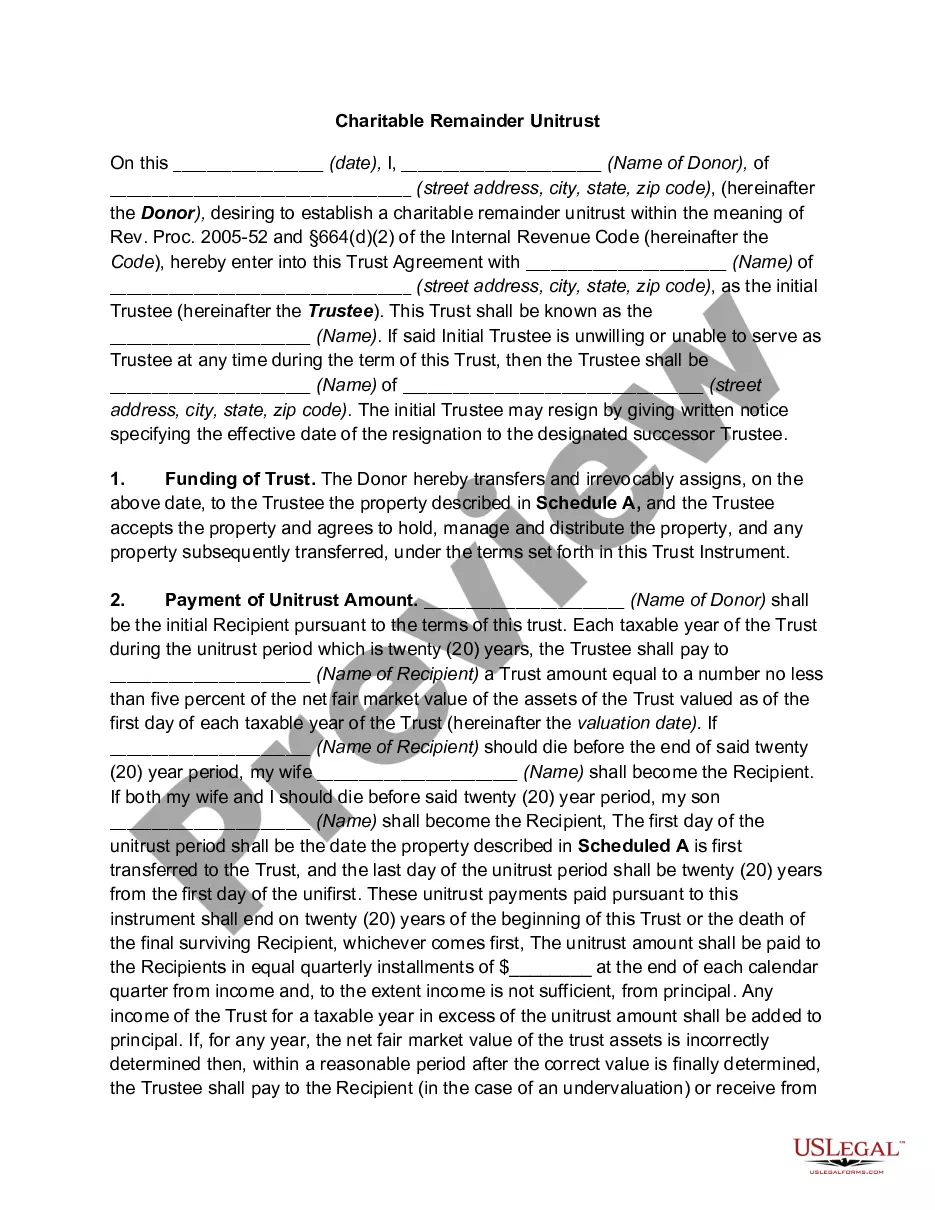
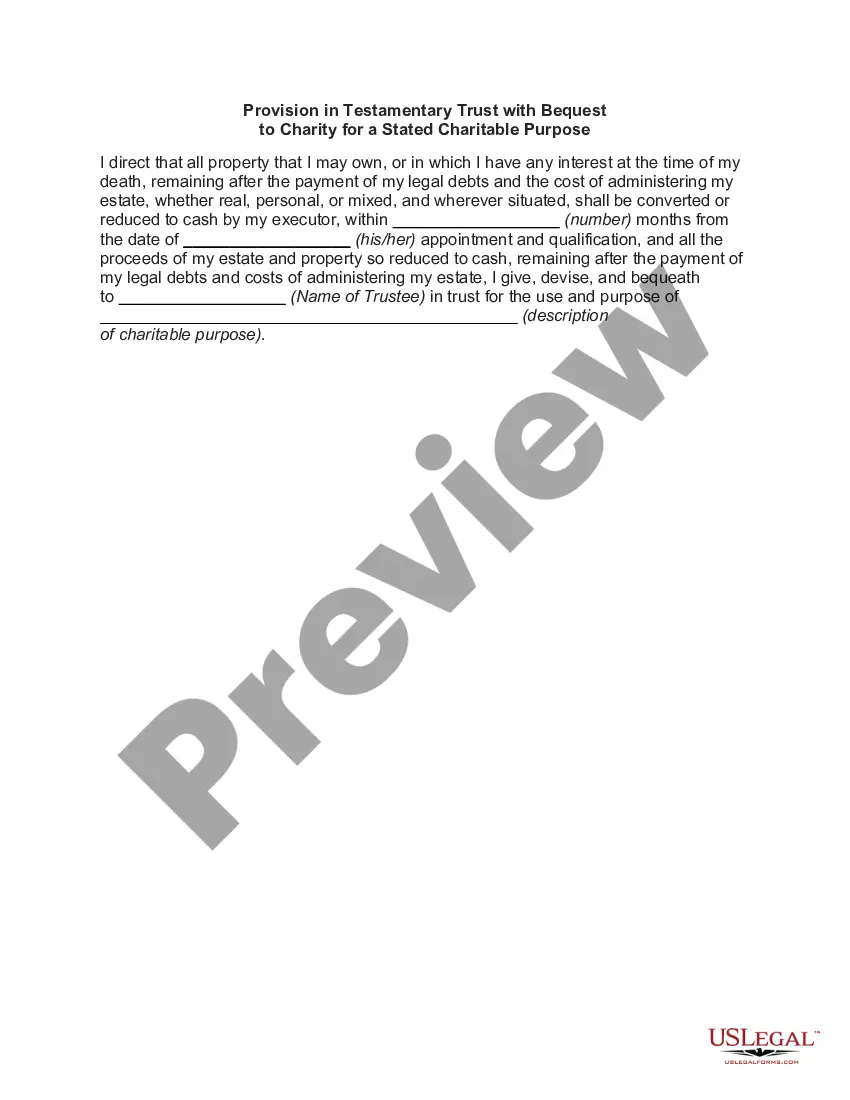
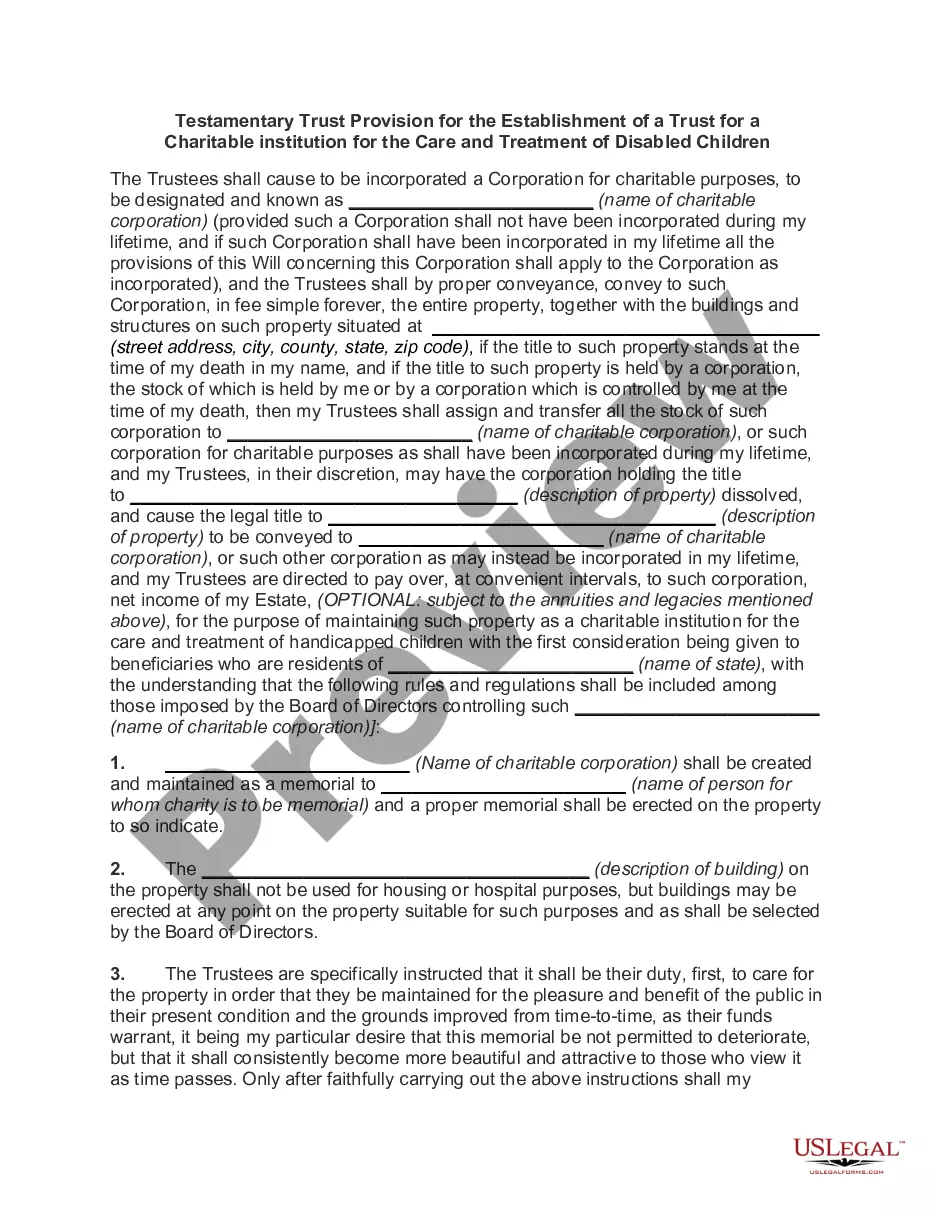
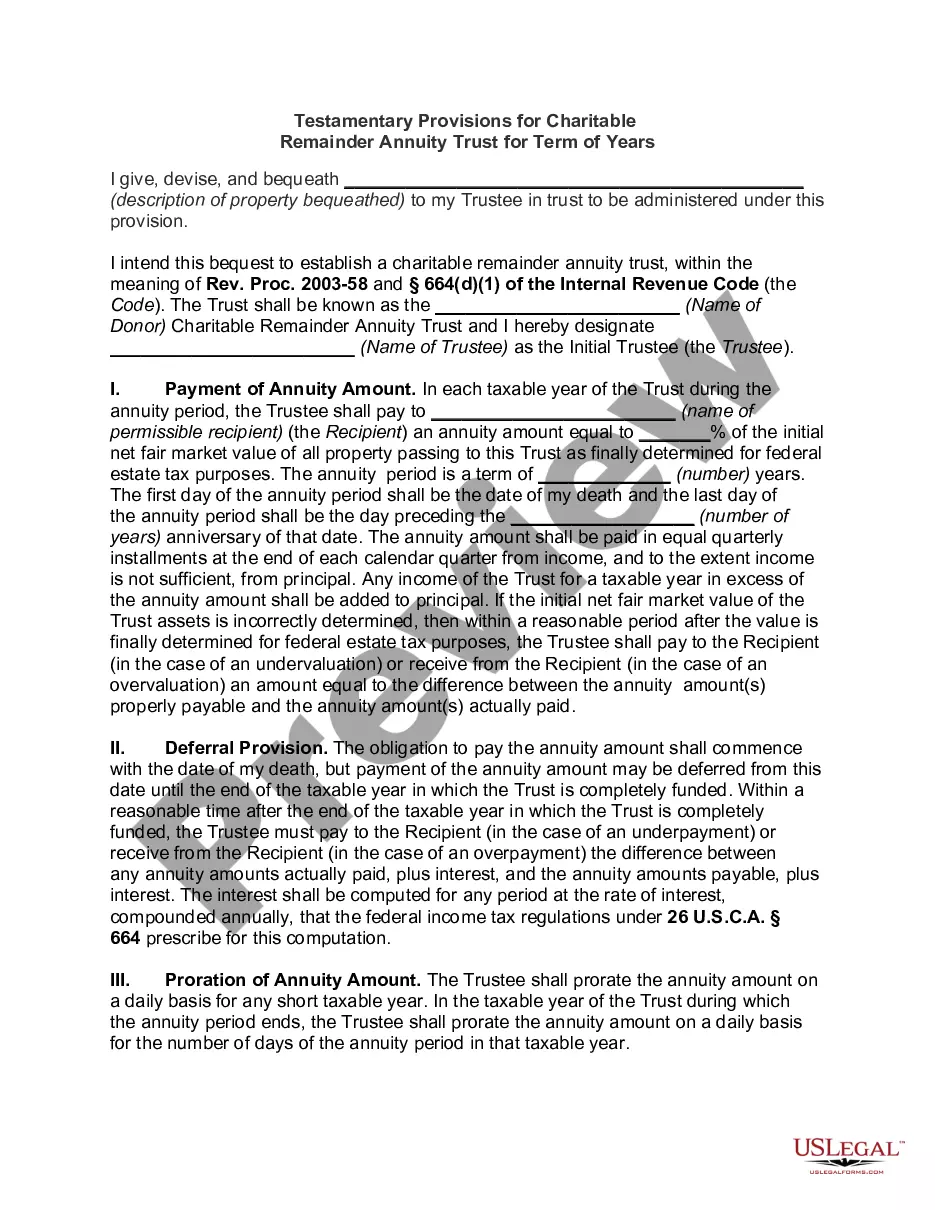
The Provisions for Testamentary Charitable Remainder Unitrust for One Life is a legal document used to create a charitable remainder unitrust (CRUT). This trust allows the donor to transfer assets while retaining the right to receive a fixed percentage of the trust's value annually for the duration of a designated beneficiary's life. This form differentiates itself from other estate planning tools by ensuring that, upon the termination of the trust, the remaining assets are distributed to a charitable organization of the donor's choice.
Main sections of this form
- Trust Establishment: Definition and identification of the trust and trustee.
- Unitrust Payments: Terms detailing the annual payment structure to the beneficiary, including percentage and valuation methods.
- Deferral Provision: Conditions under which payments can be deferred until the trust is fully funded.
- Charitable Distribution: Guidelines for distributing trust assets to a designated charitable organization at the trust's conclusion.
- Prohibited Transactions: Restrictions on self-dealing and taxable expenditures by the trustee.
- Governing Law: Specifies the applicable state laws that govern the trust.


Common use cases
This form should be used when an individual desires to create a charitable remainder unitrust as part of their estate planning. It is particularly beneficial for those looking to support a charity after their death while also ensuring a steady income stream for a designated beneficiary during their lifetime. Scenarios may include retirement planning, tax reduction strategies, and fulfilling philanthropic goals.
Who this form is for
- Individuals planning their estate who want to provide for a beneficiary while supporting a charity.
- Those seeking to minimize estate taxes through strategic charitable giving.
- Donors with assets they wish to place in a trust for ongoing income generation.
- Individuals interested in ensuring that their legacy includes support for charitable organizations.
Completing this form step by step
- Identify the parties involved, including the donor, trustee, and beneficiary.
- Specify the property or assets being placed in the trust.
- Determine the percentage for the unitrust payment to the beneficiary.
- Enter the names and details of the charitable organization that will receive the trust assets after the beneficiary's death.
- Fill in the governing law state and any additional trustee powers or limitations required.
Is notarization required?
In most cases, this form does not require notarization. However, some jurisdictions or signing circumstances might. US Legal Forms offers online notarization powered by Notarize, accessible 24/7 for a quick, remote process.
Get your form ready online
Our built-in tools help you complete, sign, share, and store your documents in one place.
Make edits, fill in missing information, and update formatting in US Legal Forms—just like you would in MS Word.
Download a copy, print it, send it by email, or mail it via USPS—whatever works best for your next step.
Sign and collect signatures with our SignNow integration. Send to multiple recipients, set reminders, and more. Go Premium to unlock E-Sign.
If this form requires notarization, complete it online through a secure video call—no need to meet a notary in person or wait for an appointment.
We protect your documents and personal data by following strict security and privacy standards.

Make edits, fill in missing information, and update formatting in US Legal Forms—just like you would in MS Word.

Download a copy, print it, send it by email, or mail it via USPS—whatever works best for your next step.

Sign and collect signatures with our SignNow integration. Send to multiple recipients, set reminders, and more. Go Premium to unlock E-Sign.

If this form requires notarization, complete it online through a secure video call—no need to meet a notary in person or wait for an appointment.

We protect your documents and personal data by following strict security and privacy standards.
Common mistakes to avoid
- Failing to clearly define the assets being placed into the trust.
- Not specifying the percentage for unitrust payments within the allowable range.
- Overlooking state-specific legal requirements that may impact the trust's validity.
- Neglecting to update the form if the circumstances of the donor or beneficiaries change.
Benefits of using this form online
- Access to professionally drafted legal language that complies with applicable laws.
- The ability to customize and download the form immediately for personal use.
- Convenient access from anywhere, allowing for easy adjustments and completion.
- Secure storage options for important documents.
Looking for another form?



Form popularity
FAQ
How long can the CRT last? A CRT may last for the Lead Beneficiaries' joint lives or for a term of years (the term may not exceed 20 years). In addition, the actuarial value of the CRT remainder left to charity must be least 10% of the initial CRT value, determined at time of funding.
A charitable remainder unitrust (also called a CRUT) is an estate planning tool that provides income to a named beneficiary during the grantor's life and then the remainder of the trust to a charitable cause. The donor or members of the donor's family are usually the initial beneficiaries.
At the end of the trust's term, the asset (that is, the remainder) goes to charity.When a charitable trust goes bad, the payouts start cutting into principal; each year, then, the donor will receive a smaller payout amount as the principal shrinks.
When added up over years, a charitable remainder trust can save significant amounts by avoiding the capital gains tax. How does life insurance play a role? A trustee can also purchase a life insurance policy inside of a CRUT, with the benefits payable to a surviving spouse.
Charitable remainder trusts are irrevocable. This means that they cannot be modified or terminated without the beneficiary's permission.
A charitable remainder trust (CRT) is an irrevocable trust that generates a potential income stream for you, as the donor to the CRT, or other beneficiaries, with the remainder of the donated assets going to your favorite charity or charities.
A CRAT pays a fixed percentage (at least 5%) of the trust's initial value every year until the trust terminates. The donor cannot make additional contributions to a CRAT after the initial contribution. A CRUT, by contrast, pays a fixed percentage (at least 5%) of the trust's value as determined annually.
Generally, if a trust beneficiary is the owner of all interests in a trust (both the income and remainder interests), the trust terminates, and the beneficiary has access to the trust principal. If the merger doctrine doesn't apply under governing state law, a court order may be required to terminate the trust.
The income interest can last for one or more lifetimes, for a fixed term that does not exceed 20 years, or for a combination of one or more lifetimes in a minimum fixed term. A longer term results in a smaller charitable deduction and a shorter term results in a larger charitable deduction.